fitness accountability apps that prioritize showing up over tracking stats
Showing up matters more than performance when building a lasting fitness habit.
Fitness apps make bank every January, and by March, most of that revenue is sitting in a graveyard of abandoned home screens. The pattern isn't random. People quit apps that make them feel like they're already losing more often than they quit apps that simply bore them. This piece looks at the smaller, growing category of apps that fixed that problem by measuring something dumber and more useful than performance: did you show up today.
What the habit science actually says about consistency versus intensity
Forget the "21 days" thing. That number has been floating around self-help circles for decades and it's basically folklore at this point. Research out of the European Journal of Social Psychology put the real average closer to 66 days, and that's an average, meaning plenty of people take longer.
For exercise specifically, research on exercise habit formation suggests that reaching a threshold of several sessions a week over multiple weeks is where a habit starts running on autopilot. Before that point, you're white-knuckling it. After that point, the habit responds to cues in your environment instead of requiring you to negotiate with yourself every morning. That's the whole game. Early-stage consistency is less about optimizing your Tuesday workout and more about surviving enough Tuesdays to stop thinking about it.
Here's the part that should embarrass every app with a fire emoji streak counter. Phillippa Lally's foundational study on habit formation found that missing a single day doesn't measurably hurt the process. None. Zero measurable damage. So the reset-to-zero mechanic that half the industry is built on runs directly against the research it claims to be inspired by.
Zoom out to a full year and the gap between someone who trains consistently and someone who trains sporadically is enormous, not because any single session is that different, but because frequency compounds in a way that intensity just can't touch. You can't out-lift inconsistency.
Two more findings worth knowing. Research on habit formation finds that positive emotion during a workout strengthens the process, meaning apps that guilt-trip you for missing a day are sabotaging the exact mechanism they claim to support. And self-selected goals tend to outperform assigned ones, which tells you something concrete about design: the user should pick the frequency, rather than leaving it to an algorithm deciding what "consistent" means on their behalf.
Put it together and the prescription is almost insultingly simple. Fix consistency before you touch anything else. For someone starting out, the best app is less about the prettiest heart-rate graph and more about whatever gets you to show up again tomorrow.
The five accountability models and why the wrong one becomes friction
Accountability isn't one thing wearing different outfits. Researchers and coaches generally point to five distinct mechanisms: small-group visibility, public social feeds, coach oversight, data feedback loops, and daily self-logging. Each one works on a different psychological lever, and matching the lever to the person matters more than counting how many features an app has stacked into its settings menu.
Social features split into two channels that get lumped together constantly: social support (people carrying you) and social comparison (people measuring you). Comparison lights a fire under competitive users and quietly wrecks everyone else. Same feature, opposite effect, depending on who's using it.
There's also what I'd call the push-notification fallacy. A reminder only works if the person already knows what to do and feels capable of doing it. If the real blocker is guilt, or confusion, or a rough week they haven't recovered from, another buzz on their phone doesn't nudge them back in. It speeds up the goodbye.
The strongest data point in this whole conversation: group fitness participants show a 56% higher gym membership retention rate than people who work out alone. That's a structural signal that social scaffolding carries a lot of the heavy lifting long-term, alongside personal willpower.
So the takeaway is practical. Someone who thrives on comparison should chase visibility features. Someone who needs warmth and slack in the system should chase supportive check-ins and forgiving streak logic. Same goal, opposite tools, and the rest of this piece uses that lens rather than a feature checklist to evaluate everything below.
Rolling window tracking versus streaks: the design decision that shapes everything else
Streaks count consecutive days and torch the whole thing on one miss. It's clean, it's satisfying, and it's also a trap. Once that number hits zero, the psychological cost of the loss tends to trigger abandonment rather than a quiet return the next morning. Nobody wants to start over from "Day 1" for the fourth time this year.
Rolling window tracking measures consistency over a sliding period instead, something like "5 of the last 7 days." A missed day dents the score. It doesn't erase your history. This maps almost exactly onto Lally's finding that one missed day shouldn't matter, and in this model, it genuinely doesn't.
There's a values statement buried in this design choice, whether or not the app ever says it out loud. A streak reset tells you that you failed. A rolling window tells you that your trend is what counts, which is a much more honest description of how habits actually work.
Some apps have kept the streak but sanded down its edges. Others ditched the concept outright. And a smaller group did something more radical: they redefined what counts as "showing up" in the first place, so a rest day or a fifteen-minute walk keeps the streak alive instead of ending it. That last version is the most philosophically committed take on presence-first design, and it's worth its own section.
Gentler Streak: the clearest product expression of the anti-perfectionism approach
Gentler Streak exists because its two cofounders got burned by the exact thing this article is describing. One overtrained. One got sidelined by injury and had to sit with the guilt of an app punishing them for healing. So they built something else.
CEO Katarina Lotrič calls it a "lifestyle app," a compass for movement rather than a scoreboard for performance, and that distinction shows up everywhere in the product, not just in the marketing copy.
The streak logic is rebuilt from scratch. A personalized "Activity Path" defines a range of acceptable activity, and as long as you stay inside it, the streak survives, rest day included, slow walk included, light stretch included. No reset for being a human with a life.
Dog walking counts. Vacuuming counts. Fifteen minutes of stretching counts. The unit of success here leans toward "you moved today" rather than "you hit your training target," and that's a genuinely different definition of winning than what most fitness apps ship with. The copy throughout avoids shame-based language too, which sounds small until you compare it to competitors whose default tone after a miss is basically a disappointed sigh.
The industry noticed. Gentler Streak won the 2024 Apple Design Award for Social Impact and 2022 Apple Watch App of the Year, a philosophy that holds up under design scrutiny. The free tier covers core tracking; premium adds readiness, sleep, and journaling.
One honest caveat: if you're doing structured training, intervals, tempo work, anything a coach is periodizing for you, the lack of lap tracking and hard readiness scores is a real limitation. An actual functional gap for that specific user.
Small-group visibility and daily check-ins: how Habit Huddle and Coach.me use social structure instead of data
Habit Huddle runs on small-group visibility. You join or start an exclusive group, log daily, and the people in that group see your presence. No public feed. No leaderboard with strangers. Just the handful of people you actually chose.
No GPS, no rep counters, no route maps. The app's only real question is "did you do it today," and your group sees the answer whether you want them to or not. That's the entire mechanism, and it's most effective for couples, friend groups, or small coaching pods where a visible miss actually stings a little.
Coach.me takes the human element further. It connects users with real coaches spanning fitness and related fields, who check in daily through in-app chat. The app started life in 2012 as "Lift," a simple habit tracker, and evolved toward human coaching once the team realized algorithmic accountability has a ceiling it can't climb over.
Worth naming that ceiling directly: a notification has no feelings to hurt. Ignoring it costs you nothing socially. Deleting the app resets you to zero consequences. A human coach closes that loop, because now someone is actually going to ask what happened.
Research on the daily-check-in-plus-coaching model showed positive results for habit formation and behavior change, and the honest reading is that it's the combination doing the work, not any single piece in isolation. Both of these apps live in the social-support lane rather than social-comparison. Nobody's getting ranked. Somebody's just watching, in a good way.
Human trainers and commitment contracts: Trainwell and StickK as high-stakes accountability structures
Trainwell pairs you with a full-time W-2 trainer, not a contractor, not an algorithm's best guess at a match, and it's built the whole product around consistency milestones instead of body-composition numbers. With more than 52,000 members and a 4.9-star App Store rating across a substantial number of reviews, it's currently the largest operation running the human-trainer accountability model.
The interesting design choice: trainers reach out first when a member goes quiet. That flips the usual dynamic, where the burden sits on the user to log back in after a lapse and face whatever guilt they're carrying. Here, someone checks on you before you have to explain yourself.
Research on coaching models consistently finds that human-led coaching produces meaningfully higher adherence than purely algorithmic tools, and Trainwell's whole structure reads like a direct response to that finding, not a coincidence.
StickK works completely differently. Built by behavioral economists at Yale, it runs on commitment contracts with real money attached. You set a goal, name a referee to verify you actually did it, and put cash on the line. Fail, and the money goes somewhere you didn't choose.
The anti-charity option, where failed stakes go to a cause you actively oppose, is the platform's sharpest tool. StickK reports a 630% higher success rate among users who use it, though that's self-reported proprietary data, so treat it as a strong internal signal rather than an independently audited fact. Adding a referee alone doubles reported success rates, and that bump comes specifically from having a named person verify the outcome, not just someone politely aware of your intentions.
Notice what StickK is actually asking: did you show up and finish what you committed to. Presence, with money as the enforcement mechanism instead of a friendly nudge, matters more here than your pace or your one-rep max.
Both of these suit people who've already accepted they need real consequence, not just warmth. That's a different intensity than Habit Huddle or Gentler Streak, and it should be a conscious choice, not an accident.
Gamification as accountability: what Habitica gets right and where it draws its limits
Habitica turns your habits into an RPG. Finish your tasks, earn in-game currency, buy gear, unlock content. Skip your tasks, and your character takes damage. It sounds silly until you realize silly is doing real psychological work here.
The group mechanic is where it gets sharp. If a party member misses their dailies, a boss attacks the entire group. There's no quietly skipping a day when three other people are about to take collateral damage for it.
This is accountability through fun instead of shame or cash, and for people wired to respond to game loops, it works through the same social-cost mechanism as small-group visibility, just dressed up in an interface that feels like a reward instead of a report card. Apps built around gamification tend to keep users engaged longer than tracking-only tools, and that's not because users are chasing a metric. They just want to see what happens next in the story.
The limitation is baked into the format. The whole thing runs on the game staying fun; the moment it stops feeling that way, the accountability collapses right along with it. There's no backup mechanism once the charm wears off. And notably, Habitica only tracks whether you did the habit, never how well, which keeps it firmly in the presence-first category even with all the swords and potions.
What features actually define a presence-first app when you strip away the marketing
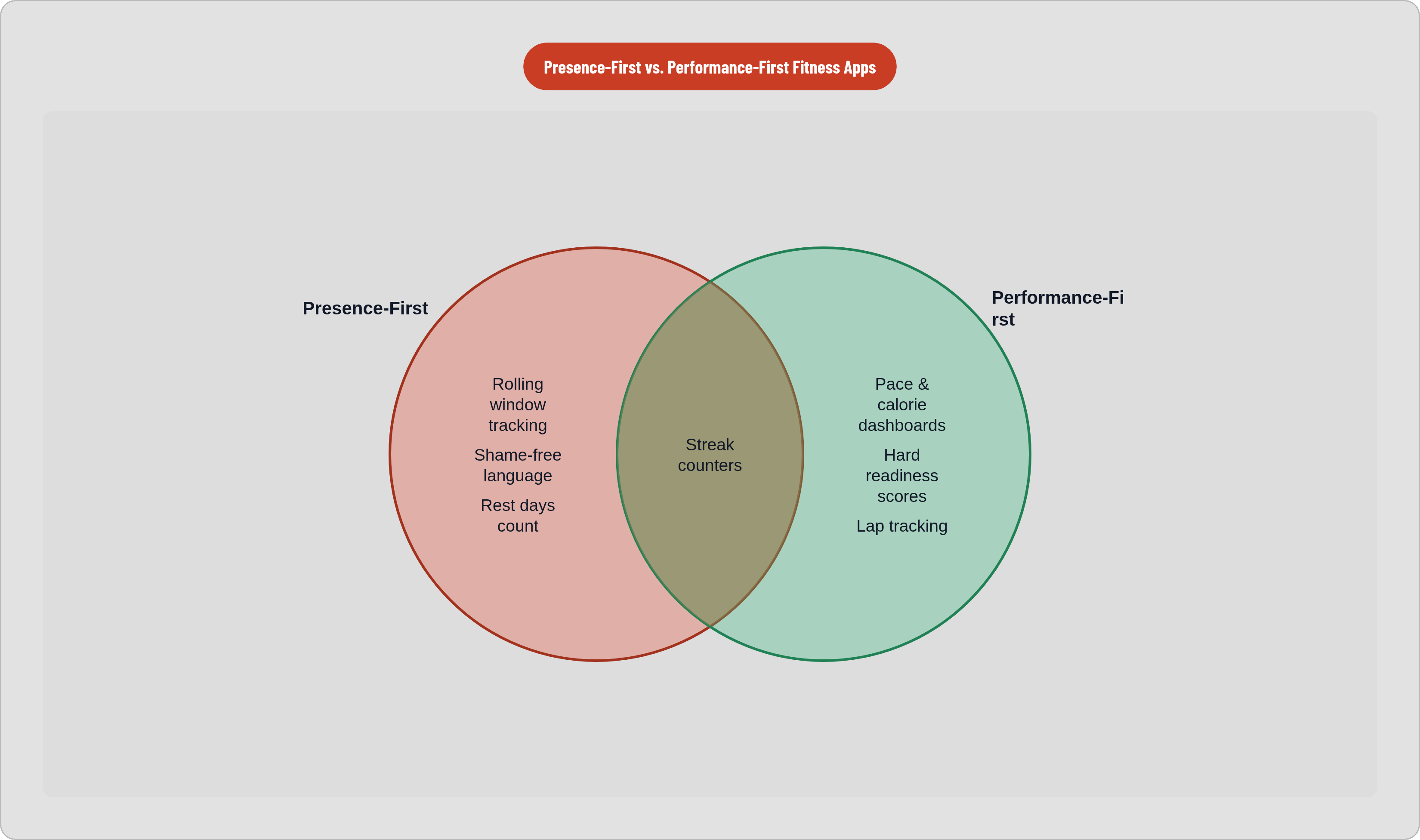
Strip the branding off any of these apps and you can sort presence-first from performance-first with four blunt questions. Does missing a day nuke your progress, or does the system shrug it off as noise? Is the headline number "did you show up" or "how well did you perform"? Does the app's tone after a miss invite you back or hand you a failure grade? And is the accountability coming from social support, social comparison, financial stakes, or an actual human relationship, matched to how you're actually wired?
Presence-first apps tend to share a specific set of traits: flexible streak definitions, rolling-window scoring, rest days that count as valid entries, shame-free language after a lapse, and the option to log "I showed up" without needing to log any performance data alongside it.
Performance-first apps wearing a friendly coat of paint tend to give themselves away fast. Streaks that vaporize on one miss. Dashboards that lead with pace or calories by default. Progress charts that visibly flatten the second consistency dips. Notifications that frame a quiet week as a failure rather than a normal week.
The social layer matters on its own, independent of everything else. An app with great forgiveness mechanics but zero social visibility is still relying entirely on your individual motivation to carry the whole load, and individual motivation is famously unreliable in January. Add even one other person who can see your log, and the math of the whole thing changes. Apps like Sweatmates, a shared fitness tracking app for partners, are built specifically around that visibility between two people. And for anyone training with a partner, the strongest setup relies less on matching workouts or synced schedules and more on two people staying visible to each other while doing completely different things.
How to choose based on your actual accountability style, not the app's marketing
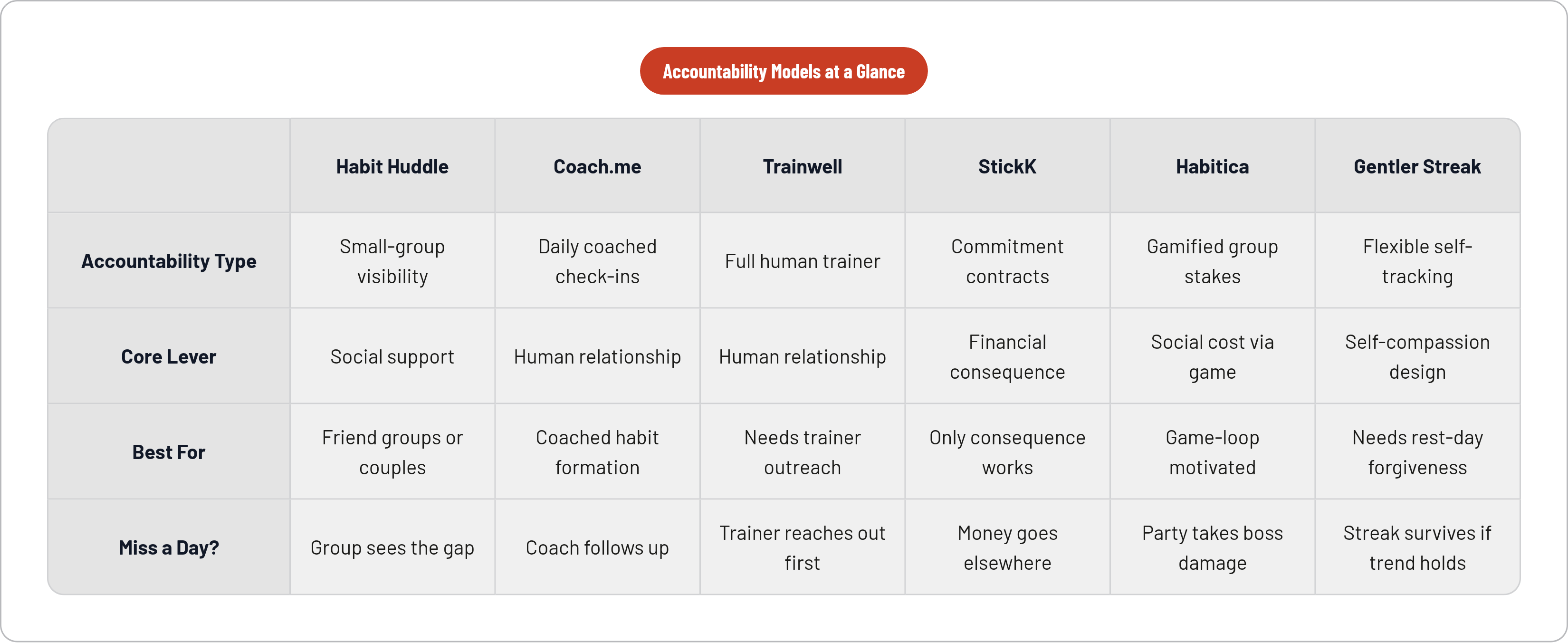
Start with the model, not the feature list. The right accountability mechanism for your personality will beat a "better" app built on the wrong one, every time, no exceptions.
If social warmth and shared momentum move you, look at Habit Huddle or any setup where a partner sees your log. If you need flexibility and a system that treats rest as legitimate rather than a lapse, Gentler Streak's rebuilt streak logic is the most fully committed version of that idea on the market right now.
If you already know you need a human relationship to stay honest, Coach.me gets you daily coached check-ins at a lower price point, and Trainwell gets you a full trainer relationship where someone reaches out the moment you go quiet. If external consequence is the only lever that's ever worked for you, StickK's commitment contracts, referee included, put real stakes behind the goal. And if game-loop psychology is what keeps you opening an app, Habitica's group mechanic supplies the social pressure without any of it feeling like punishment.
The thread running under all five of these: at the habit-formation stage, the only job is to return. So the right app for the next six weeks has less to do with how much data it collects and more to do with whichever one makes coming back tomorrow, after a day you missed, feel like the easiest decision you'll make all week.