fitness accountability tools for couples who want to work out together
Couples who work out together stick with fitness far longer than those flying solo.
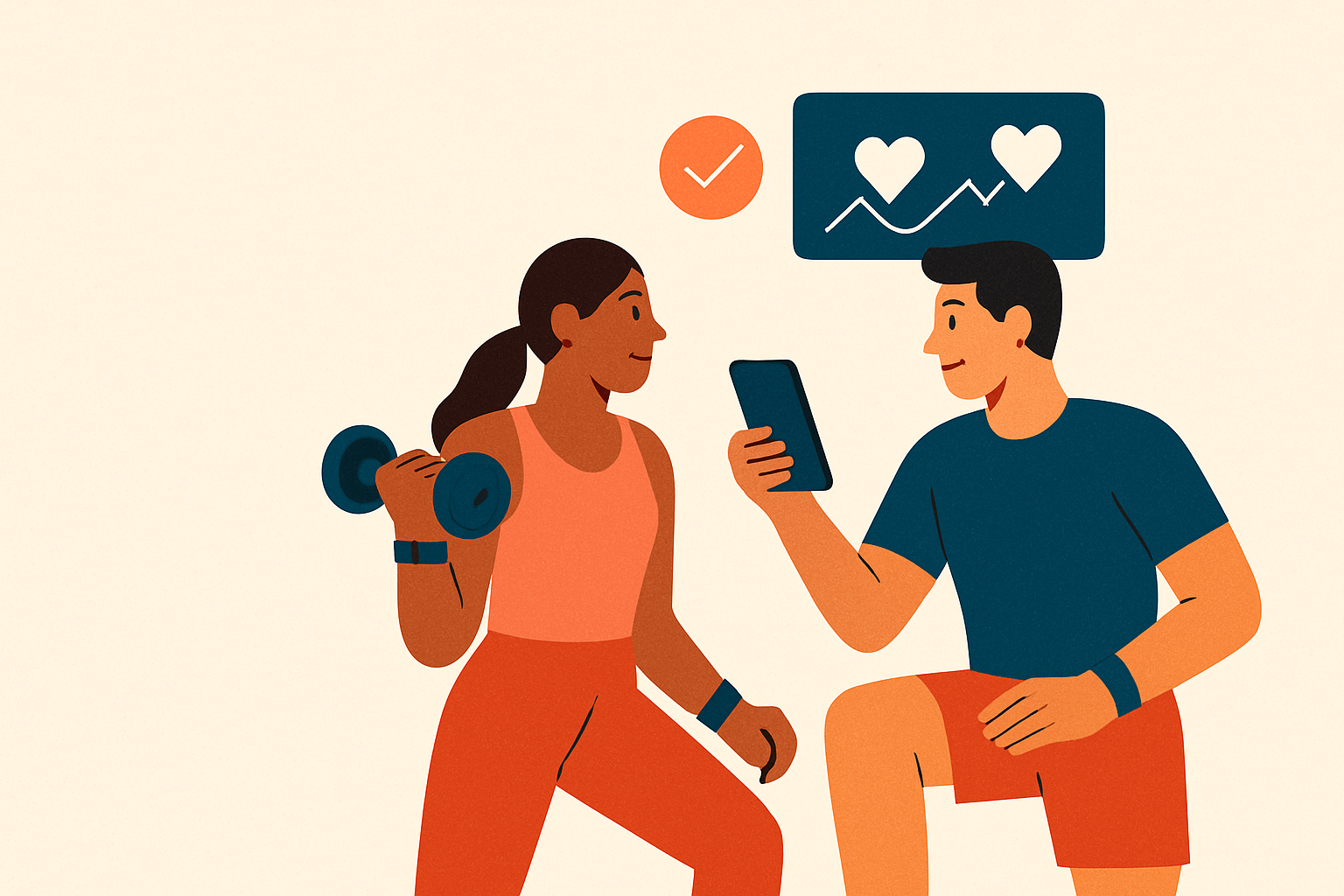
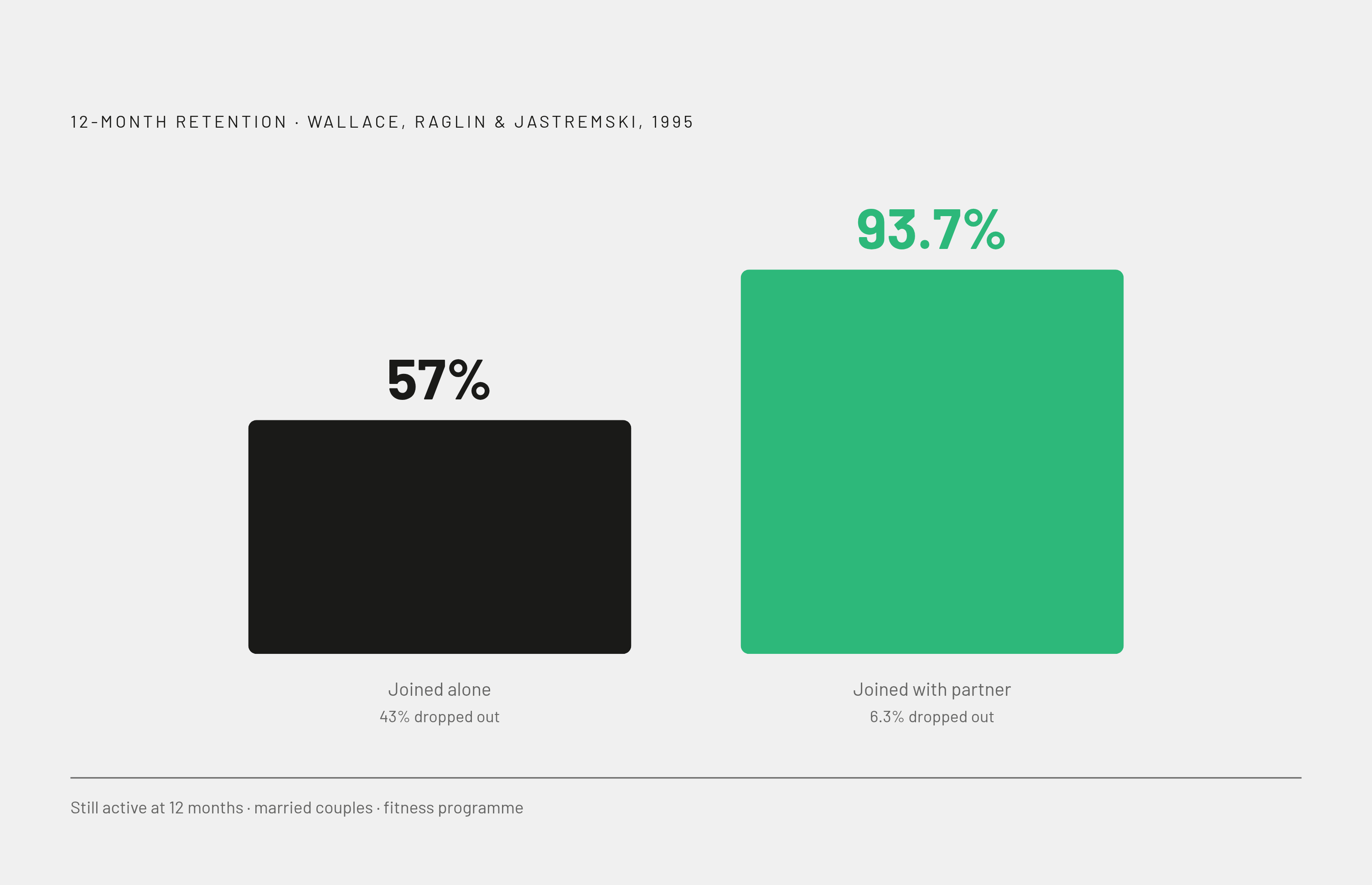
A married couple that starts a fitness program together has a real shot at sticking with it. A married person who joins alone, without their spouse, usually doesn't. That gap isn't small, and it's the whole reason this piece exists: someone else watching you show up appears to matter more than which tool you use.
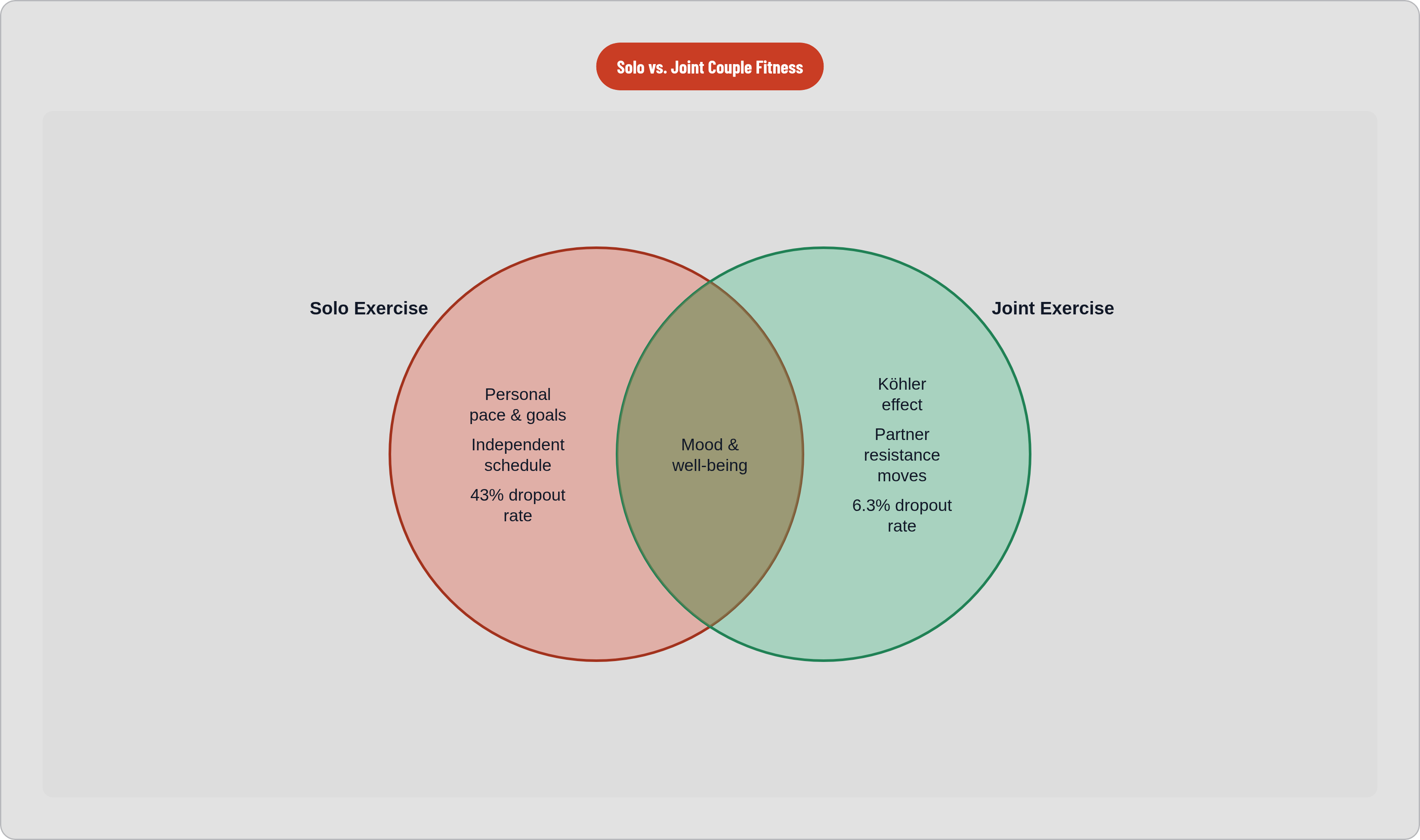
The 1995 Wallace, Raglin, and Jastremski study put numbers on this. After twelve months, only 6.3% of couples who joined a fitness program together had dropped out. Among married people who joined the same kind of program alone, dropout hit 43%. That's a sevenfold difference in who's still showing up a year later.
More recent data backs up the shape of this, even if it softens the edges a little. A 2026 BYU study surveyed 1,693 young married couples nationally and found that couples who exercised together showed stronger ties to good marital communication and less conflict. Here's the honest caveat: the study found that exercise itself, solo or joint, drives a chunk of the relationship benefit. The "together" edge is real, but it hasn't been proven statistically distinct from just exercising on your own. Translation: the goal doesn't require forcing joint workouts every single day. Keeping both people active and visible to each other seems to be what counts.
A 2021 daily-diary study with 95 participants found something simpler and, frankly, more useful: on days people worked out with their partner, they felt better during the workout, better for the rest of that day, and more satisfied in the relationship overall. Fitness gains came with a mood lift attached. And research on workout companions adds the missing piece: gaining a new exercise partner boosted how often people exercised, and the quality of support that person offered mattered alongside the shared schedule. What that person offered once they showed up shaped the outcome in meaningful ways.
So the data says shared exercise works. The harder question is how you make it work when your schedules don't line up, your fitness levels don't match, and one of you is on an Android and the other refuses to leave the Apple ecosystem.
What actually keeps couples working out together — and what quietly kills it
Here's the trap almost every couple falls into: one partner is stronger, faster, or just more experienced. Within a few weeks, one person feels held back and the other feels like they're dragging dead weight. The plan dies quietly, and both people usually blame motivation, when the real culprit is design.
The fix isn't matching weights or pace. It's matching relative effort, meaning both people work near the edge of their own capacity, not the same absolute number on the treadmill or the bar.
There's actually a name for why a modest skill gap helps rather than hurts: the Köhler motivation gain effect. A 2023 meta-analysis pooling 19 studies and 1,912 participants found a real, statistically significant motivation boost (effect size g = 0.91) when people trained next to a partner slightly more capable than them. Effort went up by as much as 24%, and nobody had to consciously decide to try harder. It just happened.
Schedule mismatch kills plenty of good intentions too. Not every workout can be shared, and most couples who actually keep this going long-term mix joint sessions with solo ones rather than forcing identical calendars. That means the best tools for couples don't require both people in the same room at the same time. They just need to keep both people feeling connected on the days they train apart.
Quick word of caution on stats floating around the internet: you'll see claims like "you're 95% more likely to succeed with an accountability partner" repeated everywhere with no traceable source. Skip those. The real, defensible finding is simpler: visible commitment to a real person, plus actual encouragement, beats willpower alone. That's the whole engine.
The deepest mechanism at play is identity, not logistics. Once "we work out together" becomes part of how a couple sees themselves, skipping a session isn't just missing a workout, it's breaking something shared. Tools that reinforce that identity, rather than just logging reps and calories, tap into something a spreadsheet never will. And there's a biochemical bonus riding shotgun: exercise releases oxytocin and endorphins, the same chemicals tied to bonding. Work out together, and you're stacking the fitness payoff on top of a bonding payoff.
Apps built specifically for two-person accountability
These apps skip the performance-optimization rabbit hole entirely. No VO2 max estimates, no cadence charts. Just one question: did you both show up this week?
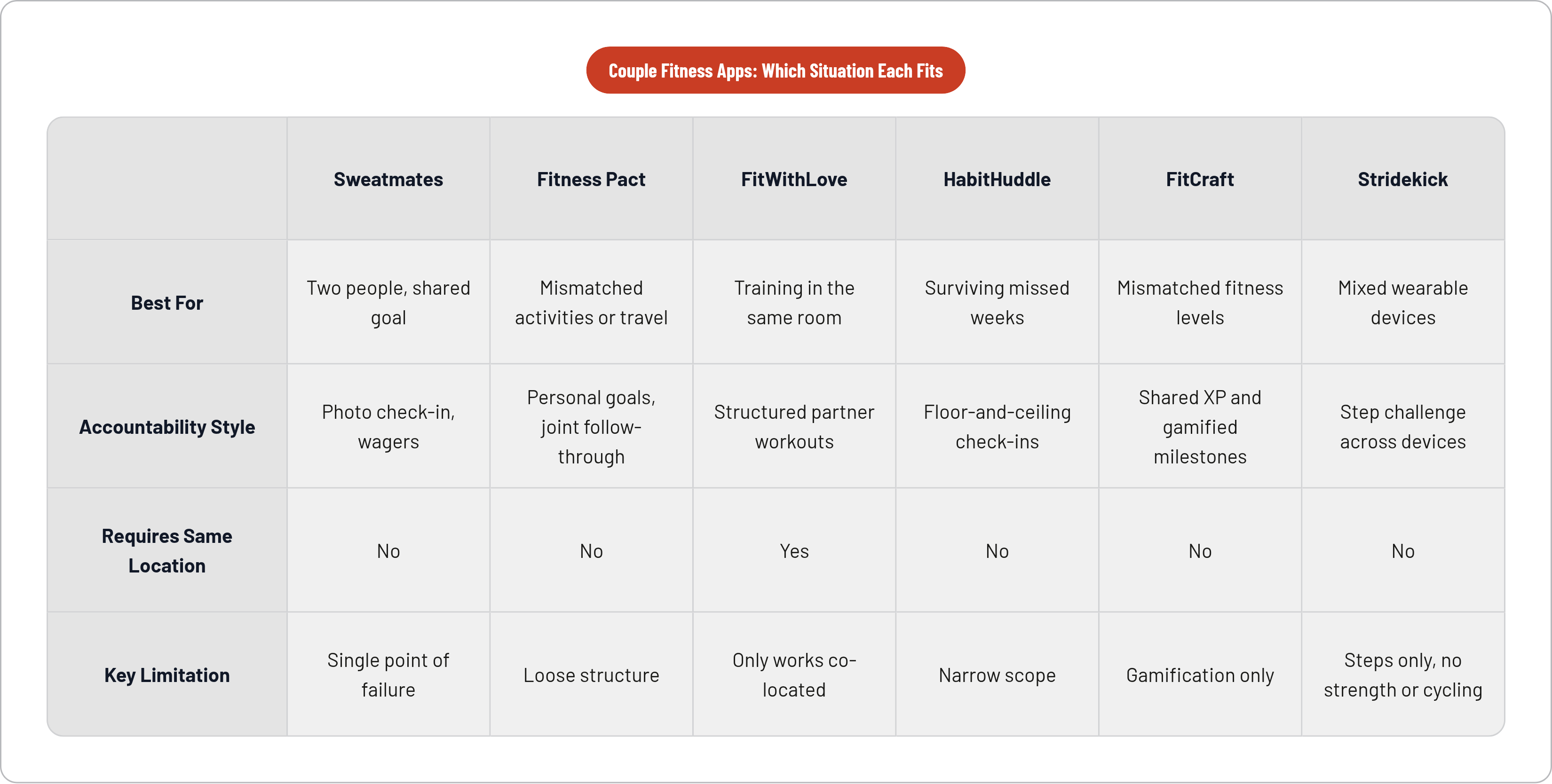
Sweatmates (iOS and Android) launched with a clear two-person focus, whether that's couples, best friends, or siblings. No leaderboards, no stat dashboards to obsess over. You set a weekly workout goal together, log each session with a photo through its SweatCam feature, and your partner sees it land in real time. Miss the goal, and you owe whatever wager you agreed on, dinner, a chore, your dignity. Hit it, and you're off the hook. The photo-first setup lines up nicely with the Aberdeen finding: the connection that matters is emotional, not logistical. Worth flagging though, one reliable partner is the strongest accountability structure there is; one unreliable partner is a single point of failure with no group backup to catch you.
Fitness Pact: Better Together (iOS and Android) takes a looser approach. Each person picks their own workout type, frequency, and consequence for slacking off. You don't need the same activity, same gym, or even the same city, which makes this a strong fit for couples with mismatched interests or one partner who travels constantly for work. Accountability stays joint (did you follow through?) without demanding identical goals.
FitWithLove: Couple Workout (iOS and Android, released 2026) goes the other direction, structured day-by-day plans built for two people physically together, partner-resistance moves, medicine ball passes, resisted push-ups. Streaks and badges give a visible shared trail. This one's for couples who actually want to train in the same room with some guidance, not just mutual visibility from across town.
HabitHuddle solves a different problem entirely: the all-or-nothing spiral where one missed "perfect" workout turns into three missed workouts and a dead routine. Its Floor-and-Ceiling structure gives you a Floor (bare minimum on a rough day) and a Ceiling (the full session), so the streak survives even when life gets in the way. Check-ins are designed to be quick, and it works across the platforms where you and your partner already talk.
Gamified and AI-personalized tools that make shared progress visible
FitCraft, released in 2026, turns exercise into something closer to a co-op game. Shared XP, collectible cards, calendar-based rewards, the whole setup leans into what Self-Determination Theory calls "relatedness," the sense of belonging to something shared rather than just checking off your own boxes. Its AI calibrates each partner's workouts to their own strength, mobility, and experience level, so both people train at the same time without one feeling held back and the other feeling steamrolled. That's a direct answer to the mismatched-fitness-level problem from the last section.
Gamification as a category works because it applies the Köhler effect at the tool level. Visible shared milestones, streaks, badges, wagers, make effort feel conjunctive instead of parallel. You're building one thing together rather than logging two separate efforts that happen to share an app. Friendly stakes (dinner, a chore, a small reward) add short-term accountability without any shame attached. The consequence is playful, not punitive, and that distinction matters more than it sounds like it should.
What gamification can't do is solve the in-person training experience. It sustains motivation between sessions, but it doesn't tell you how to spot each other on a bench press or pass a medicine ball correctly. For that, co-located tools and partner-resistance programming pick up where gamification leaves off.
Mainstream platforms couples can use together without switching ecosystems
Not every couple wants a dedicated app just for the two of them. Some already live inside a bigger fitness platform and just want it to work for both people without either one switching hardware.
Peloton offers shared challenges and social features designed to keep partners connected across sessions. Couples who both subscribe can take the same class and see each other's presence reflected in the shared experience, which is about as close as a mainstream platform gets to feeling like you're training together when your schedules don't actually line up. The catch is cost: between the equipment and the subscription, this only makes sense for couples already bought into that ecosystem.
Stridekick solves a much narrower but genuinely annoying problem: cross-device step challenges. It syncs Fitbit, Apple Watch, Garmin, and plain phone-based tracking, so a couple with two totally different wearables can still compete in the same challenge without one person's data getting stranded. It's step-based only, so don't expect it to handle strength training or cycling, but it removes the single most common technical headache in partner challenges.
Across the board, mainstream platforms trade structure for reach. A partner's workout shows up in a feed alongside everyone else's, built for broadcast rather than as a direct signal meant just for you.
Matching a tool to how a couple actually exercises
Forget which app has the longest feature list. The real question is what your specific situation actually needs the tool to do.
Same schedule, same location, similar fitness level? Lean into co-located tools like FitWithLove or shared Peloton classes, since the tool just needs to reinforce what's already working. Same schedule but different workouts or gyms? Fitness Pact fits better here, because accountability there is about showing up, not matching the activity. Mismatched fitness levels but training side by side? FitCraft's AI calibration, or just leaning into the Köhler effect on purpose, turns one partner being slightly ahead into an asset instead of a source of resentment. Different schedules entirely, but you still want to feel like a team? Photo check-in tools keep visibility alive across asynchronous sessions, and HabitHuddle's Floor-and-Ceiling setup helps the routine survive a rough week.
Most couples who actually sustain this long-term land somewhere around two or three joint sessions a week, mixed in with solo workouts the rest of the time. The tool should support that mix, not demand a perfectly synced calendar that falls apart the first time someone's boss schedules a 7am meeting.
One more thing worth saying plainly: the best tool is whichever one both people actually keep opening. Complexity that only serves the partner who loves optimizing everything will quietly push the other person out. And agree on wagers before the first missed week happens, not in the heat of the argument after it does.
What makes couple accountability feel supportive rather than surveillance
Go back to that Aberdeen finding, because it's the whole ballgame: what your workout companion offers matters more than the fact that they exist. Emotional encouragement is what drives people to exercise more often, not just having someone else's name on a shared calendar.
Visibility and monitoring can look similar from the outside, but they land differently. A partner seeing your workout photo pop up is connection. A partner quietly tracking your heart rate zones without any context or conversation around it starts to feel like surveillance. The difference comes down to consent and framing, not the data itself.
Celebrating that someone showed up, regardless of how fast or how heavy, matters more than any single metric ever will. Tools built around streaks, wagers, and frequency badges reward exactly that. Tools that surface pace comparisons or power output between partners risk turning a shared goal into a quiet competition nobody signed up for.
The shared-identity mechanism only kicks in when both people feel like the goal actually belongs to them, not like one person built a fitness plan and the other is just along for the ride. A few guardrails make that stick: pick weekly goals both people genuinely want, agree on consequences before anyone's missed a week, and leave room for solo sessions so independence doesn't get squeezed out of the relationship entirely. When a week gets missed, let it start a conversation instead of triggering a scoreboard moment.
None of these apps replace the actual relationship doing the heavy lifting. The strongest accountability structure that exists is two people who genuinely want the other one to succeed. Every tool in this piece just makes that want a little more visible, drawing it out rather than manufacturing it from nowhere.