Remote Fitness Accountability Between Friends in Different Cities
How to keep a fitness friendship alive across miles.

Your gym buddy moved to Denver. You moved to Austin. And somehow the friendship that used to run on Tuesday leg days and post-workout tacos is now running on nothing at all. Long-distance shifts like this happen for a plain reason: two people who used to sweat in the same room no longer have a room to share.
This piece isn't about picking the "best" fitness app for long-distance friends. It's about what actually makes accountability real when nobody's in the same zip code.
Remote work scattered a lot of friendships across time zones, and the casual stuff that used to hold a friendship together (the gym check-in, the after-work walk) doesn't happen automatically anymore. You have to build it on purpose now, which is a strange thing to have to say about hanging out with your friend.
And this isn't just vibes. Buffer's State of Remote Work survey found 23% of fully remote workers named loneliness their second biggest challenge, right behind the usual suspects. Research published in Science, looking at data from over half a million people between 2011 and 2024 (skipping the pandemic years), found people who work remotely and live alone are 83% more likely to spend an entire day alone. That's your old training partner, alone in a new apartment, wondering why the couch feels more appealing than the treadmill.
So the instinct to fix this with a shared fitness habit makes sense. It gives you a reason to text that isn't just "how's it going." Social fitness apps are booming, too. The market hit $3.5 billion in 2024, according to Verified Market Reports. But a big market doesn't tell you what actually works between two specific people who live 1,500 miles apart. That's the actual question here.
What the research says about why a friend's presence — even a virtual one — changes exercise behavior
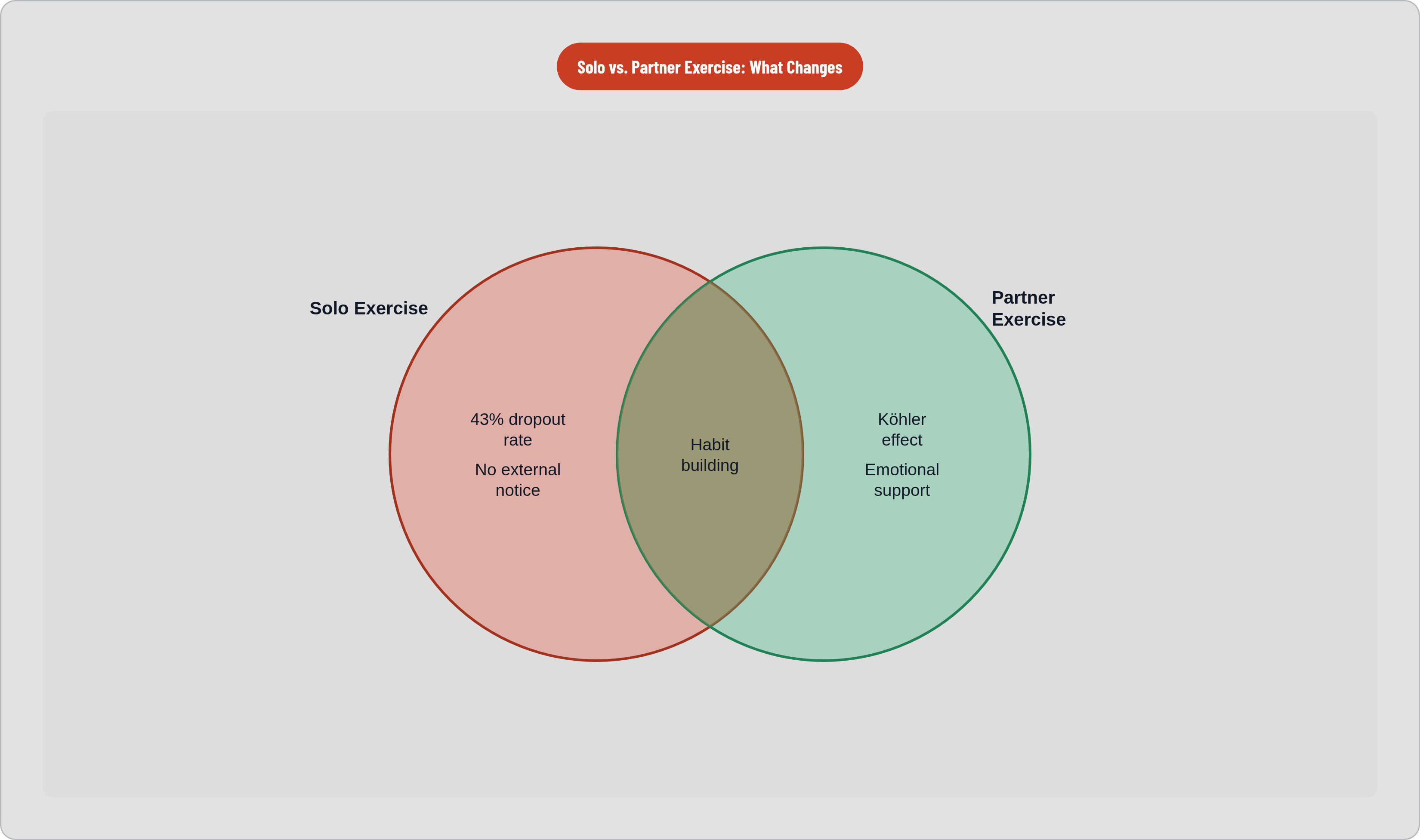
Here's the anchor fact, and it's a good one. A 1995 study by Wallace, Raglin, and Jastremski, published in the Journal of Sports Medicine and Physical Fitness, tracked married couples who joined fitness programs. Spouses who joined together had a 6.3% dropout rate. Individuals who joined alone dropped out at 43.0%. That's not a small gap, that's a chasm.
What's interesting is why it happened this way. It wasn't that partnered people had more willpower or discipline lying around. It's that somebody noticed when they didn't show up. Willpower is a resource you run out of by Thursday. A friend noticing is a resource that doesn't get tired.
Solo exercisers tend to fall off hard within six months. Group-based programs, by contrast, hit six-month adherence rates between 69% and 75%, according to systematic reviews cited in Killingback et al. (2017). That's the difference between a New Year's resolution and an actual habit.
There's a mechanism behind this, and it's worth naming because it explains why "just cheer your friend on" isn't fluff advice. A 2026 time-lagged study in Frontiers in Psychology found that self-efficacy (your belief that you can actually do the thing) accounted for 84% of the connection between social support and whether people stuck with exercise. Encouragement changes what you believe about yourself, and belief is what gets you off the couch on day 19 when day 20 already sounds exhausting.
Then there's the Köhler effect, which sounds like a fancy German car but is actually about performance. A 2023 meta-analysis in Kinesiology Review, covering 19 studies and nearly 2,000 people, found a real, measurable performance boost (effect size of 0.91, for the stats-curious) when people did "conjunctive" partnered exercise, meaning both people's effort matters to the shared outcome. The logic is simple: you don't want to be the weak link, and nobody wants to be the reason the streak dies.
Here's the part that matters most for anyone reading this from a different city than their workout buddy: the Köhler effect doesn't require being in the same room. It requires visibility and stakes. Your partner needs to see what you did (or didn't do), and there needs to be something on the line, even if it's just pride.
One honest caveat. You've probably seen the claim that people are "95% more likely to succeed with an accountability partner" floating around fitness content. That number doesn't trace back to any real source, as far as anyone can find, so it's worth skipping entirely. The well-supported version is simpler and just as convincing: visible commitment to a real person beats going it alone, consistently, across multiple studies.
Research on exercise partnerships found something else worth sitting with. Gaining a new exercise companion boosted workout frequency most when that companion offered emotional support, not just a synced calendar. A shared spreadsheet doesn't cheer you up after a bad week, but a friend does.
The specific challenges that make long-distance accountability harder than it looks
Time zones are the first wall you hit. Your 6 a.m. run is your friend's 4 a.m., and nobody's doing that. Synchrony, the thing that made gym buddies work in the first place, just isn't available anymore.
Silence is the second wall, and it's sneakier. In person, if your friend skips the gym twice, you notice at the gym. Remotely, one skipped check-in can quietly turn into a week of nothing, and neither of you registers it as a problem until it's a pattern.
Then there's a dynamic worth naming plainly: people tend to exercise more with a partner, but the partner's motivation level matters enormously. A less motivated partner doesn't average out to "fine," it drags things down. For friends far apart, there's no natural correction for this. You used to run into each other at the gym and recalibrate without even trying, but now, if your motivation levels drift apart, nothing catches it.
This connects to a structural problem worth naming plainly. A two-person accountability system is the strongest kind there is, and also the most fragile. One flaky week from either person, and there's no buffer. Compare that to a group of three or four, where somebody else can carry the momentum while one person goes quiet for a bit.
Device fragmentation adds friction nobody talks about enough. Your friend has a Garmin, you have an Apple Watch, and now you're two people who can't even see the same numbers without a bridge app doing translation work behind the scenes.
And then there's the theater problem. When accountability happens on a big public platform where everyone can see everyone's numbers, the psychology can flip on you. "My friend noticed I worked out" turns into "the internet noticed I took a rest day," and suddenly you're training for an audience instead of training for the plan. The goal was a friend who notices, not a stadium.
Last thing: a heart emoji reaction to a workout photo feels like accountability, but it's really just a nod. The check-in has to carry actual weight, or it's just digital small talk with extra steps.
What actually replicates the social pull of training side by side
Warmth beats format, every time. That's the real takeaway from the Aberdeen research: emotional support mattered more than shared scheduling. Which means you don't need to solve the time zone problem perfectly. You need to solve the "does this feel like someone cares" problem.
Photos do a lot of work here. A picture of your shoes at the door, mid-run selfie, whatever, communicates more than a logged number ever will, because it's a social gesture, not a data point. Voice notes and short videos work the same way. They replicate the "how'd your workout go" conversation you used to have in the car, minus the car.
Consistency matters more than frequency. Checking in three times a week on a rhythm you both expect beats checking in constantly but randomly. Predictability is what makes it feel like a relationship instead of a chore.
Simple challenges with a clear finish line work well too. Think: a step count goal for the month, a squat progression you're both chasing, running your age in kilometers before the calendar flips. These work specifically because they're conjunctive, meaning both people have to show up for it to count, which is exactly the setup behind that 0.91 effect size mentioned earlier. They're loose enough to bend around different schedules, yet concrete enough that skipping is obvious.
Small stakes help without turning things ugly. Loser buys coffee, or loser builds a playlist, nothing dramatic, just enough to make the outcome matter a little. There's a real shift happening in how people think about this, too. Research tracked between 2016 and 2023 (published in the Journal of Medical Internet Research, 2025) found that "motivating someone else" as a reason for sharing fitness data jumped from 8.5% to 36% of users. People are increasingly trying to pull a friend along with them, not just showing off their numbers.
You also don't need to do the same workout. That's a myth worth killing. One person runs, one person lifts, and it still counts as a shared experience, because the commitment window is shared even if the movement isn't.
Last point, and it might be the most important one: celebrate the showing up, not the performance. A rough, slow, ugly workout still counts. Acknowledging that consistently is what keeps the whole thing from turning into a judgment competition, and per that Frontiers in Psychology research, protecting self-efficacy is exactly what keeps people showing up months later.
Apps and tools that support remote fitness friendships — and what each one is actually best at
No single app wins this. It depends on your sport, your devices, and how competitive you two actually want to get.
For strength training specifically, Hevy was built as a serious lifting tracker first, complete with routines, supersets, and progression charts, with a friend feed added on top. The accountability here is quiet. Friends see your logged sessions and can react, but there's no built-in pressure structure. It functions more like a training diary your friends happen to have a key to.
If your friend group has a device mismatch problem (someone's got a Fitbit, someone's got an Apple Watch, someone refuses to wear anything and just uses their phone), Stridekick solves that directly. It syncs across most major wearables, which makes it the practical pick for mixed-device step or distance challenges.
StepBet adds real money to the equation. You put cash on the line for hitting step goals, and the wager creates strong short-term motivation. It works best as a defined sprint, a month here or there, rather than something you run indefinitely, since real stakes can strain a friendship if they run too long.
If everyone in your circle already has an Apple Watch, ring sharing through Apple Fitness+ is free and frictionless. The catch: it's iOS-only, one-to-one, and doesn't scale to a group of three or more, and anyone on a Fitbit is locked out entirely.
Peloton Teams goes the other direction, built to scale to groups in the thousands with shared targets and collective tracking. This makes sense if your friend group already has Peloton equipment or the app subscription, but it doesn't make much sense otherwise.
Some apps are built around exactly the dynamic this whole article describes: friends who train separately but stay connected through shared check-ins, photos, and simple recurring goals, with no requirement to use the same wearable or follow the same schedule, Sweatmates, for instance, is a shared fitness tracking app for partners built around photo check-ins, weekly goals, and friendly wagers between two people. That photo-and-check-in format is a direct answer to what the research actually points to: personal, warm, and low-pressure beats data-heavy and public.
On the higher end, there's remote coaching. Trainwell holds a 4.9-star rating across more than 5,000 App Store reviews. That's a human coach, not a peer, so it's a different flavor of accountability, more expert-driven than friendship-driven. Other options like Future, Kickoff, Caliber Premium, and Ladder sit in similar territory, useful if you want a coach for the workouts and your friend for the social side.
One more thing worth knowing: apps with gamification (badges, streaks, leaderboards) see meaningfully better retention than plain tracking apps, according to FitBudd's 2025 research. So if a challenge app throws a badge at you for hitting week four, that's the thing keeping you around for week five.
How to structure a long-distance fitness partnership that survives the first bad month
Start with a real conversation, not an assumption. You don't need identical goals, a runner and a lifter can absolutely hold each other accountable, but you do need similar levels of motivation. Agree on how often you'll check in and what format that takes before you start, not three weeks in when one person's already annoyed. And decide in advance what a missed week actually means. It should trigger a quick check-in, not a guilt trip.
Build a rhythm you can both predict. Three times a week, or a Sunday recap, something with a shape to it. Default to photos or voice notes over scheduled calls, since lower effort tends to bring higher warmth. A short, honest line about how the week actually went beats a polished summary every time.
Design your challenges so two different fitness levels can both win. Percentage-based goals (each person improving off their own baseline) work better than identical targets when you're not starting from the same place. Reset monthly, since everybody deserves a clean slate after a rough few weeks.
Protect against the fragility problem mentioned earlier. If you can, pull in a third or fourth friend so one person's bad week doesn't sink the whole structure. If it's just the two of you, at least agree upfront that a hard week doesn't end the arrangement. That agreement alone removes the awkward "are we still doing this?" text nobody wants to send.
And be honest with yourself about the difference between a bad month and a mismatched partner. Everyone has a rough stretch, and that's not a sign to quit. But if your friend's motivation has genuinely moved somewhere else entirely, different goals now, different priorities, the partnership might need to change shape rather than end. New challenge, new format, or just an honest conversation about what you both actually need from this. That's just two people being honest about where they are, which, coincidentally, is the entire point of a good friendship in the first place.