Shared Fitness Goals for Friends Who Work Out Separately
Accountability works better than perfect plans when friends support each other from afar.
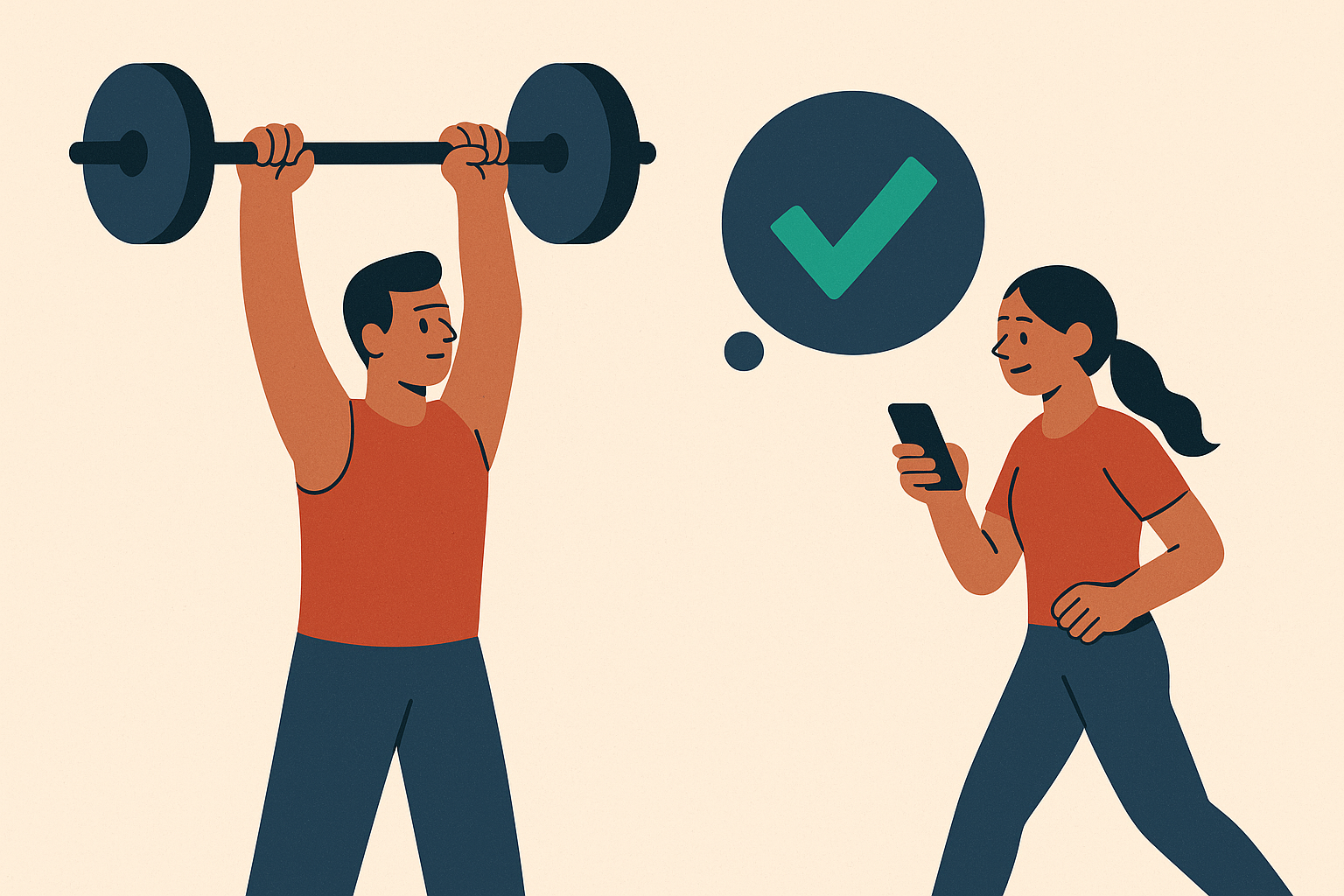
You don't fail at fitness because your plan is wrong. You fail because no one notices when you disappear.
Miss one workout, feel like the whole thing is ruined, vanish for a week. It's a quiet pattern and a devastatingly common one. A large share of people abandon fitness goals within the first month. The habit is most fragile right at the start, and that's exactly when most people are grinding through it completely alone.
Going solo removes the one thing that can actually break the spiral: someone noticing you're gone.
The fitness industry has spent decades selling better plans, smarter programs, optimized everything. And the research keeps pointing somewhere else. A study in the Journal of Consulting and Clinical Psychology found a substantial increase in exercise adherence when people worked out with a partner versus alone. Not a small bump. That's the difference between most people continuing and most people quitting.
A few things are happening at once to produce that number.
The Köhler Effect is the big one. In group settings, the person who might "let everyone down" works harder to avoid it. Michigan State University kinesiology research showed this effect persists even with a virtually present partner. You don't need to be in the same room. You just need to know someone else is in it with you.
There's also the basic psychology of commitment. Tell someone you're going to do something and your brain creates real pressure to follow through. Not because you're terrified of judgment. Because humans are genuinely wired to stay consistent with what they say they're going to do.
And then there's social contagion, which sounds clinical but is really just: seeing a friend log a session or send a sweaty post-run photo makes you want to go do yours. It's not competitive. It's just catching.
One finding that surprised me when I first came across it: a study in the British Journal of Health Psychology found that encouragement and celebrating progress mattered more for sustaining exercise habits than practical support, like coordinating schedules or sharing training plans. Your friend cheering you on actually outperforms your friend building you a spreadsheet.
The throughline across all of it is the same. Proximity isn't required. What's required is knowing someone else is paying attention.
How shared goals create accountability without requiring shared schedules
A University of Aberdeen study found that gaining a new exercise companion increased exercise frequency, and the effect grew stronger when that companion offered emotional encouragement rather than just schedule coordination. Which makes sense when you think about it. No one skips a workout because they forgot the plan. They skip because no one will know.
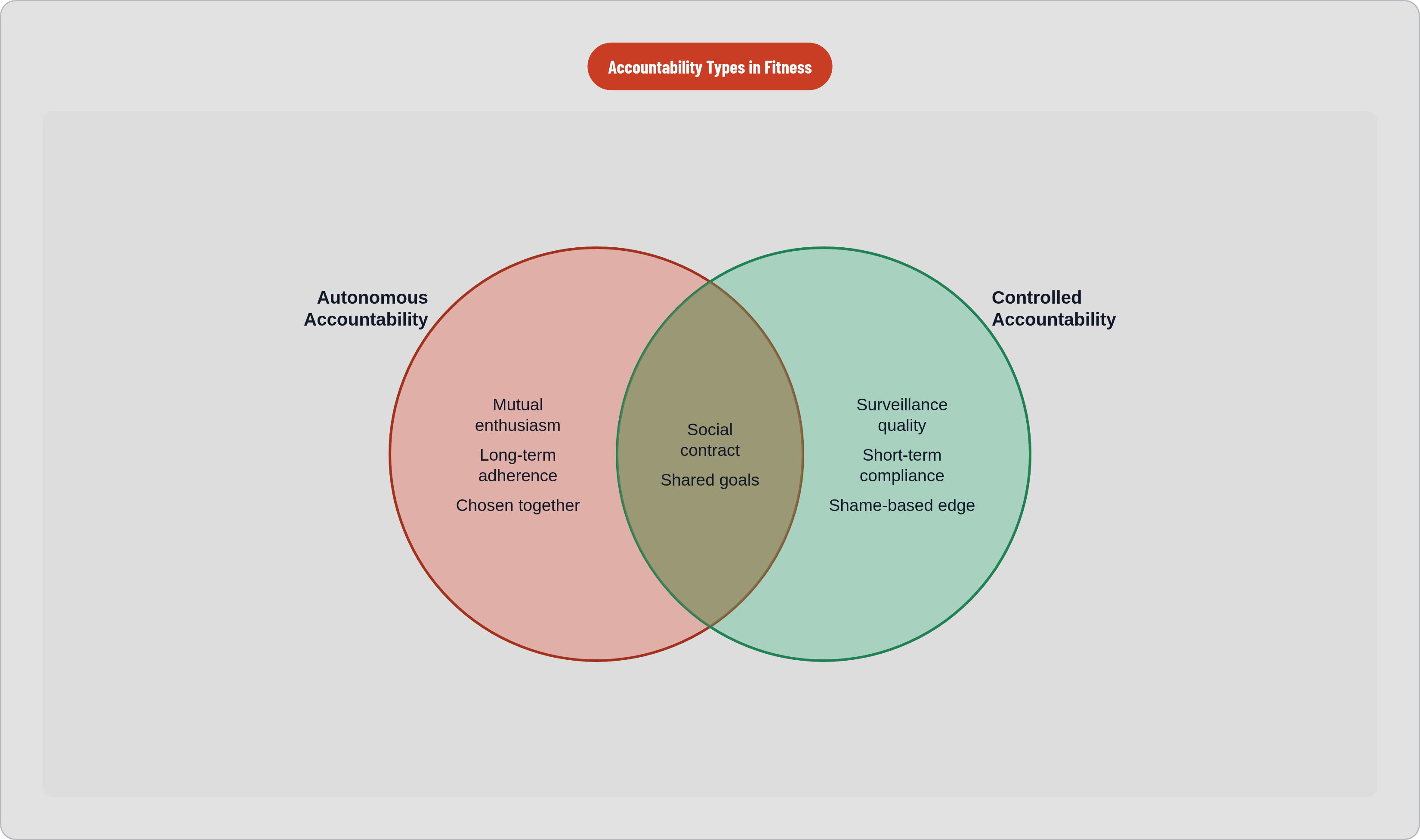
Telling a friend about a fitness goal does two things simultaneously. It makes the goal feel real. And it creates a social contract your brain actually wants to honor.
But accountability isn't one thing. Research distinguishes between two versions that produce very different outcomes.
Autonomous accountability is what you're aiming for. You and a friend choose this together, it's grounded in mutual enthusiasm and support, and it improves long-term adherence. Controlled accountability is the other kind. It has a surveillance quality to it, a shame-based edge. It produces short-term compliance and then resentment, avoidance, and eventually someone quietly ghosting the whole arrangement.
How you frame the agreement matters as much as the goal. "Let's keep each other going" lands in a completely different place than "you have to report to me."
There's also a structural tool worth knowing called the conjunctive task effect. When a goal requires everyone's contribution to succeed, each person feels a stronger individual pull to show up. A combined monthly workout count. A shared step total. Something where one person's absence visibly affects the result. The structure creates accountability without anyone having to play the enforcer.
Cooperative goals versus competitive ones, and which works better for friends
Competition in fitness works. Social comparison raises activity levels and expectations. But it has a real cost. Anxiety, stress, and a friendship that starts to feel like a leaderboard.
A 2024 study published in iScience found that both competition and cooperation involve constant self-other monitoring. You track your partner's effort and adjust your own. That mechanism is the same in both. The emotional experience of each is not.
Competition works best when the ability gap between two people is moderate. Too large a gap and the person who's behind doesn't rise to meet it. They disengage. You've probably seen this without having a name for it. It's the fitness equivalent of playing chess against someone two full levels above you. After a few games, you just stop wanting to play.
Cooperative goals fix this. Both friends only succeed if both contribute. You're not racing each other. You're building something together. And there's a side benefit: cooperative structures lower the perceived cost of trying something uncomfortable. It's easier to attempt something that feels embarrassing or hard when someone else is fumbling through it alongside you. Shared pursuit provides companionship and access to peer information. The unfamiliar becomes less daunting.
For most friendships, especially those where fitness levels or schedules don't align, cooperative structures are simply more durable. Competition can be a fun secondary layer. It just shouldn't be the load-bearing wall.
What shared goals actually look like when friends train at different times and places
The goal structures that actually hold up when two people are training separately tend to share a few features. They're flexible enough to absorb a bad week. They're specific enough to feel real. And they don't require both people to be in the same place at the same time.
Monthly cumulative totals work well. A combined step count, total miles, total workout sessions. Each person contributes whatever their schedule allows, but the shared number is what both people are watching. No synchronized schedules required.
Floor and ceiling targets are underrated. Set a minimum (ten minutes of movement counts as a session) and a stretch goal. The floor is what saves you. The most common failure pattern in fitness is perfectionism. Miss the ideal session, declare the plan ruined, stop entirely. A floor makes a bad day cost ten minutes instead of your momentum.
Fixed-end-date challenges give every solo session a shared context. Sign up for the same 5K months in advance. Every training run happens separately, but the finish line is mutual. It's a conjunctive goal with a hard deadline, and it holds up remarkably well even when all the preparation is asynchronous.
Asynchronous check-ins matter more than most people think, which is why they get their own section shortly. But in terms of structure: a quick voice note, a screenshot of your habit tracker, one sentence about the week. Anything that starts to feel like a meeting will die. Keep the friction low.
The right goal structure depends on the friendship. Casual friends need lower-stakes parallel targets. Close friends thrive with something that demands mutual contribution. There's no universal formula, but there is a clearly wrong answer: building something too rigid for real life to fit inside.
How apps built around social features support friends who train apart
The social fitness app market hit $3.5 billion in 2024 and is projected to reach $10.8 billion by 2033. That's not a niche. That's a lot of people actively trying to solve the "training apart" problem with software.
Apps that incorporate social and gamification features see up to 50% higher retention compared to tracking-only apps. The social layer isn't cosmetic. It's what keeps people coming back.
Some platforms illustrate this working at scale. One leading social fitness platform reported 180 million registered users in 2025, with about 3 million joining every month. In 2025 alone, users gave 14 billion kudos, up 2 billion from the prior year. People aren't just logging workouts. They're returning because of the encouragement. Group activities on that platform run 40% farther on average than solo ones, and 58% of users surveyed in 2024 said they'd made new friends through fitness groups on it. The social layer produces measurably different behavior.
A few others worth knowing about:
- StepBet adds financial stakes to personalized step goals. Money creates a layer of commitment that outlasts motivation alone.
- Hevy is for friends who lift. A shared training log where someone noticing your session is kind of the whole point.
- Garmin Connect is for the data-driven crowd. Follow friends, join challenges, share live activities.
One friction problem that kills more group fitness plans than any other: if friends have to download a new app, the whole thing often dies right there. Tools that let check-ins happen inside existing group chats remove a barrier that people consistently underestimate. Meeting people where they already are is genuinely underrated.
Human accountability partners provide emotional warmth but are unreliable when life intervenes. Stakes-based apps are consistent but lack warmth. The most durable approach uses both as complements. Not substitutes for each other.
Why the check-in ritual matters as much as the goal itself
The goal is the container. The check-in is where the connection actually lives.
That British Journal of Health Psychology research found that emotional support, encouragement, empathy, and noticing progress are what sustain exercise habits over time. Not the goal structure. The relationship. A 2025 study of sports club participants confirmed it directly: peer relationships had a measurable effect on both satisfaction with exercise and long-term commitment to it.
What effective check-ins actually look like in practice:
- Short enough to feel easy. A screenshot and one sentence beats a scheduled debrief every time.
- Celebrating showing up, not just performance. A completed workout that felt terrible still deserves acknowledgment.
- Voice notes and photos over data reports. A sweaty selfie carries more warmth than a chart.
- Responding to a missed week with curiosity rather than judgment. "How's the week been?" instead of "you missed your goal."
There's a real risk when check-ins tip into surveillance. Supportive, collaborative accountability sustains behavior change. Punitive, shame-based accountability produces short-term compliance and long-term avoidance. The tone of the check-in determines which one you're actually building, usually without either person noticing the shift happening.
A rough week is information. It is not a verdict on whether the goal or the friendship is working.
Friends who build a light, warm, low-stakes check-in habit will outlast friends who build a rigorous tracking system with no room for real life. The goal is to still be doing this six months from now. That requires the ritual to feel like something worth returning to.