Family Fitness Challenges for Parents and Kids
Family fitness challenges work when they fold parents' exercise into time already spent with kids.
Youth in the US just got another D- on their activity report card. The reason isn't complicated: kids and adults alike are falling short of activity guidelines. Fix the family's shared habits, and the whole household's numbers can improve together. That's the whole thesis, and everything below is just the mechanics of how.
What the guidelines actually ask of kids and parents — and how a shared challenge can cover both at once
Nobody puts this math side by side, so here it is. Kids aged 6 to 17 need 60 minutes or more of moderate-to-vigorous activity daily, split between aerobic work and stuff that builds muscle and bone. Adults have their own weekly activity targets set by public health guidelines. Broken into daily chunks, that works out to a manageable window each day.
Different totals. Same menu. Walking counts for both. Cycling counts for both. Bodyweight exercises, backyard tag, a couch-cushion obstacle course, all of it counts for both categories at once.
So a well-built family challenge knocks out the entire adult requirement in one session and makes a real dent in the kid's 60 minutes at the same time. Not the whole 60, to be clear. One shared bike ride won't fill a child's daily quota by itself, and treating it like it will just sets everyone up to feel like they failed. Better to think of it as a floor, not a ceiling: a guaranteed baseline the family hits together, with room to stack more on top. That framing also keeps the guidelines from turning into a checklist parents dread opening, which is its own quiet motivation killer.
Why parents are the single most powerful predictor of whether kids move
Kids don't build exercise habits in a vacuum. A 2025 Frontiers in Psychology study found that a mother's own exercise frequency, plus the general "exercise environment" at home, ranks among the strongest predictors of a child's physical literacy. Not the school's PE budget. Not the neighborhood park. The parent, full stop, and that's the part most people get backwards when they blame screens or schools first.
It's not just about parents showing up to activity, either. It's how they talk about it. Parents who frame movement as fun, as growth, raise kids with real intrinsic motivation. Parents who frame it as an obligation raise kids who comply until they don't have to anymore. Compliance fades fast. Motivation sticks around.
Here's the uncomfortable part: when parents stop prioritizing their own movement, usually because the kids eat up every spare hour, children lose their best available role model. UK data captures this almost too neatly: There's a widespread sense that activity levels have declined across generations, yet responsibility for reversing that trend remains contested. Everyone agrees something's slipping. Nobody agrees whose job it is to catch it.
A shared fitness challenge sidesteps the argument entirely. It doesn't ask a parent to vanish to the gym for an hour they don't have. It folds the parent's movement into something already happening with the kids, so the "who's got less time" fight never needs to start.
What families actually get from doing challenges together — beyond the obvious physical benefits
Yes, moving together burns calories and builds cardio. Everyone already knows that part, so skip ahead to what doesn't make the pamphlet.
Mental health gets a real lift. Research has found physical exercise meaningfully benefits adolescents' mental health, including tolerance for anxiety and depression, and the effect scales with how much and how varied the activity is. More movement, more variety, bigger payoff.
Cognition benefits too, and this is the stat that actually lands at the dinner table: Research links regular physical activity to better academic performance and memory in school-age kids. "Exercise is good for you" gets a shrug. "This might help with the math test" gets attention.
Then there's the relationship itself. Doing physical activity together also creates opportunities for emotional connection and shared memories, strengthening the parent-child bond on both sides. A shared goal also makes quitting awkward in a good way; nobody wants to be the one who ghosts the family push-up streak, and that low-key social pressure does more work than any app notification ever will.
Teamwork. Patience. Learning to lose a step-count leaderboard without sulking about it. These are skills a solo fitness tracker can't teach, no matter how many badges it hands out. None of this shows up after one challenge weekend, either. It compounds quietly, like interest, and only if the family keeps making deposits.
The real obstacles families face — and how challenge design can work around them
Time tops every survey. Parents say the kids become the priority and the schedule for anything structured just evaporates. Fair enough. That's basically the definition of parenting.
Cost is real, not theoretical. Research has found 35% of parents had cut spending on kids' sport and physical activity since the cost-of-living crisis started biting. A challenge that requires a membership, new gear, or an entry fee has already locked out a real slice of families before it even starts, so the format matters as much as the intent.
Screens compete constantly, and the pull only gets stronger with age. Worth naming too: a parent's own sense that there are "too many barriers" is contagious. When parents feel discouraged, kids sense it, and their activity drops right along with it.
Then there's the age-span problem, which is really a design problem wearing a parenting costume. A challenge built for a seven-year-old bores a fourteen-year-old senseless; one built for the teenager wrecks the little one. The format that survives real family life has to be short or splittable across the day, require nothing beyond what's already in the house, stay playful enough to compete with a phone screen, and forgive a missed day instead of punishing it.
Step-based and distance challenges — the easiest on-ramp for families who haven't exercised together before
Steps are the gentlest starting point there is. No skill required, no gear, and everyone from age five to grandma participates at some level. Progress shows up instantly on a phone or a cheap pedometer, and that instant feedback matters more than it sounds like it should.
The mechanic is simple. Set a household step goal, daily or weekly, either as one shared pool everyone dumps steps into or individual targets that roll up into a team total.
Age changes the shape of this. Younger kids, five to eight, take more steps per mile just because their legs are shorter, so give them a smaller individual target or the challenge feels rigged against them from day one. Tweens, nine to twelve, tend to like competition, so a leaderboard works, paired with a "most improved" category so the slow starter still has something to chase. Teens usually respond better to a distance goal than a raw step count: "walk the length of a famous trail over 30 days, tracked on a map" feels like an adventure, where a raw number just feels like homework.
The accountability trick that actually works isn't the number. It's a photo. A quick snapshot of the park, the block, the pickup loop where the walk happened keeps momentum better than any spreadsheet. Add a friendly wager, maybe whoever hits their target every day for a week picks Saturday's family activity, and plan for a slump around week two; that's when step challenges tend to sag, so line up a bigger walk or a new route right at that midpoint. Outdoor recreation participation in the US grew 4.1% to 175.8 million people in 2024, so families choosing this format aren't swimming against the tide. They're just formalizing what's already trending.
Bodyweight and movement challenges — building strength without a gym, a schedule, or special gear
The 30-day format earns its popularity honestly. A plank challenge, a squat challenge, a push-up challenge, something that escalates a little each day, gives the family a visible arc with a finish line at the end.
The psychology is almost too simple to say out loud, but it works: day one has to feel easy. That's the entire point. Early wins build an identity, "we're a family that does this," and identity outlasts motivation every time. This format also covers the muscle and bone-strengthening piece of the guidelines that a pure walking challenge skips right over.
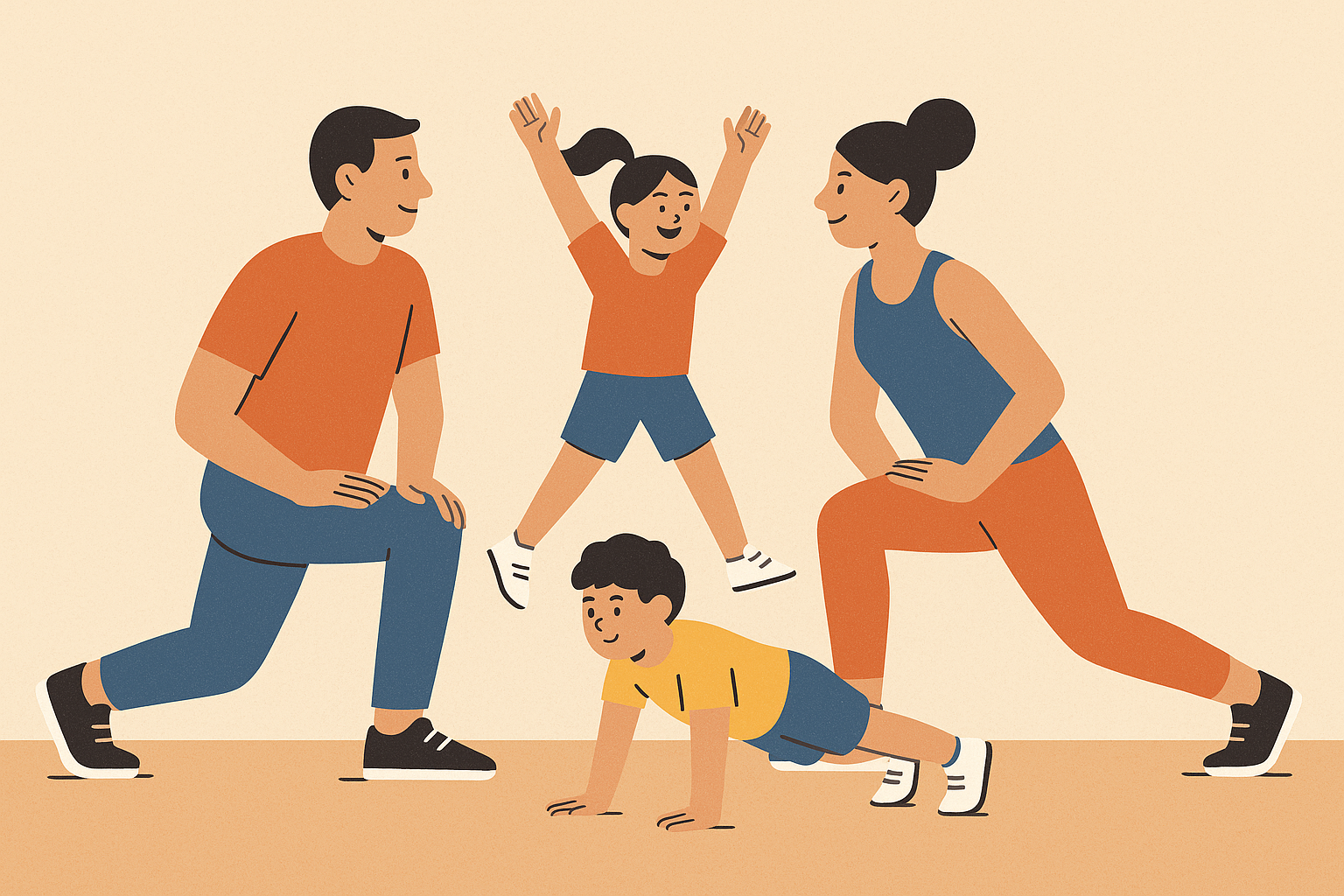
Multi-age design has a few solid options. Parallel targets work well: parents do full push-ups, younger kids do knee push-ups, same challenge, different execution. Team accumulation is another route, where the household needs a combined rep total for the day, so a five-year-old's ten squats matters just as much as a parent's fifty. Rotating the exercise weekly, planks one week, jumping jacks the next, lunges after that, keeps attention from wandering across the age range.
Record it, don't just log it. A quick video of the family mid-plank does double duty: tracking progress and capturing a moment worth keeping. And the reward at the finish line should go to the household, not the individual, a hike, a movie night, a favorite meal, something that reinforces this was a shared win. One caveat worth repeating: if the starting numbers are too ambitious, younger kids check out within a week. Start embarrassingly easy. It pays off later.
Active play challenges — reclaiming unstructured movement as a legitimate family fitness format
Unstructured play counts. Full stop. It contributes to daily movement totals and supports what kids need developmentally, yet almost no family thinks to track it or celebrate it the way they'd track a structured workout.
A weekly "active play bingo" card fixes that blind spot. Squares might read "play in the backyard for 20 minutes," "have a family dance-off," "build an obstacle course out of couch cushions," "go on a nature scavenger hunt." Complete a row, earn a small reward. Younger kids love the game mechanic on its own merits; older kids nominate squares or invent house rules; parents get to participate without leading every single activity themselves, which is frankly a relief.
Seasons keep the format fresh without any redesign. Summer brings water balloon relays, backyard Olympics, neighborhood scavenger walks. Winter shifts to indoor obstacle courses, hallway bowling, freeze-dance tournaments. Tag, hide-and-seek, and yard sports work year-round, no calendar needed.
The card itself, stuck on the fridge, is the whole accountability system. Crossing off a square with a marker beats updating an app, and there's no login required. What this format really rebuilds is the link between movement and fun, especially for kids who've had a rough time in gym class or organized sports and quietly decided exercise isn't for them. And when parents visibly enjoy the silliness of a freeze-dance tournament instead of gritting through a workout, that's the research consistently identifies as a key influence on a kid's long-term relationship with movement.
Goal-and-streak challenges — using simple weekly targets and visible streaks to make consistency the point
Each family member picks one modest weekly goal, something like "move for 20 minutes, three times this week." Not a performance target, not a personal record. Just a target for showing up, tracked by the household.
Weekly beats daily for a specific reason. Daily targets create all-or-nothing thinking, where missing Tuesday feels like the whole week is ruined. A weekly window lets Thursday make up for Tuesday, no streak lost, no guilt spiral attached.
The visible streak matters more than the goal itself. A paper chain on the wall, one link added for every week the whole family hits its goal, motivates kids in a way no app dashboard manages. It's tactile, it's public, and it's impossible to ignore every time someone walks past it. This tracks with a broader pattern in fitness research: social connection consistently ranks as a top motivator for joining a fitness group, and a family is the most available group most people will ever belong to.
Missed weeks need a protocol, and shame isn't part of it. A short check-in, what got in the way, does the goal need adjusting, models reflection over guilt, and that stance is exactly what keeps habits alive for years instead of weeks. After four good weeks running, let the family vote: raise the target, hold steady, or switch formats entirely. Keeps things alive without dumping the redesign work on one exhausted parent. Celebration should honor showing up, not performance, a shared meal, a photo wall labeled "weeks we did it," proof that consistency was the actual achievement. This format shines especially when family members exercise separately during the week, a parent's morning run, a kid's bike ride home from school, but still check in together. Movement stays individual. Accountability stays shared, which is essentially how couples-focused tracking apps like Sweatmates are built, letting two people log workouts separately while staying connected through a shared record.
Adventure and event-based challenges — giving the family a finish line to build toward together
Register for a 5K, a charity walk, a local trail, a cycling route, something 6 to 12 weeks out, and build toward it as a unit. Or skip the registration fee entirely and invent one: "we finish the whole river trail by the last weekend of summer" works just as well as an official bib number.
A finish line changes everything psychologically. Open-ended challenges slide because nothing forces the issue. A date on the calendar turns a vague intention into something the whole family checks in on, argues about, and actually preps for.
Age differences stop being a problem here, because the goal is finishing, not winning. A six-year-old and a parent training for the same event just need different paces and different training loads leading up to it, and both walk away with the same finish-line photo.