shared workout logging features across partner fitness platforms
Seeing your partner's workout efforts in real time changes whether you both show up.
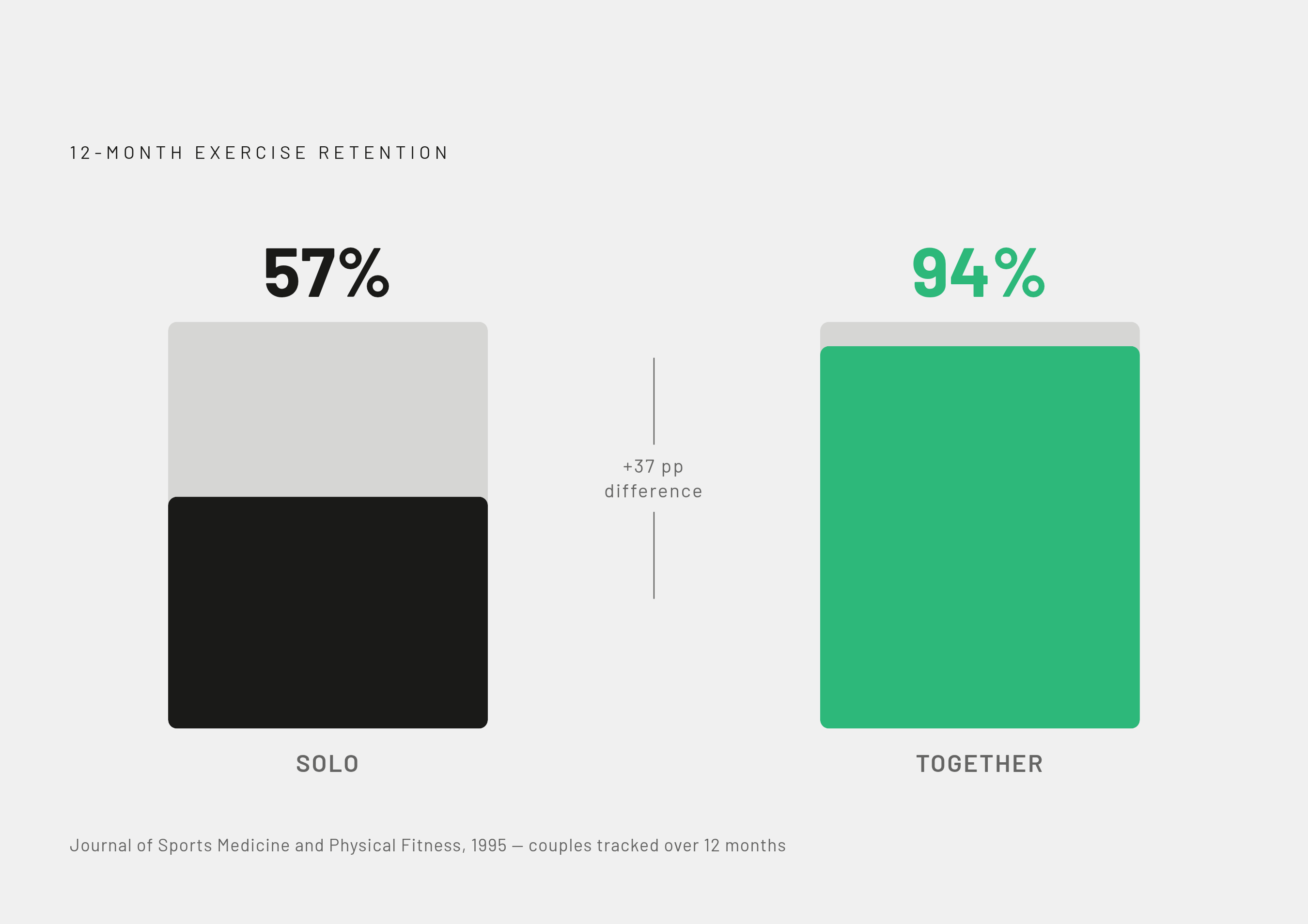
Working out solo is a losing bet. A 1995 study in the Journal of Sports Medicine and Physical Fitness tracked couples who exercised together against solo exercisers over 12 months and found 94% retention for the couples versus 57% for people going it alone. That gap isn't really about willpower, whatever your gym bro tells you. It's about whether someone else can see whether you showed up.
Visibility is the whole mechanism, and how you see the effort matters as much as whether you see it. Research out of the University of Aberdeen found that emotionally supportive partners drive more exercise than partners who just hold you accountable in a nagging, "did you go to the gym" kind of way. Shared workout logging is the feature set trying to manufacture that visibility, even when you're on a treadmill in Chicago and your partner's on a bike somewhere in Austin.
What "shared workout logging" actually means across different platforms
Say "shared logging" to five people and you'll get five different mental images back. That's because the term is a catch-all for a handful of features that don't behave anything alike.
Worth separating out early:
- Real-time visibility (you see a partner's progress as it happens)
- Asynchronous feeds (you see what they did after the fact, like a social post)
- Shared goal-setting (both of you working toward one target)
- Competitive challenges (head-to-head or points-based setups)
There's also workout plan sharing (sending a partner the exact template you followed) and lightweight stakes (small wagers tied to hitting a goal). Most platforms are decent at one or two of these. Almost none are good at all of them. Some logging creates an actual moment between two people, while other logging just stores numbers in a database nobody ever opens again. Those are different products, even when they're wearing the same UI.
How real-time visibility changes what a partner's effort feels like
Apple's Activity Sharing lets partners watch each other's Move, Exercise, and Stand ring progress throughout the day. A lunchtime walk, normally invisible to anyone but the person taking it, becomes something the other person can notice and poke at in real time. "Nice ring, did you finally leave your desk?" is a text message that exists now because of this feature.
The privacy line here is deliberate. Apple shares rings, workouts, steps, and calories, but not heart rate, sleep, or menstrual cycle data. You share with up to five people, control exactly what they see, and can shut it off whenever. That boundary is the reason the whole thing feels supportive instead of surveillance with a nicer font.
Apple also runs a 7-day Competition where points are a percentage of your own ring goals, up to 600 a day and 4,200 for the week. That's the quiet smart part of the design: if one partner runs marathons and the other is easing back into movement after a rough year, neither gets punished for where they started. Everyone races their own baseline, together, which sounds like a contradiction until you actually try it.
Day to day, what this buys you is small. A nudge notification. A quick "nice work" reaction. A glance at a ring filling in while you're waiting for coffee to brew. None of it sounds like much on its own, but stacked across a month it starts to feel like company.
The catch is the ecosystem, and it's a hard catch. This only works if both people are on Apple Watch. One Android phone in the house and the whole feature just doesn't exist for you.
Asynchronous feeds and why seeing the workout after the fact still works
Not every couple trains at the same hour, or even the same day. For most actual relationships, shared fitness happens on a delay. Turns out the delay doesn't kill the effect much at all.
Hevy runs a workout feed built around a scrolling, social-style interface, minus the food photos, plus training sessions. It leans on a scrolling habit most people already have and points it somewhere useful for once. Hevy also lets a partner share the exact template used, not some vague summary. Your partner didn't just "do legs." You can see precisely what happened to those legs, set by set, down to the last rep.
This works because of a small sequencing effect. Whoever finishes first leaves behind a visible record of effort. The one who hasn't gone yet sees it sitting there, and it tugs a little. Not guilt, exactly. More like how a made bed makes the unmade side look worse just by sitting next to it.
Sharing itself seems to be sticky, independent of anything else. Flurry Analytics found 68% of users stick with an app when they regularly share progress with someone else. That's not a nice bonus feature. It's functioning as its own retention engine.
Shared goal-setting and the difference between parallel tracking and genuine collaboration
Plenty of apps let you watch a partner's numbers without connecting either of you to a shared target. Call that parallel tracking. It looks like collaboration on the screen but is really just two solo efforts running side by side, politely ignoring each other.
Genuine shared goal-setting means both people commit to the same finish line. Peloton's social features build accountability around shared targets and leaderboards rather than purely individual ones, turning an on-demand workout into something closer to a standing plan you both showed up for.
Keep the goal simple and the whole system works better. "Four workouts this week" is checkable at a glance and gives the week a rhythm. Overbuilt goal systems, the kind with tiers and multipliers and sub-targets nobody asked for, tend to make one partner quietly check out around week two.
There's solid research behind the simple version. The American Society of Training and Development found people are 65% more likely to hit a goal after telling someone else about it, and 95% more likely with regular check-ins built in. A weekly shared target with a built-in check-in is basically that finding, wearing a product's clothes.
Partners don't need to do the same workout, either. One runs, one lifts, and the shared target, four sessions however you get there, is the thread tying the two efforts together.
Competitive challenges and where they help versus where they backfire
Here's the strongest evidence in this whole conversation. The STEP UP randomized clinical trial followed 602 overweight and obese adults and found the competition group added roughly 920 more steps a day than controls. It was also the only group whose gains held after the study ended. Competition didn't just produce a burst of effort that fades; it produced change that stuck around after the researchers stopped watching.
Apple's 7-day competitions run on that same logic, and other platforms run similar segment-style challenges. What decides whether competition helps or hurts is whether it's measured against your own baseline or against a raw number. Apple's percentage-of-personal-goal system handles this well. A flat leaderboard of total steps or total miles, on the other hand, can demoralize the less active partner inside a week.
Gamified features do move engagement broadly; the Journal of Medical Internet Research found leaderboards and similar mechanics can lift app engagement by as much as 30%. For couples specifically, though, the risk shows up fast the moment one partner wins every single time. A fun little game turns into a monthly reminder of a fitness gap nobody asked to have measured.
The fix isn't complicated. Frame the competition as a shared game, not a scoreboard. The wager or the challenge is the fun part; the final tally shouldn't be. And any competition feature should be something both people opted into, and can walk away from without turning it into a whole conversation.
Lightweight stakes and rewards as a way to make logging matter
A workout logged with zero audience and zero consequence is easy to skip. Nobody notices, nothing happens, and the log slowly turns into a graveyard of good intentions nobody visits.
Small stakes fix that by giving each logged workout a little social weight. Lose the bet, buy dinner. Miss the goal, do dishes for a week. None of this resembles the financial-penalty accountability apps built around real money on the line. The version that works for couples is playful, closer to a running joke between two people than an actual punishment system.
What the stakes really change is the framing. "I should log this" becomes "we agreed on this," and that shift from obligation to agreement is where the follow-through actually comes from. Works best when both people set the wager together, and when losing is funny rather than annoying.
Rewards beat penalties, generally speaking. Treating the partner who hit their goal (their pick of dinner, a lazy Sunday, whatever) builds connection. Punishing the one who missed builds resentment, slowly, one missed goal at a time, like sediment. A missed goal should get a shrug and a "let's try again," not a guilt trip. The stakes setups that last bake that in from day one.
How a 2025 strength overhaul changes what shared logging looks like for lifting partners
For years, shared fitness logging was built for cardio and mostly ignored everything else. Runs and rides translate beautifully to a map and a feed. A set of squats does not, at least not in the formats most platforms bothered building.
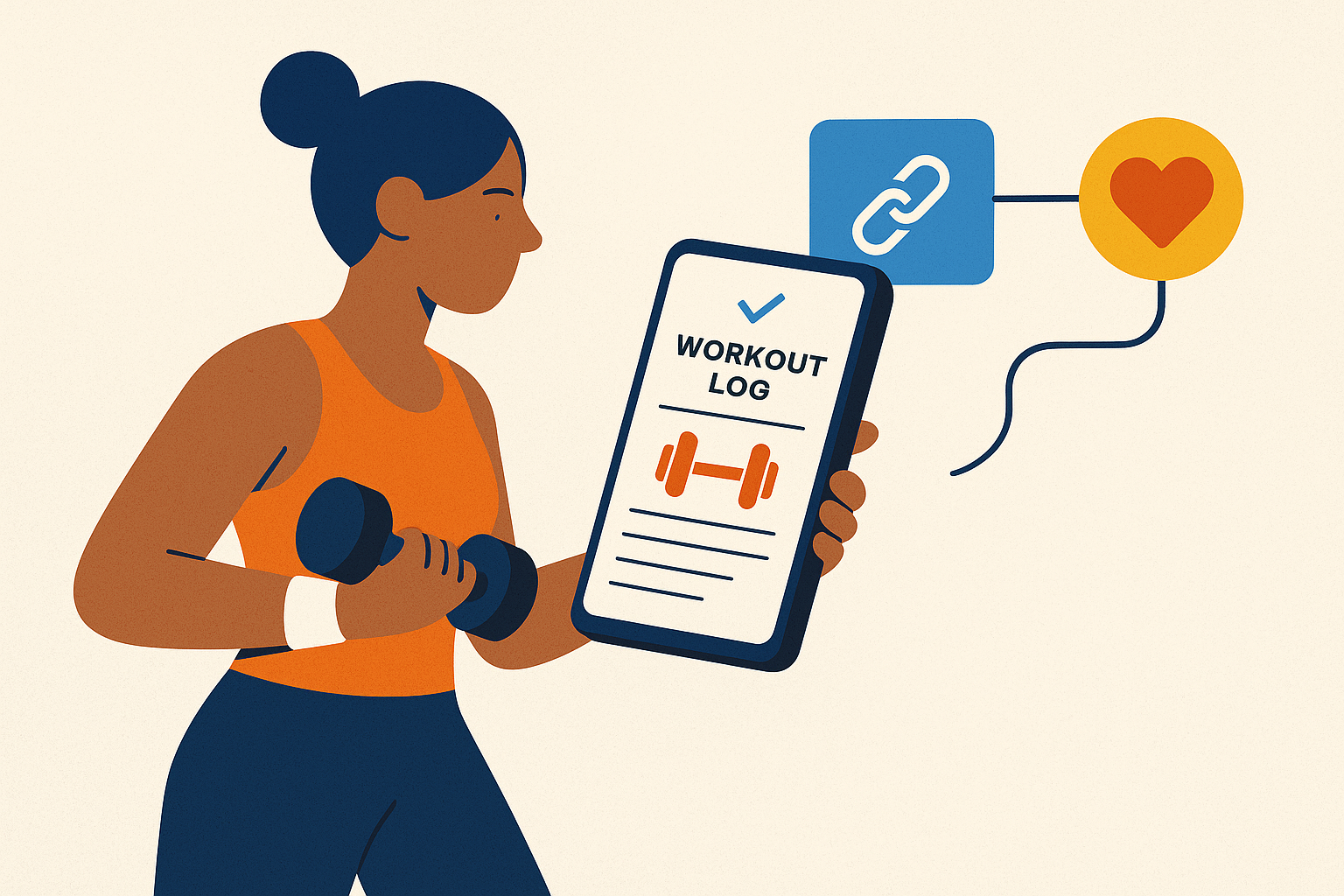
One platform's 2025 strength overhaul went directly after that gap with a dedicated workout log, muscle maps, and new shareable formats built specifically for lifts. The demand had clearly been sitting there the whole time, waiting. Strength training generated 500 million uploads in 2025 alone. The social tools just hadn't caught up to the volume already happening.
Fourteen partner integrations launched alongside it, including Amazfit, Caliber, COROS, Fitbod, Garmin, Hevy, Jefit, and WHOOP, among others. That matters more than it sounds, because lifting partners no longer have to pick between the app they actually log in and the app their partner happens to check. One runs, one lifts, and both show up in the same feed now, finally.
Hevy had already proven this idea at a smaller scale, treating a strength session with the same social weight a running app gives a 10k. That update brought that logic to a network of 195 million users. Shared logging isn't a cardio-only conversation anymore. Anything that can be logged can now be seen, squats included.
What the platforms that stick have in common
App Annie found apps with strong social features see a 30% retention boost, which is a fine data point and the wrong question for a couple trying to build a habit. Retention is a platform's metric. What you actually want to know is what produces shared behavior that outlasts the honeymoon phase of a new app on your phone.
A few patterns show up over and over in the features that actually stick. They make effort visible without requiring it to be impressive: a 20-minute walk registers the same as a brutal long run. They cut friction between two separate routines, so partners don't need matching schedules or matching workouts to feel connected to each other. They create a small, regular moment of contact, a notification or a quick reaction, rather than demanding a whole new shared system nobody has time to learn.
Features that fizzle tend to demand the opposite: equal motivation, equal skill, a shared platform neither person actually wants to switch to. The best shared logging feature isn't the one with the most data fields or the fanciest AI summary generated after every set. It's the one both people are still opening in week twelve, on a Tuesday, for no good reason. Showing up deserves credit even without a personal record attached to it, and the tools that build that credit into the experience beat out the ones only celebrating a new best.
Choosing the right shared logging setup for how you and your partner actually train
Skip the "which app is best" question; it's the wrong one entirely. The right question is which features fit how the two of you actually train, not how a marketing page imagines a couple training in soft lighting with matching outfits.
Same schedule, want to feel connected in the moment? Real-time visibility, Apple Watch rings, live sessions. Different schedules, training apart most of the time? Asynchronous feeds that let a workout speak for itself without needing coordination. Want a shared weekly rhythm? Simple goal-setting with one visible target, whether that's a joint challenge feature or just a number you both track by hand. Respond well to a little rivalry? Competition features, but only the kind built around personal-goal percentages, never raw totals. Doing completely different activities? Look at platforms or integrations, Garmin's partner tools, Google Health Connect, that pull multiple activity types into one shared view.
Ecosystem lock-in is a real cost, worth naming plainly. Apple's tools are genuinely good, but both people need an Apple Watch for any of it to function. Cross-platform households need something built to bridge devices, not fight them at every turn.
There's also a simpler option than any feature-stacked platform: apps built specifically around partner fitness that care more about the fact you showed up than the exact numbers behind it. Sweatmates, for instance, is built for couples who want shared tracking, photo check-ins, and small wagers without the overhead of a full training platform. A weekly goal, a workout photo, a light bet on the outcome, nothing more complicated. For a lot of couples, that plain version beats a platform with forty settings nobody ever configures correctly.
Before committing to any setup, run one test. Would both of you still be using this in three months, on a week where motivation is basically nonexistent? If the honest answer is no, the system is asking more of you than real life is going to give it. Shared habits survive longer than solo resolutions precisely because they lower the bar for showing up, imperfectly, together, on the days you'd rather not. Whatever setup does that best is the right one, regardless of what it costs or how many features it's missing.