Fitness Habits for Couples With Opposite Chronotypes
Sync your workout times to your body's peak hours, not your partner's schedule.
Chronotype is the biological clock that decides when your body wants to be alert, hungry, and strong, and it's substantially genetic. Couples with opposite chronotypes, one partner wired as a morning lion and the other as a night-owl wolf, don't need to fix that mismatch. They need a system that works around it, because you cannot out-discipline your own biological wiring past an hour or two of adjustment, no matter how many alarm clocks you buy.
Chronotype isn't just about when you feel like getting out of bed. It runs your mood, your metabolism, your cortisol timing, your body temperature curve, and the exact windows when your muscles and reflexes are firing on all cylinders. Dr. Michael Breus built a four-type model of Lions (early risers), Bears (those who track the solar cycle), Wolves (night owls), and Dolphins (light sleepers). A 2020 study in Chronobiology International, looking at 506 women, found 32% were morning types, 55% were intermediate, and only 13% were true evening types. Most people sit somewhere in the middle. That matters, because it means most couples aren't dealing with two extremes clashing, they're dealing with a spectrum, and the fix is building a structure flexible enough to hold both ends rather than forcing alignment. It's building a structure flexible enough to hold both ends.
Real Friction from Opposite Chronotypes in a Relationship
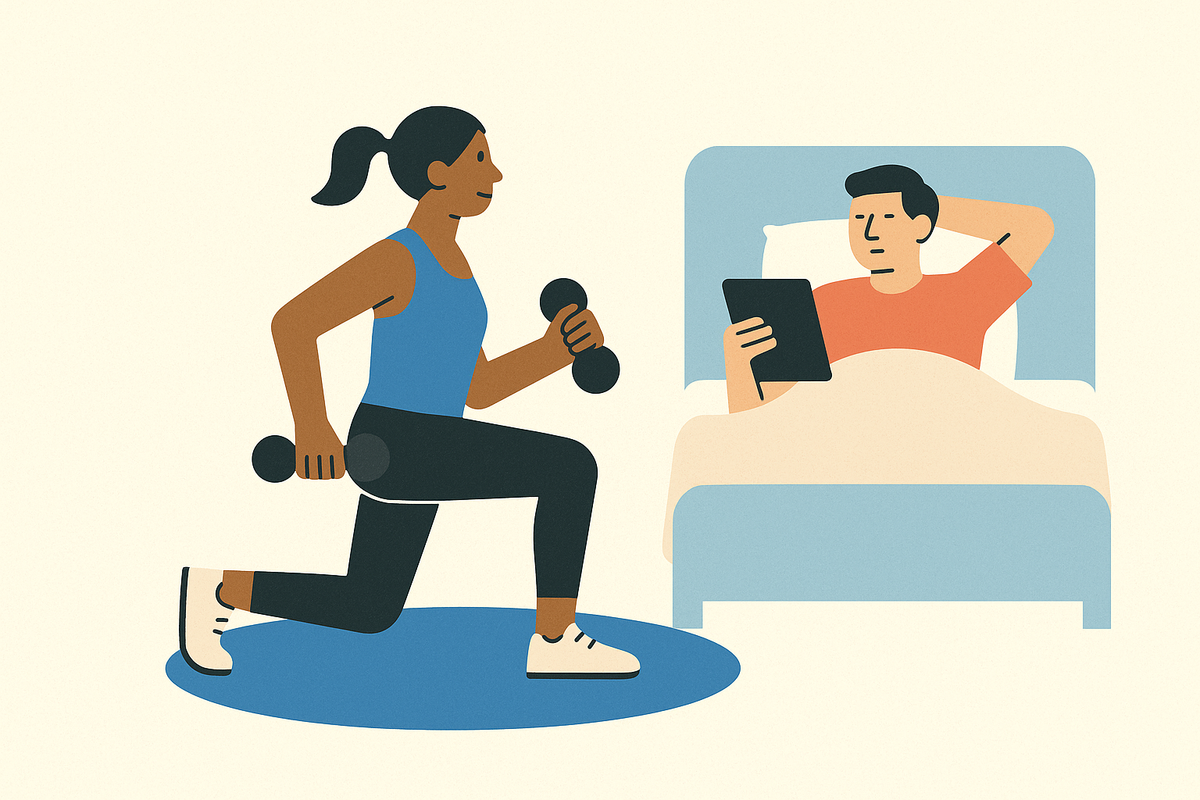
Misaligned sleep and wake cycles shrink the window couples actually have for each other. Less overlap means less conversation, less shared downtime, less intimacy, just less. Research backs this up directly: a bigger gap between partners' bedtimes is associated with more conflict and reduced relational security. It's not just annoying to be on different clocks. It changes how safe you feel with each other.
The bedroom keeps score too. A 2022 dyadic study in Chronobiology International found couples with matched chronotypes reported significantly higher sexual satisfaction than mismatched couples (F(1, 58) = 19.57). One partner's schedule disturbs the other's sleep, that partner gets tired and short-tempered, and a scheduling difference produces a full-blown argument about something else, as the disrupted sleep feeds the irritability that then feeds the conflict.
There's a subtler trap, too. When one partner gets serious about fitness and the other doesn't move at the same pace, the gap starts to feel like a values problem instead of a biology problem. "I want us to be healthy together" can land as "you're failing," even when nobody said that. Chronotype gaps get misread as motivation gaps constantly, and that's usually the wrong diagnosis.
None of this is purely bad news, though. One practical upside of opposite schedules is natural coverage across the day, one partner alert early, the other later, without either running on empty. The mismatch just means the couple needs a different kind of structure than "wake up at the same time and grind through it together." It just means the couple needs a different kind of structure than "wake up at the same time and grind through it together."
The Cost of Training Against Your Chronotype
Forcing a night owl into a 6 a.m. workout doesn't just feel bad, it performs worse. Research out of the University of Oulu in Finland found morning types logged roughly 30 more minutes of daily physical activity than evening types among men, and about 20 more minutes among women. That gap reflects a biological timing advantage, not a motivation gap. That's a biological timing advantage.
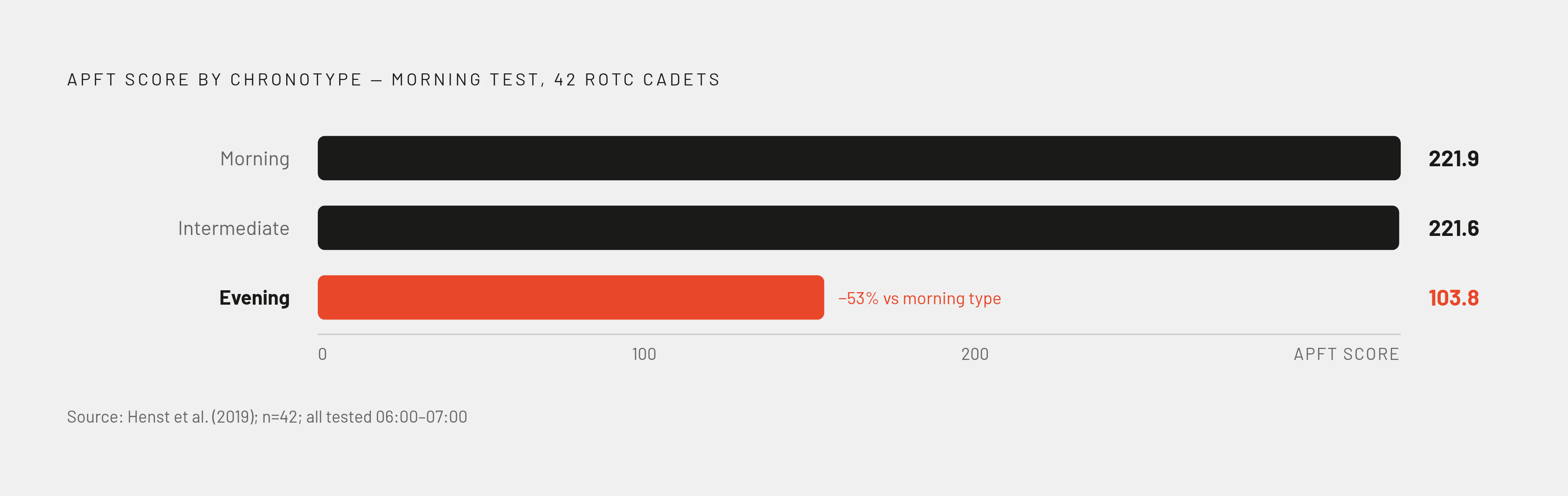
Flip the script and the numbers get uglier. Research has shown evening-type athletes tend to perform significantly worse in morning sessions than in afternoon ones, independent of total sleep obtained. A study of 42 ROTC cadets drove the point home hard: on the Army Physical Fitness Test, evening chronotypes scored 103.8 (±59.8), compared to 221.9 (±40.3) for intermediate types and 216.6 (±43.6) for morning types. That's a night owl being asked to run a race in someone else's shoes, a large gap. That's a night owl being asked to run a race in someone else's shoes.
When the night-owl partner adopts the early bird's schedule out of solidarity, they're not being a good partner, they're setting themselves up for social jetlag, the chronic mismatch between internal rhythm and external demands, which should worry couples specifically. That same ROTC study found social jetlag was significantly higher in injured cadets than uninjured ones (2 hours 40 minutes versus 1 hour 32 minutes). Forcing the mismatch doesn't build teamwork. It builds slower reaction times, weaker output, higher perceived effort, and a longer recovery clock. Evening types even reported the lowest well-being scores in the data (mean 8.35, against 13.48 for morning types). Supporting a partner's natural rhythm is the smarter move on every axis. It's the smarter move on every axis.
The Gains of Training at Your Natural Peak Chronotype
Morning training suits the early bird because cortisol is already high on waking, feeding focus and steady energy without the ramp-up. Morning sessions also reinforce the circadian rhythm itself by capitalizing on already-elevated cortisol, which supports energy availability and fat metabolism. Morning sessions also reinforce the circadian rhythm itself, sharpening daytime alertness and building natural sleep pressure for the night ahead. Structured, moderate-intensity training fits this window well, since the body's already primed and doesn't need convincing.
Evening training suits the night owl for a different, equally solid reason: core body temperature peaks between 4 and 6 p.m., and that peak lines up with better muscle elasticity, faster nerve conduction, more strength, and quicker reaction time. Female participants who trained in the evening saw upper-body strength improve by about 7% compared to morning exercisers, and they also outperformed the morning group on sit-ups and push-ups. Men saw added benefits from evening training too. And the old worry that evening workouts wreck sleep quality doesn't hold up in the research.
A 2026 trial in Open Heart followed 134 participants through 12 weeks and 60 total sessions. Both matched and mismatched training groups improved, but the group training in sync with their chronotype saw bigger drops in blood pressure and stronger gains in heart rate, aerobic capacity, and sleep quality. Neither partner in an opposite-chronotype couple is doing fitness wrong. They're doing it at different times because their bodies are built differently, and that difference, if anything, is the advantage.
The Cost to Couples Who Train Entirely Alone
Training separately protects performance, but training completely alone kills the thing that makes fitness stick. The American Psychological Association found 95% of people who started a weight-loss program with a friend finished it, compared to 76% of solo entrants. Married pairs who worked out together showed even starker staying power, 70% were still exercising weekly two years later, while solo counterparts kept the habit at only a quarter of that rate.
The pattern holds outside the gym, too. Among married couples who quit smoking together, only 6.3% relapsed, against 43% of solo quitters. Couples who exercised together were twice as likely to see weight loss than those who trained apart. Shared physical challenge has been linked to greater feelings of closeness between partners.
Training entirely apart is a quiet loss, turning fitness into two parallel solo projects instead of one shared one. It's a quiet loss, turning fitness into two parallel solo projects instead of one shared one. The rest of this piece is about closing that gap without asking either partner to override their biology to do it.
The early evening as a natural meeting point for opposite chronotypes
Early evening works because of simple thermodynamics. Core body temperature peaks between 4 and 6 p.m., which arrives as the early bird's peak has passed and right as the night owl is climbing into their best window. Neither partner is running on empty. One's winding down from a good day, the other's just getting warmed up.
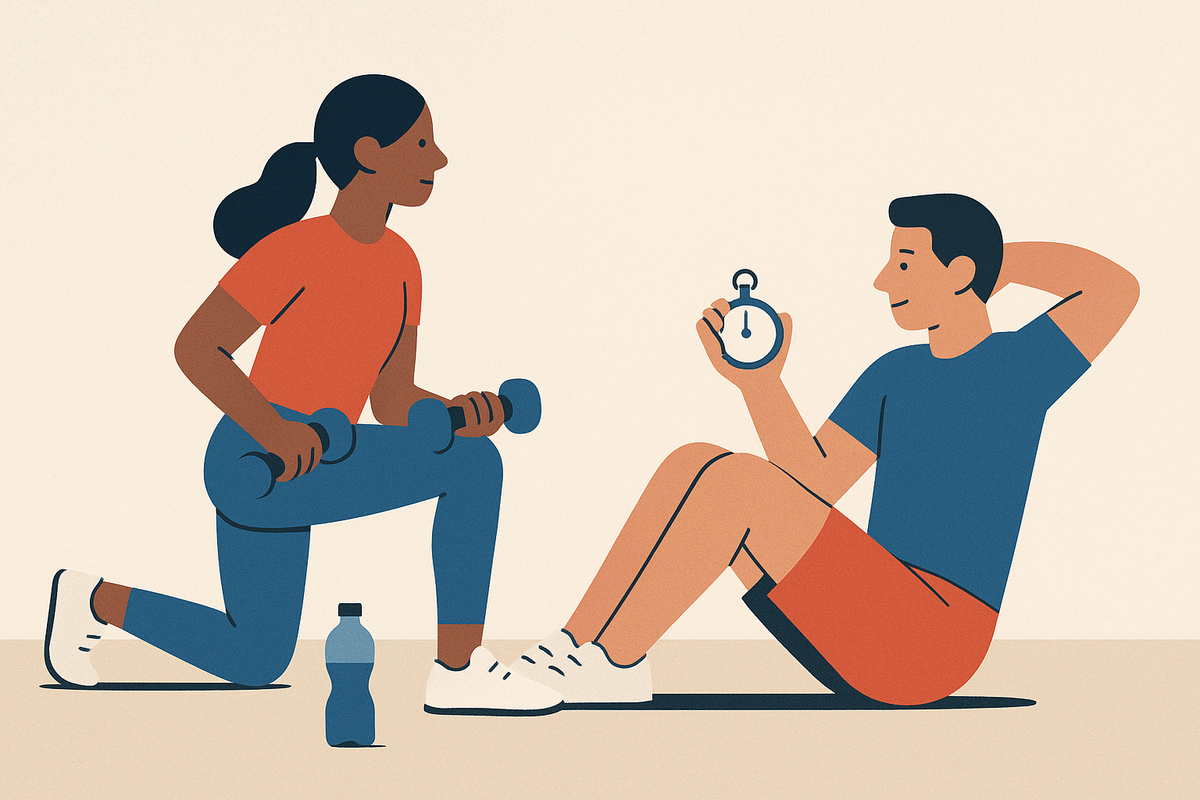
The model here is simple: each partner keeps a separate, primary workout at their own peak time, and the couple adds one lower-intensity shared activity in that early-evening overlap. Think walking, a recreational bike ride, evening yoga, a round of pickleball, or a hike, nothing that pushes the early bird's bedtime back or delays the night owl's actual training session.
Walking deserves a special mention here. It's the most underrated move for couples who feel stuck, because it's low friction, doesn't require gear or a gym membership, and still delivers real benefits for heart health and stress. Being active together doesn't require doing the same activity, either. One partner running while the other lifts still counts as shared fitness, as long as both people show up at the same time and in the same headspace. The point is showing up. It's showing up.
The fix isn't avoiding evening activity altogether; it's matching the intensity to the time of day so the early bird isn't pushed too late. The fix isn't avoiding evening activity, it's matching the intensity to the time of day.
Simple rituals that keep separate workouts feeling like a shared effort
Connection doesn't require being in the same room. It requires acknowledgment, and a workout the other person actually knows about carries more weight than one that vanishes into a private fitness app nobody else ever opens.
A few rituals do a lot of work here:
- A post-workout photo sent to the other partner, not as a flex, just proof someone showed up.
- A shared weekly goal, like three sessions each, visible to both people, no spreadsheet required.
- A short check-in during the overlap window, less "here's my splits" and more "I went, you went, we're both still in this."
- A low-stakes bet on consistency rather than performance, like who hits their weekly target more often this month.
A simple four-part daily framework, Sleep, Water, Activity, Nutrition, gives couples something to track together without demanding identical workouts or identical schedules. It's a shared orientation, not a shared spreadsheet.
Tone decides whether any of this works. A wake-up nudge can sound like encouragement or like a jab, and the difference is entirely in delivery, not content. Build the check-in so it always reads as support, never as a report card. And it helps to anchor the whole system to a real reason beyond a number on a scale, staying mobile for future kids, moving without pain at 60, having energy left over for each other at the end of the day. Reasons like that don't expire the way motivation does.
Missing a session, by the way, should trigger a two-minute conversation, not a trial. One skipped workout is information. It's not a verdict.
Handling Moments When the System Gets Tested
Every system gets tested eventually, usually right when one partner's commitment ramps up and the other's stalls out. That gap can start looking like a values mismatch instead of a scheduling one, and often what looks like an argument about exercise is really an argument about what the habit means to each person emotionally.
The more consistent partner needs language that separates observation from judgment. "I noticed you haven't gone this week" lands very differently than "I noticed you haven't gone this week, which means you're giving up." Same fact, completely different weight.
Life will also throw actual disruptions at this, travel, illness, a new job with a brutal schedule. A flexible weekly goal survives that kind of chaos far better than a rigid joint calendar does, because the measure is consistency over time, not a perfect unbroken streak. Chronotypes shift with age, too, with night owls often drifting earlier over time, so a system built with room to breathe now won't need a total rebuild in five years.
Don't pressure the night-owl partner into early training as a show of solidarity. The social jetlag data shows the mismatch between internal rhythm and external demands carries measurable costs to performance and well-being.
A Weekly System for an Opposite-Chronotype Couple
The goal was a complementary schedule, where each partner owns their peak window and the couple shares just enough overlap to stay connected. It's a complementary one, where each partner owns their peak window and the couple shares just enough overlap to stay connected.
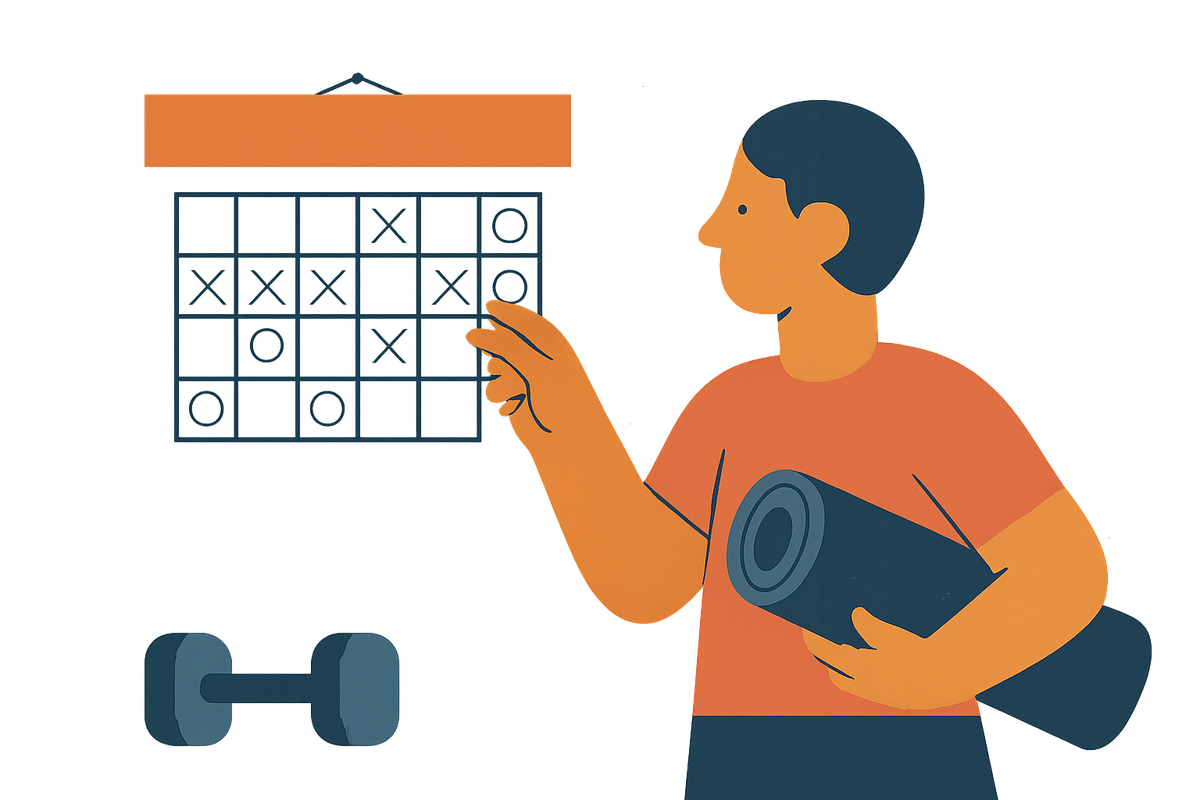
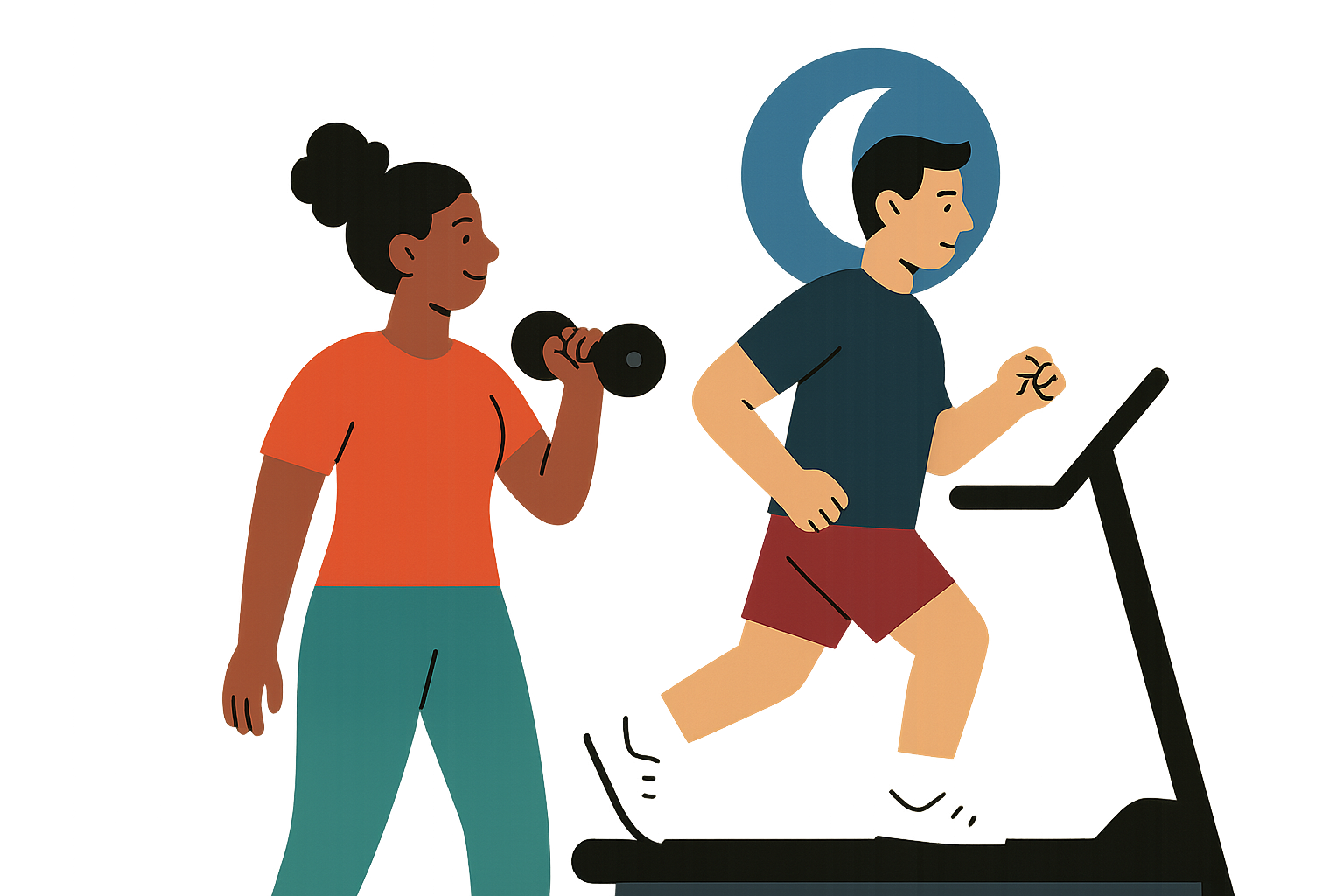
A realistic week has the early bird running three morning sessions at moderate-to-high intensity, while the night owl handles three evening sessions built around strength or higher-intensity work. Layered on top, one or two early-evening walks together, plus a weekend activity like hiking, cycling, or pickleball. The accountability layer stays light: a weekly goal each partner sets and both can see, a quick photo or message after solo sessions, and a short Sunday conversation about how the week actually went.
The daily Sleep, Water, Activity, Nutrition check-in works well here too, since it asks for the same orientation, not the same clock. Some couples find it useful to keep a shared note or use an app built around visible weekly consistency rather than optimizing one person's individual stats, the goal is staying connected, not exporting matching data.
Success here doesn't look like synchronized calendars. It looks like both partners training hard at the time their body actually wants to train, a shared activity they both look forward to instead of dread, and a real sense that fitness is a joint project even on the days they never cross paths. The best system for an opposite-chronotype couple was never going to be the one that forces them onto the same clock. It's the one they both keep training for, together.
Sources
- Similarity in Chronotype and Preferred Time for Sex and Its Role in Relationship Quality and Sexual Satisfaction - PMC
- Are Differences in Bedtimes Bad for Relationships? Associations With Attachment and Conflict in Middle-Aged Couples - PMC
- ryanandalex.com
- Sleep and sexual satisfaction in couples with matched and mismatched chronotypes: A dyadic cross-sectional study - PubMed
- ncbi.nlm.nih.gov
- ncbi.nlm.nih.gov
- sbm.org
- pmc.ncbi.nlm.nih.gov