How Habit Stacking Works for Couples Building Fitness Routines
Couples who exercise together stay committed at nearly double the rate of solo exercisers.
"I'll work out more" never works because your brain has nothing to grab onto. No trigger. No sequence. Just a floating intention that needs a fresh decision every single day, and fresh decisions are expensive. They drain attention and willpower, both of which are already running on fumes by the time you actually need them.
Habit stacking works differently. You attach a new behavior to something your brain already runs on autopilot. The existing habit does the remembering for you. You stop managing your memory and start managing your architecture.
A few things actually determine whether the stack holds:
- The anchor has to be genuinely automatic. Not "I usually do this." Mindless. If you have to think about the anchor, it cannot carry anything new.
- The activity cannot feel like punishment. Research shows that sessions people find enjoyable produce lasting automaticity. Sessions that feel like a chore do not. For couples, this matters more than anything else on this list. If one partner dreads the activity, the stack collapses for them, regardless of how well-designed everything else is.
- Small celebrations are not optional. BJ Fogg's work at Stanford's Behavior Design Lab treats the post-habit celebration as a required mechanism, not a nice touch. The positive feeling after the behavior is what triggers dopamine and builds automaticity faster. A fist bump qualifies.
Research on gym attendance found that roughly four sessions per week for at least six weeks is the threshold before behavior starts firing from contextual cues rather than conscious planning. Until you cross that threshold, you are still in the effortful zone. Good environment design shortens the time you spend there.
How long it actually takes a fitness habit to stick, and why this matters for couples
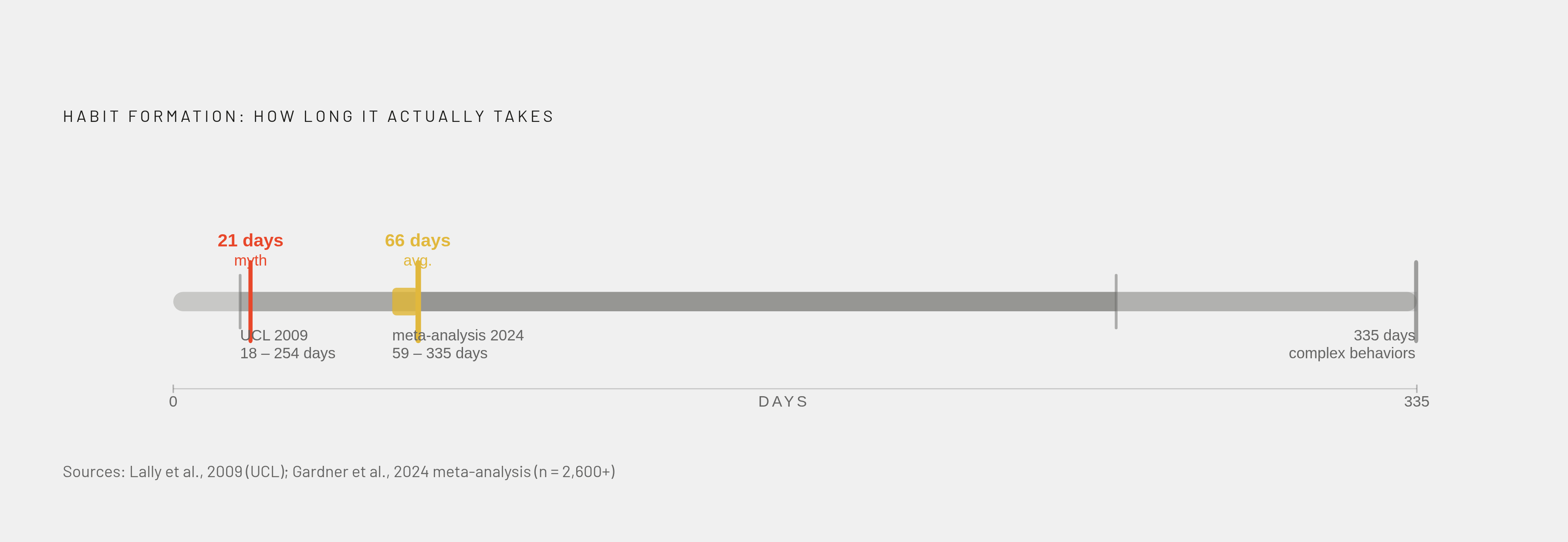
The 21-day myth has no science behind it. At all. Someone said it, it spread, and now it lives in every self-help book published between 1980 and 2010.
A 2009 study out of University College London tracked real habit formation across real people and found an average of 66 days before a behavior became automatic. The range was 18 to 254 days. A 2024 meta-analysis of over 2,600 participants put the median at 59 to 66 days, with complex behaviors stretching toward 335 days on the upper end.
Drinking water after waking up automates fast. A full workout routine sits at the slower, harder end of the distribution. That is just the actual number.
Here is the part that changes everything for couples specifically. The same UCL research found that missing a single day had no statistically significant effect on the overall automaticity trajectory. One skipped day does not break the habit. The clock keeps running. It is a data point, not a verdict.
This matters because you will miss days. Travel happens. Kids get sick. Someone has a week at work that leaves them lying on the floor staring at the ceiling. If one partner treats a missed day as evidence that the other has quietly quit, you now have a relationship problem sitting on top of a scheduling problem, and that is a much harder thing to untangle.
Couples who walk into this knowing the real timeline, 60-plus days, with bumps, do not hit day 22, have a rough patch, and conclude it is not working. They know what "working" actually looks like. That shared understanding is its own form of infrastructure, and it costs you nothing to build it.
Why exercising together produces better adherence than parallel solo efforts
The dropout rate for people who start a new fitness routine is genuinely rough. Most people stop within the first few months. Everything else is just design work done in response to that baseline problem.
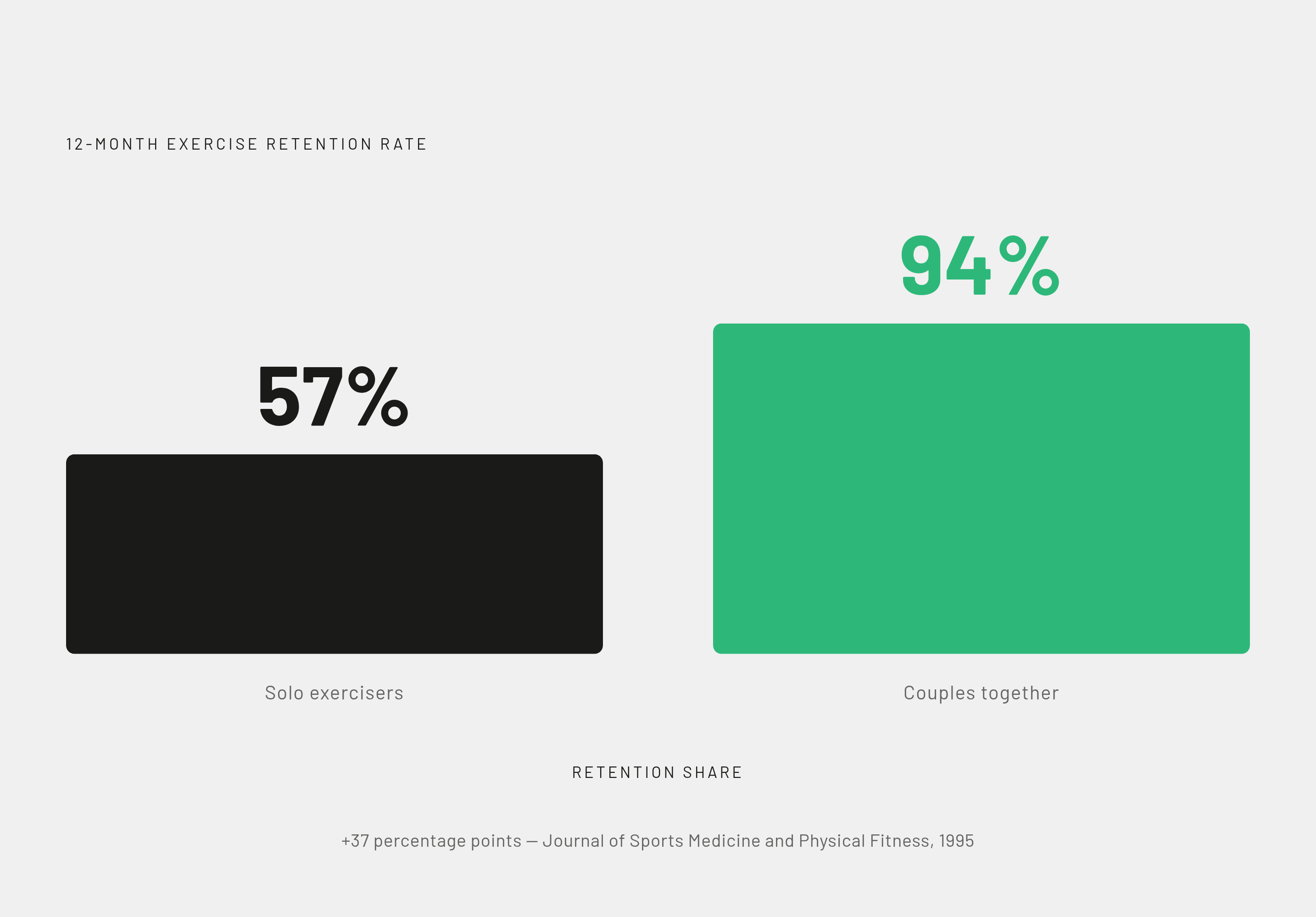
A 1995 study published in the Journal of Sports Medicine and Physical Fitness found that couples who exercised together showed 94% retention over 12 months. Solo exercisers in the same study held at 57%. Nearly double the retention rate. The only structural difference was whether they were doing it with a partner.
Before you pick a workout style, a gym, a format, or a schedule, the social structure of how you exercise predicts your outcome more than almost anything else you will agonize over. That finding should probably reorganize your priorities.
Research from Johns Hopkins adds another layer: when one spouse meaningfully improves their exercise routine, the other becomes significantly more likely to follow, even when they are not working out at the same time. The influence operates across days and weeks, not just in the same room.
There is also a neurochemical piece worth naming. Physical activity together releases oxytocin and endorphins, the bonding chemicals your brain uses to reinforce connection. You are not just sweating in proximity. You are chemically strengthening the relationship at the same time, which is either a pleasant surprise or mildly unsettling depending on how you feel about brain chemistry.
Penn State researchers found that collective support, mutual accountability, and shared motivation were among the most effective enablers of sustained lifestyle change in couples. A solo exerciser has to build that entire support structure from scratch. A couple already has it, sitting there, mostly unused.
What a shared anchor is and how couples can identify one they already have
A shared anchor is a routine both partners already do together, at a consistent time, that can serve as the trigger for a new joint fitness habit.
The word "already" is doing all the work in that definition. You are not building a new anchor. You are finding one that exists.
Both James Clear, who popularized the term "habit stacking" in Atomic Habits, and BJ Fogg agree on one requirement: the anchor has to be specific. "After lunch" is not specific enough. "After I put my plate in the sink" is usable. For couples, specificity means both partners do it reliably and at roughly the same moment, not just the same general window of the day.
Shared anchors worth looking for in your own life:
- Morning coffee together
- Evening dog walk
- Clearing the dinner table
- Both partners arriving home and changing out of work clothes
- Bedtime wind-down
Three questions help you confirm whether something qualifies. Does it happen at roughly the same time every day? Does it involve both of you? Does it already feel automatic, not aspirational? If all three are yes, you have something usable.
One rule from Clear worth keeping: the anchor has to occur at the same frequency as the habit you want to build. A weekly shared ritual cannot anchor a daily fitness stack. The frequencies have to match or the whole thing misfires.
Mornings are the most reliable part of the day, especially before schedules split. Evening anchors work too, but only if your evenings are actually consistent, which, for a lot of couples, they are not.
How to design the fitness habit that attaches to the shared anchor
Start absurdly small. Not modestly small. Absurdly small.
A two-minute shared stretch after brushing your teeth is a more durable starting point than a 30-minute session three times a week. That is not a concession to laziness. That is load management for two people whose energy levels, schedules, and moods will not line up perfectly on the same Wednesday night. Two minutes survives misalignment. An ambitious session does not.
A 2025 study found that people who started with minimal viable habits and scaled gradually were significantly more likely to maintain long-term habits than those who opened with ambitious targets. Fogg's core principle from Tiny Habits points the same direction: smaller changes survive disruption.
Contextual fit also matters. The stack has to make sense given where and how the anchor moment actually happens.
- Ten push-ups after morning coffee in the kitchen: fits.
- Ten push-ups after getting into bed: fights the context. The environment resists it.
Some practical stacks that actually work for couples:
- After changing out of work clothes → 10-minute stretch in the living room
- After clearing dinner dishes → 15-minute walk around the block
- After morning coffee → one partner leads a five-minute bodyweight routine, the other follows
Katherine Milkman's research at Wharton found that pairing a required habit with something enjoyable increased gym visits substantially. She calls it temptation bundling. For couples, the enjoyable element is frequently just each other's company. You do not have to engineer it. It is already there.
Avoid stacking too many new habits at once. Cognitive overload hits both partners simultaneously, which is worse than one person falling off alone. Build one stack solidly before adding another. Build a small post-stack ritual while you are at it. A shared smoothie, a specific phrase, a high-five, whatever does not make you feel ridiculous. The small celebration is what makes both partners want to repeat the behavior. That is the whole mechanism, and skipping it is the most common mistake.
How to stay connected as a fitness pair when schedules don't match
Scheduling conflicts are one of the most common reasons couples stop exercising together. The fix is not finding more calendar overlap. It is designing for the days when that overlap does not exist.
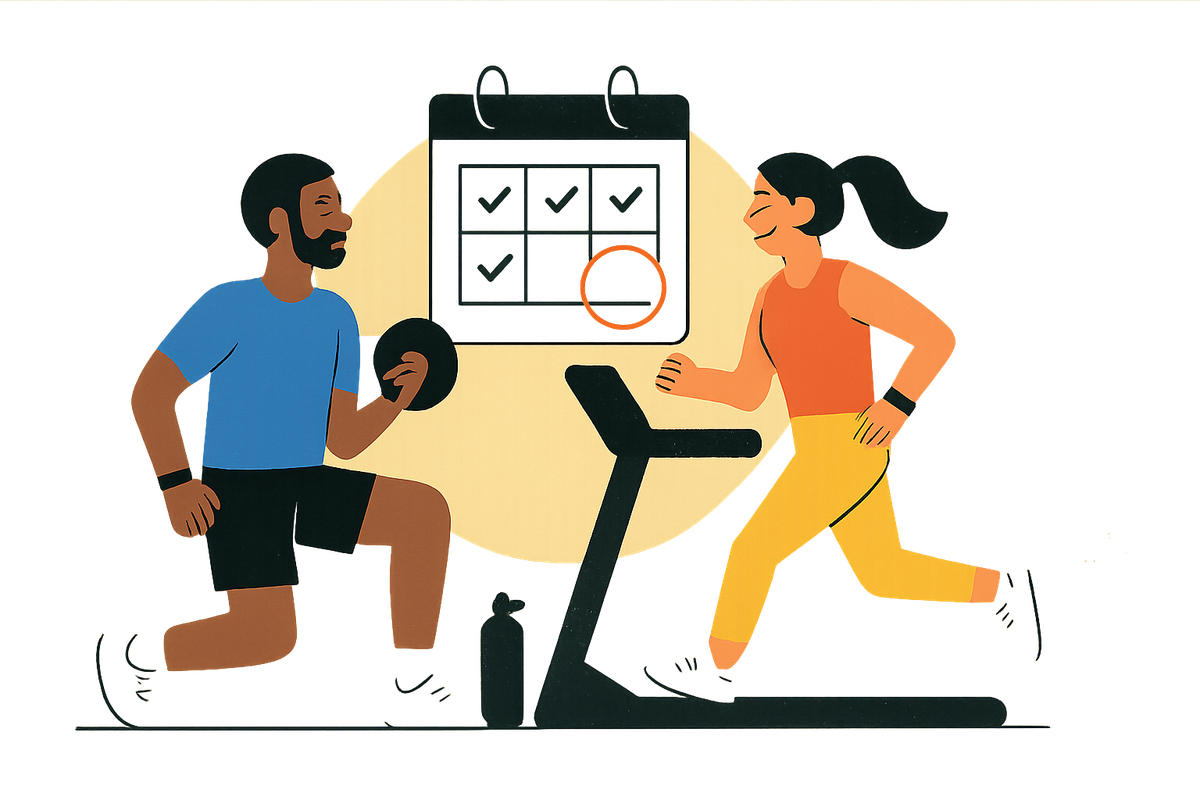
Pick two or three days each week as shared sessions and treat them like actual appointments. Fixed. Even 20 minutes counts. The anchor does the consistency work, not the duration.
On the days you exercise separately, the shared anchor still fires. You both clear the dishes. One person goes for a walk. The other does a quick stretch in the living room. The stack still happens. It just happens individually, off the same cue.
The Johns Hopkins social contagion research is useful here. One partner's improved routine pulls the other toward the same behavior across days and weeks, not only when you are in the same room. The influence is ambient. It does not require synchronized schedules.
Small connection points keep the relational thread intact without requiring perfect timing:
- A photo after a solo session
- A quick message
- A brief exchange when you both get home
None of these are complicated. None require much. They just maintain the sense that you are doing something together, even when you are physically doing it apart. Some couples use a shared fitness accountability app for that thread, such as Sweatmates, a mobile app for partners that keeps both people connected through photo check-ins, shared goals, and weekly recaps even when workouts happen at separate times.
The anchor moment is still shared, even when the fitness behavior that follows it is not. Every time one partner hits the cue, the other gets one too. That is actually most of the structure right there.
When partner influence pulls in the wrong direction and how to notice it early
The social contagion that accelerates good habits runs in both directions. Sociologist Corinne Reczek's research found that if one partner carries unhealthy habits, the other syncs toward them over time. Influence does not only run upward. It runs wherever the relationship is already moving.
Research on older couples found that a shared couple identity can sometimes impede individual behavior change. A partner's quiet unwillingness to participate, not even active discouragement, just absence, can undermine the other's momentum. Simply not showing up turns out to be enough.
Pestering and monitoring produce resistance, not compliance. When accountability starts to feel like surveillance, you have lost it.
Some early signs the shared anchor is generating friction rather than momentum:
- One partner consistently finds reasons to skip the stack moment
- Post-session conversations feel like performance reviews instead of shared wins
- A missed day triggers guilt or criticism rather than easy rescheduling
The design response is to keep the entry point small enough that neither partner fears judgment for a rough session. A two-minute stack is easy to show up for even on a terrible day. When there is no risk of failing badly, there is nothing to avoid.
A missed day should prompt a low-stakes conversation about what got in the way. Not a record. Not a pattern label. Just: what happened, and does anything need to adjust? That kind of honest, undramatic check-in protects the habit. More importantly, it protects the relationship underneath it, which was always the more important thing anyway.
What the 64% figure tells couples about choosing stacked habits over standalone goals
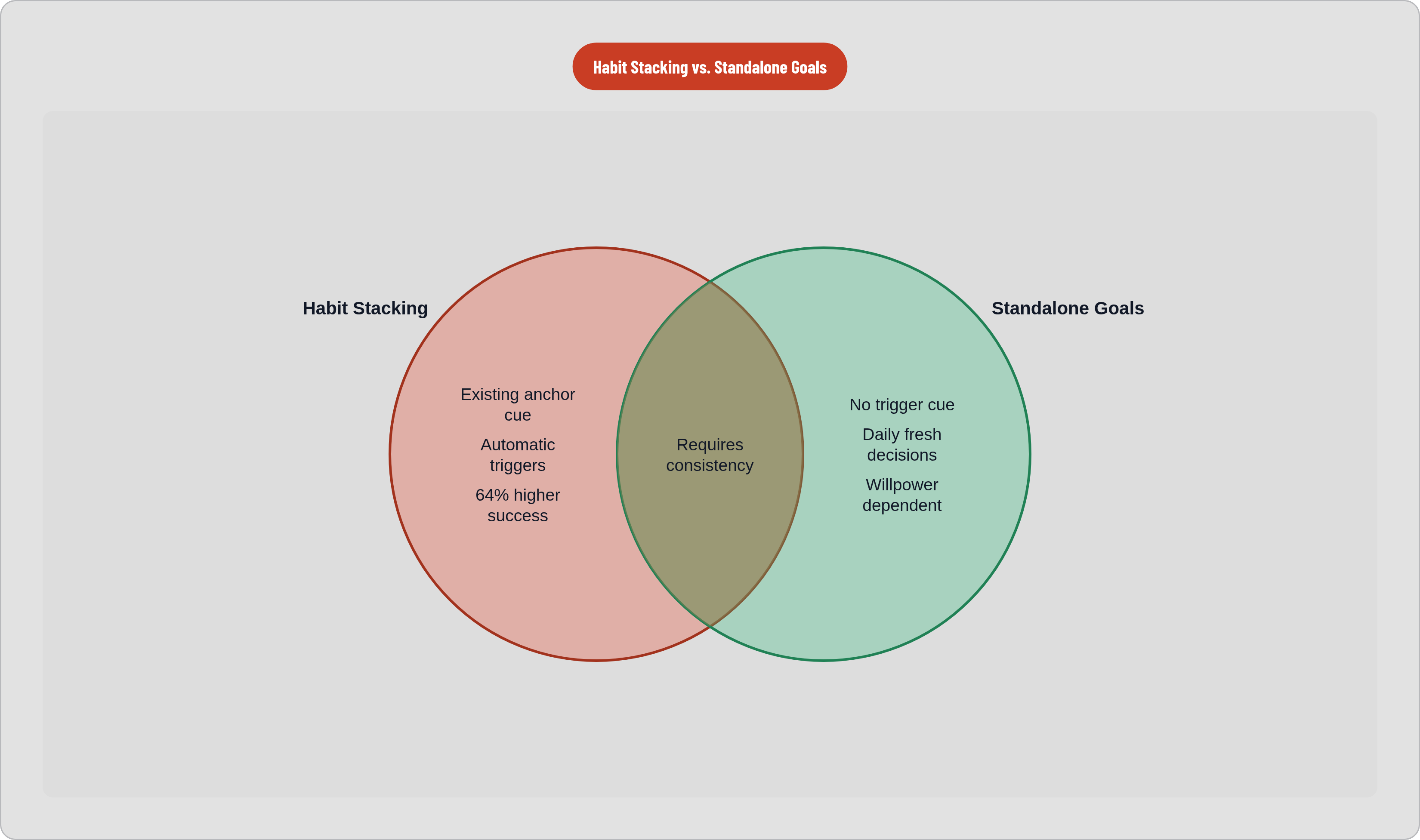
A 2025 study in the Journal of Applied Psychology found a 64% higher success rate for habit stacking compared to standalone habit creation. That is not a marginal edge. That is a structural advantage.
A standalone fitness resolution gives you nothing to attach to. "We're going to work out more this year" is a wish. It has no cue, no location, no built-in reminder. Every time you need to act on it, you are making a brand new decision from scratch. That is exhausting, and eventually you stop making it.
A shared anchor changes the equation. The cue already fires every day. It already involves both of you. The only design question is what small behavior you attach to the moment that is already happening anyway.
A realistic starting week, without fluff:
- Day one: Identify one shared anchor both partners actually do daily. Not aspirationally. Actually.
- Day one: Agree on one small physical behavior to attach to it. Specific. Two minutes or less. Logically connected to the location and timing of the anchor.
- First two weeks: Do only that one stack. Resist adding anything else. This is harder than it sounds, because it feels too easy, and that feeling is the point.
- After a few weeks of consistency: Add one layer. Keep the original stack intact and running.
The measure of success in the early phase is not performance, duration, or intensity. It is whether the stack fired. Consistency before everything else, because consistency is what builds the automatic link your brain needs before any of the rest of it matters.
Your existing shared rituals already do most of the scheduling work. The coffee, the dishes, the dog walk. Habit stacking is just the act of noticing that, and attaching something small to what is already there. When the anchor is shared, one partner hitting it cues the other automatically. No app, no alarm, no designated nag. The structure of the day does the work instead.