Making a Shared Fitness Habit Stick Beyond 30 Days
Build the right structure in weeks five through ten or lose the habit by month six.
Thirty days of working out together feels like proof the habit stuck. But that feeling of proof isn't accurate. Whether a couple is still lacing up sneakers in month six has almost nothing to do with the first month and almost everything to do with the structure they build after it.
Blame the "30-day challenge." It's everywhere: fitness apps, gym flyers, that one coworker who won't stop talking about their squat streak. The number sounds official, like someone in a lab coat measured it. Nobody did. Thirty days is a calendar convenience.
What the number actually captures is novelty. Motivation is high in week one because everything is new and a little exciting. The gear is fresh, the schedule hasn't collided with real life yet, and skipping a session still feels like a moral failing. None of that is the habit. That's just enthusiasm wearing the habit's clothes.
And the dropout data backs this up hard. A large share of new gym members disengage well before the year is out, and early disengagement tends to predict later attrition. A Norwegian study tracking 184 new fitness club members found 63.4% were exercising regularly at three months, dropping to 57.2% by twelve months, with 28.3% gone entirely by year's end. Only 37% kept a regular routine through the full follow-up. So the month-one high five reflects a genuine early bump in adherence, it's just not load-bearing. What carries a couple past it is structure. That's the actual subject here: not how to start, but how two people keep a fitness habit alive long after the novelty wears off.
Why complexity changes how long habit formation actually takes
The 21-day myth and the 30-day challenge share the same problem: neither came from research on how habits actually form. They're cultural shorthand that got repeated so often it started sounding scientific.
A 2024 meta-analysis by Singh and colleagues put the real median at 59 to 66 days, with individual studies ranging anywhere from 18 days to 254 days, a spread wide enough to swallow both extremes. That's not a typo. Some habits lock in almost instantly; others take the better part of a year.
What explains the gap is complexity. It's complexity. Drinking a glass of water at lunch is simple, cue, action, done, and can automate in as few as 18 days. Fifty daily sit-ups is a different animal entirely, sometimes taking over 250 days to feel automatic. Exercise sits firmly in the complex category. It needs scheduling, gear, travel time, energy management, and repetition across wildly different conditions (rainy Tuesday versus sunny Saturday, well-rested versus running on four hours of sleep).
Kaushal and Rhodes found roughly four gym sessions a week for at least six weeks is the minimum before attendance starts feeling automatic instead of consciously negotiated every single time. And it's not just frequency. Research has found that if the workouts themselves are miserable, monotonous, joyless, automaticity doesn't build no matter how often someone shows up. Repetition without enjoyment just produces repetition without enjoyment. Shocking, really.
The real habit-formation window runs well past day 30. Which means whatever support system is in place during weeks five through ten shapes whether the habit formed in week one actually sticks.
Dropout Data for Solo Versus Joint Exercise
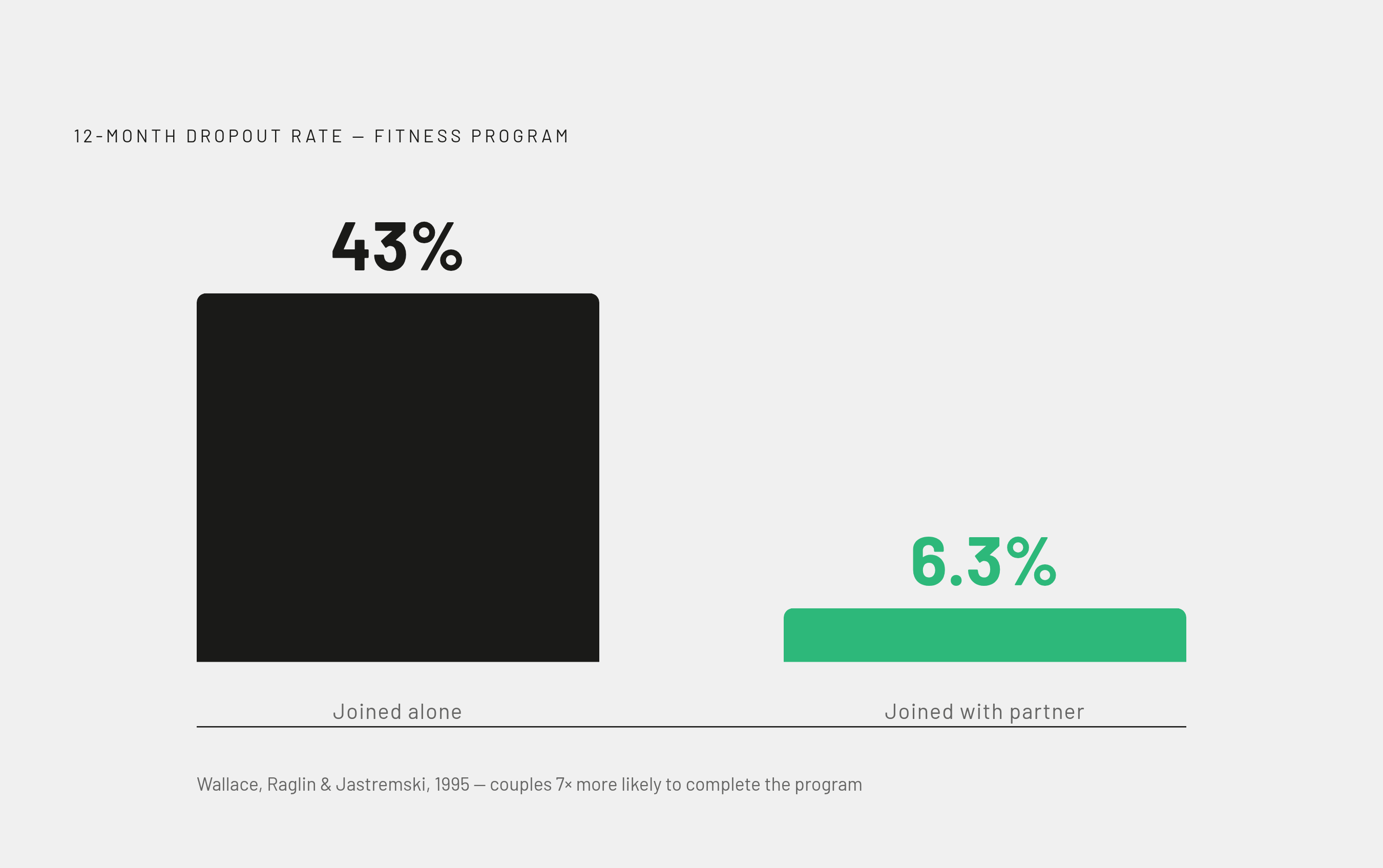
Wallace, Raglin, and Jastremski (1995) tracked married adults who joined a fitness program either together or solo. After twelve months, only 6.3% of the couples who joined together had dropped out. Among those who joined alone, it was 43%.
That's a substantial gap. That's a structural difference in how the habit gets held up.
A study out of Tsukuba and Ibaraki (published in BMC Geriatrics, 2017) followed 34 older married couples and 59 older adults through an 8-week supervised program and a 24-week unsupervised stretch after. Walking adherence in the couple group was 29.2%, and the odds ratio for adherence favored couples at 3.68. Interestingly, strength training adherence showed no meaningful difference between groups (odds ratio of just 1.30). Partnership, it seems, mostly helps people show up. It doesn't necessarily make them push harder once they're there.
Research by Nizamani and colleagues (2024) found that targeting both members of a couple in a lifestyle intervention produces more lasting change than targeting just one. A larger meta-analysis (Arvanitidou et al., 2025) covering 17 randomized controlled trials and 1,812 couples found joint interventions significantly outperformed individual approaches. Even gyms have picked up on this: family and partner memberships report 18% lower churn than single-member plans. The pattern holds everywhere researchers look for it.
The three mechanisms through which a partner sustains what willpower cannot
Willpower is a battery that drains. A partner is closer to a backup generator, one that kicks in exactly when the battery's dead.
Accountability that feels like commitment, not surveillance. Skipping a workout alone costs nothing socially. Skipping when a partner is lacing up their shoes, waiting by the door, changes the math. This only works when it feels supportive rather than controlling. Pressure that reads as judgment backfires fast. A Stanford study of 269 adults aged 50 to 65 examined how social support shapes exercise adherence over time, finding that support remained a meaningful predictor well into the follow-up period. The support has to be specific to the activity.
Self-efficacy amplified by being seen is a concept borne out by a 2026 longitudinal study in Frontiers in Psychology, following 950 Korean college students, which found self-efficacy accounted for 84% of the total indirect effect linking social support to exercise adherence. Being watched by someone who cares raises belief in one's own ability to keep going. That's not a motivational poster quote, it's a documented pathway. Women with high social support were roughly twice as likely to hit recommended exercise levels as women with low support.
Shared identity formation describes how, once "we work out" becomes part of how a couple describes themselves, missing a session carries relational weight, not just personal guilt. Research in the Journal of Personality and Social Psychology (2024) found that framing habits around identity ("I am a person who exercises") rather than outcomes increased adherence by 32%. Couples get an amplified version of this: two people reinforcing the same self-concept, back and forth, like a mirror that also happens to do lunges.
What couples who stay consistent do differently in the first eight weeks
A qualitative study of nine millennial couples, ages 25 to 34 (Nizamani et al., 2024), identified four themes around what makes shared habits stick, with couples-based program design appearing as a consistent thread.
If-then planning closes the gap between intention and action. People who wrote specific implementation intentions exercised at a 91% rate, compared to 35 to 38% in control groups without a plan. For couples, the plan needs to be joint, not two individual plans that happen to overlap on a calendar. "When we finish dinner, we walk for 20 minutes" beats "I'll try to walk sometime after dinner" by a wide margin. A 2025 micro-randomized trial called HabitWalk used a nearly identical structure ("When I finish lunch, then I will go out for a 15-minute brisk walk") and found the same cue-based framing held up. Occasional mental rehearsal of the cue, picturing the moment dinner ends and the shoes go on, seems to reinforce the pattern further.
Habit stacking onto shared rituals reduces friction. Attaching a new habit to something already shared, morning coffee, the evening wind-down, borrows an existing cue instead of building one from nothing. Morning habits tend to form faster too, likely because cues are more consistent and willpower reserves haven't been spent yet on the day's other decisions.
Starting small is strategy, plain and simple. It's strategy, plain and simple. High-intensity plans generate friction and burn through motivation fast; small, consistent actions beat big unsustainable ones nearly every time. A shared 20-minute walk three times a week for twelve weeks builds more actual habit infrastructure than a shared boot camp that flames out after three.
Variety matters, but the timing matters more. Introduced too early, novelty disrupts the cue-routine link before it's even formed. Introduced around weeks six to eight, it prevents the staleness that quietly kills adherence once the initial structure is in place. And partners don't need identical schedules to stay connected, either. What matters is visibility: knowing the other person did the thing, and saying so.
Tracking consistency together rather than measuring performance individually
Tracking process (minutes exercised, sessions completed) rather than outcomes (weight, pace, personal records) leads to 37% higher habit persistence. That's a big number for something as simple as changing what gets written down.
A 2024 systematic review of digital behavior-change tools found self-monitoring, goal-setting, prompts, and cues among the most common techniques used in physical activity interventions. None of that is exotic. It's checkboxes and reminders, mostly.
What shared tracking does that a private spreadsheet can't: it makes effort visible to someone who actually cares about it. A photo of a completed workout, a shared calendar mark, a two-word check-in text, these carry relational weight a solo dashboard simply doesn't have. Gym members who join challenges or loyalty programs show a 30% lower dropout rate, which suggests gamification serves a structural purpose beyond making fitness apps look fun. It's structural. A friendly wager or small reward can nudge intention into action without adding real pressure.
Keep the goal simple enough to check without a spreadsheet. "Three sessions each this week" works. "Optimize VO2 max" does not, unless one half of the couple happens to be an exercise physiologist for fun. Look for tools with adaptive workouts, shared progress calendars, and light gamification, features built for two different bodies working toward one shared habit, rather than apps stacked with metrics nobody asked for. The best tool is the one both people actually open again tomorrow, not the one with the most graphs.
Handling a Missed Week Without Ending the Habit
Missing one session barely dents neural pathways or momentum. It's the drift from occasional lapses into a longer break that marks where things start to wobble. Telling an ordinary lapse apart from an emerging pattern is the whole game here.
Habit formation takes time, varies person to person, and setbacks are part of the process, not evidence the process failed. Progress over perfection isn't just a fridge magnet slogan, apparently it's actual guidance.
In a shared habit, a missed week carries an extra layer of risk. One partner might quietly decide they've let the other down, and that shame response is corrosive in a way a simple reflection ("what made this week hard, what changes next week?") isn't. Shame shuts the conversation down. Reflection keeps both the habit and the relationship intact.
Build in a few recovery moves ahead of time:
- Acknowledge the miss without assigning blame; treat it as a blip on a long timeline.
- Return to the simplest version of the habit first (a short walk beats an ambitious session that gets negotiated down to nothing).
- Recommit to the original if-then plan rather than rebuilding motivation from zero. The plan is the scaffolding; use it.
Autonomy matters here too. People who chose their own habits had 37% higher success rates than those who had a habit assigned to them. A couple's plan needs to be genuinely chosen by both people, not defaulted into by whoever suggested it first while scrolling their phone on the couch.
What the research suggests about the period from day 60 onward, when the habit is consolidating
Given the median habit-formation window is 59 to 66 days, couples still exercising together at day 60 are crossing into the zone where automaticity starts to take over. Showing up begins feeling like the default, not a decision that has to be re-litigated every morning.
Past the six-week threshold identified by Kaushal and Rhodes (2015), attendance depends less on active planning and more on context. The routine itself becomes the cue. A regular time, a shared signal, a familiar route around the block, these start doing motivational work that used to fall entirely on willpower back in week one.
What separates people who keep exercising across a full year from those who quietly drift away is enjoyment and challenge. It's enjoyment and challenge. The pattern in the research points to both enjoyment and ongoing challenge as what separates people who keep going from those who quietly drift away. The partner's role shifts here too: less about accountability for simply showing up, more about keeping things enjoyable, trying a new route, mixing in a different activity, actually celebrating what's been built instead of just logging it.
A review of 24 studies found that couple-based health interventions improve long-term adherence and produce better outcomes for both people involved. And the benefit doesn't plateau at day 30 or day 60. It compounds.
Finishing a challenge was never the point. It was to become the kind of couple for whom exercise is just part of how the relationship runs, no different from splitting chores or deciding what to watch on a Tuesday night. That's what the research keeps circling back to, and it's a far better finish line than a calendar square with a checkmark in it.
Sources
- Together we win! Narratives of couples pursuing a healthy diet and physical activity: A qualitative study - Nizamani - 2024 - Health Science Reports - Wiley Online Library
- Best Fitness Apps for Couples in 2026
- Does attending an exercise class with a spouse improve long-term exercise adherence among people aged 65 years and older: a 6-month prospective follow-up study
- Together we win! Narratives of couples pursuing a healthy diet and physical activity: A qualitative study
- researchgate.net
- frontiersin.org
- researchgate.net
- coachpedropinto.com