Getting Back on Track After Both Partners Quit a Fitness Routine
Diagnosis matters more than willpower when both partners have dropped off together.
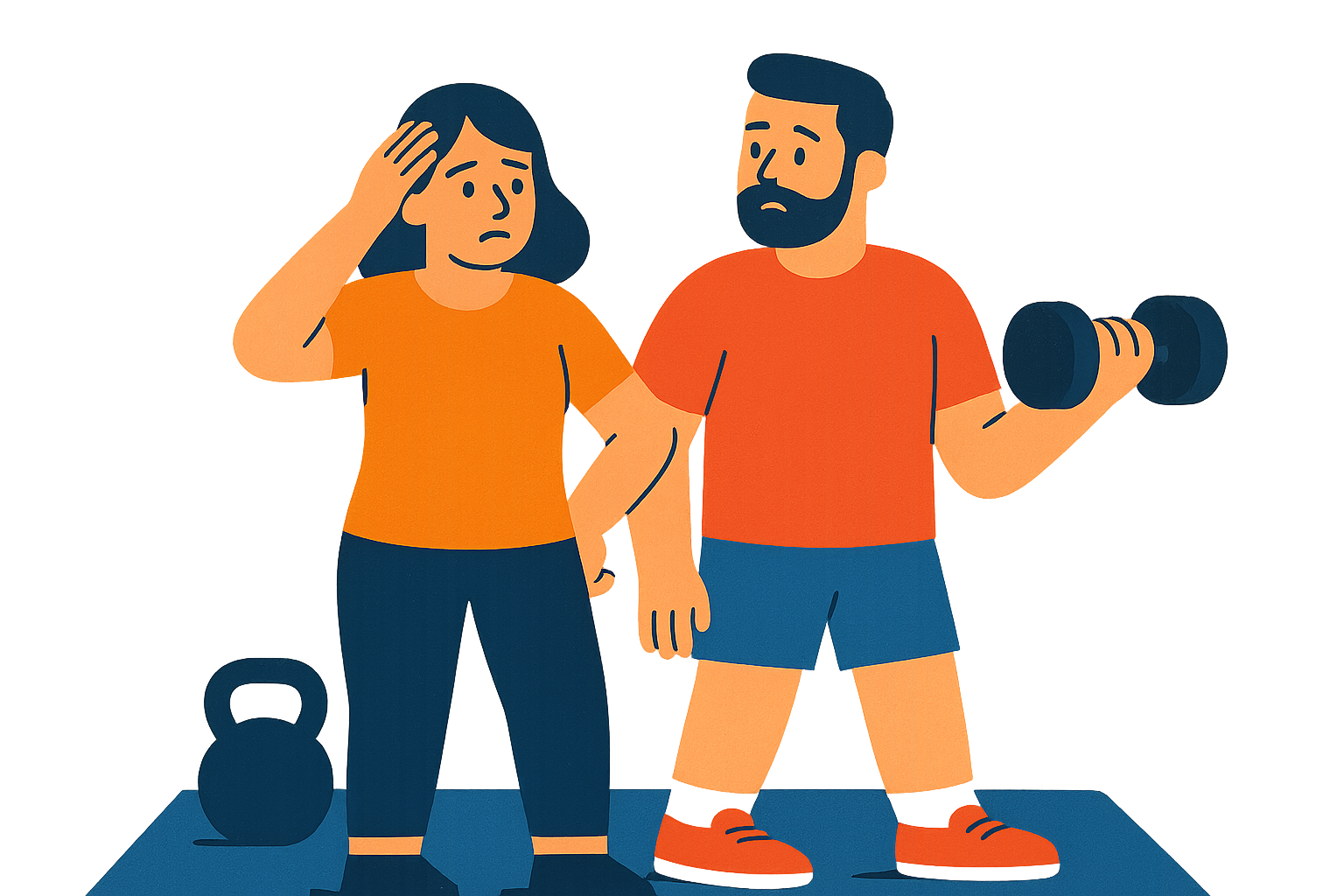
Roughly a third of gym members quit every single year (66.4% annual retention, per the HFA's 2025 Benchmarking Report). So when a couple quits together, the usual advice, "just get back on the horse," is flat-out wrong for their situation. Two people didn't lose motivation on the same random Tuesday by coincidence. Something in the shared system broke, and the fix has to be built for two people, not copy-pasted twice for one.
How one partner's dropping off pulls the other along
Partner behavior and respondent behavior are significantly related, full stop (p <.001, based on dyadic research across 215 couples). When one person in a relationship starts skipping workouts, the other's odds of skipping go up too, and not on some delay. Basically right away.
Research on couples-based health behavior change explains part of why. Partners shape each other's beliefs about what exercise will actually do for them and how confident they feel about pulling it off. Daily exercise intentions correlate significantly between partners, and one person's intention to work out is tied to the other's self-efficacy, over and above their own. Motivation gets borrowed as often as it gets earned, and most people miss that entirely: they treat a lapse as an individual failure when it's really a systems failure with two people in it.
That borrowing cuts both ways, which is the annoying part. Social contagion doesn't care whether the behavior is good for you. A couch night spreads exactly as efficiently as a gym habit does.
A few mechanics deserve to be named directly. Schedules collapse together, shared commutes, shared childcare, one bad week at both jobs, and suddenly neither person has a slot. One partner's low energy drains the social payoff that made the workout worth showing up for in the first place. The original routine was probably built around doing it together, so the whole thing seizes the moment only one person wants to go. And overcorrection at the start, training hard for 7 to 10 days straight is a common early mistake that leads to burnout, and when both partners follow the same aggressive ramp-up, they tend to hit that wall around the same time.
The lapse is two connected failures running in parallel, not two separate stories. It's one event with one cause. It needs one diagnosis, not two pep talks delivered separately.
What the joint diagnosis actually looks like before restarting anything
The single most common mistake in any restart, solo or shared, is jumping straight to a new schedule without asking why the old one died. Most people get backwards that they think the fix is a better plan. It's not. A new spreadsheet doesn't fix a root cause it never bothered to look at.
Before picking a new class, app, or 5 a.m. commitment, sit down (an actual conversation, not a vague vibe check) and work through it together. Was the old routine too time-intensive for both of you, or was one person quietly drowning while the other didn't notice? Did it require both partners in the same place at the same time, so the whole thing snapped the moment one schedule shifted? Did expectations get ahead of reality, since people who expect fast results and don't see them tend to bail, and that pattern applies to couples too? Were the goals actually shared, or was one partner just tagging along on the other's goal without ever owning it? And was it fun for either of you, or purely a chore both of you tolerated until you stopped tolerating it?
A 2024 study of 830 fitness center users across 20 centers in Slovenia (Vuckovic & Duric) found people in relationships showed significantly higher "avoiding poor health" motivation when working with a personal trainer (p = 0.020), while enjoyment-driven motivation showed up strongest in people who exercised alone. Couples restarting together risk building a routine around obligation while skipping the part that makes people want to keep doing it. Fix that, and the rest gets a lot easier.
The diagnosis should produce two things by the end. The actual reason the routine died, and a shared agreement on what a manageable restart looks like. Not the dream version. The one you'll actually do on a Tuesday in March, tired, after a long day, with zero motivation showing up on its own.
Why restarting together carries a structural advantage over restarting alone
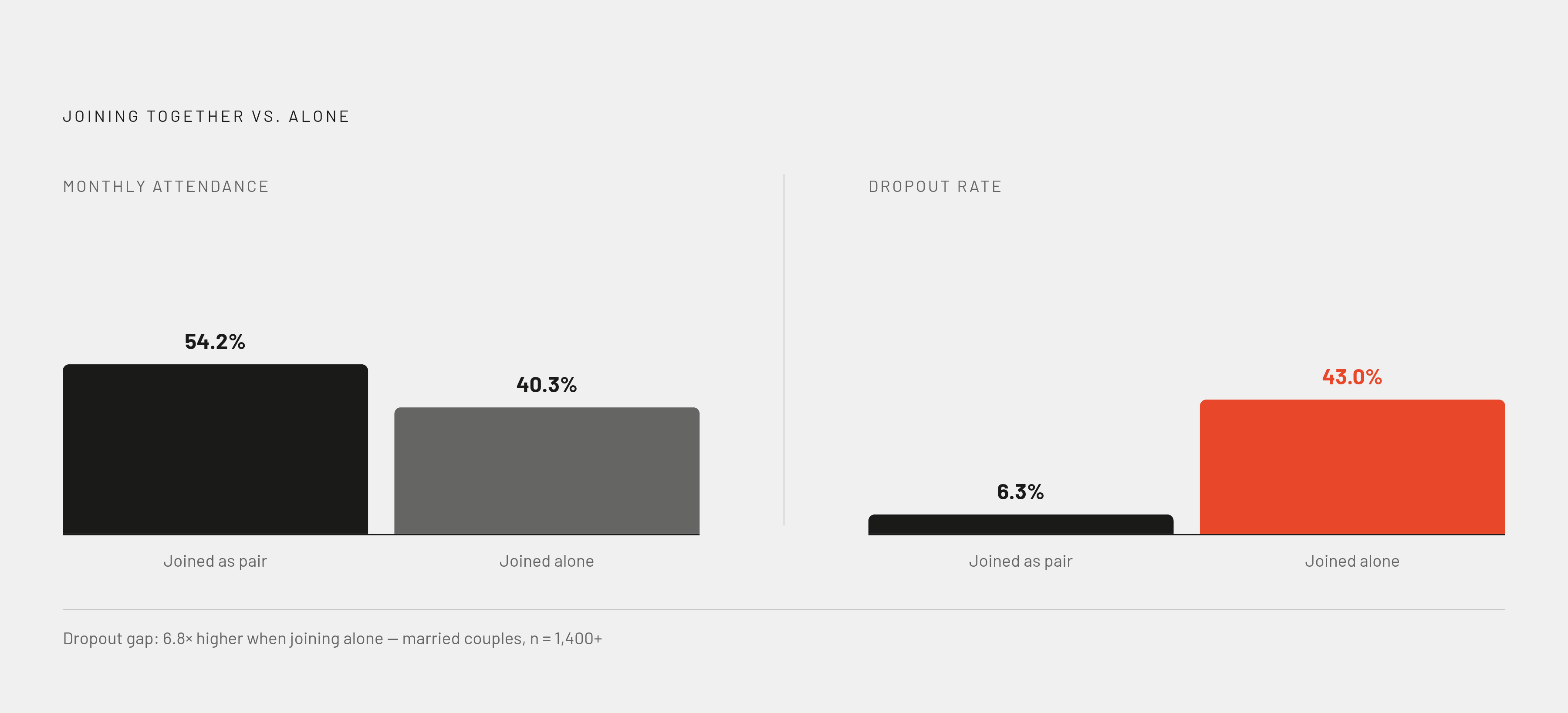
A study comparing married pairs who joined a fitness program together against married individuals who joined alone found the pairs hit 54.2% (± 10.3) monthly attendance versus 40.3% (± 14.3) for solo joiners. Dropout for pairs was 6.3%. For solo joiners, it was 43.0%. That's not a gap, that's a canyon, and it's the difference between a habit and a New Year's resolution that quietly dies by February.
Researchers attribute the gap to spousal support, not to some innate motivation advantage one group had over the other. The couples weren't more disciplined. They just had someone watching, which turns out to matter more than willpower ever did.
Social contagion, the same force that spreads a lapse, spreads adoption just as well. One partner picking the habit back up tends to pull the other along, creating a reinforcing loop instead of a competing one. A 2026 BYU study tracking 1,693 young married couples found shared physical activity linked to better communication, stronger conflict resolution, and lower marital conflict than solo exercise. Exercising together compared favorably to exercising apart across the relationship metrics the study measured.
The bar for "together" sits lower than most people assume, too. Walking is widely cited as one of the most common ways couples exercise together: no equipment, no membership, no scheduling puzzle required.
The core asset here is simple. People are less likely to cancel on a workout when someone's actually expecting them to show up. That changes the whole psychology of it, since showing up stops being a private battle of will and becomes a promise kept to somebody else. Couples who quit together already have the one ingredient most solo restarters are missing: a second person, ready at the same moment, for the same reason.
What the body and brain are actually dealing with after a break
Detraining doesn't wait around politely for anyone to feel ready. Cardiovascular fitness starts slipping within one to two weeks off. Blood volume can drop 5 to 10%, and VO2 max can fall as much as 7% after two to four weeks of doing nothing. Strength follows close behind, with noticeable losses setting in around the three-week mark.
The honest answer is that rebuilding takes time, and the length of the break matters. It's a useful gut check against expecting week-one results that were never coming.
Charging in too hard, too fast, is a leading cause of early dropout, and it's exactly the trap that likely sank the original routine (the intense 7 to 10 day start, followed by soreness, followed by dropping off). Repeating that pattern on the restart just guarantees the same ending, only faster this time.
There's a mental trap tangled up in all this, too. Clinicians generally advise against benchmarking against your old fitness level and instead tracking small, incremental gains from wherever you're actually starting. For a couple, that means resisting the urge to race back to where things left off. It also means accepting that both partners probably detrained at slightly different rates, so the pace gets set by whoever's less recovered, not by whoever's most fired up. Otherwise the restart just rebuilds the exact imbalance that helped sink things the first time.
Setting a shared re-entry point that is simpler than it needs to be
The instinct after a lapse is to overcorrect: new gym, new app, new 6 a.m. alarm, new everything. That instinct is exactly how the last routine died, just wearing a fresh outfit and pretending nobody will notice.
Start smaller than feels reasonable. A 15-minute at-home session a few days a week beats an hour-long gym commitment neither of you can consistently make time for. Coaches often frame a restart as a fresh beginning rather than a race back to a previous fitness level, and for a couple, that reframe has to happen out loud, together, not privately in each person's head where it does nobody any good.
Specificity beats good intentions, every time. Research summarized by ACE Fitness in March 2025 backs "implementation intentions," meaning plans that name the when, where, and how. "We'll walk for 20 minutes on weekday evenings after dinner" works. "We should really start exercising again" does not, and never has.
A few low-friction options worth considering are walking, the single most common way couples exercise together, requiring zero equipment and zero scheduling gymnastics. At-home sessions that don't demand both people be free at the exact same hour. Anything tolerable to both partners, prioritized over anything "optimal" that neither of you will actually stick with past week two.
Week one is about groundwork, about proving the pattern can repeat. Intensity is a problem for later. A 30-day relaunch window works well here: long enough to mean something, short enough not to feel like signing a life sentence.
How to build mutual accountability that supports rather than pressures
Accountability built on shared belief and encouragement works. Accountability that curdles into surveillance or nagging corrodes the habit and the relationship at the same time, a two-for-one nobody signed up for.
Gouin and Dymarski's 2024 research notes that effective couple-based interventions have to account for relational dynamics directly, including the unhelpful patterns that activate the moment both partners are entangled in each other's behavior change. Translated: "did you go to the gym today" delivered in the wrong tone isn't support, it's an audit. Strong social support has been linked to sustained physical activity through multiple mechanisms, and plain old accountability is one of the most consistent.
One rule tends to hold up well in practice: never skip two days in a row. Missing one day occasionally doesn't derail habit formation, according to UCL habit research. Missing two in a row is where the slide tends to start, quietly, before anyone's even decided to quit.
Supportive accountability looks like celebrating the fact that someone showed up, even for a short walk, rather than grading the performance. It looks like checking in with real curiosity ("how'd that feel today?") instead of running a compliance check. It looks like photos, small friendly bets, or little rewards that keep the energy playful instead of obligatory, and it looks like letting each other exercise solo on some days without guilt, staying connected to the shared goal without requiring shared timing every single time.
When someone misses a session, the right response is a question, not a lecture. What made today hard, and what would make tomorrow easier? Shame doesn't build habits. Curiosity does, and it's not close.
Realistic expectations for how long it takes a shared habit to feel stable
Common assumptions about how fast habits form tend to underestimate the real timeline. The actual UCL habit study from 2009 found new daily habits took anywhere from 18 to 254 days to form, averaging around 66. A more recent analysis, cited by ACE Fitness in March 2025, found median habit formation between 59 and 66 days, with average times stretching from 106 to 154 days, and outliers running from just 4 days to nearly a full year.
Exercise routines, with their demands on time, energy, and scheduling, tend to sit toward the longer end of that range. Stable cues help close the gap: same time, same place, same order of operations. For a couple, a shared cue (after dinner, before the kids are up, Saturday mornings without fail) works as a practical anchor better than vague good intentions ever will.
The early weeks tend to produce visible momentum. Then it flattens out, and that plateau is normal. Couples who know to expect it settle in, while couples who don't know to expect it often panic and quit right when they were about to settle in for good.
Stability just means consistent, resilient engagement, a routine both people return to without having to re-decide it every single time. Automatic beats optimal. Every time, no contest.
Tools and structures that help couples stay connected to a shared routine
The simplest tools tend to outlast the fancy ones. A shared calendar block, a two-person group chat, a photo texted after a walk, none of it requires a dashboard or a subscription. Visible progress just needs to be visible, not analyzed six ways from Sunday by an app that wants you to upgrade to premium.
Whatever tracker gets used should fit behavior that's already happening, not demand a new behavior just to feed the app. The best system is whichever one both people are still opening a month later, not the one with the most features.
Small, low-stakes rewards help more than people expect. A friendly bet tied to a weekly goal, loser picks the weekend plans, winner picks dinner, adds a little playfulness without turning the whole thing into a performance review. External rewards like that carry early habit formation just fine, right up until the habit starts carrying itself.
Partners exercising separately on a given day can still stay connected through something as small as a photo or a quick message logging what got done. Connection doesn't require being in the same room, just being in the loop.
Couples in exactly this spot, rebuilding after a shared lapse, do better focusing on realistic goals, visible progress, and encouragement over anything resembling a spreadsheet of metrics. Guilt-driven tracking tends to collapse early anyway, and everyone secretly knows it.
The couple that quit together already cleared the hardest part without realizing it. They've got a partner who understands exactly why it stopped, and who's willing to try again at the same time. The routine just needs a redesign built for two people from the start, not a plan built for one and stretched thin to fit two.
Sources
- Couples-based health behavior change interventions: A relationship science perspective on the unique opportunities and challenges to improve dyadic health
- Frontiers | Motivational variations in fitness: a population study of exercise modalities, gender and relationship status
- Twelve month adherence of adults who joined a fitness program with a spouse vs without a spouse - PubMed
- Partner Influence in Diet and Exercise Behaviors: Testing Behavior Modeling, Social Control, and Normative Body Size
- rp3rowing.com