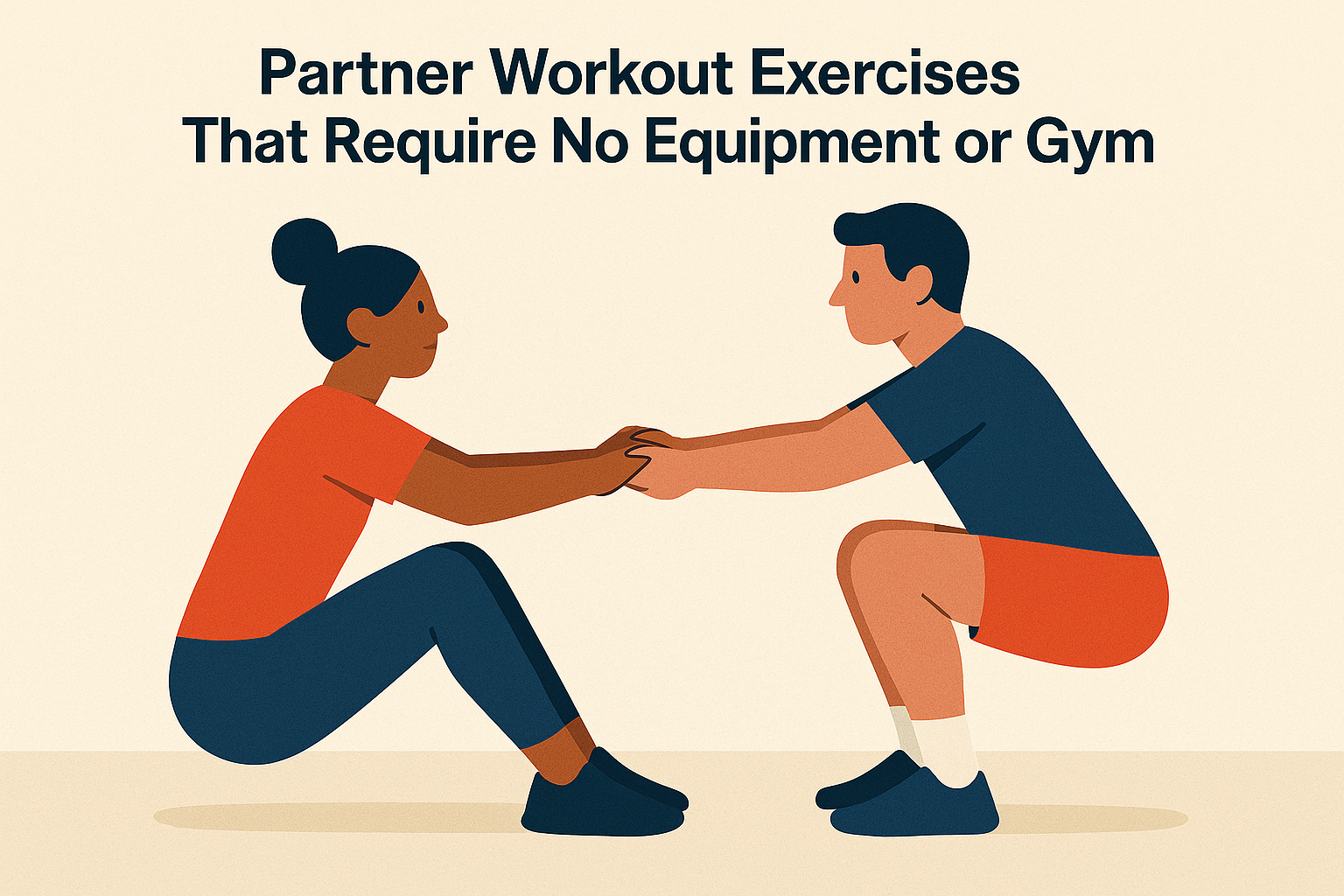
Partner Workout Exercises That Require No Equipment or Gym
Partner workouts build accountability through physical interdependence, not just shared space.
Gyms sell memberships. What actually gets people through the door is a person who's expecting them. A study by Assistant Professor Rachel Gershon, published in Management Science, found that gym visits jumped 35% when someone went with a friend, even after accounting for how much harder it is to line up two calendars instead of one. Two things explained the bump: people had more fun when the workout was social, and they felt a real sense of owing it to someone else to show up. A University of Aberdeen study backed this up and pushed it further: paired exercisers moved more than solo ones, and the gain got bigger when partners were actually warm and supportive toward each other, not just standing in the same room. The 35% is the headline number. The Aberdeen finding is the real story: it's the quality of the connection, not just the presence of a body next to you, that changes behavior.
That's the case for building workouts around actual physical dependence between two people, distinct from two people who happen to be sweating in the same postal code. Below is how to do that with zero equipment, structured for real differences in fitness level, and built to survive the obstacles that usually kill "let's work out together" within three weeks.
What makes a partner exercise genuinely interdependent
A partner exercise gives you support or resistance from the other person. It's not two people doing lunges next to each other while making small talk about their weekend, which is really just solo exercise with a chaperone.
Bodyweight training sets this up well because the body moves on multiple planes at once, balance, range of motion, strength, all firing together, and that creates natural spots where a second person can anchor you, resist you, or force you to match timing. A push-up doesn't need a partner. A push-up where your hand has to tap someone else's shoulder at the exact right moment does.
Researchers call the underlying effect the Köhler motivation gain, documented in the Journal of Sport and Exercise Psychology: effort goes up when one person's performance is indispensable to the pair, or when that person is working next to someone slightly stronger and can measure themselves against it. A partner holding a plank so you can do a squat is real interdependence. Two people doing squats on their own mats, three feet apart, is not, no matter how encouraging the playlist is.
Think of it as a spectrum. On one end: synced push-ups, matched rhythm, nothing that breaks if one person drops out for a second. On the other end: one partner literally cannot move unless the other holds still. Both ends count. They just ask different things of you.
Synchronized exercises that build shared rhythm without requiring one partner to hold the other up
These build connection through timing, not load. Neither person is bearing the other's weight, so both can scale up or down without stopping the exercise for the other.
Synchronized push-ups with a shoulder tap. Face each other in push-up position, lower together, push up together, then each of you lifts one hand and taps the other's opposite shoulder at the same time. Twelve reps, switch hands each rep. Hits chest, shoulders, triceps, core.
Plank high-five: high plank, facing each other, hands and feet shoulder-width apart, enough space between you to comfortably exchange a high-five, hands stacked right under the shoulders. Alternate high-fives while holding the plank. Add a push-up between fives if you want it to hurt more. Works the entire core along with shoulders and triceps.
Synced burpees: face each other with enough distance to move freely. Perform each phase in unison: squat, plank, push-up, stand. Moving in sync is a built-in checkpoint. If you fall out of rhythm, you both know exactly who slowed down.
Exercises where one partner's stillness is what makes the other's movement possible
This is where accountability becomes physics instead of a vibe. If your partner's plank collapses, your squat stops. There's no faking effort here, the exercise itself calls it out.
See-saw squat: one partner holds a high plank. The other stands between their feet, facing their head, holding their ankles, and performs a full squat. Every time they stand back up, the plank partner does one push-up. Switch after the set. Both people are grinding, just through different movements at the same time.
Low plank hold with hop-overs: one partner holds a forearm plank. The other stands at their side, hops up and over, lands soft, hops right back. The plank has to hold steady for the timing to work, and the timing has to be clean for the plank not to get bumped. Switch after reps.
Wall sit and tricep dip: Partner A holds a wall sit, knees bent into a comfortable seated position. Partner B uses Partner A's bent knees as a bench and does tricep dips off them. Neither move happens without the other person in position. Switch roles after the set. This combo shows up in the Nourish Move Love fifteen-minute partner routine, and it's a good example of two totally different muscle groups getting worked off one shared position.
Exercises where both partners are simultaneously loading and resisting each other
Here nobody is holding still for the other. Both people are pushing, and both are being pushed back, at the same time.
Back-to-back wall sit: stand back-to-back, brace your cores, link arms if you want extra stability, and lower into a squat until knees hit 90 degrees. You stay up by pressing into each other's backs. If either person's pressure is removed, you both go down. Works glutes, quads, hamstrings. Hold as long as you can stand it.
Back-to-back leaning squat: same starting position, arms interlocked, knees slightly bent. Lower into a squat together and stand back up together. The lean against each other is what keeps the squat stable, so if one partner checks out mid-rep, both of you tip over. Which, to be fair, is a pretty honest way to find out someone's phone buzzed.
Wheelbarrow walk with push-ups: Partner A gets into high plank, hands shoulder-width apart. Partner B squats down, grabs Partner A's legs, and stands up. Walk forward for thirty seconds, then Partner A knocks out eight to ten push-ups. Three sets. Partner A is working core, shoulders, and triceps. Partner B is getting a grip and trap workout that's basically a weighted carry with legs instead of dumbbells.
Wheelbarrow with a squat combo: same wheelbarrow setup, but instead of walking, Partner B holds the legs and squats while Partner A does push-ups. Both primary movements are happening at once. Several sources point to this one specifically as one of the better true partner exercises out there, and it's easy to see why: neither person is resting while the other works.
Core and cardio finishers that use the partner dynamic to push past the point either would stop alone
Partner bicycle crunches: move in matched rhythm. Stopping means visibly falling out of sync, which is a pretty loud way to announce you're tired.
Back-to-back leg raise (boat pose hold): sit back-to-back, a few inches apart, both raise legs to a tabletop position with knees bent at 90 degrees, and lean back slightly so your shoulders touch for support. That contact point is basically a live readout of whether your partner is holding steady or starting to wobble.
Leg lift tug-of-war: turns a plain leg lift into a small, friendly wrestling match for your core and lower back. It doesn't need much space, and the resistance keeps both people locked in instead of just quietly counting down the seconds.
Partner leapfrog: one person crouches on hands and the balls of their feet. The other puts hands on their shoulders and jumps over, then the first partner stands up and repeats it going the other way. It's cardio, but it's also just kind of fun, and fun is what gets people to come back for round two.
How to structure these exercises for two people at different fitness levels
Start with five minutes of warming up together: jogging in place, jumping jacks, high knees. Doing the warm-up in sync sets the tone before anything actually gets hard.
For the main session, aim for at least five exercises, seven is a good sweet spot, at three sets of twelve reps each. Order them from easiest to hardest so both people get a chance to settle into the rhythm before the intensity climbs.
Short on time? A full-body partner session with none of this equipment can fit into fifteen minutes, which is a decent argument against "I didn't have time" as an excuse.
Another option: ditch rep counts entirely and use timed intervals, forty seconds of work, twenty seconds of rest. This takes the pressure off matching exact reps and lets each partner push at their own intensity inside the same window.
The real obstacles to training together and how to overcome them
Mismatched fitness levels is the complaint that comes up most. It can leave the less-conditioned partner feeling frustrated or behind, and over time that can sour the whole idea of exercising together. That doesn't mean two people at different levels can't train together, it means the exercises and the structure have to be chosen with that gap in mind.
This is exactly where the interdependent formats above earn their keep. When both people are working at the same moment, even if the work looks different, the question in the room shifts from "who's stronger" to "are we both actually pulling weight." That's a much easier question to answer honestly.
Scheduling is the other repeat offender. Two calendars rarely line up on their own, and waiting for the perfect open slot is a great way to train rarely or never. Protecting one or two fixed times a week beats trying to negotiate a new plan every single day.
And then there's the risk that the whole session turns into a conversation with some stretching attached. Nothing wrong with that socially, but it's not training. A set list of exercises and a timer running in the background fixes that without having to dial back how much you actually enjoy each other's company.
Why physical interdependence in exercise builds the shared habit more durably than motivation alone
The research cited here, Gershon's work and the Köhler effect, points at the same mechanism from a slightly different angle: when another person's presence makes the workout better, and your part in it actually matters to whether it happens, both effort and return visits go up.
The exercises in this piece aren't a social trick bolted onto a normal workout. The need for another person is built into the movement itself, one partner squarely cannot finish the rep without the other holding their end up. That's a sturdier foundation than motivation, because motivation runs out on a rainy Tuesday and physical dependence doesn't care what the weather's doing.
A 2025 poster presentation at Utah State University's Research Week examined partnered training and its effects, adding to a growing pile of evidence pointing the same direction: pair the workout right, and skipping it stops being a private decision. It becomes something you'd have to explain to someone standing right next to you.