Why Fitness Consistency Is Easier When Someone Else Expects You
External accountability from someone who expects you works better than willpower alone.
Forbes data cited by Hydrow shows 78% of people who set fitness goals abandon them by the end of February. Not a slow fade. A cliff. Fitnesschallenge.club backs that up with a similar number for New Year's resolutions specifically, up to 80% quietly dead by mid-February. Only 20% say they can actually hold themselves accountable to a goal, which explains the pattern. Four out of five people, left alone with their own intentions, cannot make themselves follow through.
The usual explanation blames willpower. Not enough discipline, not enough grit, not enough 5 a.m. main-character energy. But willpower tends to erode under the accumulated demands of a day and doesn't refill just because you want it to badly enough. Willpower is the wrong tool for most people, and the real fix has almost nothing to do with what's happening inside your head. It has everything to do with who's watching.
What happens to a goal that lives only in your head
A goal nobody else knows about is a goal you can renegotiate every morning, and nobody will ever catch you doing it. Lower the standard, push the start date, forget it entirely by Thursday. No penalty, no witness, no consequence. That's just how unobserved intentions behave: they carry zero social weight, so nothing stops you from quietly editing them into oblivion.
Habithuddle.com defines social accountability as a structured way of making progress visible, so other people can support it, question it, or respond to it. Two moving parts here: visibility and response. Both have to show up, or the structure collapses.
People tend to lump two very different things together. "Text me if you need motivation" is support on demand. It's kind, but it only shows up when someone asks for it. It depends on the exact willpower that's already failing them. Social accountability works structurally instead. The check-in happens on a schedule, the habit gets defined ahead of time, and everyone agrees in advance on what counts as done. No renegotiating at 6 a.m., because the terms were locked in the night before.
Broadcasting isn't accountability either, whatever the algorithm wants you to believe. Posting a goal to a few hundred followers builds an audience. A Dominican University of California study, cited by habithuddle.com, found that people who sent weekly progress reports to a friend outperformed every other group tested, including people who simply wrote their goals down on paper. Writing it down helps you remember the goal. Reporting it to someone who's actually expecting an update is what gets you off the couch.
A meta-analysis of 138 experiments, also cited by habithuddle.com, backs this up at scale. Progress monitoring works best when the progress gets physically recorded and made visible, not just noticed privately inside your own skull. Once someone else expects you to show up, the goal picks up a weight it could never carry alone. But not every flavor of external expectation works the same way, and some of them backfire hard.
The importance of the type of accountability
Research on accountability splits it into two modes, and only one of them holds up. Autonomous accountability is chosen, supportive, and collaborative, and it improves adherence over the long haul. Controlled accountability is imposed and punitive, and while it might squeeze out short-term compliance, it curdles into resentment and avoidance fast.
Research on exercise adherence has found that emotional support tends to matter more for keeping exercise habits alive than practical logistical arrangements.
A partner who cheers you on beats a partner who audits you, every time. That's the actual design spec for accountability that lasts. It's the actual design spec for accountability that lasts. Support-based accountability celebrates showing up even on a mediocre day, and it responds to a missed session with a shrug and a plan for tomorrow.
The Köhler effect: how being the weaker partner drives harder effort
A genuinely strange finding in exercise psychology is named the Köhler effect. Pair someone with a partner who's better than they are, on a task where the group's result depends on the weaker person (a "conjunctive" task, in the jargon), and that weaker person's effort goes up. Not down, despite getting shown up constantly at every rep. Up.
Two competing explanations chase this in the literature. One is social comparison: you can now literally see how you measure up, and that alone lights a fire. The other is group indispensability: the team's outcome depends on your effort specifically, so slacking has a visible cost attached to it.
A 2023 meta-analysis in Kinesiology Review pulled together 19 peer-reviewed studies covering 1,912 participants. The overall motivation gain landed at g̅ppc = 0.91, a statistically significant effect showing meaningfully higher performance in conjunctive partnered exercise versus solo exercise. The size of that effect shifted depending on whether researchers measured persistence or intensity, the age of participants, and whether the partner was a real human or software-generated.
Archival data adds a real-world sanity check. Studies of collegiate swim teams and high school track relays found that the weaker athletes on a relay squad showed significantly bigger motivation gains than their stronger teammates. In swimming, this held for both preliminary heats and finals. Track and field showed the same pattern.
There's a gender wrinkle too. Earlier research suggested men and women weigh social comparison against group indispensability differently, and an experiment confirmed the gap. But a third experiment closed it entirely, just by priming women with a competitive goal frame more typically handed to men. The Köhler effect applies to both genders. It's a matter of framing, full stop.
None of this requires finding an equal partner, either. A slightly stronger one might push harder than an equal would. And the effect doesn't live only on the gym floor: it's been reproduced in video-based exercise games paired with human partners, so the mechanism travels well past in-person training.
What the group exercise adherence data shows
Karmabarre.com reports that people in group fitness classes hit 62% adherence on average, versus 48% for people training solo, and group settings can push workout intensity up 10 to 15% through plain social motivation.
A Frontiers in Psychology study, run across 20 of the largest fitness centers in Slovenia with 830 participants, found something sharper than "groups are good." People who took group classes exercised significantly more out of a sense of belonging than people training alone (p = 0.004) or training one-on-one with a personal trainer (p = 0.002). Belonging was the active ingredient. Not the schedule, not the structure. The belonging.
A 2025 study of school sports clubs, with 245 participants, traced the mechanism further, examining how peer relationships connect to satisfaction, commitment, and long-term adherence intention. The social bond is load-bearing.
Research on exercise psychology explains why this works: people stick with exercise long-term when they actually enjoy the activity itself, and training with others can manufacture that enjoyment even when the workout is objectively miserable. A group turns a chore into something worth showing up for, the same way a bad movie gets better with the right person next to you heckling it.
Some research has found a gender-specific angle too, suggesting group exercise may be particularly linked to exercise identity for women. The group setting can change how people see themselves.
A Stylist survey of 281 Strong Women readers found 62% prefer training alone. Preferring solitude doesn't mean someone can't benefit from external accountability, those are two separate questions. Group classes are one way to put social weight behind a goal. They're not the only way, and they're nowhere near universally appealing.
The spousal and partner effect on long-term program adherence
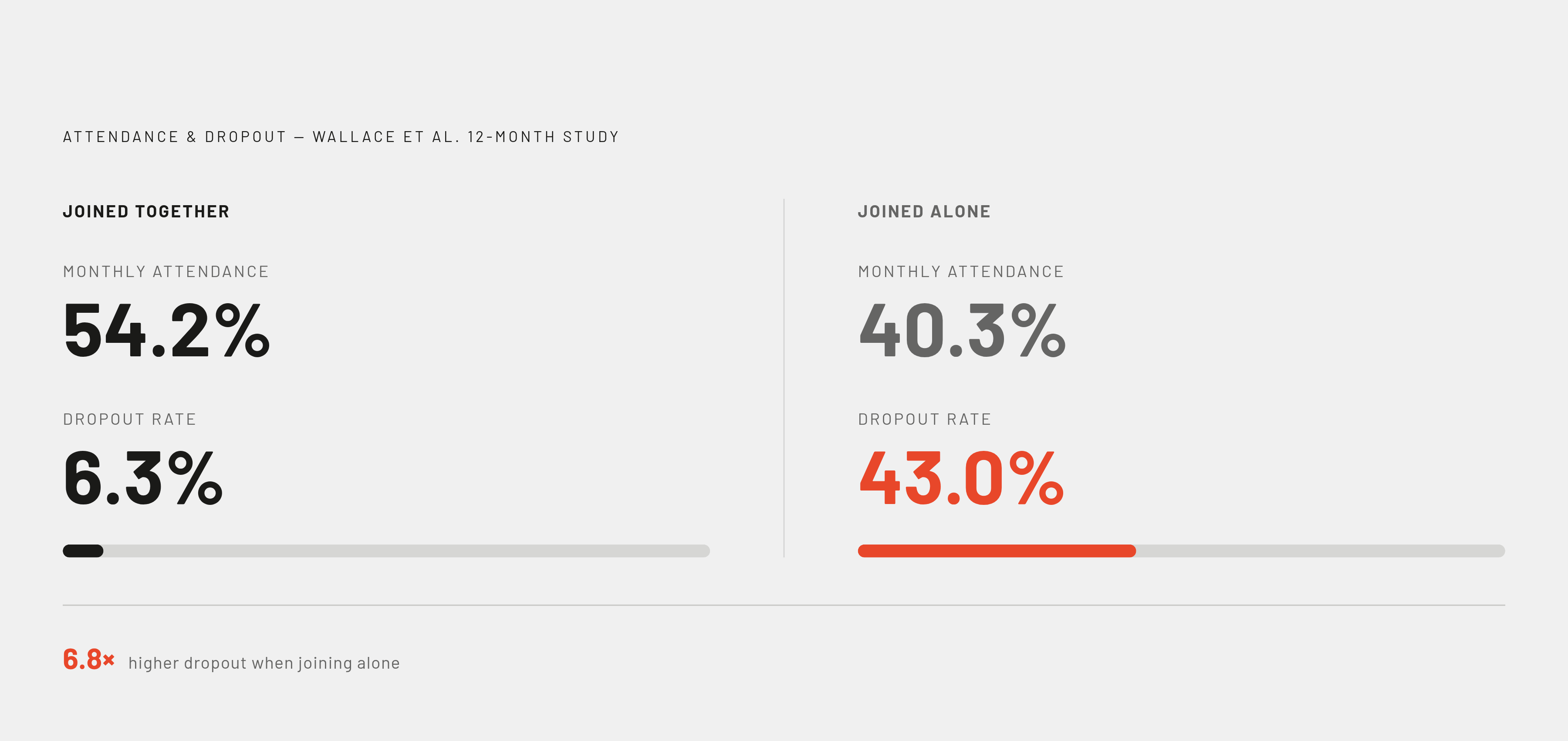
A landmark study by Wallace and colleagues tracked 12 months of adherence at a university fitness program, comparing married couples who joined together against married individuals who joined alone. The gap is stark, and it should reset how anyone thinks about "going it alone." Couples who joined together averaged 54.2% monthly attendance (± 10.3) with a dropout rate of 6.3%. Married individuals who joined solo averaged 40.3% attendance (± 14.3) with a dropout rate of 43.0%, nearly seven times higher.
The data pointed to spousal support, not personal motivation, as the driver of the difference. Half of all dropouts from the program cited family responsibilities or a lack of spousal support as the reason for quitting. The absence of that support wasn't neutral. It was actively causing the failure.
Other research on older adults has found the same pattern holding, and holding hard. Shared participation in an exercise program appeared to reinforce activity during both supervised sessions and the unsupervised stretches in between. The effect didn't clock out when the session ended.
A partner isn't just someone cheering from the sideline during the workout itself. Having one lowers the odds of quitting across the entire length of a program, largely because losing that support is itself a leading cause of dropout. Fitness can strengthen a relationship when two people chase a goal together, and shared habits tend to outlast solo resolutions. Partners don't even need to train in the same room at the same time to cash in on this. What matters is the commitment structure between them, not physical proximity.
How professional coaching creates structured external expectation
Scheduling changes behavior on its own, no motivation required. Lloydathleticclub.com reports that when a session is booked and a real person expects someone to show up, the friction required to skip it jumps sharply.
The numbers back this up hard. Lloydathleticclub.com reports personal training clients maintain 85 to 90% appointment adherence, compared to 50 to 60% among independent gym members training solo. Trained clients also average 3.2 workout sessions a week, against 1.8 for people going it alone.
A 2025 randomized controlled trial out of Miguel Hernandez University in Spain, involving 70 sedentary adults over an 11-week HRV-guided program, found that the group working with a personal trainer (23 people) achieved statistically significant gains in maximal aerobic power that the autonomous group (18 people) simply didn't hit. Frontiers in Sports and Active Living reports both groups improved strength and aerobic capacity overall, but the coached group stayed more consistent about session intensity and hit high-intensity work more often.
Research on supervised small-group exercise programs has documented meaningful long-term participation, with gender differences in dropout rates observed across program types. Separately, randomized controlled research has found that people getting regular coaching stuck with their exercise routines more reliably than people training on their own.
Anyone shopping for this in app form in 2026 should know the field narrows fast. Trainwell.net (published July 3, 2026) names four leading options: Trainwell, Future, Caliber, and Fitbod. The variable that actually separates them is something other than price. It's whether there's a real person on the other end who knows your name, your goals, and what you did last week.
- Trainwell pairs every member with a dedicated, certified personal trainer (W-2 employees holding NASM CPT or equivalent, a college degree, and at least 3 years of remote coaching experience). Unlimited messaging, video messages, live video calls with form-check breakdowns, and live motion tracking through Apple Watch or Wear OS. Starts at $149 a month, billed quarterly. Trainwell.net names it Best Personal Trainer App of 2025 by Forbes, and it also powers the Peloton Personal Trainer experience that launched in February 2026.
- Future runs a contractor trainer model, one-on-one, with limited live form feedback and unlimited messaging, priced around $199 a month per trainwell.net.
- Caliber uses contractor trainers, dedicated one-on-one coaching at the Premium tier, no live form feedback, messaging gated behind that Premium tier, around $200-plus a month.
- Kickoff runs contractor trainers, one-on-one, no live form feedback, unlimited messaging, priced between roughly $95 and $220 a month.
- Ladder offers group coaching rather than one-on-one, with limited messaging, around $29.99 a month, the budget option of the bunch.
None of this requires a paid coach. Couples and training partners who hold each other accountable instead of paying someone to do it are running the exact same playbook: visible commitment, someone who notices the silence when you go quiet, and a supportive response instead of a judgmental one. Simple shared goals with progress both people can see do the same structural job for free.
The one condition that undermines group accountability: social loafing
Groups aren't automatically good for effort, and pretending otherwise is where a lot of gym-buddy plans go sideways. Social loafing is the well-documented tendency to put in less effort inside a group than a person would put in alone, and it kicks in the moment individual contributions start feeling invisible or unaccountable. Diffusion of responsibility does the damage: everyone quietly assumes someone else will pick up the slack.
EBSCO research starters find people consistently exert less effort on joint tasks than solo ones, and the pattern gets worse as the group grows. More people in the room, less individual effort per person, on average, like a tug-of-war where half the team is just holding the rope for show.
This is the mirror image of the Köhler effect. Köhler shows up when a contribution feels indispensable to the outcome. Social loafing occurs when a contribution feels dispensable, like the group would hit its number just fine without you.
Culturemonkey.io and EBSCO point to the same fixes. Individual accountability inside the group matters most: knowing your specific piece is visible to others. Identifiability matters too, since the more personally evaluated someone feels, the less they loaf. Assigning distinct responsibilities cuts down on free-riding, and team loyalty (actual relationships between group members) raises the personal cost of phoning it in.
Couples and training partners get most of this for free, just by being a group of two. Small size and a close relationship naturally make identifiability high. A partner notices effort in a way a class of thirty strangers never will, and that's a structural edge the partner model has built in from the start, not something it has to engineer.
Knowing exactly where accountability breaks down makes it a lot easier to build a version that doesn't.
How to build an accountability structure that holds over time
Habithuddle.com (2026-06-02) draws a clean line between informal support and real structural accountability. It comes down to four decisions made up front, before motivation gets asked to do any heavy lifting it was never built for.
Agree on the specific habit first. Define what counts as done, so there's no wiggle room to redefine success after a rough week. Set a reporting rhythm on a fixed schedule, not a "whenever." And decide in advance how the other person responds: celebration when someone shows up, curiosity instead of judgment when they don't.
That's the whole structure, and there's nothing fancy about it. None of it depends on willpower, because none of it lives only in your head anymore. It lives in a shared calendar, a shared expectation, and a person who actually notices when you go quiet.