Accountability Partner Check-In Schedules That Actually Work
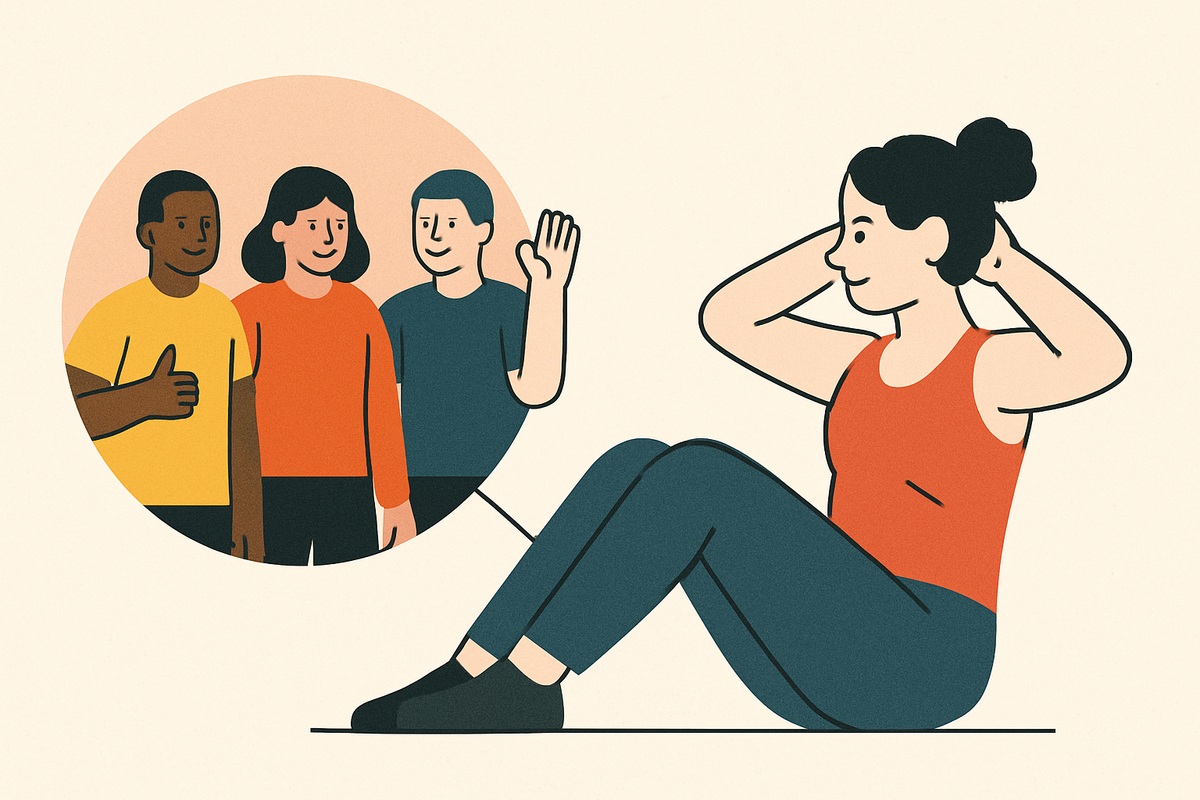
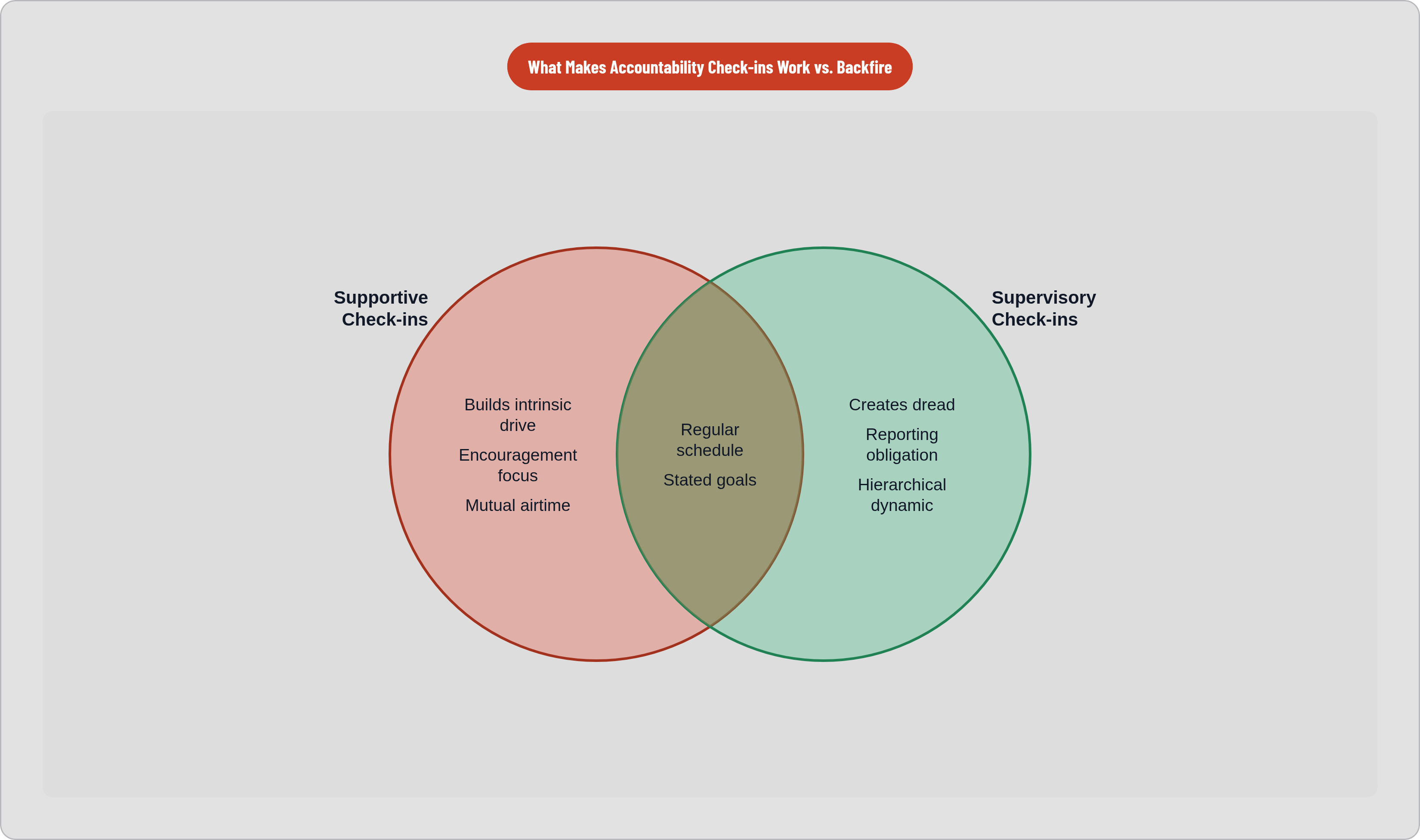
Regular, scheduled check-ins work best when they stay supportive rather than supervisory.

Most accountability partnerships don't end with a fight. Nobody sends a breakup text. Nobody officially quits. They just... fade. One week the check-in happens on Tuesday. The next week it's Thursday. A few weeks later it's a "good week!" text that neither person really reads. And then nothing. The relationship is technically still alive. It just stopped doing anything.
That's the dominant failure mode. Drama, falling-outs — those are rare. The common ending is a slow drift into silence that neither person chose.
Here's the thing: that's almost never a commitment problem. The people who set up accountability partnerships usually care about their goals. The problem is that a vague intention to check in is not a system. And a system that isn't built to survive one missed week usually doesn't survive two.
The rest of this is about building something that actually lasts.
What the research actually backs up about why check-ins work (and when they backfire)
There are three distinct mechanisms at play, and they're worth naming separately because they're also the three ways things go wrong.
Public commitment. When you say your goal out loud to another person, your brain starts working to stay consistent with that declaration. Robert Cialdini's work on consistency and decades of goal-setting research both point to the same thing: stated intentions stick better than private ones. Accountability turns a mental note into a social contract.
Social loss aversion. The mild discomfort of showing up to a check-in with nothing to report is more reliable fuel than pure willpower. It's about a small, recurring, low-stakes consequence that keeps behavior from going fully off the rails. Grand, abstract motivation fades. Small, recurring friction works.
Autonomy vs. control. This is where things get complicated. Self-Determination Theory (Deci and Ryan) draws a hard line between a partner who encourages and a partner who pressures. Encouragement builds internalized motivation over time. Pressure erodes it. The check-in that feels like a supportive conversation and the check-in that feels like reporting to your boss are structurally identical. The difference is tone. And tone determines whether the system strengthens you or makes you want to avoid it.
The American Society for Training and Development looked at this and found that the jump in goal success came specifically from scheduling regular accountability appointments. Regular, scheduled appointments — rather than vague commitments or occasional check-ins — produced the effect. Regularity is the active ingredient.
That said, there's a dissenting view worth taking seriously. Dr. Michelle Segar at the University of Michigan argues that leaning heavily on external accountability can undercut a person's own capacity for self-motivation. Research published in the Journal of Motivation and Emotion found that people are more persistently engaged in tasks than they expect to be. In other words: you don't need as much external scaffolding as you think. Don't outsource your drive entirely.
The synthesis here is simple. The same mechanisms that make check-ins work are the ones that make them backfire when the tone shifts from supportive to supervisory. Build the right kind of check-in and you get compounding motivation — like compound interest, it's boring until suddenly it isn't. Build the wrong kind and you get someone who dreads Tuesdays.
How check-in frequency should match the goal, not a calendar template
There's no universal cadence. But there is a general finding worth starting with. Weekly is the sweet spot for most goals. Frequent enough to prevent drift. Infrequent enough that it doesn't feel like a reporting obligation.
Monthly lets too much slip between conversations. By the time a problem surfaces in a monthly check-in, it's usually already compounded into something bigger than it needed to be.
Daily is too much for most formats. Unless it's lightweight.
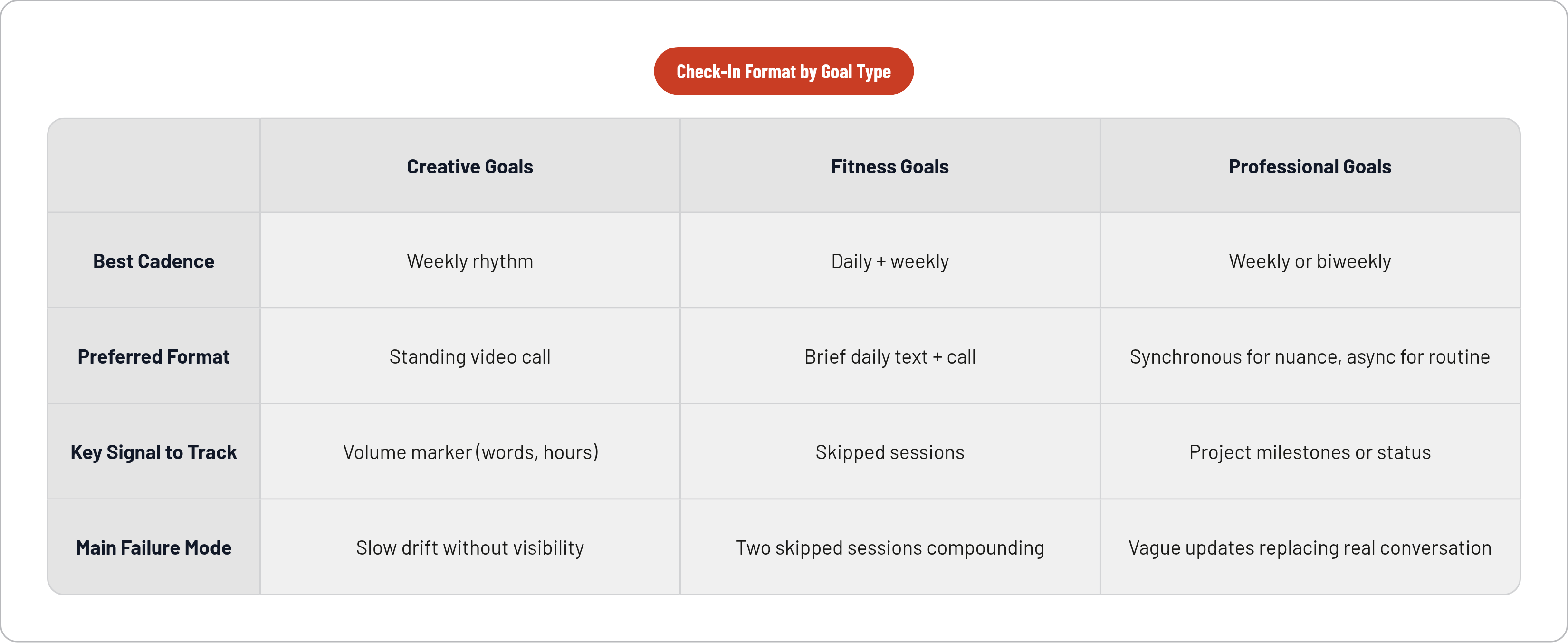
Here's how it breaks down by goal type:
- Creative goals (writing, portfolio work, long-form projects): a weekly rhythm with a simple volume marker works well. Words drafted. Hours at the desk. Hours sketching. The point isn't to audit the work. It's to honor the slow accumulation that creative work requires. A writer profiled by NPR in January 2025 credited a standing Friday Zoom session with her accountability partner for rewriting her novel three times and writing two additional books in a single year. Before the partnership, she had one draft.
- Fitness and physical goals: the failure signal is a skipped session that becomes two before anyone notices. A brief daily text can catch the slide early. The weekly call handles recalibration, reflection, and any adjustments to the plan.
- Professional or project goals: synchronous formats (video calls, phone calls) suit goals that need nuanced conversation. Asynchronous formats (voice messages, texts) suit routine execution goals where a quick status update is more useful than a live discussion.
A framework that works for most people combines two layers. A short daily touchpoint for the day's commitments. A longer call every one to two weeks for real conversation. Each layer has a distinct job. Don't confuse them.
The practical rule: calls add warmth. Texts reduce friction. The right format is the one both people will actually use.
The danger window between novelty and habit — and why this is exactly when you need structure
Research on habit formation points to a danger zone somewhere around weeks three through eight. The initial enthusiasm has worn off. The behavior hasn't become automatic yet. Internal motivation is at its least reliable.
This is the window where most partnerships fade. The novelty is gone and the habit isn't there yet to carry them through. Think of it like a bridge under construction: the scaffolding has to stay up until the structure can hold its own weight — tear it down too early and the whole thing collapses.
The check-in doesn't need to be intense during this period. It just needs to be reliable. Showing up on schedule matters more than what you say when you get there.
This has a design implication that most people get backwards. Don't build a check-in schedule that's most intensive at the start (when motivation is already high) and loosens later (when motivation is lowest). Build the opposite. Stay consistent through the danger window. Let the structure do the work until the habit can carry itself.
After roughly 90 days, the partnership itself needs a review. Is the frequency still right? Is the format still working? Have the goals shifted? Partnerships that adapt tend to last. Ones locked into the original setup tend to quietly stop.
What an effective check-in session actually looks like, minute by minute
Ten to fifteen minutes is enough. Longer check-ins become a chore. Chores get skipped.
The simplest version uses three questions:
- What did you say you'd do?
- Did you do it?
- What's the plan for this week?
That's it. You can elaborate from there. Practitioners sometimes add a brief reflection step before the new commitment — something like Report, Reflect, Recommit, Support. It keeps the same spine but adds a moment to actually learn from what happened rather than just logging it. Still fits under fifteen minutes per person.
A few structural non-negotiables:
- Lead with what went well. Before addressing gaps, name what worked. This keeps the conversation supportive rather than evaluative, which matters a lot for how long the system lasts.
- Symmetry is non-negotiable. Each partner gets equal airtime. A check-in that consistently centers one person's goals trains the other to disengage.
- End with two agreements. The specific next commitment. The date of the next check-in. A firm plan rather than "we should talk soon."
For daily touchpoints, the format simplifies even further. A habit tracker screenshot and one sentence about how the week is going is enough. The daily touchpoint is a signal, not a conversation. The weekly call is where the actual conversation happens.
Choosing a partner whose commitment level matches yours
The single most predictive factor in whether an accountability partnership works is commitment symmetry. If one person treats the goal as critical and the other treats it as optional, the partnership drifts toward whoever cares less. Every time.
A few counterintuitive points worth sitting with:
- A spouse or close friend is often the wrong choice. Proximity creates a tendency to enable rather than challenge. There's also real relationship risk when missed accountability becomes a recurring friction point.
- Peers generally outperform superiors as partners. The incentive structure is more symmetric. There's less hierarchy muddying the dynamic.
- A trial period before committing to a long-term arrangement is worth building in. WGU's guidance from January 2024 specifically recommends taking time to understand a potential partner's work ethic and communication style before formalizing anything. Don't skip this step.
GoalsAndProgress.com's Mirror Match Protocol rates prospective partners on five dimensions. Commitment level. Communication style. Schedule reliability. Goal seriousness. Emotional bandwidth. The point isn't to find someone with the same personality or even the same type of goal. It's to find someone whose intensity and reliability mirror yours.
For couples or training partners pursuing fitness together: shared goals can genuinely deepen a relationship when the accountability stays supportive. The risk shows up when the stronger partner slides into coach mode. That shifts the dynamic from mutual to hierarchical, and the partnership stops feeling like a team.
The upfront contract that prevents ambiguity from turning into resentment
Nobody signs a formal contract for an accountability partnership. But the partnerships that last do go through a version of this conversation explicitly, usually before the first check-in.
The purpose of an upfront agreement isn't formality. It's alignment. Getting specific before ambiguity has a chance to fester.
Here's what needs to be spelled out:
- Cadence: specific days, times, and medium. "Every Monday and Thursday at 8 PM via voice message" rather than "let's stay in touch."
- Grace days: a small, fixed allowance of no-questions-asked missed check-ins per month, signaled by a simple text. Rigid contracts break. Flexible ones bend.
- The restart protocol: what happens after a missed week? If there's no pre-agreed "I'm back" protocol, the awkward silence after the first disruption ends most partnerships before they have a chance to recover.
- Stakes: even minor ones. A small wager. A shared reward. Enough consequence to raise awareness, not enough to create dread.
Build a renegotiation trigger into the agreement from the start. A four-week check on whether the format is still working. A 90-day review of fit. So the partnership adjusts rather than stalls.
One edge case worth addressing upfront: when one partner's goal has a hard deadline and the other's is open-ended, urgency has a way of consuming all the airtime without either person choosing that. Agree ahead of time to split time evenly regardless of whose deadline is closer.
How couples and training partners can build check-ins that feel like connection, not reporting
The distinction that matters most here comes back to Self-Determination Theory. Accountability that feels supervisory degrades motivation over time. Accountability that feels mutual and encouraging builds the kind of intrinsic motivation that outlasts any external system.
The practical shifts in tone and format are small but they add up:
- A workout photo carries more warmth than a logged metric. It's evidence of showing up, with a human quality that a performance report lacks.
- Celebrate consistency over performance. "You showed up five days this week" lands differently than "you hit your pace target." The behavior that actually compounds is showing up. Celebrate that.
- Friendly wagers and small shared rewards turn check-ins into something to look forward to. The playfulness isn't incidental. It's structurally useful. It changes the emotional valence of the whole thing.
Partners exercising separately can still feel connected through brief asynchronous check-ins. The check-in becomes the shared ritual even when the workouts aren't synchronized.
When a goal gets missed, the check-in should open a short, curious conversation. What got in the way? What would make next week easier? A debrief that assigns blame helps no one.
The underlying principle: fitness becomes part of the relationship rather than another isolated obligation when the check-in is designed around connection first.
A practical starting template you can actually use this week
Don't overthink the starting setup. The goal is a system simple enough that both people keep returning to it after the first missed week.
The simplest version that works:
- One weekly check-in
- Three fixed questions (what did you say you'd do, did you do it, what's next)
- Fifteen minutes maximum
- Same day and time every week
For fitness and habit goals specifically, here's a starter cadence:
- Daily: a single text or photo. Habit done, or a "grace day" signal if not.
- Weekly: a short call or voice message covering the three questions.
- Monthly: five minutes at the end of the regular check-in to ask whether the format is still working.
- At 90 days: a proper review of whether the partnership itself still fits.
Before the first check-in, agree on four things:
- Cadence, medium, and specific time
- Grace day policy
- What "I'm back" looks like after a missed week
- Any stakes or shared rewards
Write it down. Informally is fine. A shared note app or a text thread works. The point is that both people can refer back to it.
One missed check-in is not a failed partnership. It's just a Tuesday that didn't happen. The protocol for resuming matters far more than the disruption itself.
The system doesn't need to be perfect. It needs to be simple enough that you both keep coming back to it. That's the whole thing.