Fitness Accountability Groups vs One-on-One Partners
Group accountability creates diffuse pressure while one-on-one partners forge direct obligation.
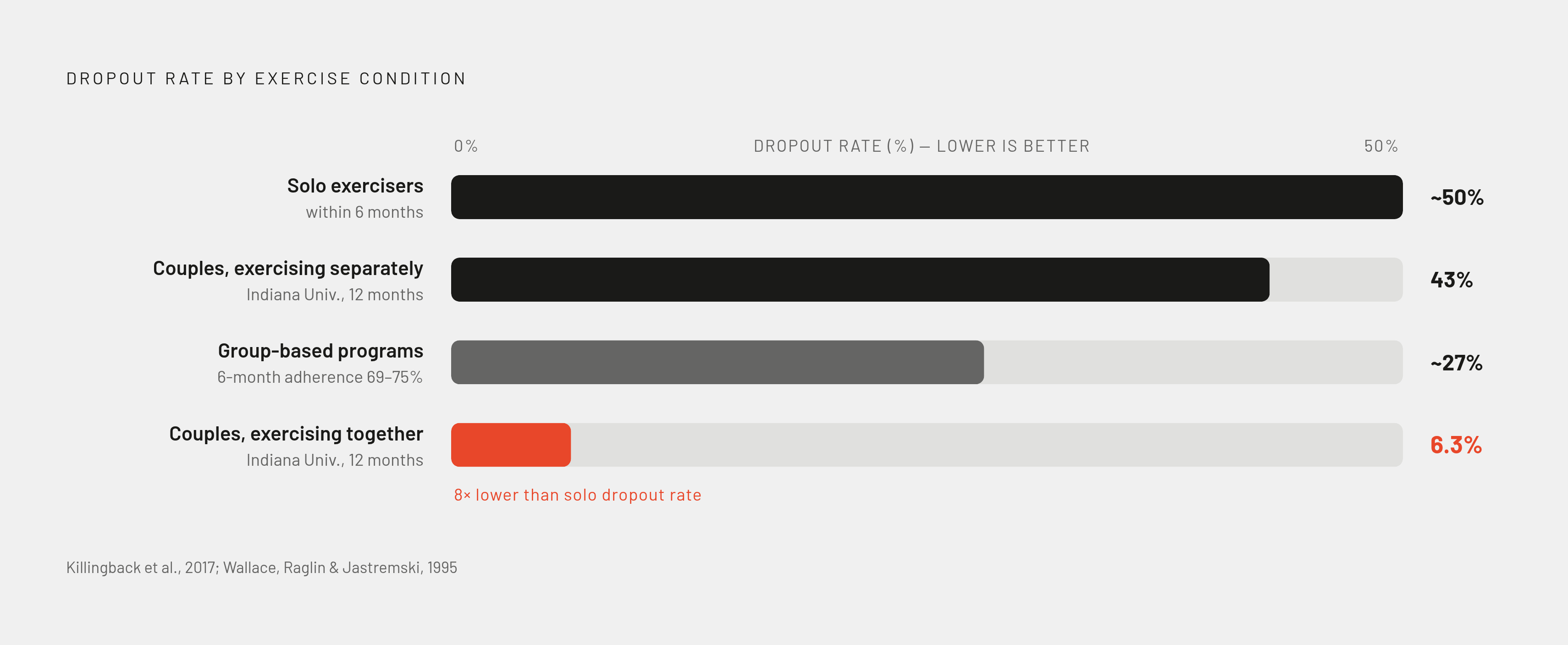
The fastest way to guarantee you'll quit working out is to do it alone. Solo exercisers drop out at rates as high as 50% within six months. That number has been floating around fitness research for years, and it holds up. The fix most people reach for is accountability. Find a partner, join a group, tell someone your plan. But here's where fitness advice gets lazy: it treats accountability like a single thing, a switch you flip, when groups and one-on-one partners actually work through completely different mechanisms. Getting clear on that difference is the whole game.
There's also a stat you've probably seen: "you're far more likely to achieve your goal if you commit to someone." It circulates constantly. Nobody can trace it to a primary source. It is directionally true. The actual research base on social accountability is solid and worth taking seriously. But that specific number is fitness-industry lore, and it's worth naming that upfront so you can weigh real evidence when it shows up.
The point of this article isn't to pick a winner. Groups and one-on-one partners are genuinely different tools. One fits certain people and certain goals. The other fits different ones. Here's how to tell which is which.
How Accountability Creates Follow-Through (and Why the Mechanism Actually Matters)
Accountability works, in large part, because of something researchers call implementation intentions. Basically: you're far more likely to do something when you've specified when, where, and how you'll do it, rather than just wanting to do it in the abstract.
Gollwitzer and Sheeran's research on this mechanism, revisited in a 2024 meta-analysis across 642 tests, found the effect on follow-through is real and durable. Its size depends on how the plan is structured and how motivated the person already is.
Telling another person your plan, and expecting to report back, is one of the most reliable ways to trigger this. Matthews' 2015 goal achievement study found that reporting weekly progress to a partner produced stronger results than writing goals down alone or simply thinking about them. The check-in is what activates the commitment. Not just having a partner. The check-in.
The University of Aberdeen found something important too: gaining a new exercise companion increased workout frequency, but the effect got stronger when that companion offered emotional support, not just a shared schedule. Quality of support matters more than logistics. That's a theme you'll keep seeing.
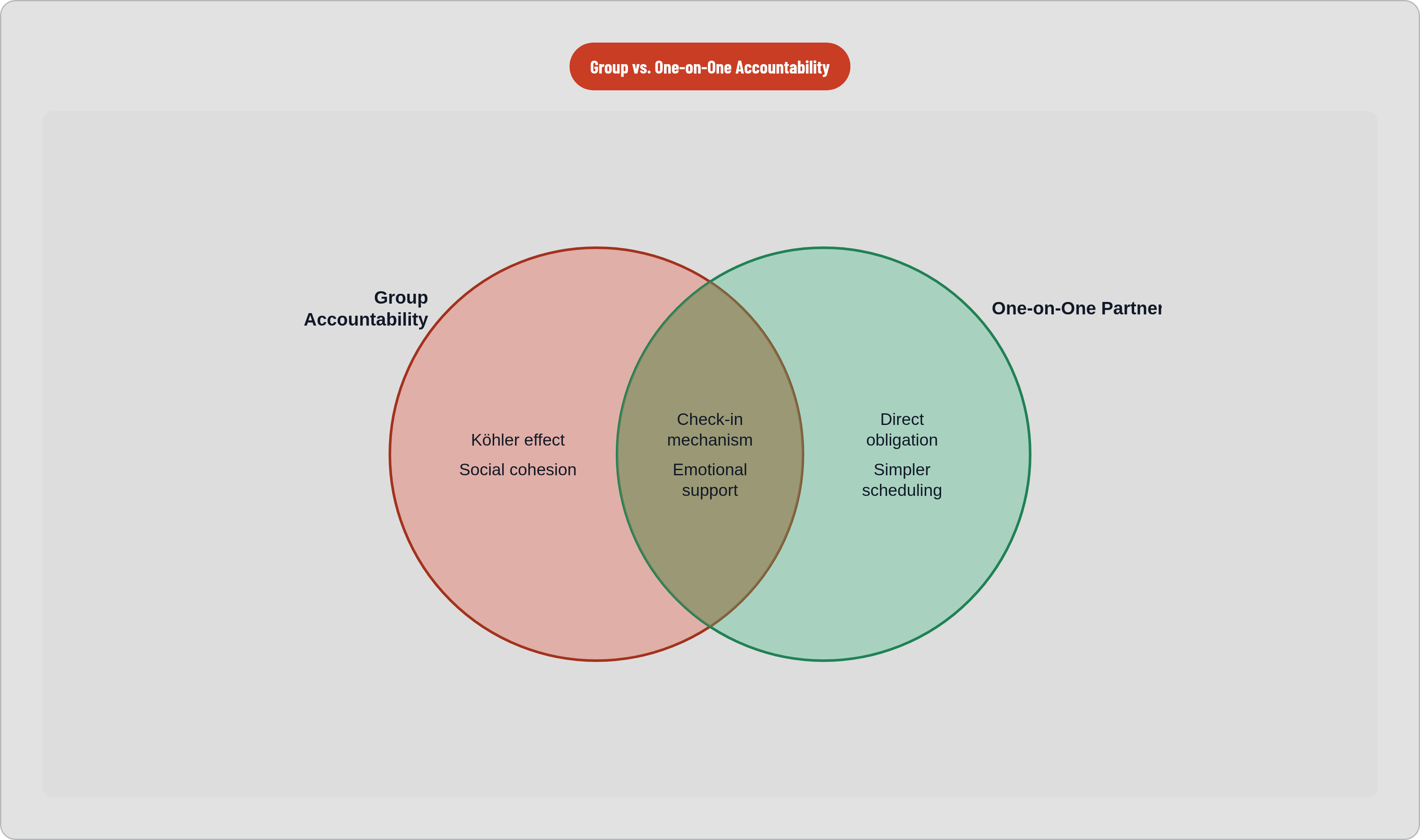
Here's the key distinction to hold onto. Both groups and one-on-one partners activate the same underlying mechanism. But they do it through different social dynamics. Groups create diffuse collective pressure. One-on-one creates direct personal obligation. That difference is everything when you're trying to figure out which one will actually work for you.
What Group Accountability Actually Does to Effort and Consistency
Group-based exercise programs achieve six-month adherence rates between 69% and 75% (Killingback et al., 2017). That's a meaningful improvement over what solo exercisers typically manage.
Part of what drives that is something called the Köhler effect. Nobody wants to be the weakest link. The presence of someone slightly better pulls your effort upward, almost automatically. A 2023 preregistered meta-analysis in Kinesiology Review, covering 19 peer-reviewed studies and over 1,900 participants, found a statistically significant overall motivation gain for conjunctive partnered exercise versus individual exercise. One of the original conjunctive task studies found that participants in the partner condition averaged around 22 minutes on a stationary bike, compared to about 11 minutes in the individual condition. That's not a small difference.
One caveat worth noting: under high-intensity interval conditions, the Köhler effect disappears. At the upper end of effort, enjoyment and self-efficacy take over as the main drivers. Group performance benefits are most reliable in moderate-intensity work.
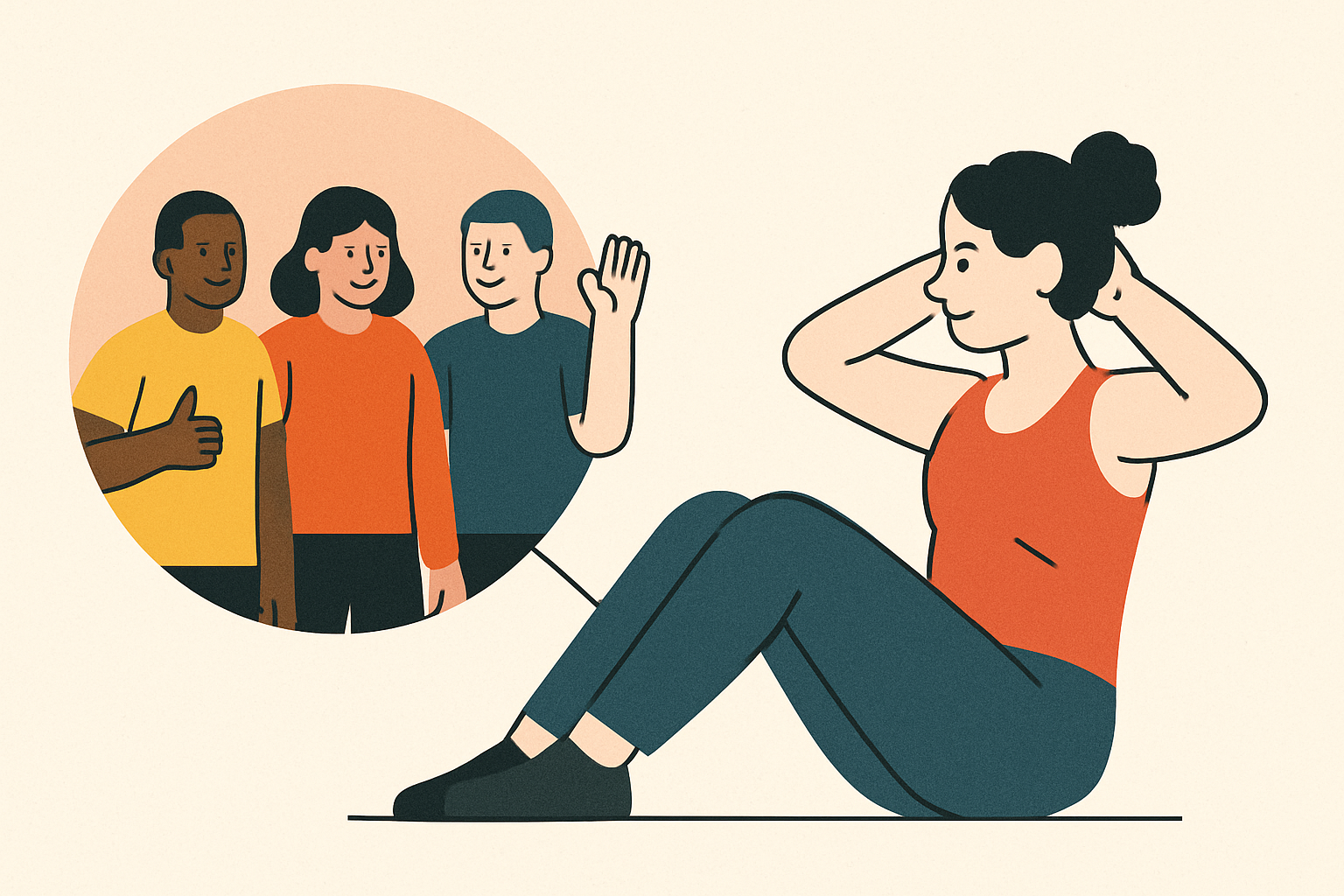
Beyond performance, groups create cohesion. A sense of shared identity. Burke et al. (2006) linked that cohesion to higher attendance compared to individual-based programs. A 2025 Frontiers in Psychology study found that group fitness can reduce feelings of inferiority while promoting peer bonding. The belonging effect has mental health dimensions that go beyond just showing up more often.
There's also a practical resilience advantage that doesn't get enough attention. If one member misses a session, the group continues. The system doesn't collapse around one person's bad week. And that structural durability matters. Research on mobile fitness contexts found that compliance scores were meaningfully higher in team conditions than solo conditions, which suggests the group effect transfers into digital formats too.
Where Group Structures Strain and Who They Can Leave Behind
Coordination friction is real and it's underrated as a quitting trigger. Finding times that work for multiple people, designing sessions that meet varied fitness levels, managing the drift when commitment levels diverge. Any one of those can become the first excuse. And once the first excuse lands, it gets easier to find the next one.
Motivational climate is a decisive variable. Competitive group norms can energize people who are already relatively fit while making things actively uncomfortable for people who feel behind. Research distinguishes between mastery-focused group climates, which are associated with better well-being, and ego- or performance-focused ones. The difference is usually in how the group was set up, not just who joined. For people carrying body-image concerns or returning to exercise after a long break, the group dynamic can work against belonging rather than for it.
Some people respond well to public challenges and collective energy. Others find group settings amplify self-consciousness rather than motivation. That's not a character flaw on either side. It's just personality. And it's a genuine moderator, not a minor caveat.
There's also a diffusion problem. In a group of eight, your absence is noticeable. But it's also impersonal. The group goes on without you. For some people, that makes it easier to drift rather than harder.
What One-on-One Accountability Offers That a Group Structurally Cannot
When it's you and one other person, your absence immediately and personally affects them. There's nowhere for that to diffuse. The obligation is direct in a way group membership rarely achieves.
The most-cited real-data point here comes from a study of couples at Indiana University (Wallace, Raglin & Jastremski, 1995). Couples who joined health clubs and worked out separately had a 43% dropout rate over a year. Couples who worked out together dropped that rate to 6.3%. Worth noting: these were married couples, not general peer partnerships. The intimacy and existing commitment of that relationship likely amplifies the effect. But the directional finding is consistent with a 12-week qualitative study of couples that found perceived partner support was a key reported driver of exercise adherence. It's the quality of the relationship, not just the shared schedule, doing the work.
One-on-one structures also have a real edge when your goal requires individualized feedback. Rehabilitation, technique-heavy training, or goals that need to adapt as circumstances change are harder to serve in a group setting. A group has to calibrate to multiple people. Your partner calibrates to you.
Scheduling is simpler too. Coordinating two people is categorically easier than coordinating many. That matters more than it sounds for people with irregular hours, caregiving responsibilities, or frequent travel.
One thing to keep clear: an accountability partner is a peer asking "did you do what you said?" They're not a coach providing expertise. Keeping that role distinction clear prevents the relationship from drifting into friendly weekly chats that feel supportive but don't actually change behavior. The check-in needs to stay a check-in.
Where One-on-One Partnerships Break Down
Single point of failure. If your partner loses motivation, gets injured, or faces a life disruption, your accountability system goes with them. That's not a theoretical risk. Roughly half of accountability partnerships dissolve within three months due to schedule conflicts, life changes, or one partner losing motivation. The fragility is common, not a fringe outcome.
Unequal commitment creates resentment in both directions. The more motivated partner feels unsupported. The less motivated one feels judged. When that pattern sets in, both often disengage rather than address it directly. It's an awkward conversation, and people avoid awkward conversations.
The intimacy that makes one-on-one accountability powerful can also work against honesty. Social politeness softens feedback. The check-in starts to feel more like a reassurance call than an actual accountability moment. Contrast that with group dynamics, where accountability has some natural diffusion that protects individual relationships from the full weight of a missed session.
How to Read Your Own Tendencies Before Picking a Structure
The right format depends not on which structure looks better in theory but on how you actually show up. Your social wiring. Your schedule. What kind of pressure motivates versus deflates you.
Some questions worth sitting with honestly:
- Do you respond to collective energy, or does a crowd make you self-conscious?
- Is your schedule predictable enough to commit to group timing, or would coordination friction become the first excuse?
- Are you more motivated by not letting one specific person down, or by not wanting to fall behind a group?
- Does your goal require individualized feedback and adaptation, or is showing up and moving the main job?
- If your partner quit tomorrow, would you find a new one, or would your system collapse?
People who prefer private goal-setting and individual recognition tend to thrive in one-on-one structures. People who draw energy from collective momentum tend to thrive in groups. Neither preference is a character flaw.
One pattern from the research worth noting: adherence to group-based physical activity is similar for men and women, even though men show higher leisure-time activity overall. Groups are a particularly equitable format for women who have historically been underserved by gym culture. The format matters more for some populations than for others.
And one thing that's easy to overlook: partners who exercise separately but check in still experience accountability. Shared commitment doesn't require identical schedules or the same workout.
Why Hybrid Structures Work and How to Build One That Doesn't Overcomplicate Things
The formats aren't mutually exclusive. Research on hybrid models suggests that combining home-based programs with in-person group sessions enhances engagement and adherence while preserving scheduling flexibility. A useful frame is to think in layers. Different layers close different escape routes.
A practical layered approach for most people looks something like this:
- One close partner as the primary direct-commitment layer. The person whose question "did you go?" actually lands.
- A group or community as the ambient motivation layer. Collective energy for the days when personal commitment alone isn't enough.
- Simple shared tools: a workout photo, a weekly check-in message, a small friendly wager. Things that keep the connection active without requiring synchronized schedules.
The risk of layering is overcomplication. A system that requires too much coordination will be abandoned before it produces results. Simple, visible, and low-friction beats comprehensive and elaborate every time.
Apps with shared goal features, workout photo sharing, and friendly wagers can bridge both structures. They let partners maintain connection whether they train together or apart, without demanding perfect data logging or matching schedules. Sweatmates, a fitness accountability app for couples, is built for exactly that first layer: it gives partners shared workout tracking, photo check-ins, and friendly wagers so the direct commitment between two people stays active whether they train side by side or on separate schedules. The nudge from your partner, the shared streak, the weekly recap, those are the mechanisms the research keeps pointing to, and Sweatmates is designed to deliver them.
An active NIH-registered clinical trial (NCT06662292, registered 2025) is currently examining whether adding digitally-delivered social support to existing digital physical activity programs improves outcomes. The research is catching up to what practitioners and everyday exercisers have already been doing in hybrid formats.
What Makes Either Structure Actually Hold Over Months Rather Than Weeks
The format doesn't determine long-term success. The quality of the commitment within the format does.
What the University of Aberdeen research pointed toward: emotional support and encouragement within the partnership, not just shared logistics, is what strengthens exercise frequency over time. That's not a soft finding. It's the mechanism.
Consistency is what compounds. A workout shared with someone, even imperfectly, outperforms an optimized solo plan followed for three weeks and then abandoned. Every time.
Missing a session should trigger reflection, not shame. The accountability structure that handles a missed week with honesty rather than judgment is the one people return to. Structures that feel like obligations waiting to catch you in a failure tend to get quietly dropped.
Celebrating showing up, not just measuring performance, is what keeps either structure from becoming another thing to feel bad about.
The best accountability structure is not the one with the strongest research backing in a lab setting. It is the one a specific person keeps returning to, with a specific other person or group, over real time. In six months. In a year.
The practical question isn't "which format is better." It's "which one will you actually still be using in six months?" That answer depends on self-knowledge more than any study. And you probably already know more about that than you're giving yourself credit for.