apps designed for two-person fitness accountability
Social pressure from one real person beats motivation from an app alone.
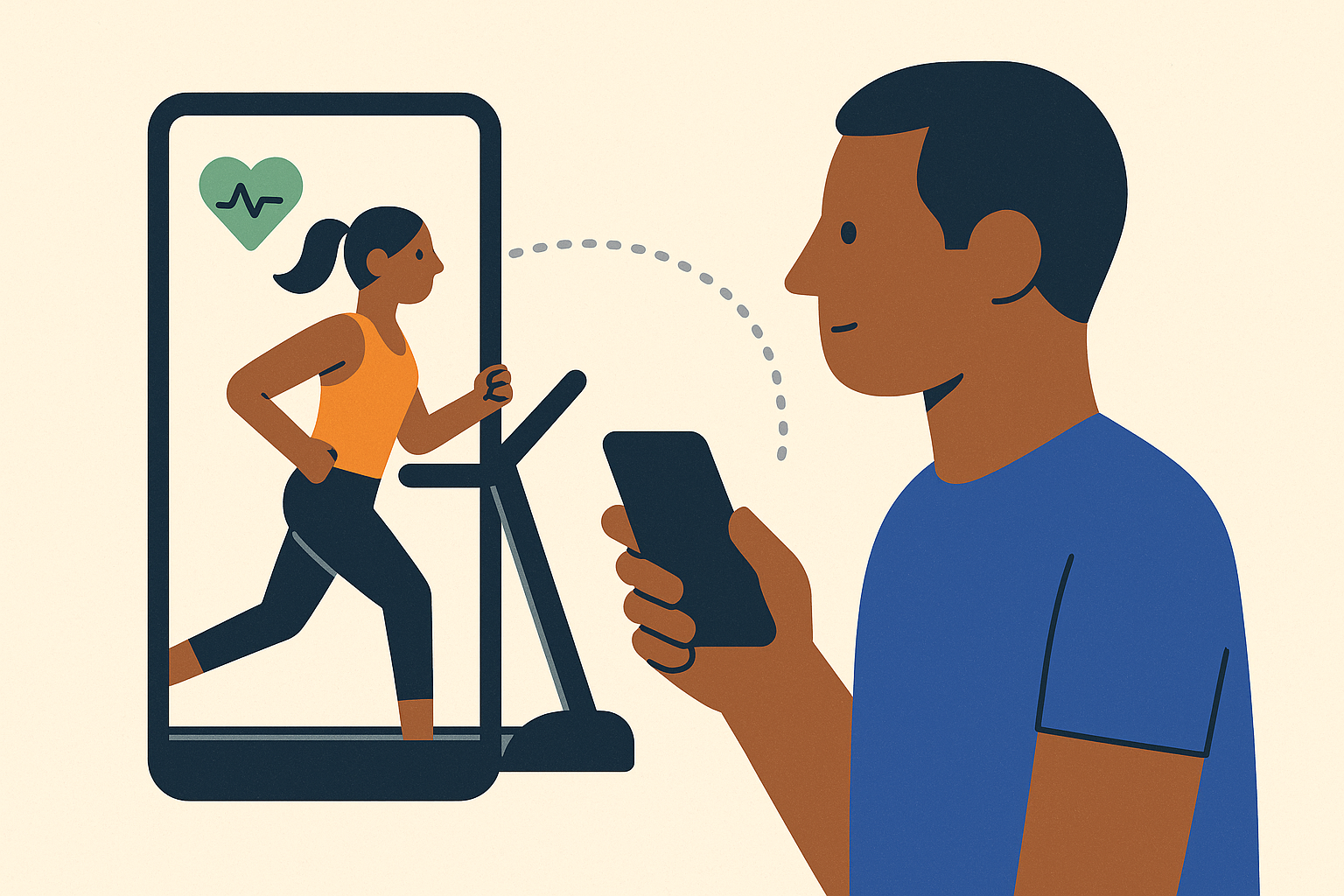
Two-person fitness apps work because they replace a dashboard with a witness. Nobody feels guilty ghosting a chart, but people feel something entirely different when they ghost a person who's expecting a photo from them at 7am.
Most fitness apps still treat you like a solo act: your steps, your calories, your streak that nobody else will ever see. That's the actual gap here. A missed workout costs you nothing socially when the only entity tracking it is an algorithm that doesn't care if you live or die. One missed day turns into three, and then the app just becomes an icon you feel vaguely bad about every time you scroll past it. Two-person apps exist to fix exactly that: they make your absence visible to someone who'd actually notice, and who'd actually ask where you went.
What the research says about why a second person changes things
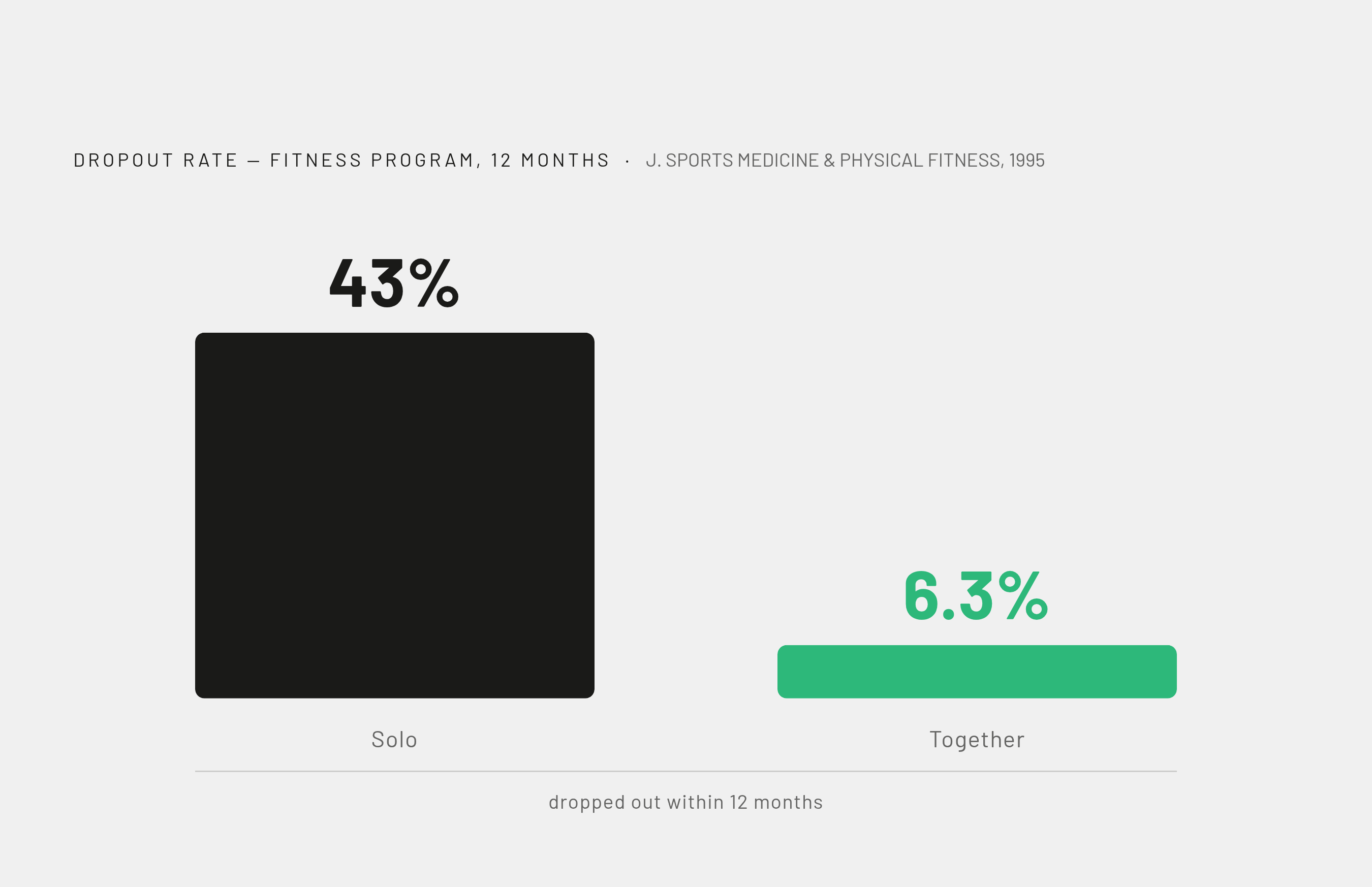
Here's a number that should stop you mid-scroll. A 1995 study in the Journal of Sports Medicine and Physical Fitness found that only 6.3% of couples who joined a fitness program together dropped out over 12 months, while people who joined alone dropped out at a rate of 43%. That's a landslide, and it's not explained by carpooling or convenient scheduling. Something relational is doing the heavy lifting.
Research into exercise companionship has found that getting a new exercise companion boosted how much people exercised, but the companionship itself wasn't the active ingredient. Emotional support was. The finding's framing: it matters more to encourage each other than to do the activity side by side. Which is good news if your workout buddy lives four time zones away, because it means the encouragement can travel even when your bodies can't.
A separate cross-sectional population study found people who exercised with companions were 32% more likely to hit sufficient activity levels and 45% more likely to report good mental health, compared to people going it alone. Put those numbers together and the takeaway is clear: the mechanism runs on care rather than surveillance. An algorithm flagging your inactivity is a parking ticket. A partner noticing you went quiet is something else entirely.
The window when accountability matters most
Habit formation isn't instant, and exercise habits are slower than most. Research published in the European Journal of Social Psychology found habits take an average of 66 days to form, and exercise habits run about 1.5 times longer than simpler behaviors.
Translation: weeks two through four are where things fall apart. That's when the initial burst of motivation has worn off, but the habit hasn't calcified yet. You're standing in the gap, and it's a long gap.
This is exactly where a second person earns their keep. Their presence gives you something to lean on before your own willpower can carry the weight. So when you're evaluating one of these apps, don't just ask if it tracks workouts. Ask if it keeps both people showing up through week three, because that's the actual test.
The structural difference between two-person apps and general social fitness platforms
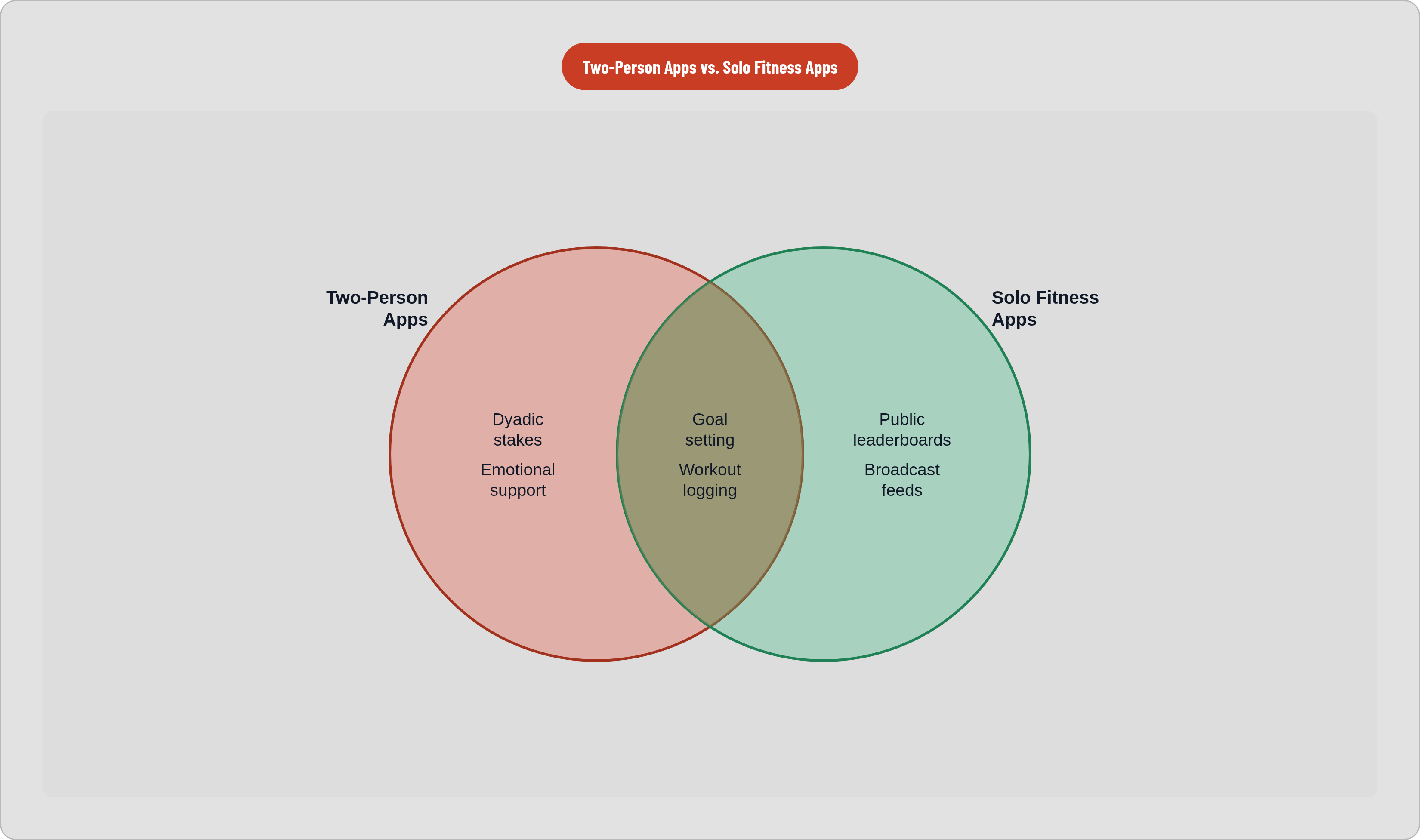
General social fitness platforms are broadcast machines. You post a workout, people you've never met give it a thumbs up, and somewhere a leaderboard exists that you check obsessively and pretend you don't. Accountability there is diffuse, optional, and nobody's really counting on you specifically.
Two-person apps work differently. The person on the other end isn't an audience, they're a counterpart. You're checking in with someone who's checking in back, rather than performing for a feed.
A few things define this category structurally:
Shared visibility instead of a public feed: both people see each other's check-ins, and nobody else does.
Mutual commitment: it's not one person supporting another, both people have skin in the game.
Asynchronous design: you don't need to be in the same gym, same city, or same time zone. The app holds the thread between you.
Dyadic stakes: what happens when someone misses gets worked out between two people, not broadcast to a crowd.
The narrowness is the whole design. One person who actually shows up beats a hundred followers who double-tap and move on.
Apps that put showing up ahead of performance metrics
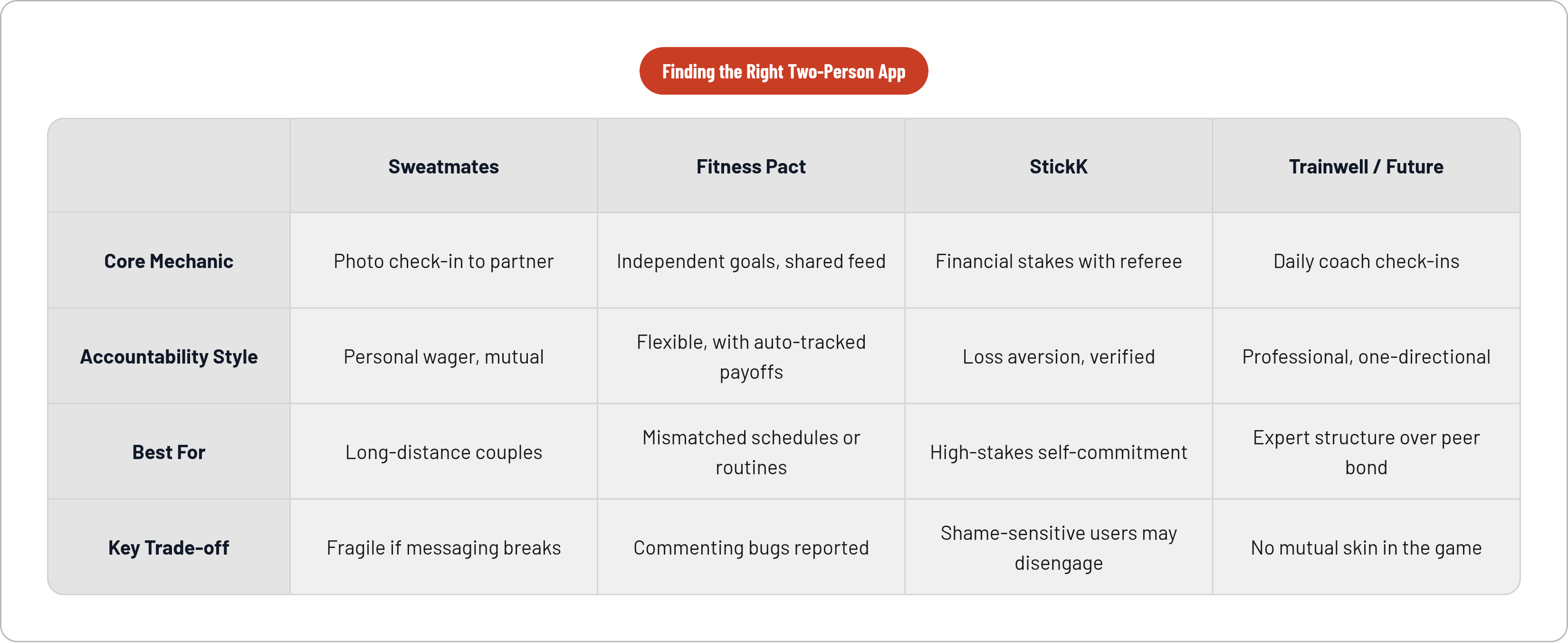
Sweatmates is built around a single question: did both of you show up this week? Partners set a weekly workout goal and check in with a photo, sent instantly through something called "SweatCam," straight to the other person rather than into a public feed.
Miss your goal, and you owe something small and personal, usually whatever the two of you agree on. Dinner. A chore. Nothing that feels like a court summons, in other words. Reviewers note it works especially well for long-distance couples, where the photo check-in becomes the one small daily thread connecting two people who can't actually train in the same room.
Fitness Pact takes a slightly different shape. Each partner sets their own workout type and frequency, independently, so you're not forced into the same routine or even the same time zone. There's a shared group feed for encouragement, and the app automatically tracks "payoffs" when someone misses a goal. It's positioned deliberately as a fitness connection, not a social feed. Worth noting: some App Store reviews mention a commenting bug that's disrupted the core communication loop, and that's a useful reminder on its own, because these apps are fragile in a specific way. When the messaging breaks, there's no group of forty people to absorb the slack. It's just the two of you, and if the line goes dead, so does the accountability.
Both apps share the same core belief: your partner knowing you showed up is the product, not a bonus feature bolted onto a tracking app.
Apps where commitment has financial or verifiable stakes
StickK was built around a simple idea from behavioral economics: people fight harder to avoid losing something than they ever fight to gain the same thing. Set a goal, decide what happens to your money if you fail (a friend gets it, or worse, a cause you can't stand gets it), and appoint a referee to confirm whether you actually did the thing.
That referee is your second person, functioning as a verifier rather than a cheerleader. Different relationship than the photo check-in or personal-wager model, but just as dyadic; there's still one specific human on the other end of your commitment. StickK reports over 600,000 goal-setters have used the platform.
There's outside research backing the general approach. The STEP UP randomized clinical trial, covering 602 adults, found that gamification with competition was the most effective of the social incentive structures tested, and the only one whose benefits held up after the study ended.
But financial stakes aren't universally motivating. If you're wired for loss aversion, a dollar amount on the line lights a fire. If you're shame-sensitive, that same mechanic can quietly push you to disengage instead of try harder. Choosing the right pressure type matters as much as choosing the right app; a lot of people who "fail" at these tools didn't fail at fitness, they just picked a flavor of accountability that fought their personality instead of working with it.
When a professional fills the second-person role
Trainwell and Future sit at the premium end of this category, where the second person is a certified personal trainer who checks in daily, adjusts your plan when your knee starts complaining, and notices when you've gone quiet for a week. Trainwell holds a 4.9-star rating across thousands of App Store reviews.
The accountability logic is similar to the peer model. A real person notices your absence, but the relationship is professional, and the price tag reflects that. What you're buying is consistency: your coach doesn't have an off-week where their own motivation craters and drags yours down with it. The attention flows one direction, and it flows reliably.
What you don't get is mutuality. There's no shared identity forming here, no sense of "we're the two people doing this together," because one party is being paid to show up. Great fit if you want expert structure and don't need the relational texture of a peer partnership. Less great if the whole appeal for you is having someone in it with you, not just for you.
How mismatched fitness levels and schedules get handled
Real objection, and a fair one: partners rarely match on strength, mobility, experience, or free time. Force two mismatched people into one identical program and you'll end up with one person bored out of their mind and the other one limping to the car.
The smarter apps in this space solve it by decoupling accountability from identical workouts. In apps like these, each partner sets their own goal and works toward it on their own terms. The shared layer is the visibility and the commitment sitting on top of it, not the workout itself. Some more built-out couples apps go further, using AI-driven personalization to calibrate each partner's plan to their own capacity, so nobody's pacing the other person or getting dragged along.
The asynchronous design does double duty here too. Different cities, different work schedules, it doesn't matter, because a weekly photo or a goal summary connects two people without requiring them to be in the same room at the same time. The underlying principle is worth repeating: being accountable to each other doesn't mean doing the same thing. It means both people's effort is visible to the other, and that's the whole trick.
What actually makes someone stay with one of these apps
Two-person apps have one obvious weak point: they're only as strong as the weaker link. If one person checks out, there's no group of thirty other members to keep the momentum going. Compare that to a group challenge, where one silent member barely registers. Here, one silent partner can collapse the whole thing.
So what keeps people in? Circling back to the Aberdeen research, emotional support, rather than surveillance intensity, keeps the wheels turning. A few design choices show up again and again in the apps that people actually stick with for months instead of weeks:
Check-ins that take ten seconds, like a photo, not a full workout log nobody wants to fill out after leg day.
Stakes that feel playful, a dinner bet, not punitive, a wallet hit.
Weekly goals instead of daily streaks, so one bad Tuesday doesn't blow up your whole month.
A visible record of consistency over time, rather than a scoreboard obsessed with today's number.
If public feeds and leaderboards motivate you, a two-person app might feel too quiet, honestly, almost too intimate. But if public feeds always felt a little performative to you, like showing your homework to the whole class, this format is going to feel like a relief. Some apps lean hardest into the durability side of this equation: no performance data, weekly resets, ten-second photo check-ins, small personal wagers. The entire design is built around one repeatable question, will both of you come back next week, and not much else.
Picking the right app for the relationship you're actually in
This isn't really a feature comparison. It's a question about what kind of pressure your specific relationship, and your specific personality, can actually sustain for months rather than a couple of enthusiastic weeks in January.
A few pairings, based on what you're actually looking for:
Couples or close friends who want connection without matching workouts, especially long-distance: something built around photo check-ins and small personal wagers.
Partners who want flexibility in what they track, plus a bit of group texture alongside the one-on-one: Fitness Pact, where each person sets their own goal and a shared feed adds encouragement on top.
Someone who responds to real financial stakes and wants formal verification: StickK, where the referee model and loss-aversion mechanics are explicit, and grounded in actual behavioral economics research.
People who want expert structure and consistent check-ins over peer camaraderie: Trainwell or Future, where a professional fills the second-person role with more consistency and less mutuality.
Before you download anything, ask yourself one honest question: what do you actually want to happen the week you miss a workout? A financial hit? A conversation? A photo from your partner proving they still showed up even when you didn't? Or genuinely nothing, just a quiet reset?
Whatever your answer is, it'll point you toward the right app faster than any spec sheet or star rating ever could.