Couples fitness accountability apps compared
Couples who work out together stay committed, but most fitness apps weren't built for two.
A married couple who joins a gym program together barely quits. A 1995 study in the Journal of Sports Medicine and Physical Fitness found only a small fraction of couples who signed up for a fitness program together dropped out over 12 months, compared to a much bigger chunk of married people who signed up solo. That gap tells you something important about the mechanism at work: accountability between two people rests on structure more than willpower. This piece breaks down which fitness apps actually build that structure into their design, and which ones just bolt a share button onto a solo tracker and call it a day.
A 2021 study by Sackett-Fox, Gere, and Updegraff (published in the Journal of Social and Personal Relationships) tracked 95 adults over 14 days and found something worth sitting with: on days people worked out with their partner, they reported better mood during and after the workout, and higher relationship satisfaction. Adherence and relationship quality move together. Add in the Köhler effect, which says people push harder and longer when working alongside someone else (even a virtual someone), and you get a pretty clear picture. Nobody wants to be the one who quits first, and once "we work out together" becomes part of how a couple sees itself, skipping a session stops being a minor lapse. It becomes breaking a shared routine, which is a much bigger deal than missing a personal goal.
All of that explains why partner fitness works, but it says nothing about which apps actually recreate those conditions on a phone screen. That's the gap this piece fills.
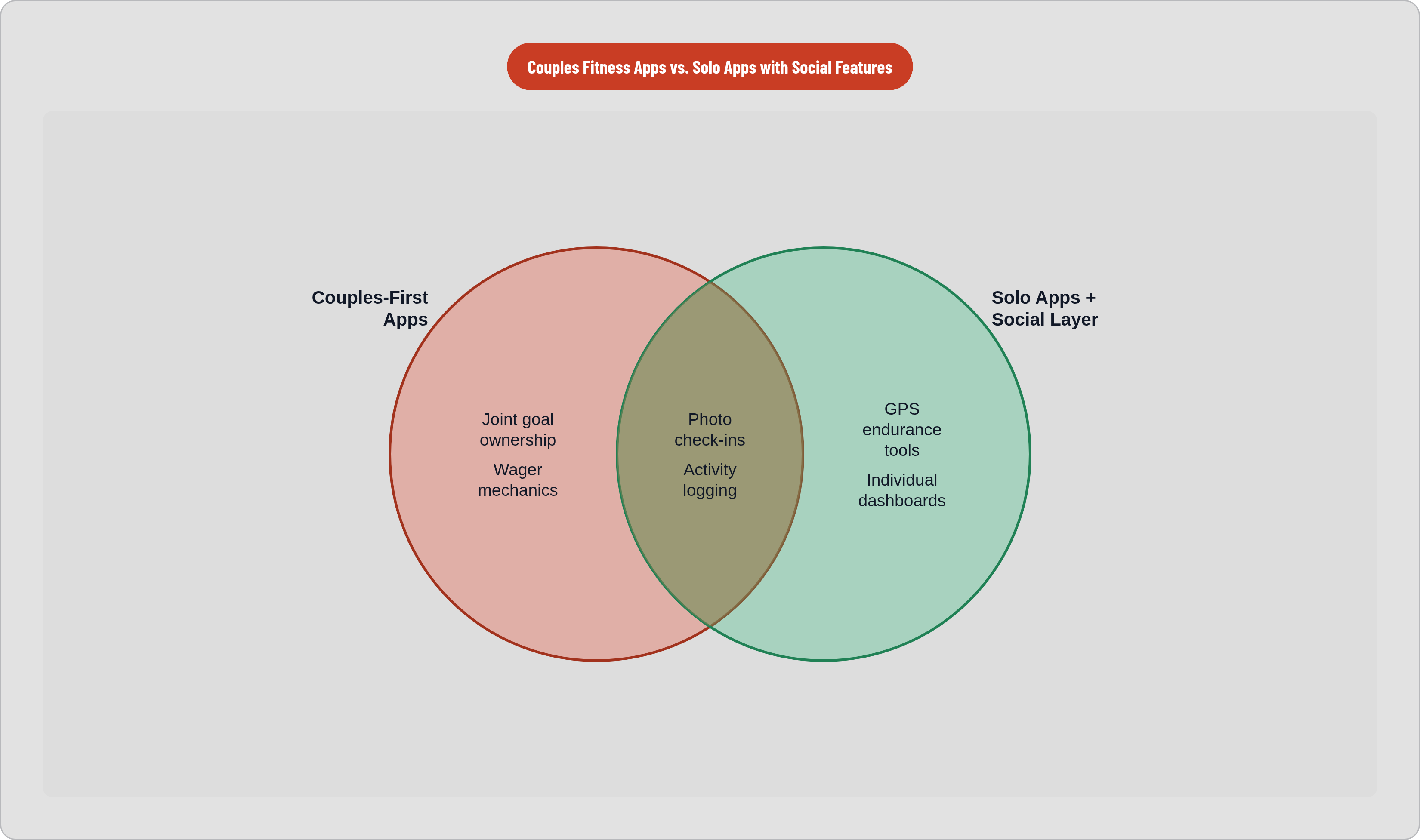
What separates a genuine couples fitness app from a solo app with a share button
Most fitness apps are built for one body, one goal, one dashboard. Social features get added afterward, like a garage turned into a bedroom. It works, technically, but the wiring wasn't meant for it.
A real couple's app has to handle two people who might have different fitness levels, different sports, and different schedules, while still building toward something shared. Four things determine whether an app clears that bar.
First, goal structure: are the two people tracking side-by-side individual goals, or is there one goal neither partner owns alone? Second, check-in visibility: is it ambient, meaning your partner happens to notice your log, or engineered, meaning a prompt, photo, or wager fires the moment something happens (or doesn't)? Third, encouragement mechanics: passive likes and kudos, or active stakes that both people have to maintain? And fourth, modality fit: does the app only track steps, only track running and cycling, or does it work for whatever the two of you actually do?
There's a fifth filter worth adding, and it might matter more than the other four combined. What happens when one partner misses a day? Does the app treat that as a shared event, something the couple works through together, or as an individual failure logged quietly against one name? That single design choice decides whether a rough week pulls two people closer or just creates friction. Every app below gets measured against these five things.
Sweatmates: the case for radical simplicity in a two-person accountability loop
Sweatmates is built for exactly two people. Couples, best friends, siblings, whoever — but always a pair, with no group mode repurposed for two.
The loop is simple: set a weekly goal for number of workouts, log each one with SweatCam (a photo your partner sees right away), and owe a small wager if you miss it. Dinner, a chore, whatever the two of you agree on ahead of time. No stats, no GPS tracking, no calorie math. The only question the app asks is whether you showed up, and that lines up neatly with the research: social visibility drives adherence more than a pile of data ever will.
User reviews mention long-distance couples using it as a daily touchpoint that doesn't require a full conversation. Just a photo, a quiet signal that both people are still in it. It's available on iOS and Android.
The two-person design cuts both ways. One reliable partner is about as strong an accountability system as exists, but one unreliable partner is a single point of failure; there's no group to absorb a bad week the way a bigger cohort might. This approach has real limits: no wearable syncing, no workout plans, no nutrition tracking. If either partner wants performance data alongside the accountability piece, this kind of app won't give it to them. It's built for couples whose real obstacle is showing up, not couples who need coaching or metrics.
GymRats: flexible scoring makes it the most modality-agnostic option for active couples
GymRats has been downloaded 3.1 million times and holds a 4.77 out of 5 rating across 100,000 ratings, which represents a strong validation signal among the apps in this comparison.
The mechanic: create a private challenge for two, pick a scoring metric, and log workouts with a photo and title. Any activity counts, which matters more than it sounds. The flex scoring is the real differentiator here. Couples can score by workout count, miles, minutes, calories, steps, or a fully custom point system, so one partner lifting weights and the other running can still compete on equal footing. Challenges can be set to private, so it's not broadcasting your gym selfies to strangers.
The time-boxed challenge format also does something quietly clever: a couple who finishes a 30-day challenge and starts a new one is re-committing, over and over. That repetition reinforces the shared-identity effect mentioned earlier. There's one technical wrinkle worth flagging: a 2025 update broke Google Health and Health Connect syncing for some Android users, which stops automatic workout logging from coming through. Android couples who want that passive sync should test it before committing to the app as their main tool. GymRats Pro adds advanced stats and upgraded chat (mentions, reactions, threaded replies), but the free tier handles a basic private challenge just fine. Best fit: couples with different training styles who want a fair, competitive scoreboard, and friend groups that happen to include a couple.
Strava: ambient accountability at massive scale, with real limits for couples who don't run or ride
Hundreds of millions of people use Strava across more than 185 countries, and the social feed carries real weight because of that scale. When a partner's run shows up in your feed, it's visible in a way that feels almost unavoidable.
The accountability here is entirely ambient. One partner logs an activity, it lands in the other's feed, kudos and comments follow. There's no paired-workout mode, no joint goal-setting, nothing engineered specifically for two people. Strava functions as an individual log with a social layer draped over it, without the structural features that define a dedicated couples app.
It works well when both partners run, cycle, hike, or walk; the feed stays relevant, and premium features like heart rate zones and training load add value on both sides. It breaks down fast for gym lifting, yoga, or strength training, since Strava's premium tools are built around GPS-based endurance sport. A couple where one person lifts and the other runs ends up with a lopsided experience, one partner gets a rich dashboard, the other gets a blank one. Recent acquisitions (Runna for running plans, The Breakaway for cycling) push the platform further into endurance sport. Worth noting: Strava's 2025 Year in Sport report recorded billions of kudos given that year, so the encouragement mechanic clearly gets used at scale, even without being couple-specific. Best fit: couples who already share a running or cycling habit and want passive mutual visibility without changing how they train.
Fitness Pact and Habit Huddle: two ways to use commitment contracts as the accountability engine
Both apps run on the same behavioral logic: make the cost of quitting real before you actually quit. A gamification trial by Patel and colleagues, published in JAMA Internal Medicine, found families in a gamified step-goal program hit their targets at a meaningfully higher rate than a control group, and kept that higher activity level even after the program ended. Commitment devices work. These two apps just build them differently.
Fitness Pact lets couples set up custom pacts with defined consequences for not following through, using similar wager logic, but framed more explicitly as a contract. It supports both diet and exercise goals and leans into the "shared journey plus healthy competition" framing. It's iOS only, which rules it out for any couple split across Android and iPhone. A 2025 update also broke in-app commenting (the app froze whenever someone tried to comment); patch notes suggest a fix landed in early 2026, but it's worth testing before leaning on it as your main communication channel. No wearable sync either.
Habit Huddle takes a gentler approach. Small groups, called huddles, commit to a habit and check in daily, and the shared "Checkin Chain" acts as the scoreboard. Every check-in adds a link; a missed day breaks the chain. The standout feature is the Floor/Ceiling design: couples define a minimum version of the habit (the floor) and a full version (the ceiling). On a bad day, hitting the floor keeps the chain alive, which directly undercuts the all-or-nothing trap that kills most streaks. Streak freezes and a 14-day vacation mode handle real-life interruptions without piling on guilt. It's available on iOS, Android, and web, with Discord and Telegram bot integration for couples already living in those apps. One caveat: Habit Huddle publishes its own comparison content, so treat any self-assessment from them with that in mind.
The split between the two is straightforward. Fitness Pact runs on consequences: miss it, owe something. Habit Huddle runs on continuity: miss it, the chain breaks, but the floor stops it from being catastrophic. Couples who respond to the fear of losing something will lean toward Pact, while couples who want steady, low-pressure persistence will lean toward Huddle.
FitWithLove, Stridekick, and Fitbit: three narrower fits worth knowing about
FitWithLove gives couples actual guided workout content: structured plans, step-by-step instructions for two-person exercises, per-person calorie tracking, more than 30 achievement badges, and streak tracking. It uses a one-time Pro purchase instead of a subscription to remove ads and unlock extra plans, which is a rare pricing model worth noting for anyone tired of monthly fees. The catch is real, though: this is a workout delivery app, with a narrower focus than an accountability layer. It only works when both partners are doing the same workout, at the same time, in the same place. Couples who train separately, at different gyms, or in different sports won't find a shared thread here. Best fit: couples new to working out together who want the app to tell them what to do, side by side.
Stridekick solves a different problem entirely: mismatched wearables. It syncs Fitbit, Apple Watch, Garmin, Withings, Polar, Xiaomi, and native phone step counting, so two people on totally different devices can still compete in the same challenge. It has more than 1 million users; the free tier now runs public 7-day challenges, and Stridekick Pro unlocks private challenges and longer time frames. The hard limit is that it only tracks steps, so couples doing gym work, yoga, or cycling won't have much to log. Best fit: couples whose shared habit is walking or running and who use different wearable brands.
The Fitbit app rounds this group out. It includes couples challenges plus sleep, heart rate, and activity tracking with side-by-side comparisons between connected users. The catch is obvious: both people need to already own Fitbit hardware, which is a real barrier if only one partner has a device. Best fit: couples who already own Fitbits and want challenge features without downloading yet another app.
How to match the right app to how two people actually exercise together
Forget the feature list for a second. The single biggest variable is whether the two of you train together in the same room, or separately on your own schedules.
Training together, same activity? FitWithLove works well for beginners who want guided workouts, and GymRats fits better if you're self-directed and want a bit of competition mixed in. Training separately but doing the same kind of thing, both running or both lifting? GymRats covers gym-based or mixed training, and some endurance-focused tools suit runners and cyclists. Training separately in completely different sports? GymRats fits well here, since it treats "showing up" as the shared metric instead of tying success to one specific activity.
The second variable is what kind of accountability actually moves each partner. A photo and a light wager works for couples who want zero friction, while an explicit contract with real consequences (Fitness Pact) suits people who respond to stakes. A streak-and-chain system with a built-in floor (Habit Huddle) fits couples who want persistence without shame spirals. An ambient social feed works for people who don't want to be managed at all, and competitive scoring across any activity (GymRats) suits couples who like a bit of friendly rivalry.
Third, check the technical fit. Mixed wearables point toward Stridekick, and both partners on Fitbit point toward the Fitbit app. An Android-and-iPhone household rules Fitness Pact out entirely, since it's iOS only.
And if the two of you can't agree on an app? Pick the one you'll both actually open, even if it's not perfect. The research is consistent on this point: consistency and shared identity matter more than which specific tool you're using. A flawed app both people use every day will beat a flawless app that one partner abandons after a week. The Köhler effect and the shared-identity research both point to the same conclusion: any of these apps, used consistently, beats having no shared structure at all. The app matters less than the choice to pick one together and actually stick with it.