accountability features that keep workout partners consistent without stat pressure
Workout partners beat leaderboards for keeping people consistent.
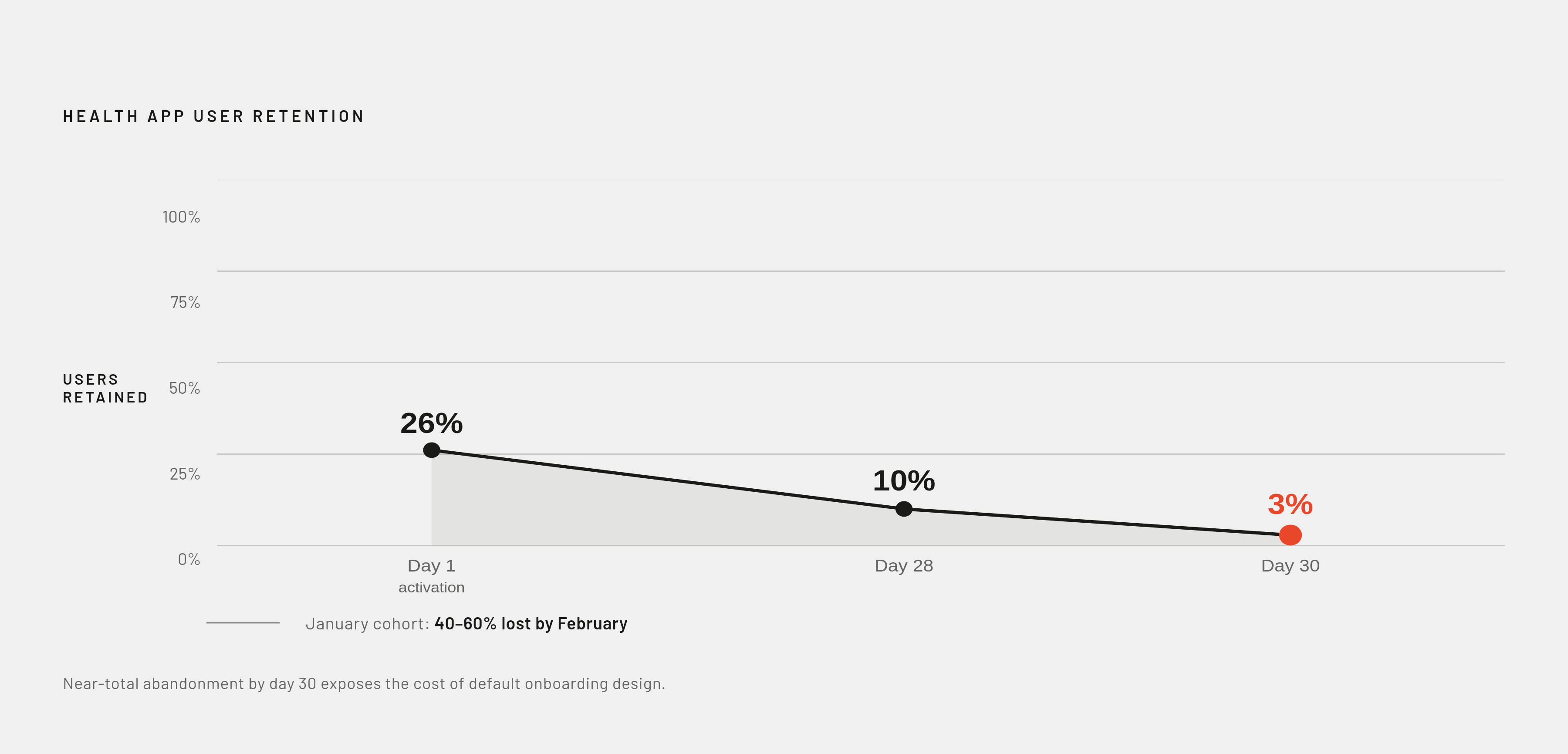
Health apps lose people faster than almost any other app category, and the data on why is pretty damning. Day 1 activation runs around 26%, and by Day 28 it's dropped to 10%, with only 3% of users still active by Day 30 (Business of Apps, 2023). Then every January, gyms and apps get flooded with new sign-ups, and by February, 40 to 60% of those people are gone, the same pattern repeating every year like clockwork.
A notable drop-off happens with apps built around manual logging: type in your reps, log your miles, chart your macros. The pitch is always the same, track more, know more, do better, except the numbers say that pitch doesn't hold up for most people. The design may well be broken, but the deeper issue is whether these apps ever built the one thing that actually keeps people moving: another human who notices when you show up.
What stat-heavy accountability does to the people it's supposed to help
A 2025 study looked at what happens when fitness apps let people compare performance with each other, and the results weren't pretty: comparison bred inferiority, frustration, and defensiveness, with little sign of the motivation it was meant to spark.
Leaderboards create a strange emotional seesaw: pride when you're on top, insecurity when you're not. One participant noted that running with a slower friend affected her own performance data, and a feature built to bring two people together ended up introducing friction rather than support.
Fear of judgment starts changing behavior in ways that have nothing to do with fitness, as people adjust their workouts not to get stronger but to protect a number on a screen. A 2025 paper published in Information Systems Research examined fitness technology-facilitated social comparison and its mediating role on well-being, finding that such comparison can work against the users it's meant to support. When accountability starts feeling like surveillance, something that only lights up when you mess up, it functions less like encouragement and more like punishment, a design flaw with real weight behind it, the whole engine running backward. The people who need the most support are usually the ones most rattled by comparison, which means the feature built to help them is often the one working against them.
What psychology says people actually need to keep exercising
Self-Determination Theory, a framework psychologists have used for decades to study motivation, points to three needs that keep people engaged in almost anything long-term: autonomy (it's my choice), competence (I'm getting better at this), and relatedness (someone else is in this with me).
SDT also draws a line between intrinsic goals, like health, skill, and connection, and extrinsic ones, like looking good or getting recognition, and intrinsic goals are the ones that predict whether someone sticks around. A 2025 review of 38 SDT-based exercise studies backs this up: interventions built around these needs boosted intrinsic motivation (effect size g = 0.29) and identified regulation (g = 0.23), while cutting external regulation (g = −0.16) and amotivation (g = −0.14). These are modest numbers, sure, but they're consistent across a huge body of research, which counts for something.
Translation: people stick with exercise when it feels like theirs, when they can see themselves improving, and when someone else is sharing the experience, far more than when a screen is simply watching them. Controlled motivation, working out to dodge shame or climb a leaderboard, drains people, while chosen motivation refills the tank, even after a hard workout. For workout partners specifically, relatedness is the need doing the heavy lifting, and it's the one data-first apps consistently forget exists.
How visible commitment to another person changes the math on quitting
Research comparing adults who joined a fitness program with a partner versus those who went in alone has found the paired group tends to show better attendance and fewer dropouts. Romance isn't doing the work here; the discomfort of standing someone up is, since breaking a promise to a specific person costs more than breaking a promise to an app.
Research has found that gaining a new workout companion can boost how often people exercise, and the effect tends to be stronger when that companion offers actual emotional support rather than just a shared time slot. Apps built for two people, like Sweatmates, a fitness accountability app for couples, lean on this by centering check-ins and shared goals over raw performance data. Logistics matter less than most people assume, since support does the heavy lifting.
People hate disappointing others more than they hate disappointing themselves, and that's leverage that good accountability uses without turning it into a weapon. Owing something to a person feels different from owing something to a system: one carries relationship weight, while the other is just data sitting in a database.
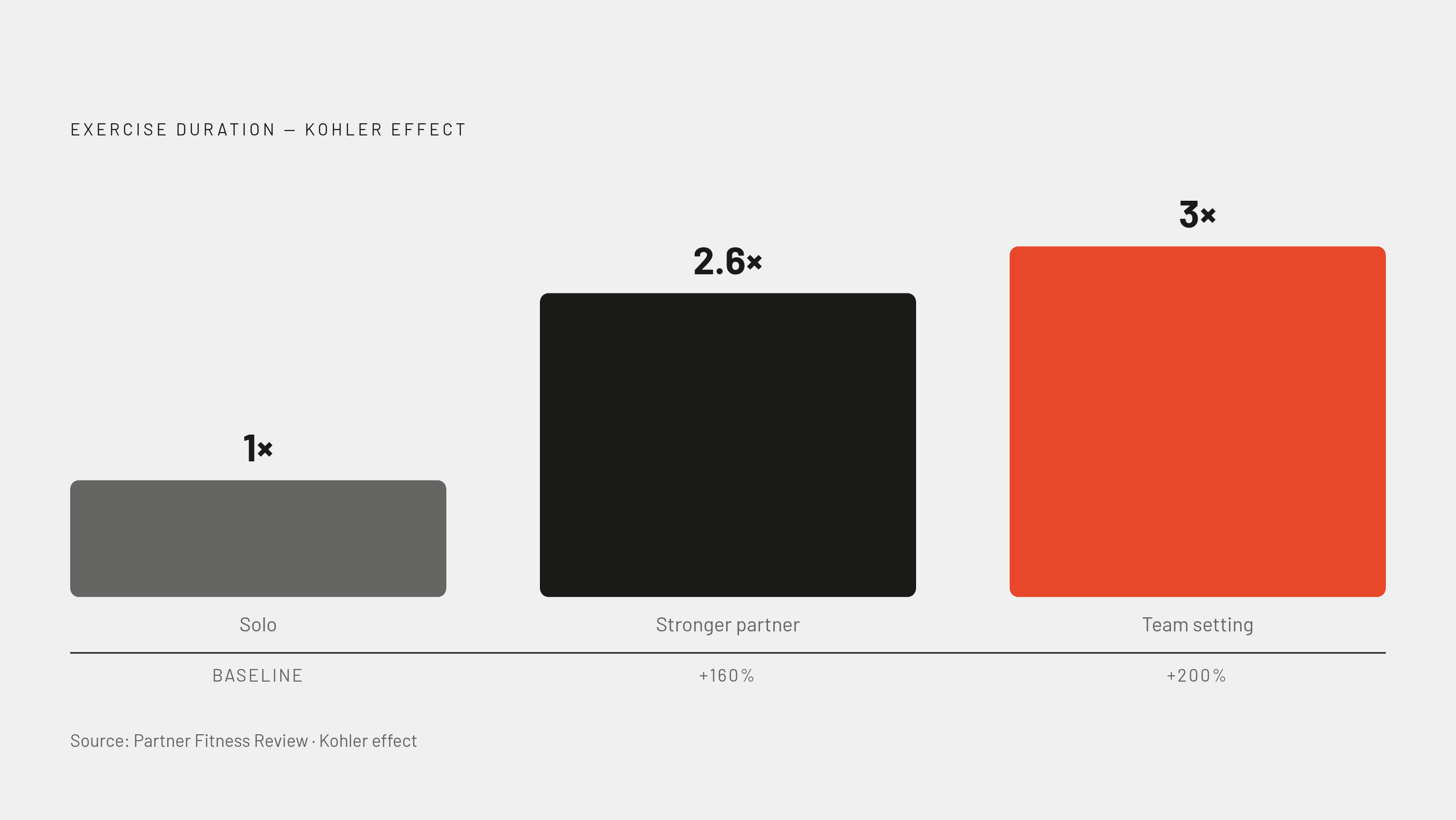
There's a well-documented pattern called the Kohler effect, where nobody wants to be the weak link in a pair or team. According to Partner Fitness Review, participants exercised 160% longer paired with a stronger partner, and 200% longer in a team setting compared to working alone. Rankings and leaderboards aren't what's driving this; not wanting to let someone down is. Quiet, disengaged partners kill this effect fast, and it only works when both people are actually present.
The specific features that signal presence and encouragement without triggering comparison anxiety
"Did it today" check-ins. No metrics, no charts, since the win condition is showing up, not optimizing every rep. This keeps the social signal alive while removing the anxiety of underperforming. Partners see effort and intention, not a rankable output.
Encouragement reactions over leaderboards. Simple acknowledgment features, such as reaction buttons rolled out by some platforms, have driven engagement increases of 38% and premium subscription growth of 15%, driven by recognition rather than competitive ranking. A workout photo sent to a partner carries more relational weight than a stat line ever could; it's personal in a way a data point simply isn't. The best reactions are quick and low-friction, a moment of recognition, not a performance review.
Self-calibrated goals. Goals measured against your own baseline build competence without introducing comparison. Pair that with nudges tailored to your own slip-up patterns, and you get consistency without needing a partner to play referee.
Gamification built for habit, not competition. Streaks and badges tap into what psychologists call the variable reward loop, small, unpredictable wins that keep people coming back. The key design choice is tying rewards to personal consistency, so a badge for seven days straight says nothing about how anyone else is doing.
Backup plans. If the morning session falls apart, a shorter evening option keeps the streak alive and stops one missed workout from spiraling into three. Partners who plan the backup together, in advance, are far less likely to let each other quietly drift away.
Ambient presence, or body doubling. The idea is that just having someone nearby, not judging, not commenting, can reduce isolation and sustain effort, even when that person isn't actively engaged. For partners training separately, this looks like checking in before and after a workout, not narrating the middle of it.
How to set up a partnership structure that actually holds
Start small, since two or three committed partners beat a big group of half-committed ones every time, because the whole system depends on people actually showing up, not on headcount.
Match on compatibility, not fitness level, since schedules, personality, and shared goals matter more than whether you run the same pace. Mismatched schedules cause friction, and mismatched personalities cause pressure, while a partner who brings encouragement beats one who just happens to share your calendar.
Set the check-in cadence before you start, not after the first missed week. A message at the end of each workout day, a weekly reflection, a shared photo, any of these work, as long as they're agreed on ahead of time instead of improvised later.
Decide in advance what happens when someone misses, since a missed goal should trigger a shrug and a plan, not a guilt trip. Partners who settle this early handle real lapses far better than ones who never talked about it, and a named backup plan (shorter workout, different day) keeps one miss from turning into a pattern.
Let early wagers and challenges do the initial heavy lifting, then step back. These extrinsic nudges are useful for building the habit, not for running it forever; the goal is for the relationship itself to eventually carry the weight. Friendly competition works best when both people set the terms together and treat it as play, not evaluation.
Tools and apps that center connection over performance in 2025 and 2026
Habit Huddle runs on daily check-ins for small groups: no GPS, no sets-and-reps analytics, just a simple record of who showed up. Good fit for couples, friends, or small communities who want mutual presence over comparison.
GymRats uses time-boxed challenges that build shared momentum. The finite structure makes it feel more like a game than an audit.
Boss as a Service pairs users with a human accountability coach who checks in daily, no training log, no charts, for a modest monthly fee. Good fit for people who want a human check-in without recruiting a dedicated workout partner.
Strava built its accountability layer around shared activity logs, Kudos, and clubs, fostering a community-driven culture around shared activity. It works well for people who want fitness to feel public and community-driven. The Kudos system softens comparison, though segments and leaderboards are still there for anyone chasing rank, which makes it a weaker fit if your partner has quit, or if private encouragement matters more to you than public visibility.
Partner Fitness Review is built specifically around two people training together, exploring how couples, friends, and workout partners build routines through shared goals, photos, wagers, and encouragement instead of dashboards. The design mirrors what the research keeps pointing to: visible commitment, mutual support, and progress measured in consistency, not optimization.
Tools that layer shared accountability onto whatever workout each partner chooses show that the most effective signals are asynchronous: a photo check-in, a weekly recap visible only to one other person, or a simple "I did it today" marker that says nothing more than I showed up. These features work precisely because they answer the relatedness need without dragging comparison into the room.
The right tool is whichever one both people will actually open, since simplicity and shared use beat a longer feature list every time.
What consistent partners actually look like after six months
Six months in, consistent partners aren't necessarily faster or stronger than when they started; they're just still showing up, which turns out to be the harder metric to hit.
The habit has folded into the relationship instead of sitting on top of it as some separate chore. Weeks got missed along the way, and they got handled without drama: the backup plan kicked in, the check-in resumed, the streak reset with no shame attached.
The accountability itself has changed shape by then, too. Early on, wagers and nudges did the pushing, but by month six, the relationship carries that weight on its own. Performance may well have improved, but neither person is measuring the other anymore. What's visible is simpler than that: showing up, knowing the other person showed up too, and the shared texture of a habit that's become normal rather than notable. Nobody set out to optimize anything. They just built a fitness practice they could keep coming back to, and six months later, that's exactly what they've got.