Fitness Goal Tracking Methods for Partners Without a Smartwatch
Accountability between partners beats any smartwatch for sticking with fitness goals.

Fitness tracking for two people doesn't need a wearable, a subscription, or a sync cable. A notebook, a shared spreadsheet, or a text with a photo attached beats a smartwatch, because the thing that predicts follow-through is the other person checking whether you actually showed up.
The smartwatch industry has done a great job convincing everyone that progress requires a screen strapped to your body. The reality is simpler and cheaper, and what follows is a set of methods, low-tech and no-tech, built for two people instead of one, along with a case for which ones are worth your time.
What the research actually says about accountability between two people
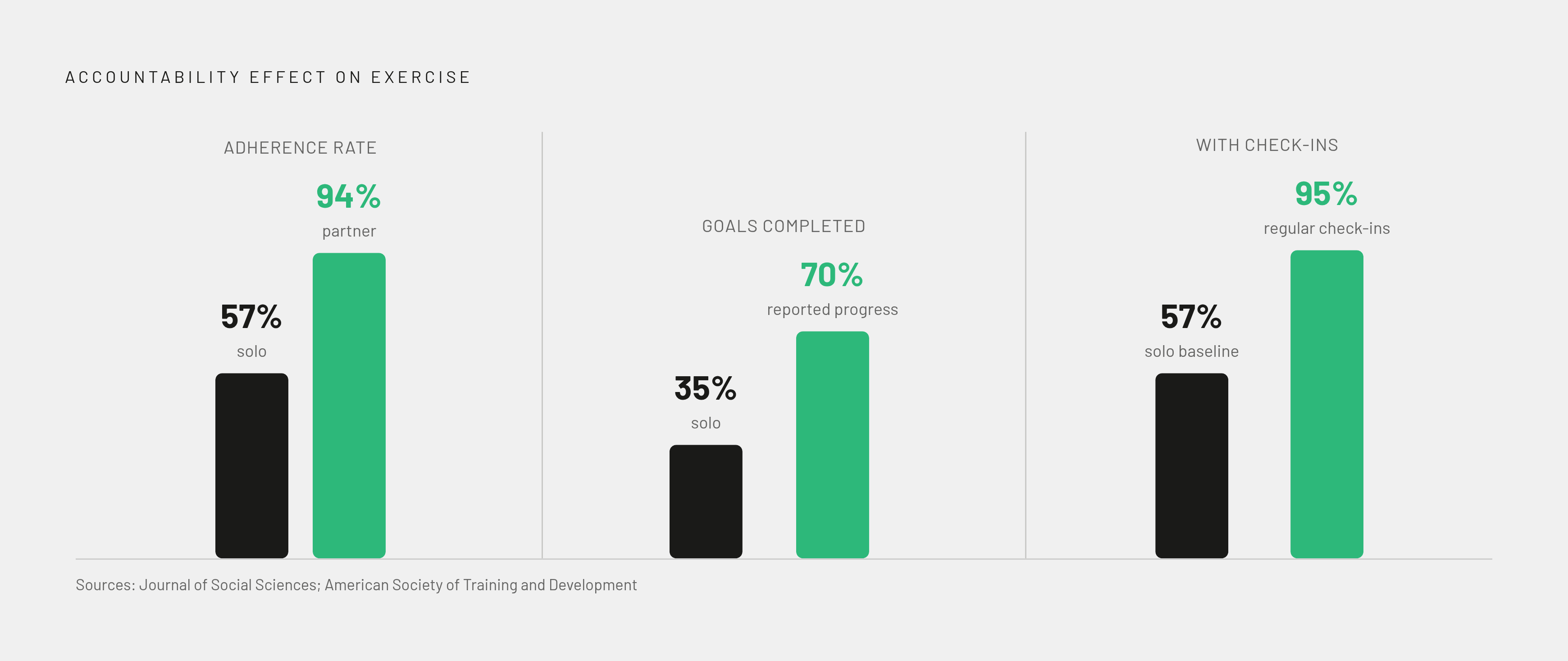
Start with the gap, because it's not subtle. Couples who exercise together hit a 94% adherence rate; solo exercisers land at 57%. That's not a rounding error, and it points to a different sport entirely.
Dr. Gail Matthews' research at Dominican University found the same pattern outside the gym: people who reported progress to an accountability partner completed 70% of their goals, compared to 35% for people going it alone. Pair a commitment with regular check-ins, and the American Society of Training and Development found success rates climb to 95%. The check-in is part of the goal itself, not an afterthought bolted onto it.
Field research from Rachel Gershon, published in Management Science, found that coordinating gym visits with a friend increased attendance by 35%. Here's the funny part: more than 80% of people surveyed said they'd rather skip the hassle of syncing schedules with anyone else. They found it annoying, did it anyway, and performed better because of it. That's the tax on accountability, and it's worth paying.
There's a wrinkle worth knowing if the two of you don't train at the same level. The Köhler Effect, documented in the Journal of Sport and Exercise Psychology, found that training with a more experienced partner boosted the less experienced partner's motivation by 24%. Being the "weaker link" is basically the job description here. Couples working toward shared goals also tend to report higher relationship satisfaction and commitment, so the payoff doesn't stop at the gym door.
None of this depends on hardware. It depends on two people watching each other's effort and reacting to it, and every method below is just a different container for that same mechanism, so pick the container, not the gadget.
The shared paper log: slow to set up, fast to use, and harder to ignore
One notebook, two sets of handwriting, kept side by side, is the whole system, and it beats an app more often than people expect.
Some partners alternate entries in a single book; others keep parallel journals and review them together once a week. Either way, each entry covers exercises, sets, reps, weight, and a line on how the session actually felt. That weekly sit-down mirrors the accountability check-in structure from the research above, minus any app pinging you to do it.
Handwriting also sticks better than typing does. The physical act of logging seems to reinforce memory of the workout itself, not just the record of it. And the "paper is slower" argument doesn't survive contact with a stopwatch: a handwritten entry takes under 10 seconds, while logging the same set into an app runs 15 to 25 seconds once you factor in unlocking the phone, opening the app, and tapping through menus. Paper wins the race it's not supposed to be in.
What paper can't do is chart your month for you. No auto-calculated volume trend, no line graph creeping upward, and if either partner wants that kind of long-view analysis, plain paper will eventually annoy them. A spreadsheet, meanwhile, can't fake the sight of your partner's handwriting getting shakier after a brutal set, or a PR circled twice because they were too excited to just write it once. That's a shared record of effort, worth more than the chart you're missing.
Performance benchmarks: shared tests that replace wearable metrics with real-world proof
Daily step counts measure motion, not progress. Set a test, put a date on it, and see who improves.
A shared 1-mile time trial, synchronized push-up counts, a plank-hold face-off, even resting heart rate taken manually each morning with two fingers and a clock — none of it needs a device more advanced than a kitchen timer and a notepad.
The test date does double duty. It builds in a deadline, which hands partners the "timely" piece of a real goal without an app nagging them about it, and it also gives shape to something couples' research keeps circling: friendly rivalry extends workout duration and raises perceived effort. A benchmark turns vague competitiveness into something you can actually schedule.
This is also where the Köhler Effect earns its keep. If one partner is clearly ahead, retesting together doesn't just spotlight the gap; it puts the less experienced partner in exactly the room where that motivation boost kicks in. A short list of benchmark numbers, tracked over three months, tells a more honest progress story than any step count ever will.
Photo check-ins and friendly wagers: the lightest possible system that still creates real accountability
This is the system for partners who'd rather not fill out a form after every workout. A post-workout photo, sent to the other person, is the entire mechanism, nothing else required.
No log, no spreadsheet cell to fill in. The photo is the record and the social signal at once. One partner knows the session happened because the photo exists; the other did the workout knowing the photo was coming. That mutual awareness is the accountability, full stop. Stack enough of these photos up and they start to look like a timeline, and for a lot of people, that visual record does more motivational work than any number ever has.
Pair it with a friendly wager if the relationship can handle a little competitive needling. Agree in advance on a small, low-stakes consequence for missing a weekly goal: whoever falls short cooks dinner, does the dishes for a week, or lets the other pick next week's workout. The stakes barely matter. What matters is that the goal now has a shape both people agreed to.
Keep it playful, not punitive. The moment a missed goal turns into real shame instead of a small bit, the wager stops working and starts corroding the partnership, and missing the goal should earn a shrug and a minor consequence, not a fight.
Set the actual target loosely, too. "Three sessions each this week" is something two people can hold in their heads without a dashboard, and partners can train at completely different times, in different places, and still feel connected through that shared number and the check-in after. Because the system rewards showing up rather than performing well, a short walk counts, a rough session where nothing felt right still counts, and just getting off the couch counts too.
Smartphone apps that add structure without requiring any wearable
The phone already in your pocket does more than people give it credit for, and less than the wearable companies would like you to believe.
Both iPhones and Android phones track steps automatically through built-in accelerometers, no extra app required. The accuracy isn't lab-grade: smartphone pedometer readings show error rates between roughly 27% and 41%, compared to about 3% to 6% for dedicated wearables. Still, a 2024 validity study found smartphone step counts correlated with reference accelerometers at 0.93, a strong relationship for something that costs nothing extra. For motivating each other rather than publishing a paper, that's plenty. One catch: accuracy drops on stairs and uneven terrain, so flat walks and commutes are where the phone's count actually earns your trust.
A few apps are worth knowing by name, and none of them require a wearable. Nike Training Club offers shared workouts and milestone tracking on a free tier, suited to couples who like guided sessions done together rather than freestyle training. Sweatmates takes a similar couples-first approach, pairing shared goal-setting with photo check-ins so partners can track consistency whether they train together or apart. Apps like FitWithLove or Couple Workout are built specifically around partner exercises, with streak tracking and shared workout history synced across both phones. Favor tools that surface shared effort, weekly goals, photo logs, simple wagers, over tools that just spit out raw numbers nobody looks at twice.
Gamification does something paper can't replicate. Badges, streaks, and progress bars boost engagement by up to 47% among people tracking multiple habits at once. In head-to-head completion data, 67% of digital-only users finished a 30-day challenge compared to 59% of paper-only users, though paper users reported higher satisfaction with the process. Digital wins on finishing, while paper wins on how it feels to finish. If forced to pick one for a couple just starting out, take the higher finish rate; satisfaction is easy to build once the habit exists, and a habit that doesn't survive week one has no satisfaction to speak of anyway.
Shared spreadsheets as a middle path between paper and app
A shared Google Sheet splits the difference between a notebook and an app, and it costs nothing.
Both partners log daily or weekly in the same document, each with a column, visible to the other in real time. No account required beyond the Google login both people already have for something else. Free templates are everywhere, most with conditional formatting, monthly completion percentages, and sometimes a linked nutrition tab.
Here's what it adds over paper: the data doesn't live in one notebook that can get left at the gym, and a basic formula can total weekly sessions or calculate a streak automatically. Here's what it's missing compared to an app: no push notifications, no badges, no social feed nudging you back in. The accountability depends entirely on both people actually opening the sheet, which is either a feature or a flaw depending on how self-directed the partnership already is.
The strongest setup borrows from both. Use the spreadsheet or an app for the numbers, sets, reps, steps, sessions completed, and keep a small paper notebook on the side for the texture: how a session felt, what threw off the day's energy, what to try differently next week. Let the machine hold the numbers, and let the paper hold the meaning behind them.
How to set goals that two people can actually agree on and follow through with
SMART goals (specific, measurable, achievable, realistic, timely) remain the default for good reason: each piece can be taught and applied on its own, not because the framework demands rigid perfection. Research consistently suggests that time spent deliberately crafting a goal is most of the work — the act of setting it carefully is itself a meaningful intervention.
There's a twist. Research published in 2025 in the International Journal of Sport and Exercise Psychology found that for people already active, SMART goals and open-ended goals performed about the same, but for people who weren't consistently active yet, open goals ("move three times this week, any way you want") led to more enjoyment and more confidence than a rigid SMART target did. For a couple where one or both partners are just starting out, that's the whole answer: skip the strict targets at first and let the goal breathe.
Couples don't have to chase the identical goal, either. Some pursue the same run distance or the same class together; others run parallel goals and hold each other accountable to separate tracks. The adherence research supports either approach, as long as both people can see what the other is actually doing.
Weekly goals beat monthly ones, and it's not close. A bad week is easier to shake off than a bad month, and a weekly reset gives partners more chances to actually celebrate something. The goal also has to match the schedule both partners really have, not the one they wish they had on their best week, and starting smaller than feels ambitious is the smarter move, nearly every time.
Choosing a method based on what your partnership actually looks like
No single method wins for every couple, but the decision isn't as complicated as the options make it look. Three questions settle it. How much structure do both people actually want, benchmark testing or loose photo check-ins? Do you train together, which favors a joint journal, or separately, which favors a shared spreadsheet or app? And how competitive is the relationship, since wagers thrive with some couples and flop with others who'd rather just cheer each other on?
For partners starting from zero, skip the app store entirely. A reasonable opening setup looks like this: one simple weekly session goal, a photo sent after each workout, and a benchmark retest once a month. No hardware, no download, fully revisable after four weeks once you know what actually stuck.
Add structure only once the habit is real, not before. A spreadsheet or a free app tier can layer on top of an established routine once that routine already stands on its own. If one partner is noticeably more advanced, lean toward methods that make both people's effort visible, joint journals, shared spreadsheets, photo logs, since that visibility is exactly what triggers the Köhler Effect's boost for the less experienced partner instead of making them feel behind.
The coordination cost is real, and it's worth naming plainly: more than 80% of people, per Gershon's research, would rather skip the hassle of syncing schedules with someone else, yet they're outperformed by the people who do it anyway. Picking any method in this piece means choosing to deal with that friction on purpose. The payoff on the other side is well documented, and the best system, in the end, is just the one both people are still doing next week.