Workout Photo Check-Ins as Motivation Between Partners
Sending workout photos to a partner beats willpower alone.
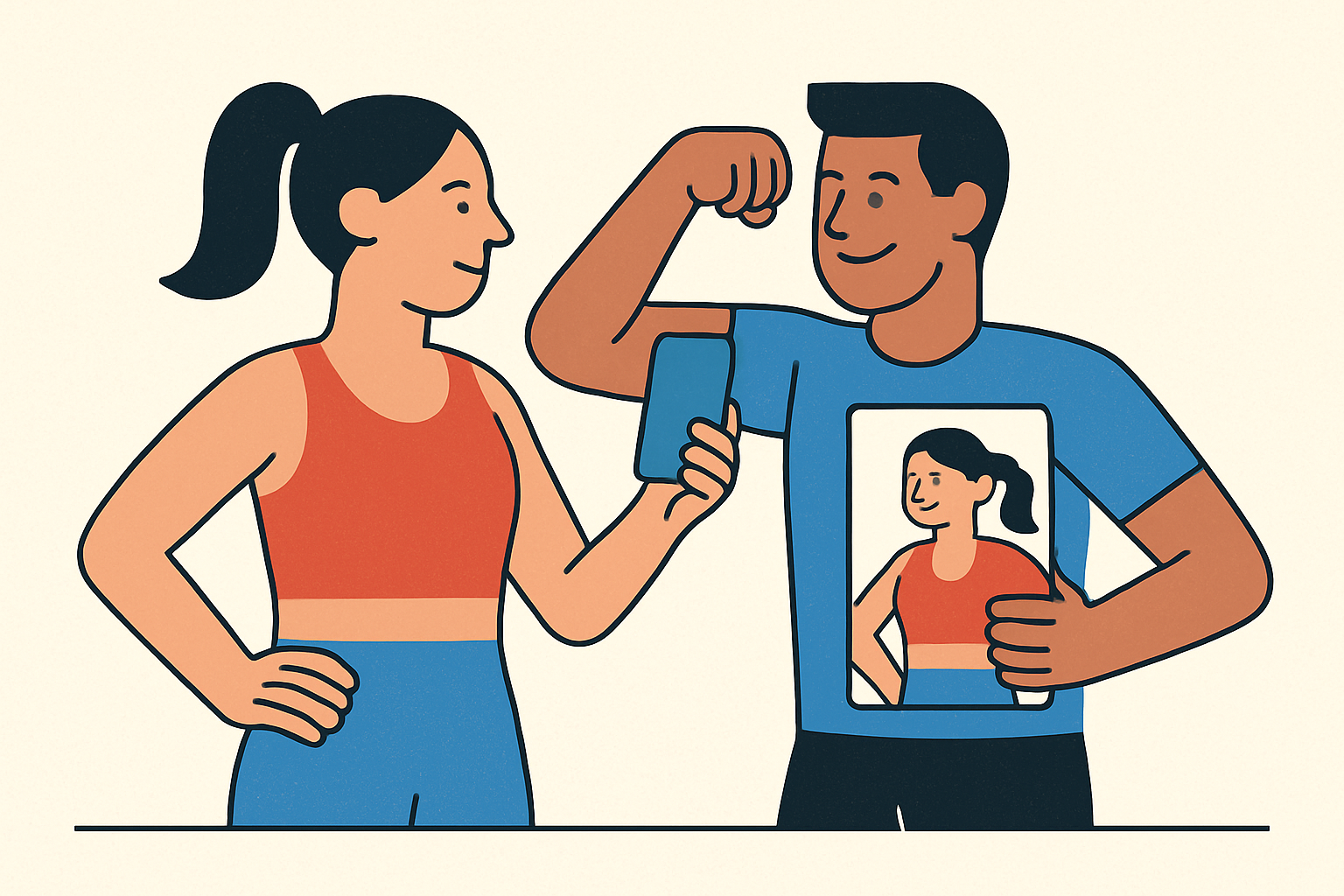
Half of adults who deliberately start an exercise program still fail to hit 150 minutes of activity a week. That's basically a coin flip. And the fix nobody talks about isn't a better app or a stronger why, it's sending someone a photo of yourself sweating.
What a photo does that a logged rep count cannot
A number on a scale lies to you constantly. Water weight, muscle gain, what you ate for dinner, whether you slept, it all shows up as noise that either frustrates you or gives you false hope. Ask anyone who's stepped on a scale the morning after pizza and salt-bomb wings. The number doesn't know the difference between fat and inflammation, and neither do you, most days.
A photo catches what the scale can't: posture straightening out, a jawline showing up that wasn't there in March, the specific look on someone's face right after the last rep of a set they weren't sure they'd finish. Fitness coaching research points to progress photos as a distinct tool precisely because people are terrible at noticing their own gradual change. You see yourself every day, so the drift is invisible to you. Someone else looking at a photo from six weeks ago sees it instantly.
There's also the act itself. Snapping the photo and sending it means pausing, framing the shot, deciding this moment counts enough to share. That's a small ritual of self-acknowledgment, and an app that auto-syncs your rep count to the cloud can't replicate it, because it asks nothing of you. A photo asks you to notice yourself first, before anyone else does.
And a photo is personal in a way a dashboard export never will be. A screenshot of your workout log is an abstraction. A photo carries your actual face, your actual gym or garage or living room floor, the actual effort from twenty minutes ago. The person on the other end isn't looking at data. They're looking at evidence that you existed, in a body, doing a hard thing, at 6:42 a.m.
The psychology that makes being seen change behavior
Behavior changes when people know they're being watched. That's the Hawthorne Effect, old news in psychology circles, but worth naming because it explains why a single check-in message can outperform a week of solo willpower. Even a small observer, even just one friend on the other end of a text thread, can be enough to keep someone honest.
Here's the catch. Research looking at studies with post-intervention follow-up found that in 80% of cases, the Hawthorne Effect faded or disappeared within three months once the observation stopped. So a one-off "hey, check out my gains" post does nothing long-term. The photo check-in has to keep happening, on a rhythm, or the whole mechanism quietly evaporates.
Then there's the Köhler Effect, stranger and more useful. People push harder when they believe a partner is slightly more capable than them, and when they believe their own effort actually matters to the outcome. Kansas State researcher Brandon Irwin tested this directly: participants told their virtual partner had ridden roughly 40% longer than them rode, on average, 9 minutes longer themselves. Nobody wants to be the weak link, even in a partnership that exists mostly over Wi-Fi.
A 2023 preregistered meta-analysis in Kinesiology Review pulled together 19 peer-reviewed studies and 1,912 participants and found the motivation boost from partnered exercise was statistically significant, with an effect size (g̅ppc) of 0.91. That's not a rounding error. That's a real, repeatable bump in performance just from knowing someone else is in it with you.
This matters for photo check-ins specifically because the effect works remotely. A photo showing your partner's progress ahead of yours can trigger a similar motivating pull toward effort. But Irwin's research also flags the ceiling: too big a gap and the effect flips, because now the partner feels less like a peer and more like a different species. Research on ability pairing puts the sweet spot around a 20 to 30% difference in ability. Irwin also found something almost counterintuitive: people worked out longer when a more skilled partner kept the cheerleading to a minimum. Visible evidence of effort beats a pep talk, every time. Nobody needs a motivational speech. They need proof someone else showed up.
Underneath all of it sits self-efficacy, the confidence that you can actually do the thing. Social support builds visible proof of progress, visible progress builds confidence, and confidence builds adherence. Research consistently identifies self-efficacy as one of the strongest predictors of exercise behavior across different populations. The photo isn't just a nice gesture. It's a link in that chain.
How the check-in ritual actually holds people to their word
Sending the photo says, without saying it, "I showed up." That statement puts a quiet expectation on the person receiving it: your turn next. It's a soft contract, nothing notarized, but real enough to feel when you break it.
People show up for relationships. They ghost arrangements. That distinction does a lot of work here. The difference between a supportive partner and a purely transactional arrangement does a lot of work here: nobody feels bad standing up a spreadsheet, but standing up a friend stings.
Distance doesn't break this. Partners training in separate gyms, separate cities even, can hold the same accountability as two people on adjacent treadmills, as long as the check-in ritual stays consistent. The ritual is the thing, not the zip code.
What happens after a missed check-in matters just as much as the check-in itself, and most people get this part backwards. The instinct is to follow up with a debrief, or worse, a guilt trip. Don't. The right response to silence is "you okay?" Full stop. Accountability that starts to feel like a performance review is accountability people quietly opt out of. Gabrielle Hargrove, a licensed professional counselor at Memorial Hermann, put it this way: an accountability partner can be "that little voice saying, 'I'm going to be here waiting for you. I expect you to show up.'" The photo is that voice, just asynchronous, just quieter, sitting in a phone instead of a gym doorway.
Hargrove also draws a line worth keeping in mind: healthy competition is fine, but comparison isn't the goal. "Try to focus on competing against yourself rather than other people," she advises. The photo check-in should mark that someone showed up. It's not a leaderboard, and the second it turns into one, it stops working.
What makes a photo check-in partnership work over time
Agree on the format before anything else. Photo, voice note, a two-line text, doesn't matter which, but both people need to expect the same thing. Ambiguity here is where the whole system starts to wobble.
Frequency needs thought too, and weekly beats daily. Weekly check-ins work as a natural rhythm, enough to see change, not so often it turns into background noise. Daily check-ins risk becoming just another notification to swipe away, and given that 80% figure on the Hawthorne Effect fading within three months of no observation, going quiet for too long undoes the whole arrangement anyway. So weekly is the floor and the ceiling at once.
Ability pairing matters more than people expect. The 20 to 30% gap identified as the sweet spot applies here too: a partner slightly ahead pulls you forward, a partner miles ahead just reminds you how far behind you are. Goals don't need to match exactly. One person can be training for a 5K, the other trying to deadlift double bodyweight. What needs to line up is the commitment to the ritual itself, not the workout.
A trial period helps cut the awkwardness. Four weeks is usually enough to know if the rhythm fits or if it's forced. Duke Recreation's guidance on this is straightforward: set expectations up front, how often, what format, what counts as a good week, so accountability doesn't drift into guesswork. And agree, before day one, that a missed check-in gets a "how are you" instead of a lecture. The goal is reflection, not a courtroom.
Where photo check-ins can go wrong
Image-based comparison has a documented downside. Research on fitness content links social comparison through images to body image disturbance, appearance anxiety, and disordered eating patterns. Research has flagged fitness and muscle-focused social media content as a potential risk factor for body dysmorphia. None of that is small print.
Here's the distinction that actually matters, and it's the one people flatten when they lump all "posting your body online" into one bucket. A photo sent to one person who knows you is structurally different from a photo posted to a public feed of strangers. The audience is known. The relationship goes both ways. The intent is support, not performance for an algorithm.
Still, even a private check-in can slide toward comparison if the tone isn't set right. If one partner's photos consistently show more visible progress, the other can start to feel like they're falling behind instead of getting pulled forward, the exact inversion of what the Köhler Effect is supposed to do. A slight gap motivates. A wide one demoralizes. Same math, whether it's a stationary bike study or two friends texting progress pics on a Sunday.
The safeguard is simple to say, harder to hold onto: showing up gets acknowledged regardless of how it looks. The photo marks effort, not a fitness ranking, and the moment it starts marking anything else, it's time to renegotiate the format.
Tools that support photo-based partner accountability
Accountability tools generally fall into three buckets. Self-tracking apps built around streaks and personal visibility work well for people who are already disciplined and just need a nudge. Social or partner apps are built specifically around shared commitment and mutual check-ins, which is where something like Sweatmates fits, a shared fitness tracking app for partners that ties photo check-ins and weekly goals into one place. Coach-led platforms fold in professional oversight alongside the partner piece.
For photo-based peer accountability specifically, a few named options stand out from the landscape covered at habithuddle.com. GymRats is built for time-boxed group challenges, the kind where a bunch of people commit to a month and compare notes along the way. StickK leans on financial stakes, putting money on the line as the enforcement mechanism. Future pairs a human coach with partner-style accountability, and it has appeared on roundups of best remote fitness accountability apps alongside options like Trainwell itself. Trainwell carries a 4.9-star rating across more than 5,000 Apple App Store reviews, according to trainwell.net.
None of that is required, though, and honestly, most people don't need any of it. For two people running their own informal system, the simplest setup is a group chat or a shared photo thread. No app, no login, no subscription. Partner Fitness Review is built around exactly this kind of low-friction setup for couples and training partners, using shared goals and friendly wagers instead of anything that demands optimization.
Social platforms in general offer richer back-and-forth than a typical health app, mixing passive scrolling, active engagement, and self-presentation. But that richness comes with the comparison risk covered above. A private channel between two people keeps the upside and drops most of the exposure, which is exactly why the fanciest tool on this list isn't automatically the right one.
Whatever gets picked, the tool should serve the relationship, not the other way around. If the app adds friction or turns the check-in into a chore, the ritual won't survive long enough to matter.