Strength Training Programs for Couples at Different Fitness Levels
Same movements, different weights, keep couples training together without frustration.
Most couples who don't make it work in the gym aren't failing because they don't care. They're failing because they share a gym bag and assume the rest will sort itself out.
What goes sideways is pretty predictable once you've watched it happen enough times:
- The stronger partner holds back, or the weaker one gets buried. Neither person gets an appropriate challenge. Both get frustrated.
- Goals don't match. One person wants to lose fat. The other wants to add muscle. They default to the same program and neither one is well served.
- Relationship dynamics walk right through the door with them. Competitiveness. Impatience. The unsolicited mid-set form correction. None of that disappears when you pick up a barbell.
- They show up together but train in parallel. Shared presence isn't the same as shared structure.
The root mistake is assuming "training together" means identical weights, reps, and programming. It doesn't. That conflation. the idea that same session equals same prescription. is what breaks most couple training setups before they ever find a rhythm.
And if one partner is consistently correcting the other's form without being asked, fix that dynamic before you fix anything else. No program design in the world addresses it.
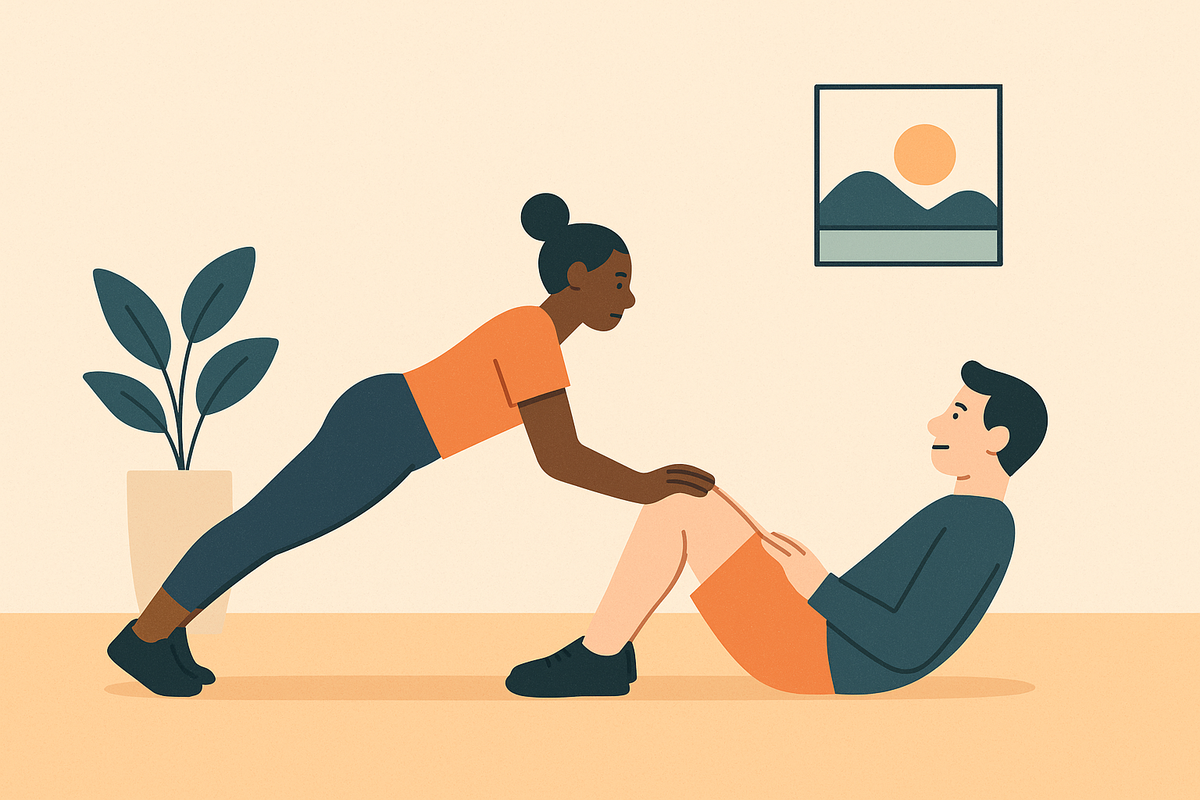
The actual goal is a shared session structure, not a shared load. Same movements, different prescriptions. Everything below is about making that work in the real world.
How the Köhler Effect Shapes What the Less Experienced Partner Gets from Training Together
There's a well-documented psychological phenomenon called the Köhler motivation gain effect. Short version: when partners work toward a shared outcome, the less capable partner works harder than they would on their own.
A meta-analysis published in Kinesiology Review looked at this across multiple studies and thousands of participants. The motivation gain held up consistently. Partnered exercise groups outperformed solo exercisers on persistence measures, repeatedly, across different study designs.
For couples, this means the beginner partner gets a real motivational lift just from training alongside someone stronger. Not because of pep talks. Not because of coaching. Just from being in the same room, doing the same thing. The social environment does the heavy lifting.
There's a catch, though. The Köhler effect works when the ability gap feels moderate. If one partner always feels like the obvious weak link, that motivation gain eventually flips into discouragement. You can't let the gap feel extreme.
The answer isn't to hide the gap. It's to design around it:
- Keeping the same movement pattern puts both partners inside the same "shared task" frame.
- Individual load prescription keeps the difference from feeling like a public verdict.
The effect also runs the other direction. The stronger partner tends to push slightly harder when someone is watching. A well-built shared session quietly raises effort on both ends, which is a better outcome than either partner training alone would have produced.
What Couples Need to Understand About Sex Differences in Strength Before They Design Anything
If a man and a woman are starting a program together and they're being honest about their numbers, the upper-body gap is going to be significant. On bench press and chest press variations, female strength typically sits somewhere in the range of 40 to 55 percent of male values. Lower-body movements close that gap considerably. Squat and leg press numbers tend to land closer to 60 to 65 percent.
That's just the honest picture. Knowing it going in keeps both partners from misreading a weight difference as a sign that something's wrong.
Here's where most people get the story wrong: men don't actually adapt faster. Research pulling together data from dozens of studies has consistently found that women's muscles grow at roughly the same percentage rate as men's. Men end up with more absolute muscle because they started with more, not because they're getting more out of the same training. The adaptation rate itself is not a meaningful difference.
One practical gap does show up in recovery data. Women tend to show more pronounced strength loss in the 24 hours after a heavy session than men do. The numbers in the literature are striking enough that I think about it when building out scheduling for mixed-level couples. Women genuinely benefit from slightly longer recovery windows between heavy sessions. Build that into the schedule rather than fighting it.
The big takeaway: the load difference at the start of a program doesn't predict who adapts faster or who ends up stronger in six months. Both partners are more capable of similar progress than the initial gap suggests, and pretending otherwise doesn't help either of them.
How Beginner and Intermediate Training Actually Differ, and Why It Changes What a Shared Session Can Look Like
Beginners and intermediates aren't just at different points on the same road. They're following different maps.
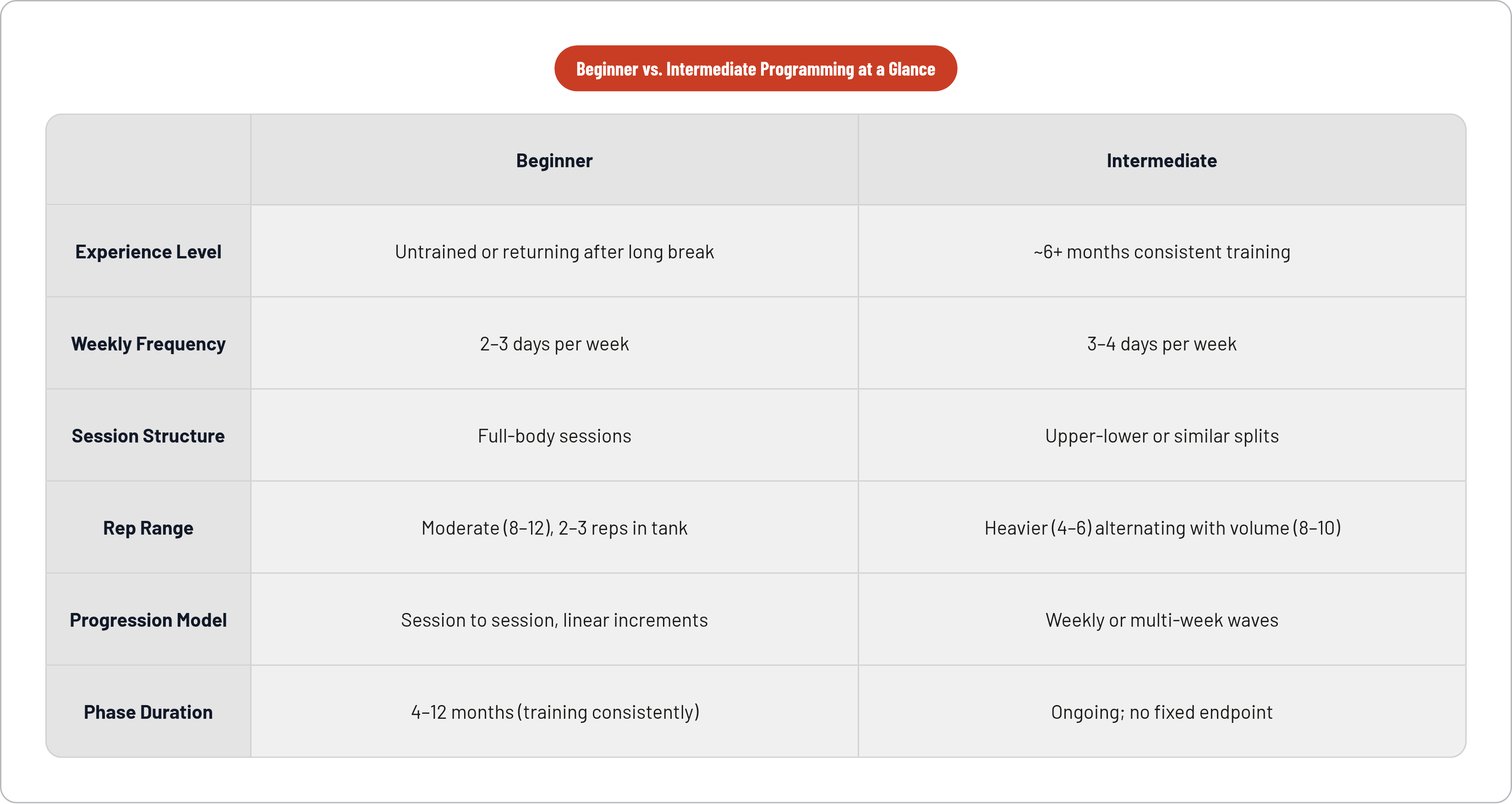
The American College of Sports Medicine's position on resistance training progression draws a clear line between them. Novice lifters. meaning untrained individuals or people returning after a long break. do best with moderate rep ranges across two to three days per week. Intermediate lifters, somewhere around six months of consistent training in, move into heavier loading, wider rep variation, and typically three to four days per week.
The way progress actually happens is just as different as the loads.
Beginners improve almost session to session. The nervous system is adapting so quickly at this stage that almost any reasonable program produces results. Add a small increment when reps are completed cleanly, and progress comes fast.
Intermediates progress in weekly or multi-week waves. Meaningful progress on a main lift over the course of a month is solid. Expecting it every session is exactly how intermediate lifters stall out.
The beginner phase typically lasts somewhere between four and twelve months for people training consistently two to four times per week.
Why does any of this matter for the shared session? A beginner and an intermediate can't share the same progression model. But they can absolutely share the same movements. The exercise stays the same. The weight, the set scheme, and the weekly structure differ.
The full-body versus split question comes up here too. Full-body sessions three times per week suit beginners well. Upper-lower splits four days a week suit intermediates better. That means partners train together on some days and separately on others. That's not a failure of the arrangement. It's just how different programming phases work, and treating it as normal takes the friction out of it.
One thing both partners can align on regardless of level: protein. Somewhere around 1.6 to 2.2 grams per kilogram of body weight supports muscle repair at both stages. It's a shared habit that holds even when the programs themselves look nothing alike.
The Structural Options for Keeping the Session Shared When the Prescriptions Diverge
Same Movement, Different Load
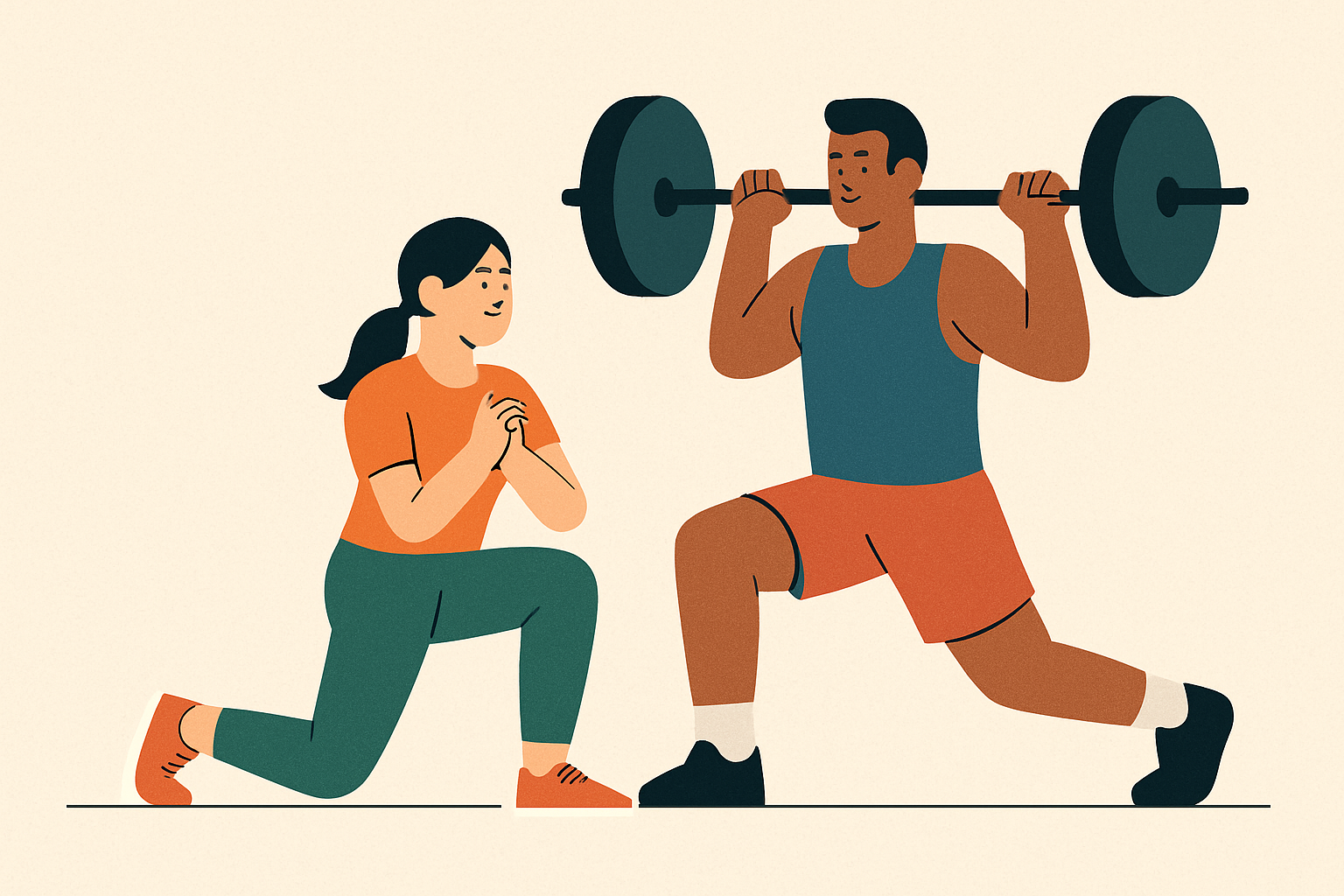
This is the default and the most flexible option. Both partners squat, press, hinge, and row. Weights are set individually. Same cues, same timing, same rest windows.
It works at any gym and requires nothing beyond both partners knowing their working weights before they walk in. The load difference on upper-body lifts will be visible. On lower-body lifts, much less so. Knowing that in advance keeps neither person from reading the number on the other's bar as some kind of verdict.
Partner Circuits
One person works while the other rests or spots. One station, no wasted time. Rest time naturally becomes encouragement time, which reinforces the motivational dynamic described earlier because both partners stay visibly in the mix even when one is between sets. This works especially well when equipment is limited or when one partner genuinely needs longer rest periods than the other.
Scalable Equipment That Quietly Removes the Comparison
Suspension trainers (TRX-style setups) are genuinely underrated for mixed-level couples. Same movement, difficulty adjusted by body angle, no plates to load. Both partners can train the identical exercise at very different intensities without making the difference obvious.
Cable machines and resistance bands carry the same advantage. The load is less visible, which quietly reduces the social comparison that chips away at the less experienced partner's confidence over time.
Hybrid Scheduling
An intermediate training four days per week and a beginner training two to three days per week can share two of those sessions and train separately the rest. The shared sessions carry more weight, relationally, when both partners know the other is also showing up on their own. The gap feels smaller when both people are in motion.
The one setup to avoid: mirror-image programs where both partners follow identical sets, reps, and progressions. The beginner stalls or gets hurt trying to keep up. The intermediate under-trains trying to stay matched. Nobody wins that arrangement.
A Sample Shared-Session Template Built Around Compound Movements
This template runs as a full-body session, three days per week, organized around four patterns: squat, hinge, horizontal push, and horizontal pull. Both partners follow the same exercise order and the same rest intervals. Loads and set-rep schemes differ.
Beginner prescription: 3 sets of 8 to 12 reps at a weight that leaves two to three reps in the tank. Linear progression. Add a small increment when all sets are completed cleanly.
Intermediate prescription: 4 sets with a periodized rep range. Heavier sets of 4 to 6 alternate across the week with volume sets of 8 to 10. Progress tracked weekly, not session to session.
Here's how it maps:
- Squat. Both partners squat. The goblet squat is a natural beginner option that doesn't require handling a barbell before the pattern is solid. The intermediate loads a barbell.
- Hip hinge. Romanian deadlift for both. Load differs, cues are identical, spotting is straightforward.
- Horizontal push. Dumbbell bench or push-up variation. Push-up progressions scale naturally for the beginner. The intermediate uses added load.
- Horizontal pull. Cable row or dumbbell row. Same movement, different weight.
On rest periods: beginners may only need one to two minutes between sets. Intermediates may need three to five on heavier work. Partner circuits solve this naturally. One person rests while the other works, which also happens to be the most efficient use of a single station.
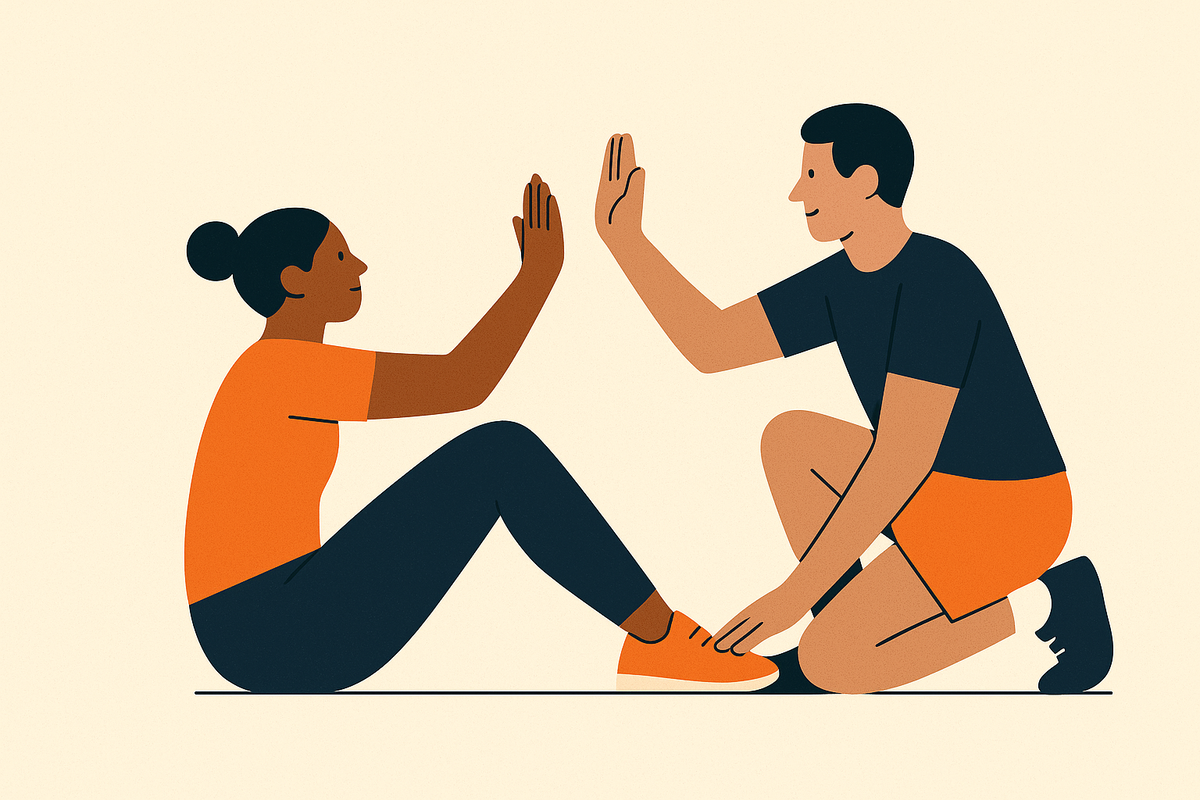
Both partners finish at the same time. Shared cooldown, shared end. That might sound like a small detail, but the relational function of training together lives in those bookends as much as it does in the actual lifts.
Both partners track their own numbers separately. Reviewing them together once a week keeps goals visible without turning every session into a comparison.
How to Handle Goal Misalignment When One Partner Wants Fat Loss and the Other Wants to Build Strength
This sounds like a program design problem. It mostly isn't.
Different goals don't require different exercises. They require different nutrition and sometimes different volume. The movements stay the same.
Here's why: resistance training preserves lean mass during a caloric deficit, which serves fat loss directly. It also builds strength and muscle. Both goals are served by the same compound movements. The session doesn't have to split.
Where the programs actually diverge:
- The fat-loss partner uses slightly higher rep ranges or shorter rest periods to increase caloric expenditure within the session.
- The strength-building partner focuses on heavier loading and longer rest.
- The exercises are identical.
Most of the real divergence is nutritional. Caloric intake, deficit size, and protein targets differ between partners. The gym session doesn't have to carry that weight.
Practical approach: design the shared session around the strength goal. It's more structurally constrained, which means the fat-loss partner can follow it without issue while the strength-focused partner gets what they need. Then let each partner's nutrition and accessory work serve their individual objective outside the session.
One trap that keeps coming up: adding cardio to the session as a compromise. It rarely satisfies either goal well. Longer sessions are also one of the most consistent predictors of people quietly dropping off, which is the one outcome both partners are trying to avoid.
When Training Together Stops Working and What to Do Instead
There are real limits to this model, and glossing over them doesn't help anyone.
If one partner is an advanced lifter and the other is genuinely untrained, the structural options above get strained. Advanced training demands. rest periods, loading schemes, weekly volume. simply don't map cleanly onto a beginner's session. The gap is too wide to paper over with exercise selection, and trying to do so will frustrate both people.
If one partner consistently coaches, corrects, or criticizes the other without being asked, the gym becomes a source of friction. That's a conversation that has to happen outside the gym first. Until it does, training together probably makes things worse rather than better.
Competing schedules and recovery needs are a practical limit too. Forcing shared sessions when one partner's work schedule or sleep debt genuinely doesn't align creates resentment around something that's supposed to be good for both people.
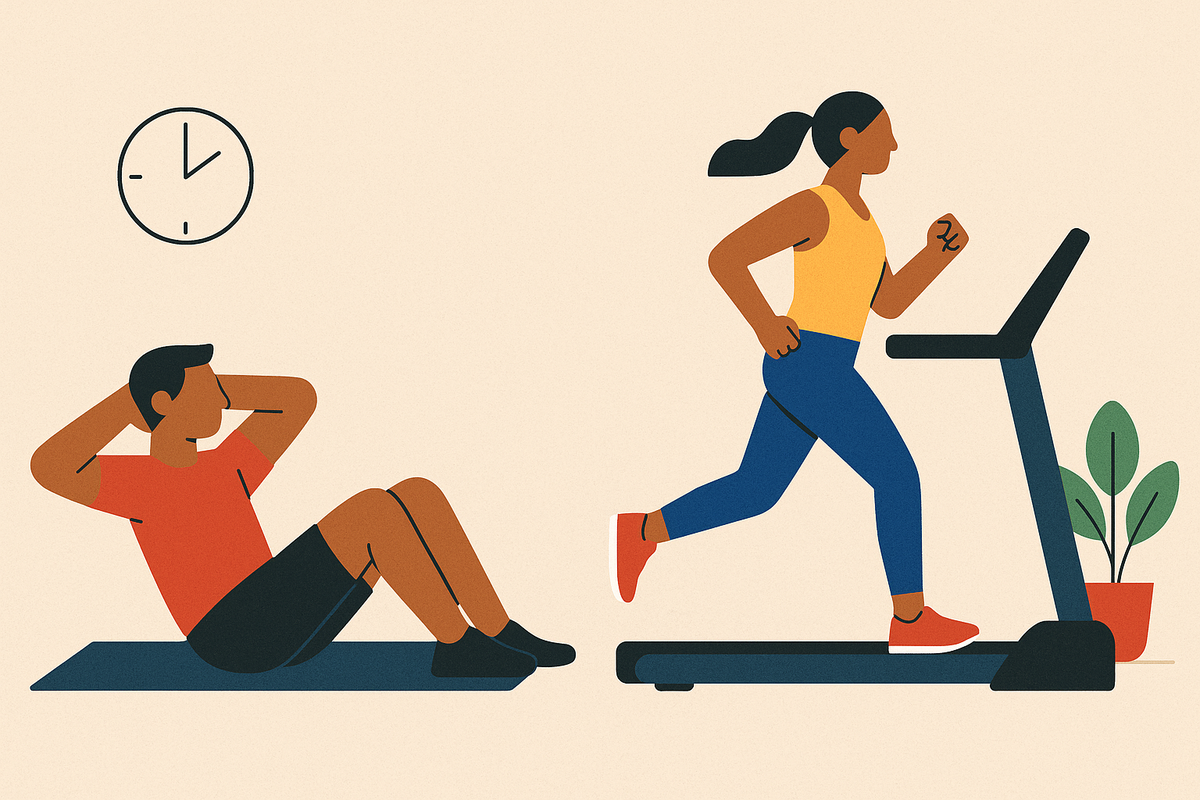
The hybrid model is the sustainable answer for most of these situations. Partners train individually most of the week and share one session. That's often enough to get the relational benefits without forcing incompatible programs into the same hour.
One shared session per week still earns most of what the research points to. The goal was never identical programming. It was a shared structure, a reason to show up, and a training environment where both people feel like they belong. You can build that on one day a week and still have it mean something.