Partner Bodyweight Workouts for Small Apartments
Two bodies, one yoga mat, and no noise upstairs.
Partner bodyweight training fits in a small apartment because most bodyweight movements barely travel at all.
Planks, squats, lunges, wall sits. These are stationary exercises. Your footprint during any of them is roughly the size of a yoga mat. When you're working with a partner and using each other as resistance and counterbalance, neither person needs to go anywhere. Back-to-back wall sits are anchored in one spot. Face-to-face plank high-fives stay within two yoga-mat zones. Partner leg throws need one standing footprint and one lying footprint. That's the whole setup.
The useful benchmark is a 7-by-7-foot clearing. Both partners can lie down fully, move through a complete session, and not bump into anything. You don't need to rearrange the apartment permanently. Slide the coffee table aside and you're done.
What makes partner training more space-efficient than solo training isn't clever programming. It's that you're using each other. When your partner is your resistance, your anchor, and your counterbalance, there's nothing else you need to bring into the room.
The real constraint isn't square footage. It's knowing which exercises belong in a small space and which ones don't. Once you know that, the space problem disappears.
The noise problem and how bodyweight training solves it
Apartment workout noise has a pretty short list of actual causes.
Jumping. Dropped weights. Plyometric landings. That's basically it. A barbell hitting the floor, a round of burpees performed directly above your neighbor's bedroom. Bodyweight training without jumps or equipment removes all of those at once. Not as a compromise. As a design choice.
The exercises to skip are obvious once you see the pattern: jumping jacks, box jumps, burpees with a jump, anything involving dropped kettlebells. What replaces them isn't a downgrade:
- Slow-tempo squats
- Isometric holds like wall sits
- Plank variations
- Controlled leg throws
All quiet. All effective. A yoga mat under both partners absorbs contact noise and cushions joints on hard floors. Cheap fix. Matters more than most people expect.
Here's the thing nobody mentions upfront: slow, controlled movement increases time under tension, and that's actually how bodyweight training builds real strength without adding load. You end up training better than you would have by default, not because you were disciplined about technique, but because the quiet-apartment constraint pushed you there. The restriction does the coaching for you.
Why working out with a partner produces more effort, not less
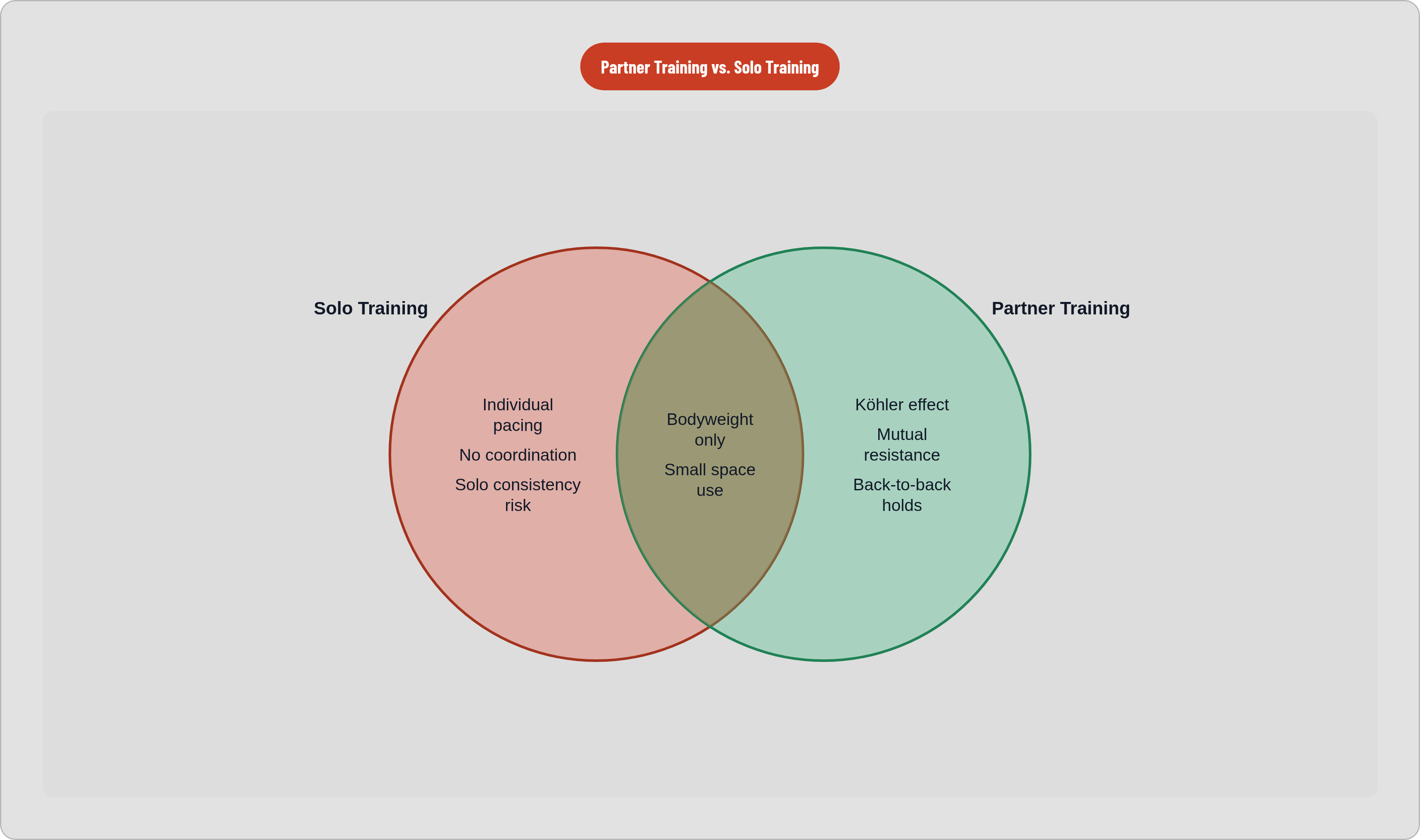
Training with someone makes people work harder. The pattern is consistent enough to build around.
There's a well-documented phenomenon researchers call the Köhler effect. People push harder in group settings than alone, particularly when a partner is a bit more capable. The sweet spot appears to be a partner who's noticeably stronger or fitter, but not so far ahead that keeping up feels pointless. In plank hold tests, people paired with a more capable partner held position significantly longer than those working solo.
The relationship layer matters too. Research published in the Journal of Social and Personal Relationships found that on days couples exercised together, they reported more positive feelings during the workout and higher satisfaction overall that day. Which isn't shocking, but it's useful to have confirmed.
One real caveat: some research has found that older adults who exercise with a spouse are sometimes less active overall than solo exercisers. When fitness levels are significantly mismatched and neither person wants to push the other, the social dynamic can quietly slow both of them down. So the goal isn't to manufacture competition. The goal is to show up together, because that's what keeps people consistent over months and years. Consistency is the whole game.
Six partner bodyweight exercises that work in a living room
Every exercise here meets the same criteria: zero equipment, one anchored footprint per person, no jumping, and it works across different body sizes and fitness levels.
Partner Plank High-Fives
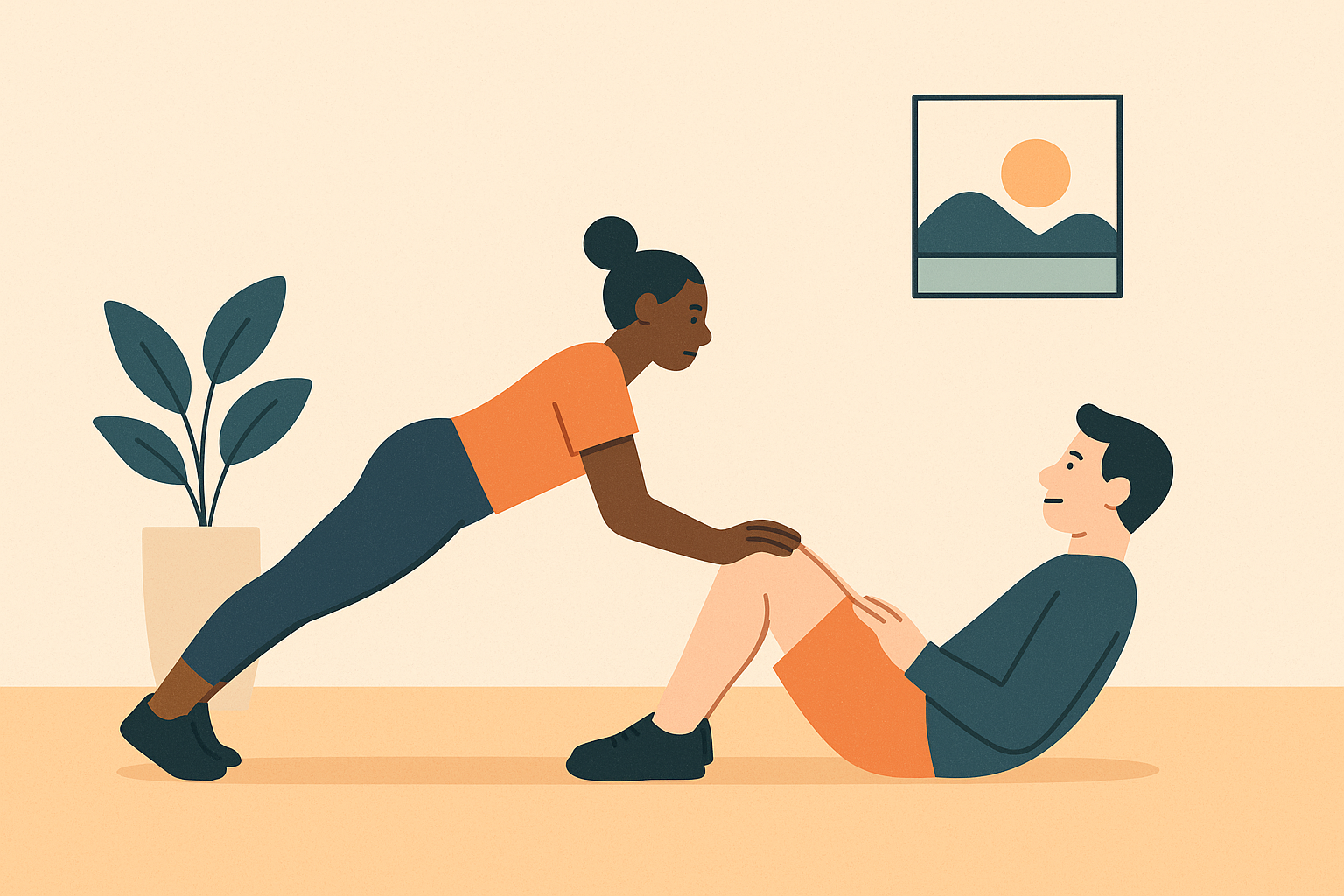
Both partners hold a high plank facing each other. Alternate tapping opposite hands across the midline. Core, shoulders, triceps. The harder version: add a push-up between each tap. Both people stay in one spot the entire time.
Back-to-Back Wall Sit
Partners press their backs together in a 90-degree seated position. No wall needed. You're supporting each other. Quads, glutes, hamstrings. Because it's time-based, it scales easily. Both partners control their own effort within the same hold, which makes it a good starting point when fitness levels differ.
Partner Leg Throws
One partner lies flat. The other stands at their head, holds their ankles as they raise their legs, then pushes them back toward the floor. The person on the floor controls the lowering with their core. Lower abs and hip flexors. Space requirement: one standing footprint, one lying footprint.
Wall Sit and Tricep Dip Combo
One partner holds a wall sit against an actual wall. The other places their hands on that partner's knees, legs extended, and does tricep dips off that surface. Both partners are working at the same time. Switch after the set. Two people's work in the same window. Surprisingly efficient use of a small room.
Partner Walk-Out to Plank
Both partners stand facing each other. Hinge forward, walk hands out to a high plank. Pause at full extension. Optionally high-five. Walk back up. Hamstrings, core, shoulders. Works well as a warm-up or inside a timed circuit.
Mirror Workout (Leader-Follower)
One partner leads a sequence of moves: squats, slow lunges, lateral steps. The other mirrors in real time. Switch leadership every minute or every round. The follower stays within arm's reach, so the footprint stays compact. The leader controls difficulty, which makes the whole thing self-adjusting when one person is stronger or more experienced.
How to build a repeatable routine from these exercises
Two formats work. Pick whichever fits how your week actually runs.
Sets-and-reps: Five to seven exercises, three sets of twelve reps each. For exercises where only one partner works at a time, switch before moving to the next set.
Timed intervals: Forty seconds of work, twenty seconds of rest. Ten exercises runs about ten minutes. That's a real session that fits before work or after dinner without requiring any planning.
Three to five sessions per week is sustainable for most people. Bodyweight training puts less stress on joints than loaded lifting, so recovery is faster and you can go more often without breaking down. Alternating full-body sessions with lower-body or core-focused days keeps you from hammering the same muscles two days running.
The fifteen-minute session is not a fallback. It's a legitimate option. Short enough that scheduling stops being an obstacle, long enough to actually matter. What you're protecting is the habit slot. The specific exercises inside it are secondary. When a week falls apart and a session gets skipped, the only useful question is: what got in the way, and is the format realistic for what this particular week looked like? That's it.
How to make the routine harder without adding equipment or space
Progression in bodyweight training runs on four levers. None of them require more gear or more room.
Tempo. Slow a squat or a push-up to a four-count down with a two-count hold at the bottom. More time under tension, same movement. Harder than it sounds the first time you actually try it.
Volume. More reps, more rounds, shorter rest. Any one of these changes what the session asks of you.
Exercise variation. Move from a two-leg squat to a single-leg squat. From a standard plank to a plank with reach or tap. The pattern stays the same; the demand goes up.
Partner resistance. A hand on a shoulder during a push-up, slight pressure on a leg during a throw. Your partner becomes adjustable load, which is one of the more underrated tools in this kind of training. The resistance can increase or ease off in real time depending on how the set is going. A fixed weight can't do that.
Tracking progress doesn't require a spreadsheet. Can both partners hold the back-to-back wall sit ten seconds longer than last month? Does a movement that felt genuinely hard three weeks ago now feel controlled? Those are real markers. They're also more motivating than a chart of rep counts, because progress you can feel in your body lands differently than a number on a page.
The small apartment isn't a temporary limitation waiting to be outgrown. It's the context the routine is built around. Build the routine to fit it, and it stops feeling like a constraint at all.