How Engaged Couples at Different Fitness Levels Can Train Together Without Leaving Anyone Behind
Matched exercises with personalized loads let couples train together at their own pace.
Engaged couples at different fitness levels don't need separate workouts. They need a shared structure flexible enough to meet each partner where they are, so neither feels held back or left behind. The fix isn't identical effort. It's the same session, different prescriptions, plus visible shared progress and accountability that keeps both people showing up. Here's how to build that, in the gym and beyond it.
Why training together is worth structuring carefully
Couples who train together stick with their fitness programs at much higher rates than people who train alone. That shared workout is one of the most effective adherence tools available to an engaged couple. The reason isn't just motivation. A shared workout identity ("we work out together") turns exercise from a personal chore into a default couple behavior.
The mood and relationship benefits are real, too. A 2021 study by Sackett-Fox, Gere, and Updegraff in the Journal of Social and Personal Relationships found that on days participants exercised with a romantic partner, they reported higher positive mood during exercise and throughout the day. They also reported higher relationship satisfaction compared to days they exercised on their own.
But the payoff doesn't happen automatically. Couples who walk into a shared workout with no structure tend to default to identical routines. The stronger partner gets bored. The newer one gets swamped. The shared session quietly dies. Structure is what keeps the whole thing alive.
Why mismatched fitness levels threaten a shared workout before it starts
When one partner is more experienced, both default approaches fail. Identical workouts at the same load bore the stronger partner and overwhelm the newer one. If you split into separate sessions, you lose the shared experience that makes training together worth doing. So the obvious question hangs in the air: isn't it demoralizing to train next to someone far more capable?
It's a fair objection, and there's research that gives it weight. A study from Nanyang Technological University found that older adults who exercise with their spouse achieve lower physical activity levels than those who exercise individually. That's a genuine counterpoint, and dismissing it would be dishonest. But context matters. The NTU finding applies most directly to long-married older adults who have deeply ingrained separate routines. It doesn't map cleanly onto engaged couples in the earlier stages of building shared habits.
There's also a countervailing force. The Köhler motivation gain effect shows that the less capable partner increases effort when working alongside a more capable one. But that effect is real and contingent at the same time. It shrinks when the gap between partners is very small or extremely large. Big disparities need deliberate scaffolding before joint sessions become reliably positive. That's the key reframe: the fitness gap is a design problem, not a compatibility problem. Same session, different prescriptions.
How the same exercise at different prescriptions gives both partners a real training stimulus
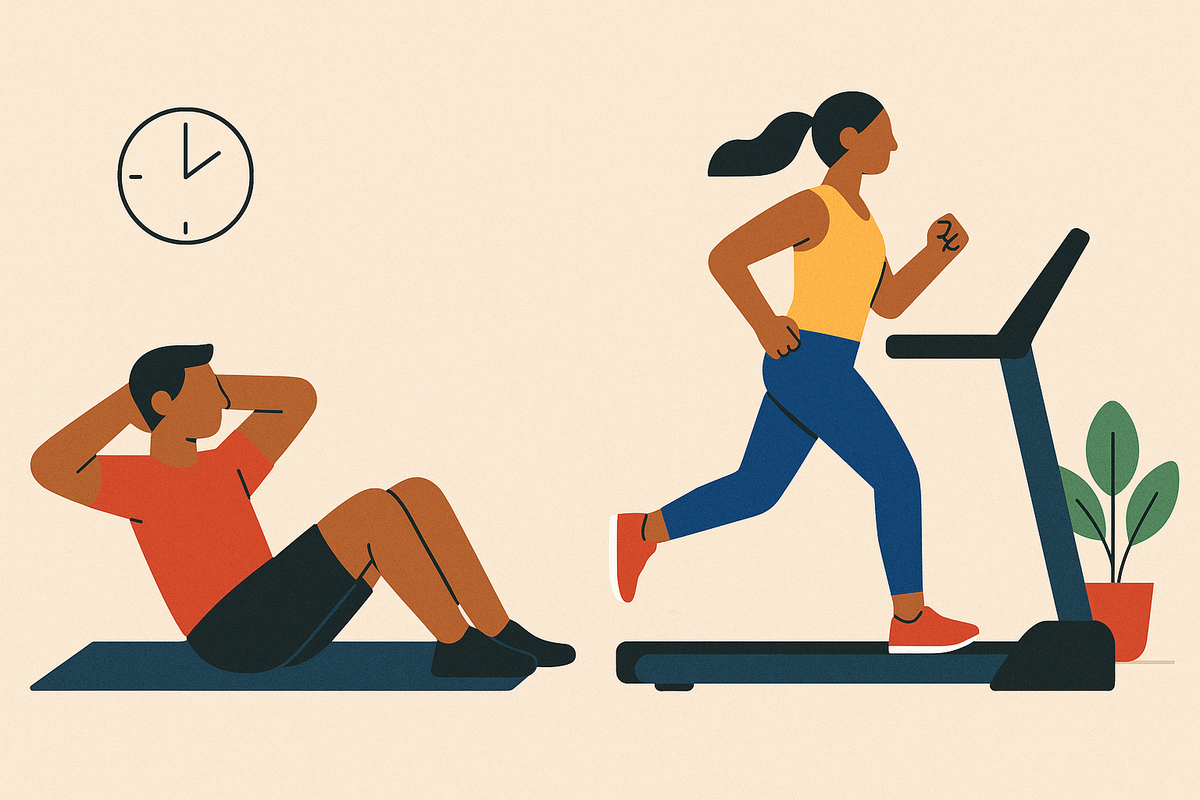
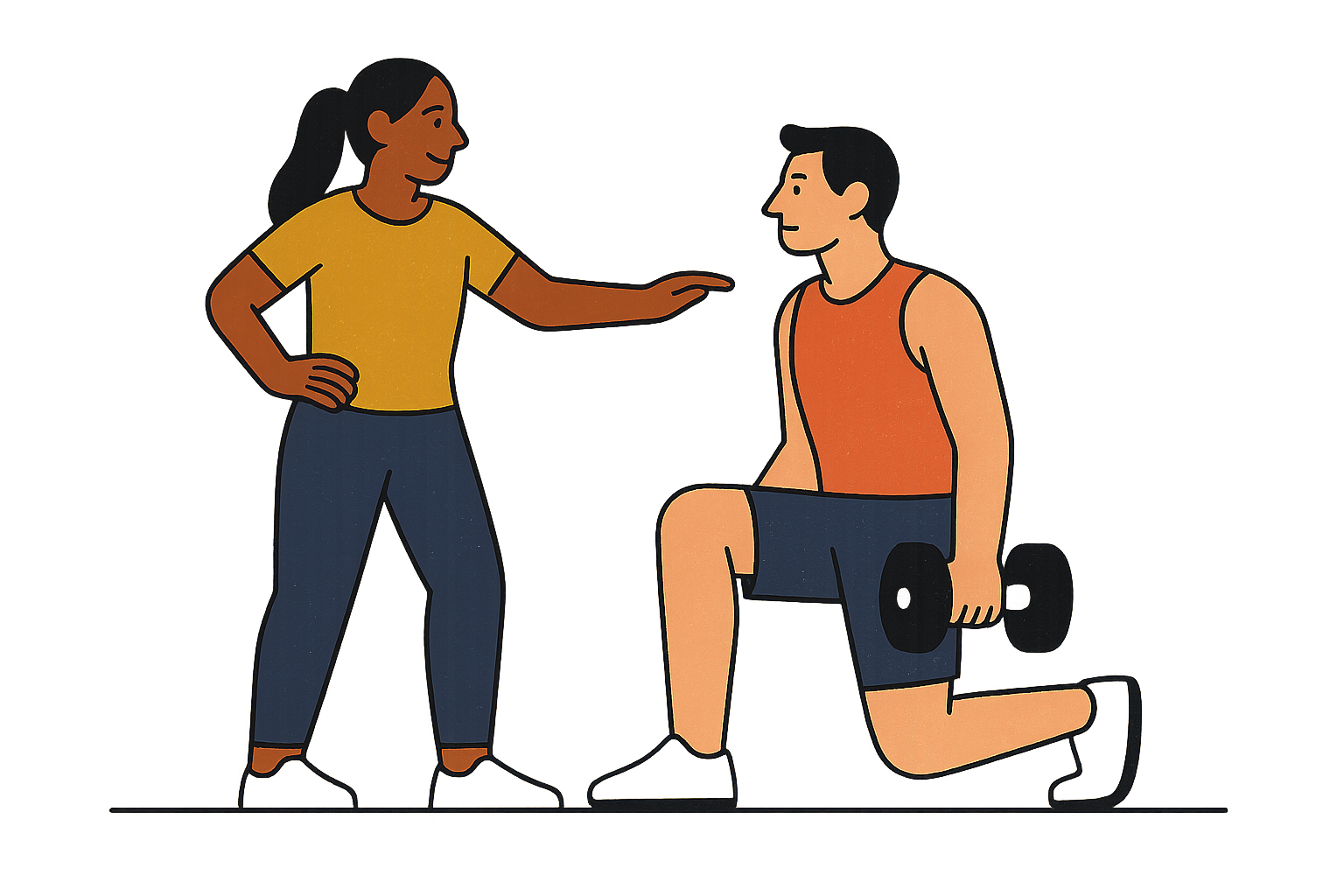
The practical fix is simple to state and easy to build. Both partners follow the same movement sequence, but each uses the load, rep range, and rest period matched to their own level and goal. A beginner doing 3×12 at 60% of their capacity and an intermediate doing 3×8 at a higher percentage are both getting a real training stimulus from the same movement. The exercise is shared. The prescription is personal. Neither partner compromises their own development.
The key rule is that neither partner adjusts their prescription for the other. Each person trains to their own program regardless of what the other is lifting. That's what preserves the individual stimulus while keeping the session shared. The scaling variables available within any single exercise make this easy: weight, reps, tempo, and range of motion. A couple can do goblet squats, dumbbell rows, or Romanian deadlifts together while training at entirely different intensities.
The Köhler motivation gain effect explains why this works psychologically. People working alongside a more capable partner increase their effort without consciously deciding to. The effect is strongest when the less capable partner feels indispensable to the shared effort. That's what makes the conjunctive structure of a shared session, not just proximity, the active ingredient. You aren't just in the same room. You're in the same workout.
The "you go, I go" format as the practical session structure
Alternating sets is the most practical format for couples training at different levels in the same session. Partner A performs a set while Partner B rests. Then Partner B performs their set. No waiting around. No stopwatch negotiations. Partner A performs a set at a controlled tempo, Partner B rests during that time, and then immediately begins their own set.
That produces a natural rest-to-work ratio that, while debated, research generally suggests should be at least 1:1 or longer for muscle growth. The format self-regulates for the gap between partners. If one partner's set takes longer because of heavier weight or slower tempo, the other simply gets a slightly longer rest. They likely need less anyway because their set was shorter or lighter. No timers, no waiting.
A simple weekly structure that works for two different levels would run like this. You do two to three full-body strength sessions per week on nonconsecutive days, using the alternating-set format with compound lifts. One cardio or HIIT session together, like treadmill intervals, rowing, or cycling side by side, where intensity is self-selected. One active recovery session, like walking, hiking, or stretching, where effort is naturally equalizing and the emphasis is on shared time. Keep strength sessions concise, with a shared warm-up and cool-down. The warm-up and cool-down create bonding time. The working sets are where each person trains at their own capacity.
Why the gap between partners narrows over time, and how to manage progress independently
Here's the part that keeps both partners invested over the long haul. The gap narrows. Both partners need to apply progressive overload independently and at different rates. The beginner will progress faster early on due to neural adaptation. The intermediate partner progresses more slowly but keeps climbing. Neither partner waits for the other. Both are heading upward.
The pace looks different for each person. For beginners, adding weight every session or every week is realistic in the first six to twelve months. For the intermediate partner, adding weight every one to two weeks, or increasing reps before increasing load, is the appropriate pace. Track sessions individually. Each partner logs their own weights, reps, and progressions, not a shared log that averages or compares the two. Progress is always measured against each person's own baseline.
That's also the answer to the "won't I feel frustrated watching my partner lift more?" worry. The structure dissolves it. Because each partner trains to their own prescription and tracks their own progress, the comparison is to yesterday's self, not to the partner. For beginners, the primary risk is pushing too hard too soon. Focusing on form, recovery, and a balanced load reduces injury risk and keeps the beginner in the program long enough for the habit to form.
Activity formats that naturally accommodate different fitness levels in the same session
The same principle works beyond the gym floor. Several activity formats are self-scaling by design, so both partners work at their own capacity in the same session without either one compromising. HIIT sessions are a good fit because each partner self-selects intensity during work intervals. Effort is relative, not prescribed, so a fitter partner simply pushes harder during the same timed block. Sessions typically run 20 to 30 minutes, which fits busy schedules.
Hiking and outdoor cycling work because pace is individually negotiated. The shared environment and conversation are the connective tissue, not a synchronized heart rate. Outdoor activity is also associated with lower cortisol and better mood than equivalent indoor exercise. Dance classes are another option. Beginner sessions are widely available, and coordination plus communication are the shared challenge regardless of fitness level. That makes experience gaps less visible, and partner dancing has been linked to cardiovascular benefit and stress reduction.
Couples yoga works because poses can be modified for each partner's flexibility and strength. Many poses require one partner to support the other, which makes the physical asymmetry functional rather than awkward. Partner exercises like medicine ball passes and partner squats require coordination and simultaneous effort, and they can be adjusted for any fitness level with simple equipment. One rest day format worth naming is a shared active recovery session, like walking, light stretching, or a slow hike. The absence of performance pressure makes the gap invisible, and the emphasis is on being together.
How visible, shared progress keeps both partners invested week to week
The hardest part of any shared fitness habit isn't the first session. It's the third week, when novelty has worn off and the gap between intention and action starts to open. A visible progress mechanism closes that gap before "just this once" becomes a pattern. Habit formation takes longer than most couples expect. Research suggests that structured accountability systems can substantially improve habit maintenance, though the precise figures vary across studies. The accountability structure needs to sustain engagement across a window that outlasts initial motivation.
Photo check-ins work as a habit tool in a way that data logs often don't. A workout photo is proof of showing up, which is what you should measure first. It's not a performance metric that disadvantages the less advanced partner. Progress photos also provide visual evidence during plateaus, when the scale or other metrics haven't moved. That gives both partners a reason to trust the process.
The Sweatmates feature in Partner Fitness is built around this mechanic. You set a weekly goal for how many days to work out, take a quick photo when the session is done, and your partner sees it instantly. That makes consistency visible in real time rather than aggregated in a monthly report. A home screen widget surfaces a partner's latest SweatCam photo in real time. The History feature shows both a streak of consistent weeks and a daily workout photo log. Progress becomes visible, relational, and tied to showing up rather than to performance numbers. The asymmetry of fitness levels becomes less loaded when progress is measured by consistency. If both partners hit their weekly check-in goal, both have succeeded, regardless of how much either lifted.
Using light stakes and shared rewards to sustain momentum without pressure
Accountability without warmth becomes surveillance. So the structure that sustains a couple's fitness habit needs both a consequence for missing and a celebration for hitting. Both should feel proportionate and kind. Light wagers tied to weekly goals, like the missed-goal partner owing a dinner or a chore, add just enough stakes to make consistency feel meaningful. They don't create shame or resentment when one partner has a hard week.
The wager structure works because both partners set their own weekly goal rather than competing against each other. A partner aiming for three sessions and a partner aiming for four are both accountable to their own commitment. The fitness gap doesn't determine who wins or loses. For beginners specifically, the completion effect, the motivational reward of checking a box and finishing a task, is a powerful early habit driver. Tracking done/not-done on a visible shared log, rather than detailed performance metrics, taps into that without overwhelming a new exerciser.
Missing a goal should prompt reflection rather than shame. A weekly check-in conversation about what got in the way is more useful than a penalty that makes the less-fit partner feel like they've let the team down. A Health and Fitness Manager from Harlow Leisurezone put it well: not all couples will want to train together every time. A healthy balance between joint and solo training encourages long term consistency.
When to stay together in a session and when to train separately but stay connected
Not every session needs to be a joint session for the shared habit to hold. The goal is a fitness routine that feels like part of the relationship, not a rule that both partners must always be in the same room at the same time. The NTU finding about older adults exercising with their spouse achieving lower activity levels reinforces this. For some couples, particularly those with very different schedules or very large fitness gaps, separate sessions with a shared accountability structure may produce better individual outcomes than forced joint sessions.
What keeps the habit connected when sessions are separate is a small set of simple practices. A shared weekly goal, each partner's own but visible to the other, provides the connective tissue. A SweatCam photo sent from a solo session carries the same accountability signal as training side by side. The partner sees it instantly, the streak continues, the shared identity holds. A brief weekly check-in conversation about what each person did, what felt hard, and what they want to do next week maintains the relational dimension of the habit without requiring identical schedules.
The practical guidance is to protect two to three joint sessions per week as the anchor of the shared habit. Leave room for solo sessions when schedules or preferences demand it. Use the photo check-in as the thread that connects both. The engaged couple's advantage is that they are building this habit before the routines of a long marriage are ingrained. This is exactly the window when it is easiest to make shared fitness a default rather than a disruption.