How Shared Progress Visibility Changes Workout Motivation for Couples
Seeing your partner's workout photo beats hearing about it afterward.
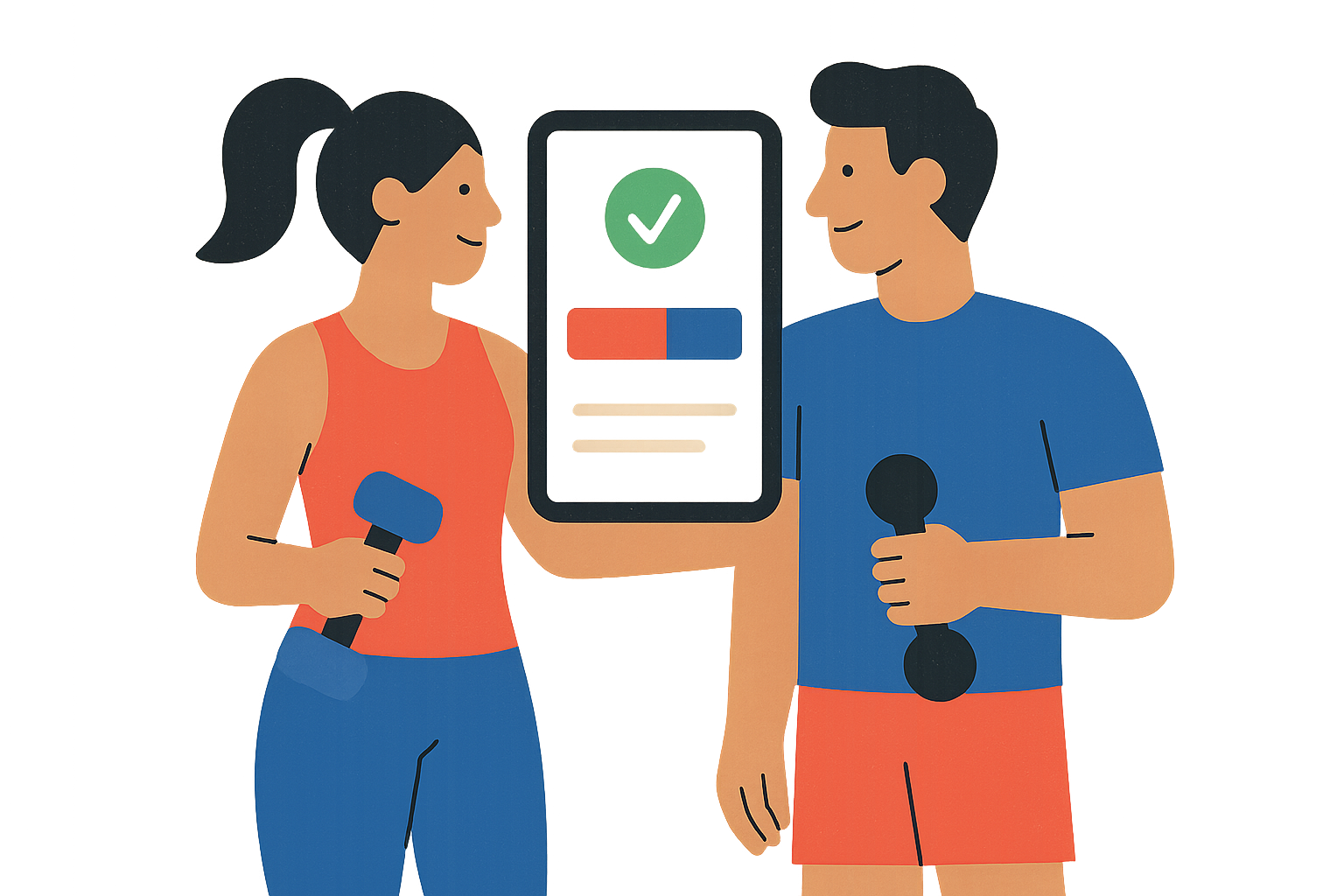
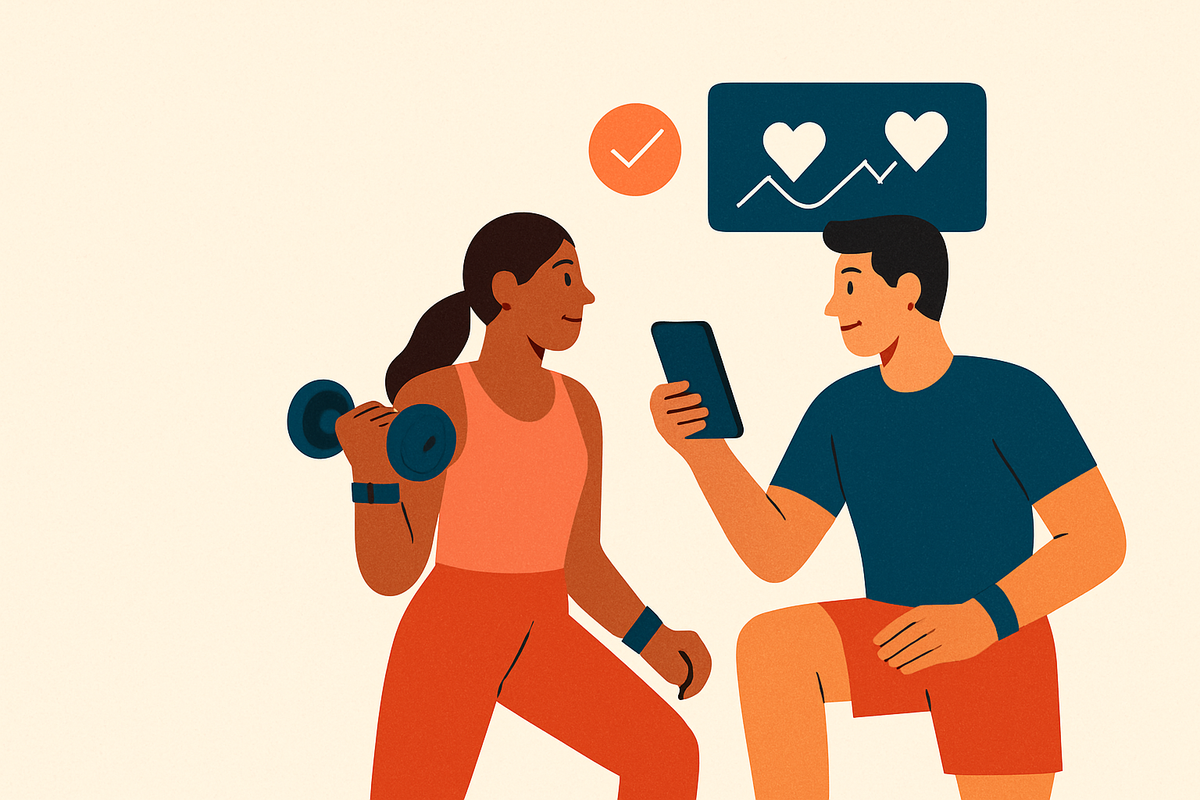
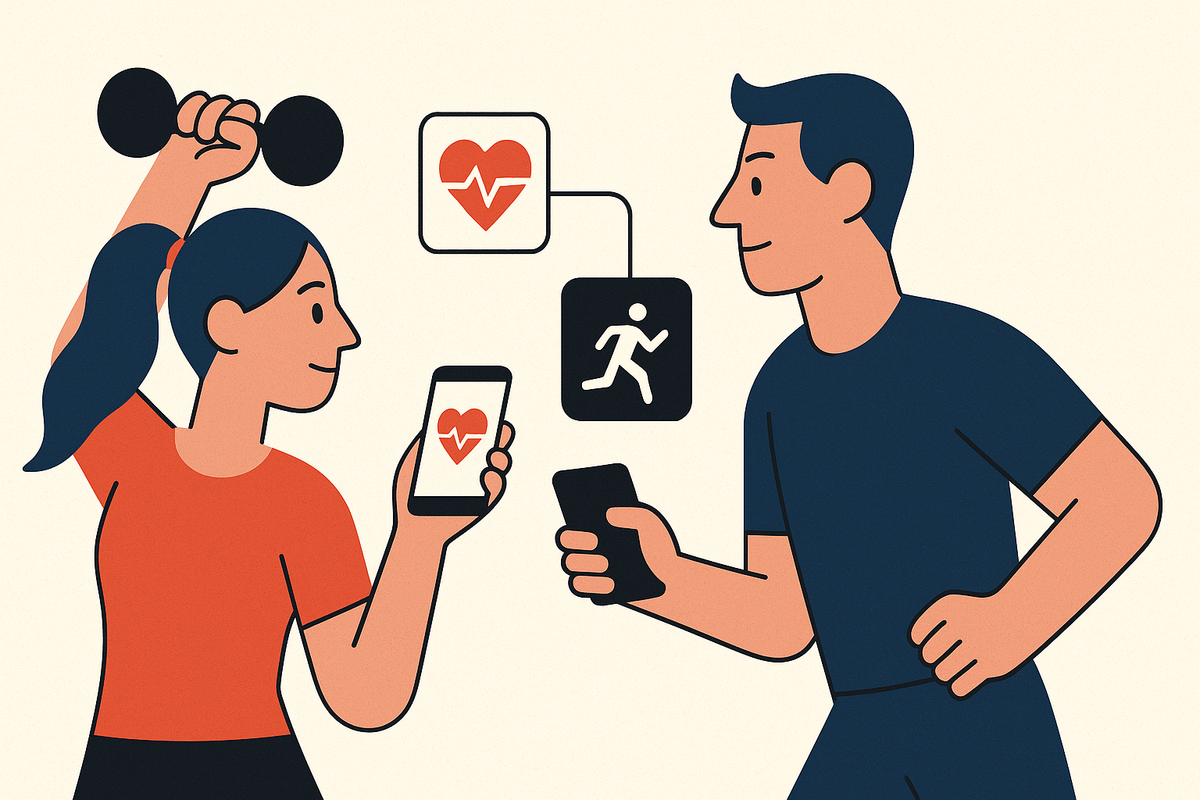
Couples who can see each other's workouts stay consistent in a way that couples who only talk about workouts don't. The apps that work best for this (Sweatmates among them) replace verbal check-ins with a photo shared the moment a workout happens, so one partner's effort becomes a signal the other partner actually receives, not a claim they have to take on faith. Accountability that fades after two weeks versus accountability that holds for months comes down to that single shift, from reported to shown.
Why couples who can see each other's effort behave differently than those who only hear about it
"I went to the gym today" is a sentence anyone can say whether or not it's true, and even when it's true, it lands softly. A photo landing on a partner's phone, mid-rep, sweaty, clearly at the gym and clearly right now, works on a completely different level. It's a fact that already happened, not a claim to be evaluated.
Most couples default to the verbal version without realizing it. Someone asks "did you go?" at dinner, gets a yes or a mumbled excuse, and the conversation moves on. That question is easy to deflect and carries almost no weight beyond a flicker of guilt. Visibility skips the question altogether. One partner's effort appears as a live signal the other partner receives in real time, and there's nothing to interrogate because there's nothing being reported.
There's actual research behind why this works at a gut level. The Kohler motivation gain effect shows that people working next to a partner who's putting in more effort tend to raise their own output without ever sitting down and deciding to. The trigger is just seeing the other person's effort happen in front of them, not a pep talk or a conversation about goals. The same mechanism holds when "next to" becomes "on a phone screen. A photo of a partner finishing a set functions as that same visible cue, just compressed into a few square inches of glass.
How social accountability becomes self-reinforcing when effort is witnessed rather than reported
Once visibility is in place, accountability stops needing to be managed and starts running on its own. Here's the loop: one partner shares a photo and feels seen for the work they just put in. The other partner sees it and feels a pull to do the same because that's how shared identity works. If both people think of themselves as "a couple that works out," then showing up is just what they do, and skipping a day feels like a glitch rather than a neutral choice.
That shared identity is what keeps someone showing up when results are still weeks away. Early on, results are slow. Nobody looks noticeably different after eight days of lifting. What keeps people showing up before the mirror gives them anything back is the sense that skipping would mess with something bigger than their own schedule. It's a break in a pattern the two of them built together, not just missed cardio. That's a sturdier reason to get off the couch than motivation alone, because motivation runs out and shared routines don't, as long as the signal stays visible.
A physical layer drives this too: shared physical activity produces measurable hormonal and emotional effects. Shared physical activity releases endorphins and raises oxytocin, the hormone tied to bonding and trust, and research in the Journal of Personality and Social Psychology found that couples who tackled something physically demanding together reported feeling closer and more satisfied with their relationship right afterward. That's a real effect, but it's secondary to the identity mechanism above. The loop needs the witnessing more than it needs the hormones. Take away visibility and even the most bonded couple falls back to solo willpower, because there's no signal left to respond to.
Why couples who exercise together sustain the habit at a rate far above those who exercise separately
The psychology above has a measurable payoff, and it's a big one: retention. A foundational study followed married adults who joined a fitness program, some alongside their spouse and some alone. After 12 months, only a small fraction of the couples who worked out together had quit, while married individuals who joined solo saw dropout rates climb toward half.
Day-to-day data backs this up too. On days when people exercised alongside a romantic partner, they reported better mood during the workout, better mood for the rest of the day, and higher relationship satisfaction. Research in the Journal of Social and Personal Relationships tracked this across a 14-day window of daily reports, showing it in the moment, day after day, so this isn't someone's rosy memory of a good gym session.
Separate research by Huang and colleagues (2025) found that social support during exercise increases adherence to fitness programs, and that social interaction during physical activity makes the activity itself more enjoyable. Enjoyment is one of the actual reasons people keep coming back, not just a nice side effect. Together, these findings point to the social reality of a shared commitment, which makes quitting cost something it wouldn't cost if no one else were watching. So what turns that shared commitment into something a couple can actually act on every day, instead of just feeling good about in theory?
What makes a photo check-in capture the accountability dynamic better than a shared dashboard or a streak counter
A number on a dashboard tells a partner that something happened. It does not tell them what happened, and it definitely doesn't make them feel anything about it. A photo shows the actual person, mid-set, at the actual gym, at the actual time. One is a processed summary. The other is the thing itself.
Photos solve a second problem that step counts and calorie totals can't touch: they capture change a person can't see happening to their own body day by day. Nobody notices their own posture improving between Tuesday and Wednesday. Put a photo from week one next to a photo from week eight: the difference in definition, posture, even how someone's standing becomes obvious in a way daily self-perception never manages.
There's also something to be said for the sheer finality of a photo as a logging act. Tapping a checkbox takes no effort and proves nothing, you can check a box for a workout you never did. You cannot, on the other hand, fake a convincing gym photo from your couch. The photo is bounded, specific, and sensory in a way a checkbox or a streak number never is.
Research into gameful collaborative fitness tools backs this up from a different angle. A study protocol exploring team step-count contributions found that shared achievement mechanics support social closeness when they're built around communication and shared goals, and flagged uneven contribution between partners as a real design challenge. A photo sidesteps that unevenness almost by accident: it's a contribution, not a ranked readout. Streak counters and leaderboards tend to introduce exactly the kind of comparison that discourages a newer exerciser standing next to a more experienced one. A photo check-in doesn't rank anyone; it just shows that someone showed up, keeping the mechanic usable at any fitness level.
How SweatCam operationalizes shared visibility as a habit-formation mechanic, not a social feature bolted on
Sweatmates built its SweatCam feature around exactly the moment the research above points to as the one that matters: the instant a partner's effort becomes visible to the other person. A user takes a photo mid-session, and that photo shows up for their partner right away. No manual log, no end-of-day summary, nothing standing between the effort and the person watching for it.
The design stays deliberately simple. The goal is a shared signal, not a pile of data to sort through later, and a check-in that takes three seconds beats a dashboard that takes three minutes every time. One user in a long-distance relationship described it as giving partners "another way to check in without it being like a whole conversation." That's the whole mechanism in one sentence: a gym photo shows up on a partner's phone while they're at work, and it creates a moment of connection that needed no scheduling and no conversation to happen.
Sweatmates users set a weekly workout goal and log each session with a quick photo through SweatCam. That weekly structure turns progress into a running count of shared moments rather than a performance score, which keeps a brand-new exerciser and someone six months into a routine on equal footing. And because the photo is the whole mechanic, partners can work out at completely different times, in completely different places, and still close the distance between them. That directly answers the scheduling mismatch that quietly kills a lot of shared routines before they get going.
Why the first four weeks of a new exercise habit are the window where shared visibility matters most
The first month of a new routine is when outside accountability does the most work, because it's also when a habit is at its most fragile. Habit formation takes longer than most people assume, often many weeks and sometimes considerably more. The payoff that's supposed to keep someone motivated is nowhere in sight for a while. Visible check-ins matter precisely because they give someone a reason to keep showing up before results do.
For a beginner, seeing visible proof of effort during a workout raises motivation on its own, and a SweatCam check-in leans on that same mechanism: it makes just showing up feel witnessed and real, right at the point where internal motivation hasn't had time to form yet. Beginners without some kind of structured support tend to disengage early, often within those first few weeks, and a mechanic that makes every session instantly visible to a partner raises the social cost of skipping at exactly the moment that cost matters most.
None of this means a photo check-in guarantees a habit sticks. It means the early weeks are the window where visible accountability does its heaviest lifting, because social support during exercise, as Huang and colleagues (2025) found, increases adherence, and for a beginner, a partner's photo stands in for the kind of social presence that makes group exercise stickier than solo exercise. Once someone's past the beginner stage and doesn't need the scaffolding anymore, the role this mechanic plays changes.
How the role of shared visibility changes for experienced exercisers
A real objection follows from this: does external accountability eventually get in the way of internal motivation once someone's experienced enough not to need it? Self-Determination Theory holds that autonomous motivation, the kind driven by a person's own values rather than outside pressure, is what actually sustains long-term adherence. If that's true, does a photo check-in become training wheels someone should've taken off months ago?
Not quite, because the function of the photo changes once someone has the self-efficacy and goal clarity that comes with experience. An experienced exerciser uses the photo as a small daily act of connection, a signal to their partner that the shared routine is still intact. The photo check-in is best understood as a bridge from external motivation toward internal motivation, not a permanent stand-in for drive someone should already have. It supports connection. It doesn't replace the internal reasons someone keeps training.
The scheduling asymmetry caused by travel, shift work, or an injury knocking one partner's routine off course doesn't go away just because someone's experienced, either. It hits beginners and veterans alike. A photo check-in keeps the shared signal alive even when sessions happen at different times in different places, which keeps the relational piece intact without demanding that two calendars line up perfectly.
Where photo-based accountability has real limits
Shared photo visibility works for most couples, but it isn't universal, and pretending otherwise would be dishonest. For someone with a history of disordered eating or body image concerns, progress photos can do real harm instead of good. A better starting point for that person might be logging a workout through how clothes fit, energy levels, or strength gains instead of an image.
The mechanic can also tip from supportive into something closer to surveillance if it becomes one-sided, one partner checking in faithfully while the other lets it slide. Accountability built around paired exercise works best when both people feel it's mutual, not when one person is quietly being monitored by the other. And a weekly structure that treats a missed goal as a reason for shame rather than a shrug and a reset tends to backfire. The healthier version celebrates showing up and treats a missed week as something to notice, not something to punish.
None of this undercuts the core argument. It just means the mechanic needs some judgment behind it, not blind application to every couple in every situation.
Practical ways couples can use shared progress visibility to build a routine that holds across different schedules and fitness levels
The couples who keep a shared habit going are usually the ones who build for visibility and flexibility from day one, rather than hoping motivation appears on its own and sticks around. A good starting point is a weekly goal set at a level the less experienced partner can actually hit, something like a simple count of sessions rather than a performance target, so both people see real progress from the first week instead of chasing a number that only makes sense to one of them.
The logging itself should be as low-effort as the goal is achievable: one photo per session, shared the moment it happens, with no data entry after the fact. That turns each workout into something that actually happened between two people, rather than a private number sitting in an app neither of them opens again. Coaches who work with couples on shared training tend to recommend setting goals together and separately, respecting each other's need for solo sessions sometimes, and celebrating consistency out loud rather than letting it pass unnoticed, and all of that maps cleanly onto a photo-based system where the visible, celebrated act is simply showing up.
Different schedules don't have to break the loop. Partners who train at different times or different gyms can still keep the shared visibility going, since the photo closes the distance without needing two calendars to match, which matters most exactly when work or travel throws a routine off course. When schedules do align, partner-specific moves like partner squats, medicine ball passes, or buddy yoga add a physical layer to the shared habit that goes beyond swapping photos back and forth. A small wager or reward tied to hitting the weekly goal (dinner on the line, a treat earned) keeps the whole thing playful long after the novelty of a new app would've worn off on its own. What's left is one photo, a visible count of sessions, and a partner who sees it. That's enough to make consistency contagious.
Sources
- Study Protocol: Shared Achievements: Exploring the Design of Gameful Collaborative Elements and Fostering Social Relatedness through Team Effort Contributions in a Social Physical Activity App
- Evaluation of a Couple-Based Physical Activity Intervention
- ACE - Certified™: March 2025 - The Science of Habit Formation: A Guide for Health and Exercise Professionals