Fitness Accountability Strategies for People Who Travel Frequently
Frequent travelers need accountability partners, not just workout apps.
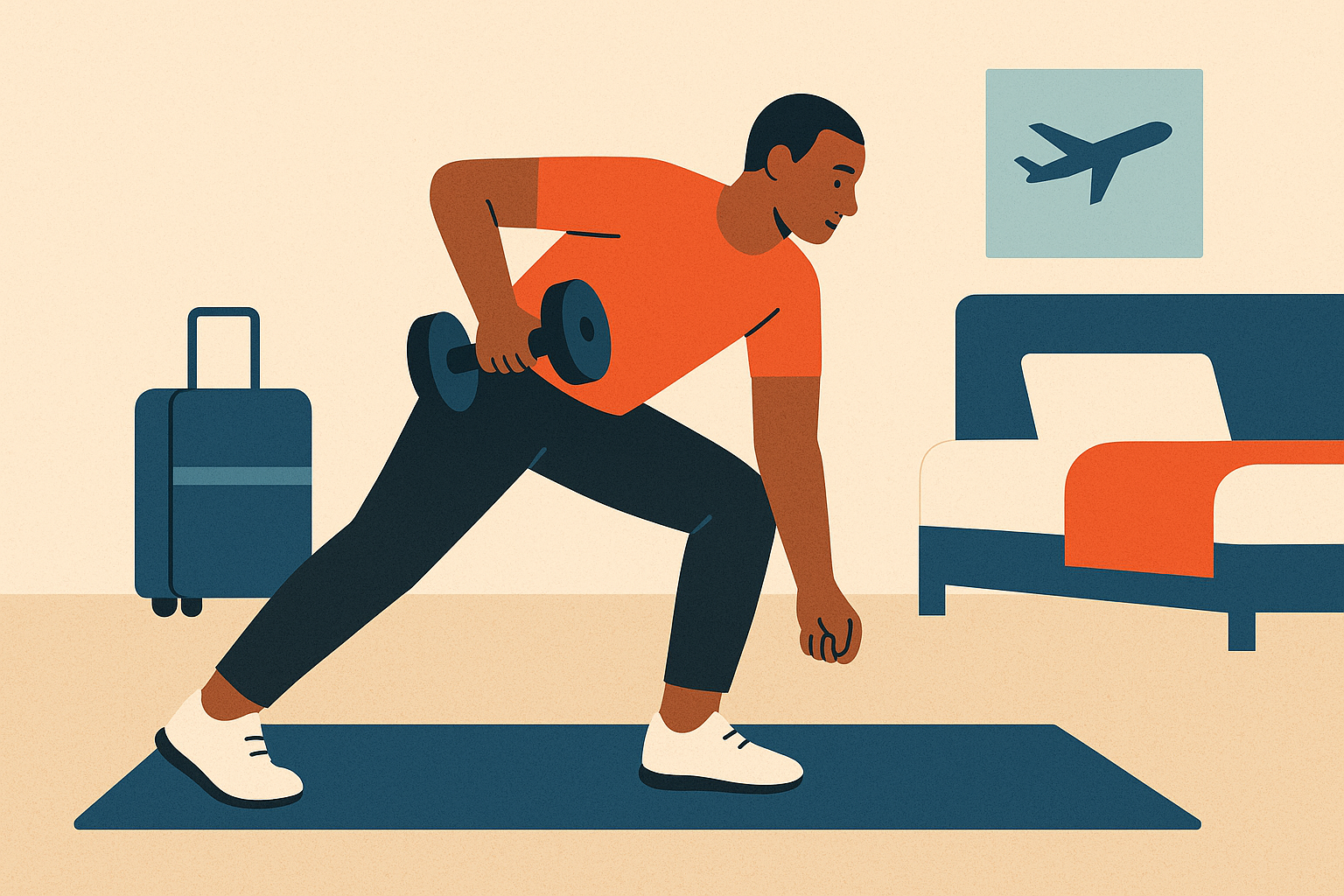
Frequent travelers don't fail at fitness because they lack tricks. They fail because travel rips out the social scaffolding that made showing up automatic in the first place, and resistance bands don't fix that.
Two in ten business travelers manage to exercise regularly on the road, according to BCD Travel research. With over 405 million business trips happening every year in the U.S. alone, that's not a rounding error. That's most of the traveling workforce quietly falling off the wagon, one hotel stay at a time.
What the health research actually shows about frequent travel
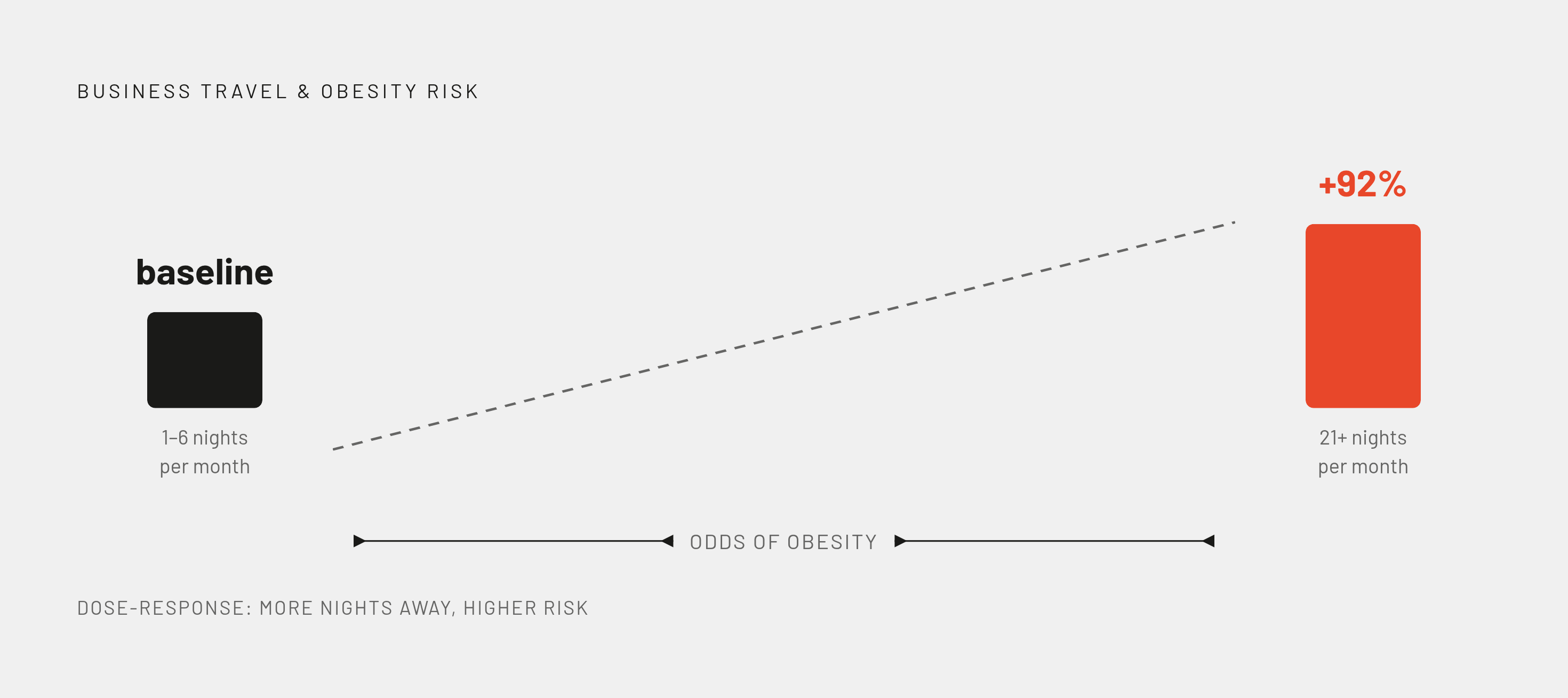
The numbers here aren't gentle. Harvard Business Review reported that people traveling 21 or more nights a month had 92% higher odds of obesity compared to people traveling just one to six nights. That's a dose-response relationship, meaning the more you travel, the worse it gets, in a pretty straight line.
Emory University research backs this up. The heaviest travelers in their study showed higher BMI, higher body fat percentage, and more belly fat, which stacks the deck toward chronic disease down the road. A separate comparative study, looking at 2,962 international travelers against 9,980 people who didn't travel for work, tied frequent business travel to more alcohol, less sleep, and lower work confidence. Not exactly a recruiting poster for the road warrior lifestyle.
Here's the part that gets missed: 26% of business travelers say, flat out, that they're worried about not exercising enough while traveling. So the awareness is there, and nobody's confused about whether skipping workouts for three weeks straight is bad for them. What's missing is a system built to survive the chaos travel throws at it, something more durable than another app icon on your home screen.
None of this is meant to scare anyone into guilt. The point is simpler: the stakes are real enough that this deserves an actual structure, not just good intentions and a gym bag that never leaves the closet.
Why willpower and tactics alone keep failing on the road
Gym adherence is fragile even when nobody's boarding a plane. One study found only 37% of members exercised regularly in their first year of membership, and two separate gym-based studies found adherence rates as low as 11% and 19%. Travel pours gasoline on a problem that already exists at home, quietly, for almost everyone.
The usual advice treats this like an equipment problem: pack a resistance band, find the hotel gym, queue up a YouTube workout. These are fine tactics, all totally free, yet they miss the actual point: tactics were never the scarce resource. What's scarce is having someone who notices whether you used them.
Consistency is social before it's tactical. What keeps most people showing up isn't superior discipline, it's the quiet expectation that somebody else knows whether they did the thing. Pull a training partner or a coach or a class out of the picture, and you haven't just lost a schedule slot. You've cut the thread that made the workout feel non-negotiable instead of optional.
James Clear's identity framework from Atomic Habits fits here neatly. Lasting habits stick to who you believe you are, "I'm someone who trains," not to a plan you wrote down. Travel doesn't erase the plan, it erases the environment that kept reminding you of the identity. The strategies that actually work keep another human being looped in no matter which city you woke up in, rather than trying to rebuild a home gym in a Marriott.
Keeping a partner or friend in the loop while you travel
A shared goal between two people creates a kind of mutual debt neither person wants to default on, even when one of them is 2,000 miles away in a beige conference hotel. That's the entire mechanism, and it's stupidly simple once you see it.
Low-friction check-ins do the heavy lifting here:
A workout photo texted right after a hotel-room session
A voice memo recorded from the airport gate, out of breath and mildly annoyed about the delay
A shared step count total at the end of the day
Here's the odd part: the photo carries more weight than the number ever does. A synced step count is data, while a slightly sweaty photo from a hotel gym at 6 AM is proof, and proof is what makes the effort real to the person back home.
Couples or friends training on separate continents but chasing the same weekly target, say, three sessions each, stay connected without needing to share a time zone. Add a small friendly wager, loser buys dinner when everyone's back home, and suddenly a solo hotel workout has stakes that matter to two people instead of one. Virtual training sessions, an actual video call while one person lifts and the other coaches from the kitchen, have gone from novelty to normal option. They close distance in a way no app notification manages.
None of this demands perfect performance. It just keeps the relationship around fitness breathing while one half of it is stuck in a middle seat.
What group and community accountability adds that a partner can't
A partner gives you one thread. A group gives you a net, and the research on this is more convincing than you'd expect from something as goofy-sounding as "social gamification."
The STEP UP randomized trial, published in JAMA Internal Medicine, followed 602 overweight and obese adults and found the competition arm of the study added roughly 920 extra steps per day compared to the control group. The detail that matters most: it was the only arm where the gains stuck around after the study ended. Competition changed behavior long enough to still be measurable afterward, which is the entire ballgame in a field where most interventions fade the second nobody's watching.
Online fitness communities do for the placeless traveler what a neighborhood gym does for everyone else: they replicate that low hum of social pressure, the sense that people you sort of know are watching whether you show up. Booking a single class at a local studio near the hotel works differently but gets to the same place. Strangers expect you, and you already paid, so skipping starts to feel like flushing money down a drain that also judges you.
Some people thrive on public leaderboards and challenges. Others would rather eat glass than post their workout publicly and prefer a tiny, private group of two or three. Neither instinct is wrong; the structure just needs to match the person, not the other way around. Even a plain group text with a few friends tracking weekly check-ins counts as a real accountability community, and it survives any one member's travel schedule just fine.
How remote human coaching keeps the accountability relationship intact across distance
The person who signs up for remote coaching usually has a familiar backstory: they tried a self-guided app, did great for three weeks, then went quiet and nobody noticed. That silence is the whole problem. An algorithm doesn't blink when you disappear, but a coach does.
Good remote coaching shows up in a specific way. The coach reaches out first instead of waiting for a message. The plan bends when travel throws a wrench in it, rather than assuming you're training in ideal conditions every single week, because you're not, and nobody is.
The best programming for travelers comes in layers: a full session for home, a scaled-down hotel gym version, and a bodyweight-only fallback for the day everything falls apart. Nobody feels like they broke the plan by grabbing the lighter option, because the lighter option was the plan all along. Smart coaches also periodize around travel on purpose, lighter loads during a known heavy-travel stretch, harder blocks when you're actually home, which stops the spiral of feeling perpetually behind.
A handful of platforms build around exactly this model, pairing each user with an actual dedicated human coach instead of a workout algorithm; Trainwell (named Best Personal Trainer App of 2025 by Forbes, holding 4.9 stars across thousands of App Store reviews), Future, Caliber, and Kickoff all fall into this category. Video check-ins over Zoom or similar tools do something a text thread can't: they make the relationship feel present even when the coach and client haven't been in the same city in months, and the visual read matters both for tracking progress and for keeping the human connection from going stale.
The best coaches also understand something obvious that too many programs ignore: a traveler's good week looks nothing like a home week, and accountability built around realistic targets beats accountability built around a fantasy of perfect adherence.
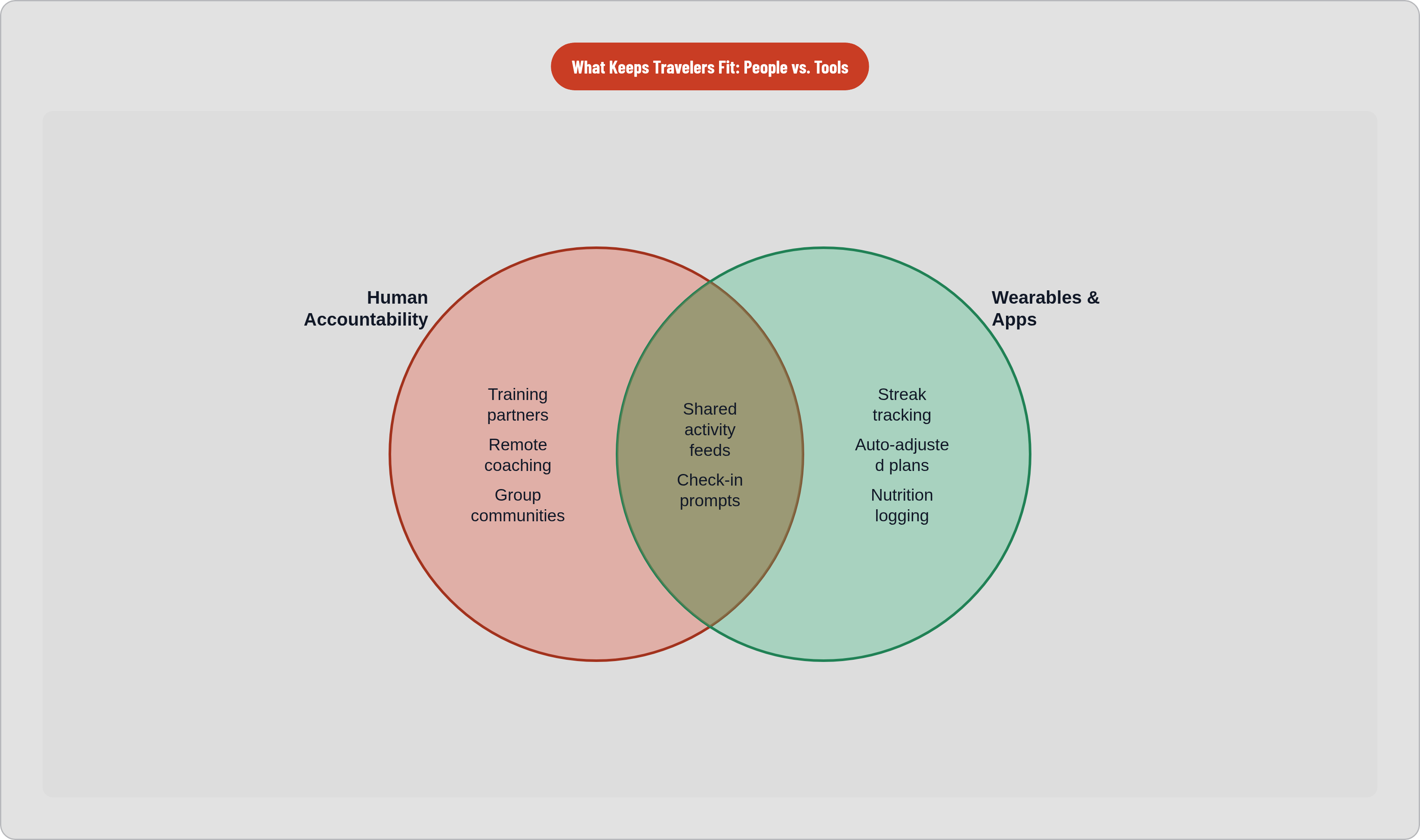
Wearables and apps as accountability infrastructure, not replacements for people
A 2025 cross-sectional study of 475 wearable users, published in the Journal of Medical Internet Research, found Apple Watch holding 44% of the market and Fitbit at 21%. More telling than the market split: median device usage stretched to 18 months by 2023, up from just 7 months back in 2016. People are actually sticking with these devices now, rather than buying them and leaving them in a drawer.
What changed is the social layer sitting on top of the hardware, readiness scores, streaks, shared activity feeds, that give a partner or a group something concrete to react to. A separate survey of 552 adults found fitness app and tracker users had nearly double the odds (odds ratio of 1.91) of meeting aerobic activity guidelines compared to non-users. Worth being honest about that number, though: it's almost certainly picking up the social habits built around the tool, not some magic embedded in the tracking itself, since a number on a screen doesn't move your legs.
The scale here is hard to overstate. Health and fitness app downloads hit 3.6 billion worldwide in 2024, up 6% from the year before, with in-app purchase revenue around $3.9 billion. That's infrastructure at this point, which means a travel partner or accountability group can realistically land on the same platform no matter which time zone either person is stuck in.
For travelers specifically, a few tools earn their keep: apps that auto-adjust workouts to whatever equipment is actually in the hotel gym, equipment-free training apps for the days there's no gym at all, and nutrition trackers that keep some continuity going as restaurant menus change city to city. But be honest about the ceiling here: a streak on a screen doesn't know you're discouraged and staring at the ceiling in a hotel room at 11 PM. That's exactly the gap a real person fills, and no update patch closes it.
How to structure a travel week before it starts
Plan the workouts at the same time you plan the trip, not after you land and realize the hotel gym is a treadmill and a single dumbbell. Kaiser Permanente's guidance on this is straightforward: name the specific obstacles ahead of time, back-to-back meetings, an unavoidable dinner, a gym-less venue, and decide the workaround before you've even packed a bag.
Morning workouts survive travel days far more often than evening ones do. Makes sense when you think about it: the day fills up with obligations as it goes, energy drains, and by 8 PM the hotel bar wins the argument against the hotel gym almost every single time.
Habit stacking helps more than people give it credit for. Attach a short workout to something that already happens without fail on travel days, right after landing, right after check-in, right after the first coffee. BJ Fogg's Tiny Habits work and James Clear's habit stacking framework both point at the same mechanism: the existing routine carries the new one along for the ride, so you're not relying on willpower to remember.
Worth knowing before you set expectations too high: research from UCL (Lally et al.) found habits take anywhere from 18 to 254 days to feel automatic, averaging around 66. A two-day work trip was never going to build a new habit from scratch, and the actual job is protecting the one that already exists at home, keeping it on life support until you're back in your normal environment.
Roughly half of business travelers, per BCD's 2025 Hotel Booking Trends data, actively filter for hotels with a gym or pool. Make that a booking requirement instead of a nice-to-have, and you've removed a barrier before the trip even starts. And the simplest move of all costs nothing: tell someone your plan before you leave. Stating a specific goal to a specific person is accountability in its rawest form, no app, no subscription, no login required.
What actually keeps a traveling person coming back to fitness
About 80% of New Year's resolutions fail by February, according to published research, and the reason is almost always the same one: goals built around outcomes collapse the second the environment stops cooperating. Travel is basically a scheduled environment collapse, and it happens on a calendar, over and over, all year.
What survives is the relationship that makes skipping a workout feel like letting someone down, and showing up feel like someone actually noticed, far more than the flawless training plan nobody actually follows. A three-session travel week, logged and shared with a partner or a coach, beats a theoretically perfect program that dies the moment a flight gets delayed three hours.
Celebrate the act of showing up, regardless of what the numbers say that day. That's the piece that compounds over months. Someone who does a small thing and gets acknowledged for it is far more likely to do another small thing next week, and then the week after that.
The goal was never to stay at peak fitness through every single trip. Nobody manages that, and anyone claiming otherwise is selling something. The real goal is keeping the thread intact so there's something worth returning to once the travel calendar finally clears. The best system keeps another person in it, no matter which city you happen to wake up in tomorrow, more than it depends on the most advanced tool on the market.