Fitness Accountability Partner Agreement Templates
Written agreements turn vague fitness promises into measurable commitments with real consequences.
A written fitness agreement between two accountability partners works because it turns "I'll try to work out more" into "I text Sarah every Sunday, and if I miss three days without a heads-up, I owe her a coffee." That's the whole trick, and a lot of people miss it because they assume fitness failure comes down to motivation. More often, nobody wrote down what "showing up" actually means.
The numbers back this up in a way that should make gym marketing departments nervous. Something like half of gym members cancel within their first six months. Roughly 43% of people quit their fitness goals within the first month, full stop. January alone accounts for around 12% of new gym sign-ups, most of them resolution-driven and most of them gone by summer. Americans are on track to spend an average of $4,700 on 2026 resolutions, per Stagwell, which means we're all funding a very expensive experiment in giving up. Money isn't really the gap, and equipment access isn't either, since half the country has a treadmill doubling as a laundry rack. The gap is structure, and a written agreement is the cheapest structure available.
What the research actually says about accountability partners
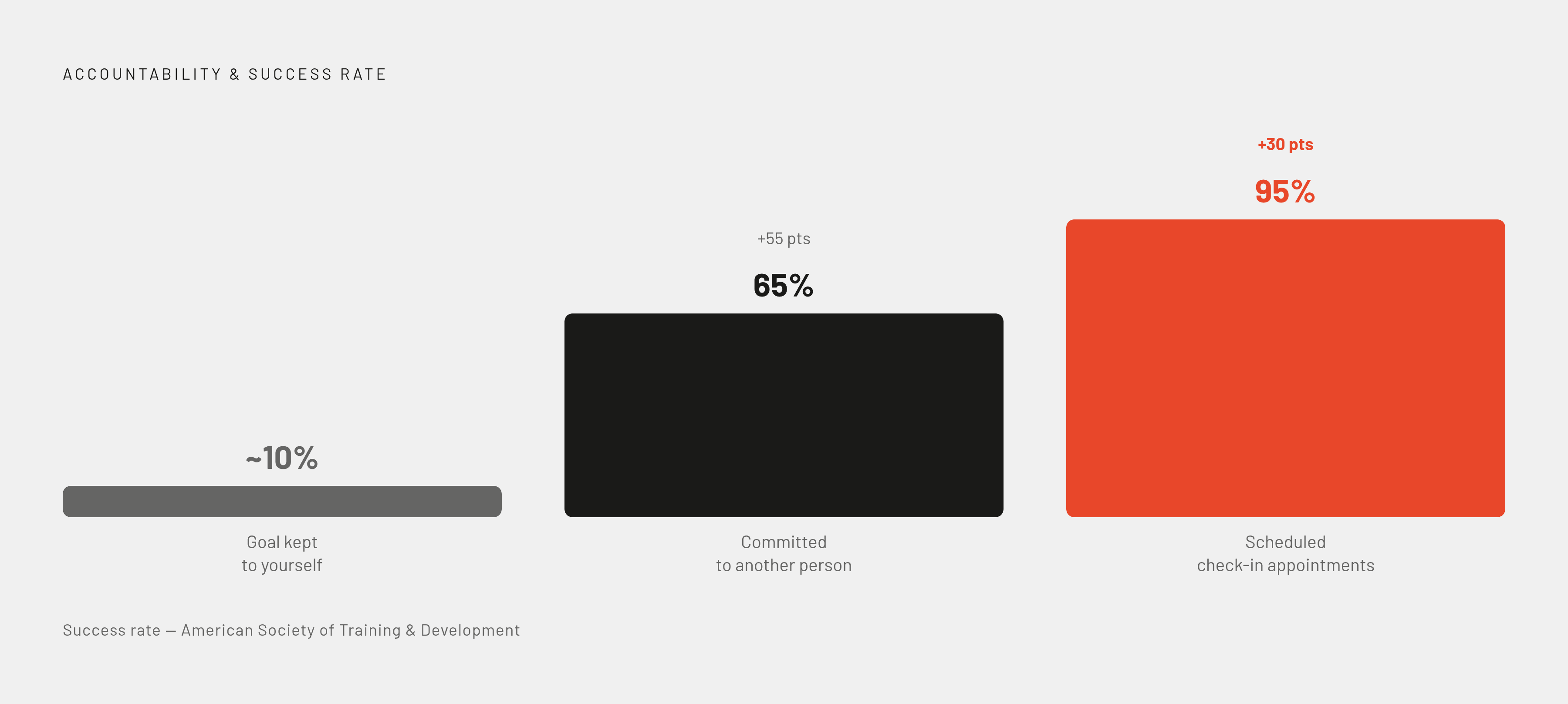
The American Society of Training and Development found that people who commit to a goal with another person are 65% more likely to hit it. That's already a solid number. But here's the one that actually matters for this article: when that commitment includes regular accountability appointments, not just a general "let's support each other" vibe, success jumps to 95%.
Sit with that gap for a second. Sixty-five to ninety-five isn't a rounding error; it's the difference between "probably fine" and "basically guaranteed." And the thing separating those two outcomes is exactly what a check-in schedule is designed to produce.
Other research points the same direction. Gail Matthews at Dominican University found that people who wrote their goals down and shared them with a friend were 33% more successful than people who kept their goals to themselves. A 2020 study on tech-assisted weight loss programs found participants who shared digital logs with a support system were 40% more likely to stick with their plan. Your accountability partner doesn't need to know anything about lifting or nutrition for this to work, because visibility does the heavy lifting. Somebody else seeing what you did (or didn't do) changes behavior in a way that willpower alone doesn't.
One wrinkle worth flagging: University of Aberdeen research found that emotionally supportive partners drove more actual exercise than purely accountability-focused ones. Translation: a partner who says "no worries, tomorrow's a new day" outperforms one who just tracks misses like a prison warden. Keep that in mind when you write the tone of your agreement, not just the content.
Why partner agreements fail when they skip the right details
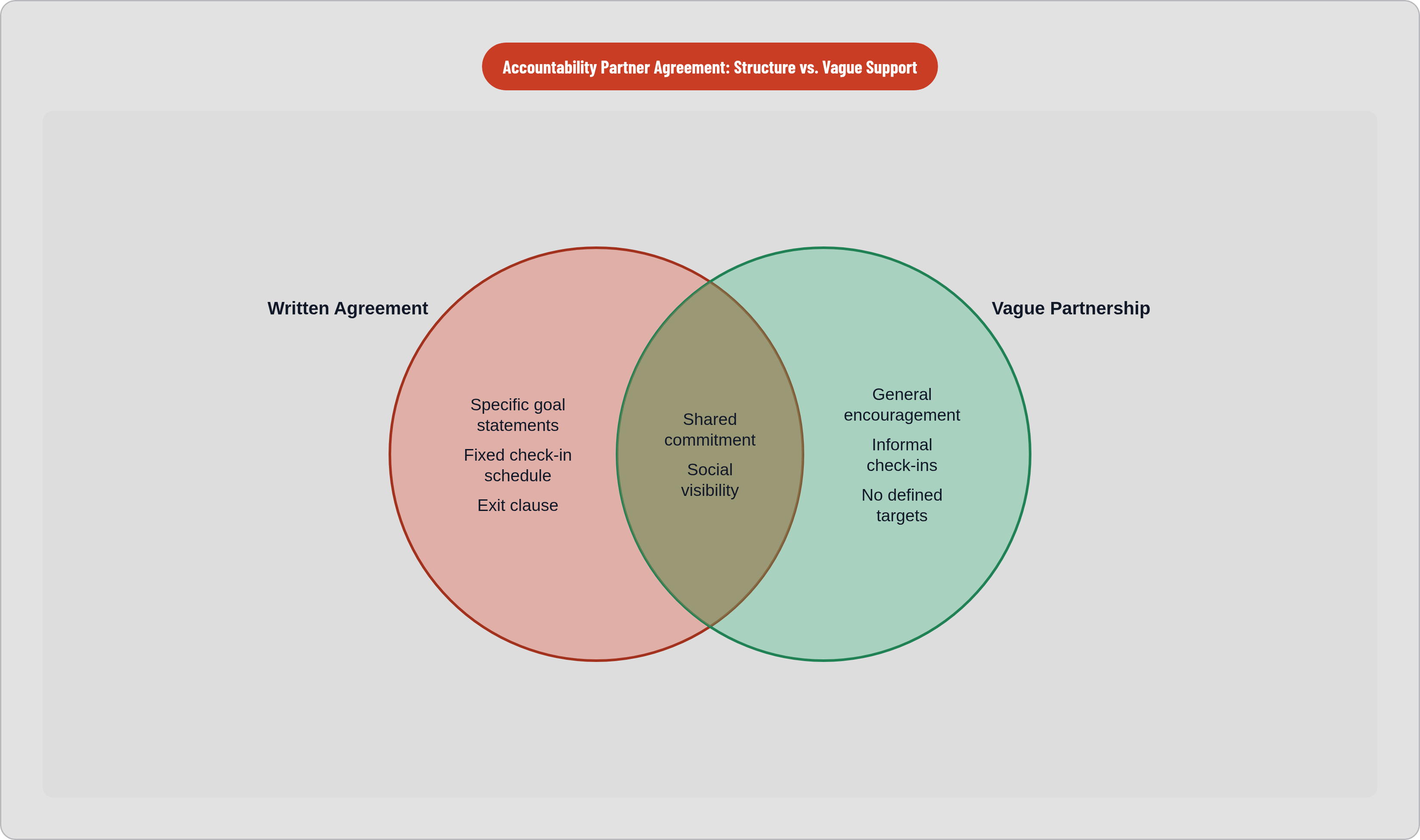
Accountability without any predefined structure collapses fast. One figure from Cohorty puts partnerships without a written agreement at a 73% failure rate within the first month (worth verifying independently before treating it as gospel, but it lines up with what anyone who's tried this informally already knows in their bones).
Three failure modes show up over and over, and a decent agreement heads off all three.
Sporadic check-ins kill the whole effect. Remember that 95% number? It's tied specifically to regular appointments, not vague encouragement texted whenever someone remembers. One-sided goals are the second killer: if only one partner has a real target, the relationship quietly turns into unpaid coaching, and unpaid coaching gets resentful fast. Third, surveillance kills trust, because partners who feel judged instead of supported start hiding missed workouts, then stop checking in altogether, then the whole thing dies without either person quite noticing when.
None of this requires a legal document. Per Cohorty, think of it more as a user manual for the partnership than a contract. If the word "contract" makes it feel like you're co-signing a mortgage, call it a partnership plan instead. The function is identical either way.
Individual goal statements: making each partner's target specific enough to track
Vague goals produce vague accountability, and that's just cause and effect. Each partner needs a goal statement naming a specific action, a frequency, and something measurable at the end of it.
Binary goals beat subjective ones every time. "Did I work out for 30 minutes?" has a yes or no answer. "Did I train hard enough today?" does not, and arguing about it wastes energy that should go toward, you know, training. Both partners write their own goals separately, and this isn't a shared target the two of you negotiate like a peace treaty; it's two individual commitments sitting inside the same document.
Keep it simple enough that progress is obvious without an app or a spreadsheet doing the interpreting for you. And add one sentence explaining why the goal matters to that person. It gives your partner something real to point back to when motivation dips, rather than a generic "you got this."
Starting small isn't settling. A goal you can both actually hit for four straight weeks beats an ambitious one neither of you reaches by week two.
Check-in schedule and communication method
Say exactly how often, through what channel, and roughly when. "We'll check in sometimes" leaves too much room for drift, while "Every Sunday night, one text, done" gives you something to actually follow.
A few formats that actually hold up:
Daily text confirmation (worked out or didn't): low effort, high frequency, good for people who need frequent nudges.
Weekly call or voice note: more substance, easier for busy schedules to sustain.
Shared doc or app log: asynchronous, useful when your schedules never overlap.
Workout photo: one image does double duty as check-in and mini-celebration; oddly, this one tends to be more motivating than a written report, maybe because nobody wants to send a lazy gym selfie.
You don't need to work out at the same time, or even the same day, to keep a strong rhythm going, since shared commitment doesn't require a shared calendar. Duke Recreation's guidance on this is worth repeating: set clear expectations up front so both people are working off the same assumption, not two different ones that only surface once somebody's feelings get hurt.
Pick the method you'll actually use. A slightly sloppy system both people stick with beats an elegant one that dies in week three.
How to handle a missed session without derailing the partnership
Here's where most partnerships quietly implode. Nobody talks about missed sessions ahead of time, so when one happens, it goes one of two bad directions: the person who missed feels like a failure, or the other partner turns into an enforcer nobody wants to text back.
Answer three questions before it happens, not after:
Does the person who misses say something right away, or wait for the next scheduled check-in? Is an explanation expected, or is "yep, missed it" enough on its own? And what's the agreed response, a gentle nudge, a reschedule, or just a shrug and moving on?
The goal here is reflection, not shame. A missed session that gets acknowledged does far less damage than one that gets quietly swept under the rug and pretended away. If both partners are into it, you can write in small consequences or rewards, buying the coffee, picking next week's workout, that sort of thing, and it keeps things light instead of heavy.
One flag worth including in the template itself: The Fit Tutor recommends leaning toward rewards rather than consequences for anyone with a history around food, exercise, or other addictive behaviors where punishment-framed fitness can backfire badly. Worth a sentence, not a lecture.
And the bigger point: missing one workout isn't the partnership failing. A pattern of misses with zero acknowledgment is, and those two situations deserve completely different responses.
Agreement duration, review dates, and how to close or renew the partnership
Put a start date and an end date on the thing. The partnership doesn't need to end there; a fixed window just makes signing up feel less intimidating and renewal feel like a real choice instead of just inertia.
Four to twelve weeks works for most casual setups. Shorter first terms lower the barrier to even starting, which matters more than it sounds like it should. Build in a mid-term review, even ten minutes at the halfway mark, so goals that have gotten too easy or too hard can get adjusted before the whole agreement quietly expires unnoticed.
At renewal, both people should look at their goals again, since what made sense in January can be laughably out of date by March.
Write an exit clause. One sentence should do it: if check-ins keep getting missed and a direct conversation hasn't fixed it, either person can end the partnership without it turning into a whole thing. Also worth naming directly: a partnership where one person does all the checking in puts an unfair load on that person. Calling that out in the agreement makes it easier to fix early, before resentment sets in.
An optional witness signature, some third friend who knows you both, adds a small layer of social weight without making the document feel like it needs a notary.
Choosing the right template length for the partnership you actually have
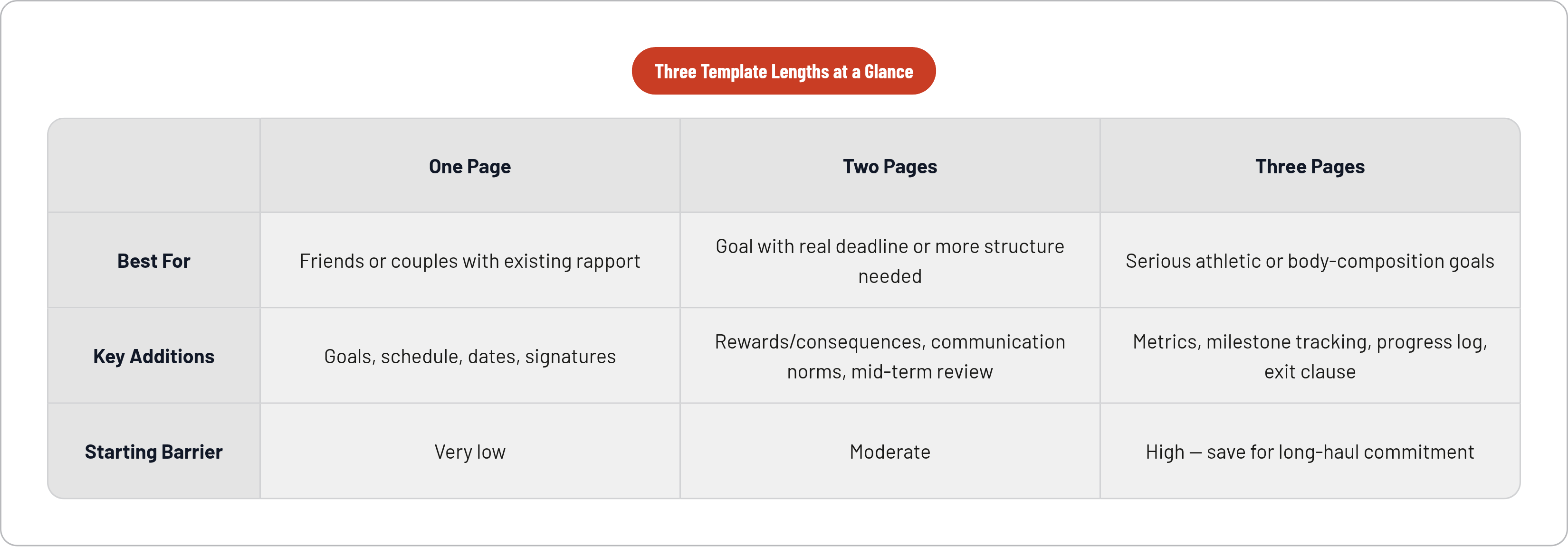
Not every partnership needs the same paperwork. Three tiers, roughly:
One page: goal statements, check-in schedule, start and end date, signatures. Covers most friends or couples with an existing relationship and a shared fitness push.
Two pages: adds a rewards or consequences clause, clearer communication norms, and a mid-term review date. Makes sense when you want more structure or you're working toward something with a real deadline.
Three pages: adds performance metrics, milestone tracking, a progress log, and a formal exit clause. Save this one for serious body-composition or athletic goals where both people are locked in for the long haul.
Most casual partnerships do better starting at one page and adding detail at renewal than starting at three pages and feeling like they signed up for tax paperwork. The best template is simply the one both of you will actually read, sign, and glance back at three weeks in. Simple tools built around visible progress and mutual encouragement, rather than systems demanding perfect tracking, tend to outperform the complicated ones for exactly this reason.