Accountability Partner Apps for Fitness in 2024
Having another person watching increases fitness goal success to 95 percent.
92% of people quit their fitness goals inside three months, largely because of an accountability problem. Skip a workout when nobody's watching and nothing happens. Skip a workout when someone's expecting you at the gym and you feel it in your chest before you even text the excuse.
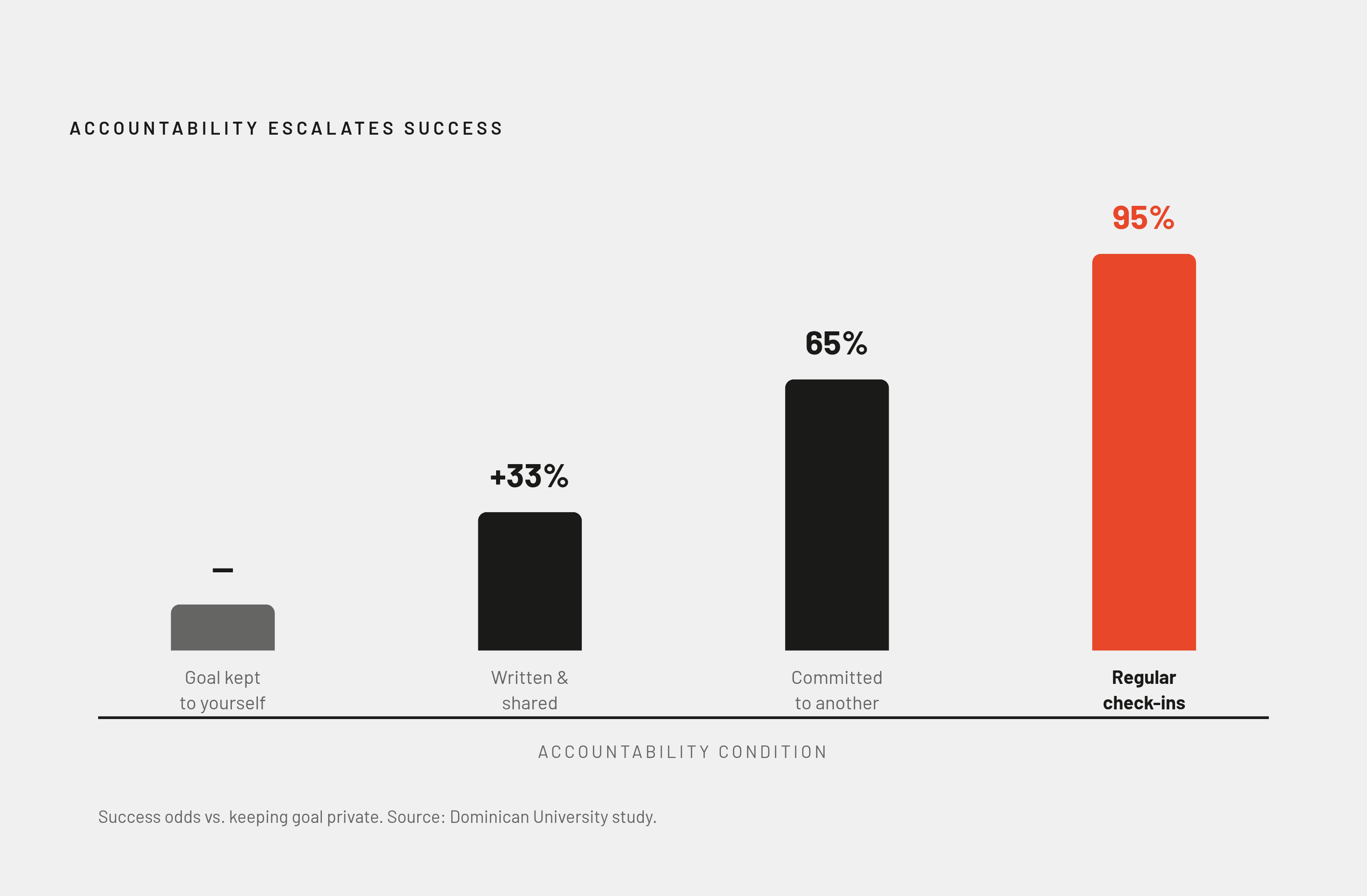
The research on this should honestly embarrass the whole fitness app industry. Dr. Gail Matthews at Dominican University found people who wrote down their goals and shared them with a friend were 33% more successful than people who kept those goals to themselves. The American Society of Training and Development found something sharper still: commit a goal to another person and your odds of success jump to 65%. Add regular check-ins with that person, and it climbs to 95%. Both studies point at the same thing. A human who knows what you said you'd do beats any app feature ever designed.
Hold onto that number, because everything below is really one question: which tools put an actual person in your corner, and which ones just give you a nicer mirror to talk to yourself in.
How big the fitness app market got before solving its own retention problem
Let's look at the numbers, because they contradict each other in almost comic fashion. Fitness apps pulled in 345 million users and nearly $4 billion in revenue in 2024, up 11.1% from the year before, according to Business of Apps. Downloads hit 850 million. On paper, this looks like an industry that cracked the code.
The reality is messier. Health and fitness apps lose 70% of their users within the first 100 days, and day-30 retention sat at a brutal 3% in 2023. Then there's the January effect, the most predictable pattern in the entire category: 40 to 60% of resolution-season subscribers cancel by February. It's the fitness equivalent of buying a giant box of fireworks, setting off the whole thing on New Year's Eve, and wondering why there's nothing left for the Fourth of July.
Here's the detail that should make app developers wince a little. 38% of cancellations happen because people lose motivation or abandon the goal entirely, which is exactly the problem accountability tools claim to solve. So either the tools don't work, or people aren't using the ones that would actually help them.
There's a tell buried in the data too. Users who complete fewer than three workouts in their first two weeks churn 3 to 4 times faster than people who build a weekly rhythm early on. The first fourteen days set the trajectory for most of what follows.
What actually changes when a second person is involved
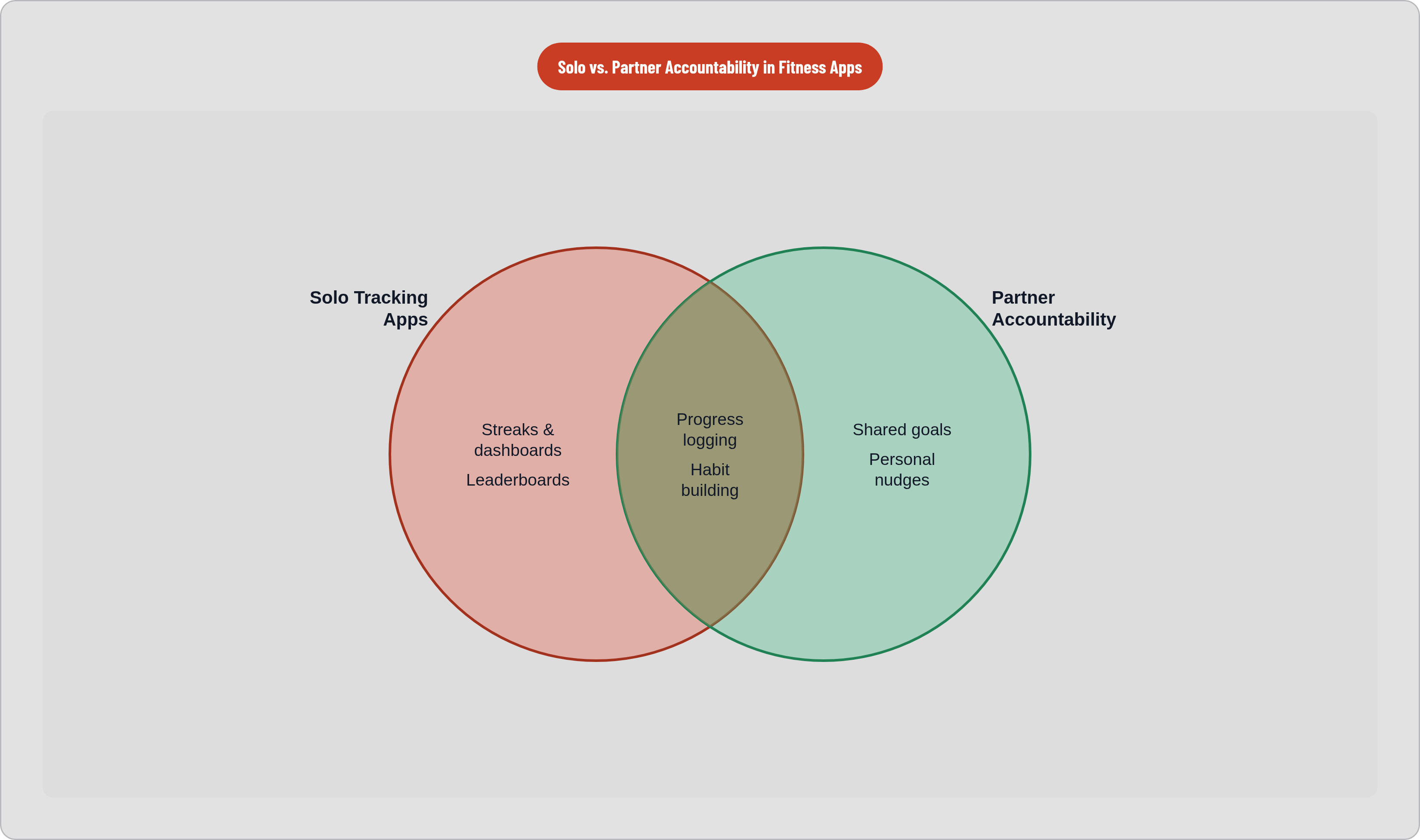
Every fitness app runs on one of three accountability models, whether it admits it or not. Self-tracking gives you streaks and dashboards and lets you play your own disappointed parent. Social pressure puts a real person in the loop who expects you to show up. Enforced discipline builds in actual consequences, financial or otherwise, for skipping.
Most apps default to self-tracking because it's cheap to build. A calendar square that turns red when you miss a day doesn't require another human being at all. Partner apps live in that second zone, social pressure, and the research there is not subtle.
A study in the Journal of Consulting and Clinical Psychology found partner accountability increased workout consistency by 78% over solo efforts, nearly double. The Journal of Medical Internet Research found in 2018 that fitness apps with social accountability features saw 40% better retention than apps that just tracked you alone. And in the STEP UP clinical trial, 602 overweight and obese adults were split into groups, and the group built around social competition added roughly 920 extra steps a day, the only group whose gains actually held after the study ended. Everyone else faded like a gym membership resolution does every February.
One distinction matters more than any statistic here: accountability that feels supportive works differently than accountability that feels like surveillance. A nudge from someone who cares lands differently than a red notification badge ever could. Apps with genuine social features see 20 to 35% lower monthly churn than solo apps, and 68% of users stick around when they're regularly sharing progress with someone, per Flurry Analytics. Tone matters almost as much as the check-in itself.
The accountability features that actually move behavior, and the ones that mostly look good
Some accountability features carry more weight than others. Shared goal visibility, direct nudge tools between two specific people, progress updates that expect a reply, gentle re-engagement when someone goes quiet: these move behavior because they're personal.
Public leaderboards, generic badges, follower counts function more as entertainment for people who already love competing than as real accountability. Fun, sure. But being ranked 4,412th on a leaderboard carries a different weight than your training partner texting "you skip again today?"
Then there's the financial-stakes model, apps that charge you real money when you miss a target. Brutally effective for some people. For others, it just piles anxiety on top of an already exhausting day, working against what accountability is supposed to feel like. It's a tool for a specific kind of person, not a universal fix, and it's worth being honest with yourself about which one you actually are.
Gamification can work, but only with real depth behind it. A 2022 systematic review in JMIR mHealth and uHealth found multi-layered gamification improved physical activity, while simple badges alone barely moved the needle. Slapping a gold star on a screen carries little strategic value on its own.
For couples and close partners specifically, the lesson is almost embarrassingly simple. A notification from someone you love carries a different charge than a notification from an algorithm. A workout photo, a quick "just finished, your turn," a short check-in between two people, does more relational work than any streak counter ever will. So the real question for any app is this: does it help two specific people stay connected, or does it dissolve that connection into a crowd of strangers doing burpees?
Accountability through community rather than partnership
Large group-based fitness platforms have built entire businesses on the idea that people don't primarily open a fitness app to chase a personal record. They open it to feel seen. Clubs and social feeds built around shared activity, not pure competition, have grown fast over the past few years, and members of these groups are far more likely to log activity weekly than people going it alone.
Kudos, comments, friendly competition on a shared route: it all creates a light layer of social pressure, but it's broadcast to a feed. Accountability here is ambient. It's in the air rather than aimed at one person. Great if you're an athlete who wants your effort witnessed by a wide audience. Less useful if you're after a dedicated two-person structure, because there's no "just us" mode. The crowd is the whole point.
MyFitnessPal and Noom: accountability layered onto tracking and coaching
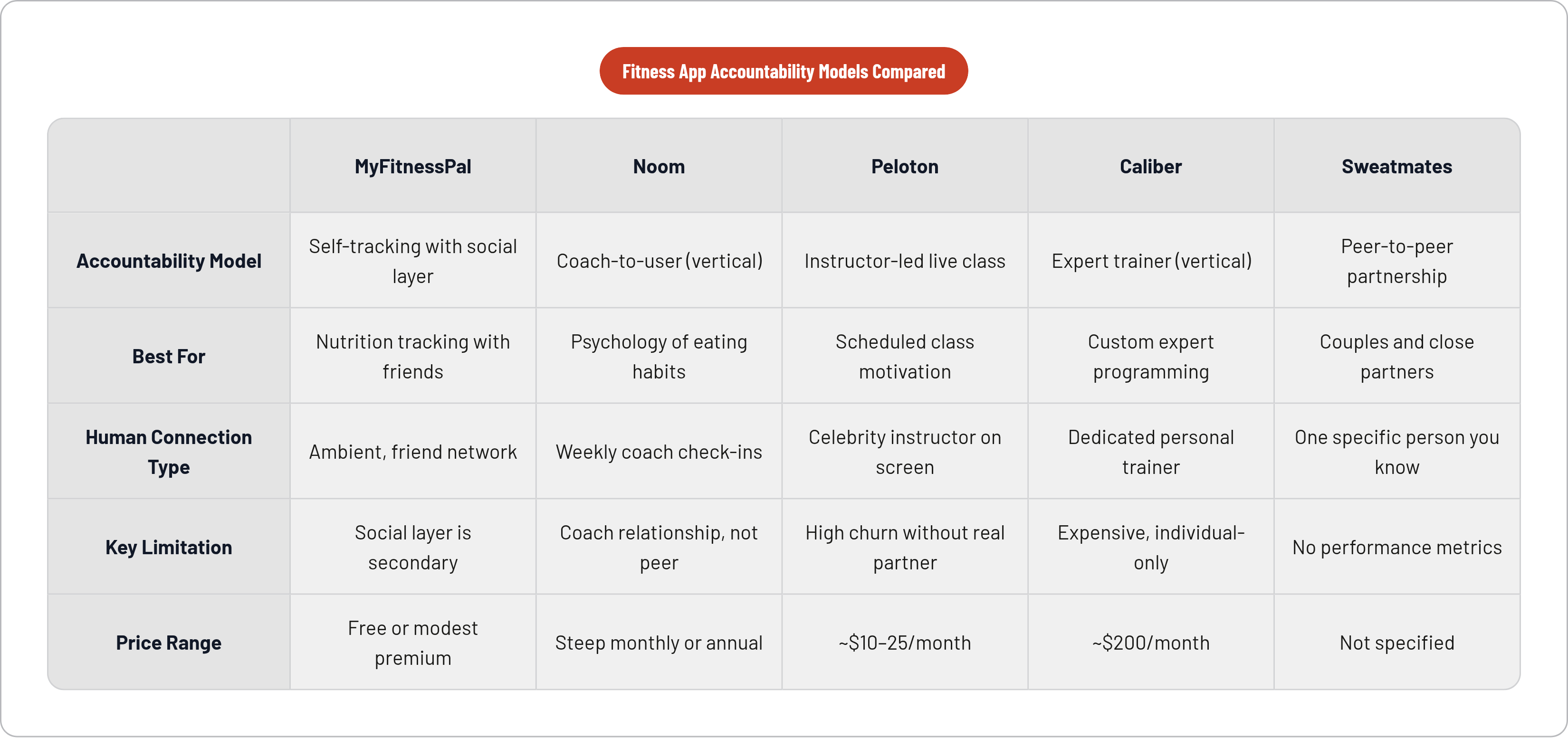
MyFitnessPal has more than 200 million registered users and built its name on its food and macro database. Friends can connect for a bit of friendly competition, but that social layer sits on top of a tracking-first product. The default mode is you, alone, logging chicken breast for the third time this week. Free covers calories, macros, barcode scanning, and device syncing; premium runs at a modest monthly or annual rate for extra features.
Noom takes a different road entirely. Used by over 45 million people, it's built on Cognitive Behavioral Therapy, aiming at why you eat instead of just what you eat. Its accountability engine is a coach checking in once or twice a week, which is a real human relationship, just not a peer one. You're reporting to someone, not sharing a goal with an equal. Pricing runs from a steep monthly rate up to an annual plan, making it one of the pricier options in this category.
What both share is a vertical accountability structure: coach to user, or app to user, rather than two people on equal footing pushing each other along. Good fit if you want structured guidance or serious nutrition tracking with a side of social. Less ideal if what you actually want is to stay connected to one specific person.
Peloton and Caliber: live accountability and expert coaching at opposite price points
Peloton's app tiers run roughly $10–25 a month for App One and App+, no bike or treadmill required, and they sync fine with Apple Watch and other wearables. The live class format builds in a soft accountability trick: a scheduled class, a real instructor, a visible leaderboard. Skipping starts to feel like an active decision instead of the path of least resistance. In 2024 Peloton rolled out personalized weekly plans tuned to goals and frequency, leaning further into habit-building.
The numbers still tell an interesting story, though. Peloton's app subscription churn hit notably high monthly levels in Q4 2024, per SEC filings, which is steep for a subscription product. That suggests live-class accountability has a ceiling once your social connection is to a celebrity instructor on a screen rather than a person who actually knows your name.
Caliber sits at the opposite extreme. The free tier gives you a library of more than 500 movements with video demos, while premium coaching runs about $200 a month for a fully custom program built by a real trainer tracking your progress. High-touch, genuinely effective, but expensive and built for individuals, not pairs. Peloton fits people who respond to a scheduled class and instructor energy. Caliber fits people who want expert eyes on their program and have the budget to pay for it.
Sweatmates and the case for a purpose-built partner app
Sweatmates runs on a different premise entirely: the point is showing up together, not optimizing split times. What it leaves out says as much as what it includes. No stats obsession, no leaderboard, no performance dashboard to dread opening on a Monday.
The core mechanic is refreshingly simple. Two people share a goal, log that they showed up, and see each other's consistency. The unit of success is the shared habit itself, not a mile time. Photos, quick check-ins, and friendly nudges replace charts and graphs, keeping the connection between the two people at the center of the product.
It's built to work even when partners train separately: different gyms, different schedules, different workouts entirely. You don't need to be doing the same thing at the same time to feel like you're doing it together. That deliberate simplicity solves the most common failure mode in this whole category, apps piling on so much data and so many metrics that fitness turns into a second job. And when someone misses a day, it prompts reflection and reconnection between the two partners rather than snapping a shame-inducing streak clean in half. Best fit: couples, close friends, or family who want fitness to bring them closer, not hand them another dashboard to babysit.
How to match the right accountability structure to the relationship you already have
The real question was never "which app is best." It's which accountability structure fits the relationship you're actually in, and the goal you're actually chasing.
Want community and public motivation at scale? Large social fitness platforms with clubs and shared feeds deliver that, especially for runners and cyclists who like being seen by a crowd. Want structured behavior change with a coach steering the ship? Noom if you're focused on the psychology of eating, Caliber if you want expert programming and can afford it, both vertical relationships between you and an expert rather than a peer. Want a scheduled commitment with a live element pulling you out of bed? Peloton works when the class itself becomes your anchor, though its churn numbers suggest it holds up better paired with an actual human partner than as a standalone system.
And if the goal is simpler than any of that, just keeping one other person in the loop on whether you both actually showed up this week, some apps give couples shared goals, photo check-ins, and weekly recaps that turn consistency into something two people own together instead of tracking alone.
Here's a test you can run in about two weeks with any app you're considering: does it leave you feeling more connected to the other person, or just more aware of your own numbers? That answer tells you nearly everything about whether the accountability mechanism is doing its job. Simple weekly goals beat complicated tracking systems, mostly because simple things are things people actually come back to, and complicated things get uninstalled in February, right on schedule.
Celebrating the act of showing up, instead of chasing a perfect performance, is what carries a shared habit past the resolution spike and into something that actually resembles a routine. Everything else is just decoration stacked on top of that one fact.