apps for two-person fitness accountability partnerships
When one partner goes quiet, the structure breaks unless the app anticipates it.
Two people trying to keep each other consistent with fitness usually don't fail because they lack motivation on day one. They fail because nobody built the scaffolding for day forty-three, when one person goes quiet and the other doesn't know whether to text or let it go. The right app fixes that specific problem, and which app is "right" depends entirely on what kind of quiet you're trying to prevent.
A University of Aberdeen study found that gaining a new exercise companion increased how often people worked out, and the effect got stronger when that companion offered emotional support instead of just showing up on the same schedule. That's worth sitting with. A calendar invite isn't a partnership. Separately, there's a documented phenomenon called the Kohler effect: people push harder when someone else is present, especially someone slightly ahead of them. Not a leaderboard of strangers. A specific, known human being. A twelve-month study on spouses who joined fitness programs together found markedly better attendance and far fewer dropouts than solo participants, and the mechanism wasn't romance. It was that someone specific noticed when the other person stopped showing up.
Put that together and you get a strange conclusion: the two-person partnership is the single strongest accountability structure there is, and also the most breakable. A group absorbs one person's bad week. A pair doesn't. One person goes dark, and there's no buffer left. That's exactly the gap an app is supposed to fill, structure the bond wouldn't otherwise have on its own.
How two-person partnerships tend to break down without structure
Precision Nutrition's 2023 data pegs it plainly: about half of accountability partnerships dissolve within three months. Schedule conflicts, life changes, one partner's motivation quietly evaporating while the other pretends not to notice.
Here's the typical arc, and you've probably lived it. Day one, both people are fired up. They promise to text after every workout. Then one person gets busy, work piles up, a kid gets sick, whatever. The other person feels weird chasing them down about a gym session, so they don't. Nobody decides to quit. The arrangement just fades, the way a group chat fades, except there's no group left to carry the conversation.
An informal pact is a fragile stack of dependencies: memory, energy, timing, and both people initiating at once. Miss any one leg and the whole thing wobbles. Unequal commitment makes it worse. When one partner is clearly more dedicated than the other, both eventually check out, not out of spite, but because nobody enjoys being the visibly slacking half of a duo. The dynamic plays out consistently: people show up for a relationship. They ghost an arrangement.
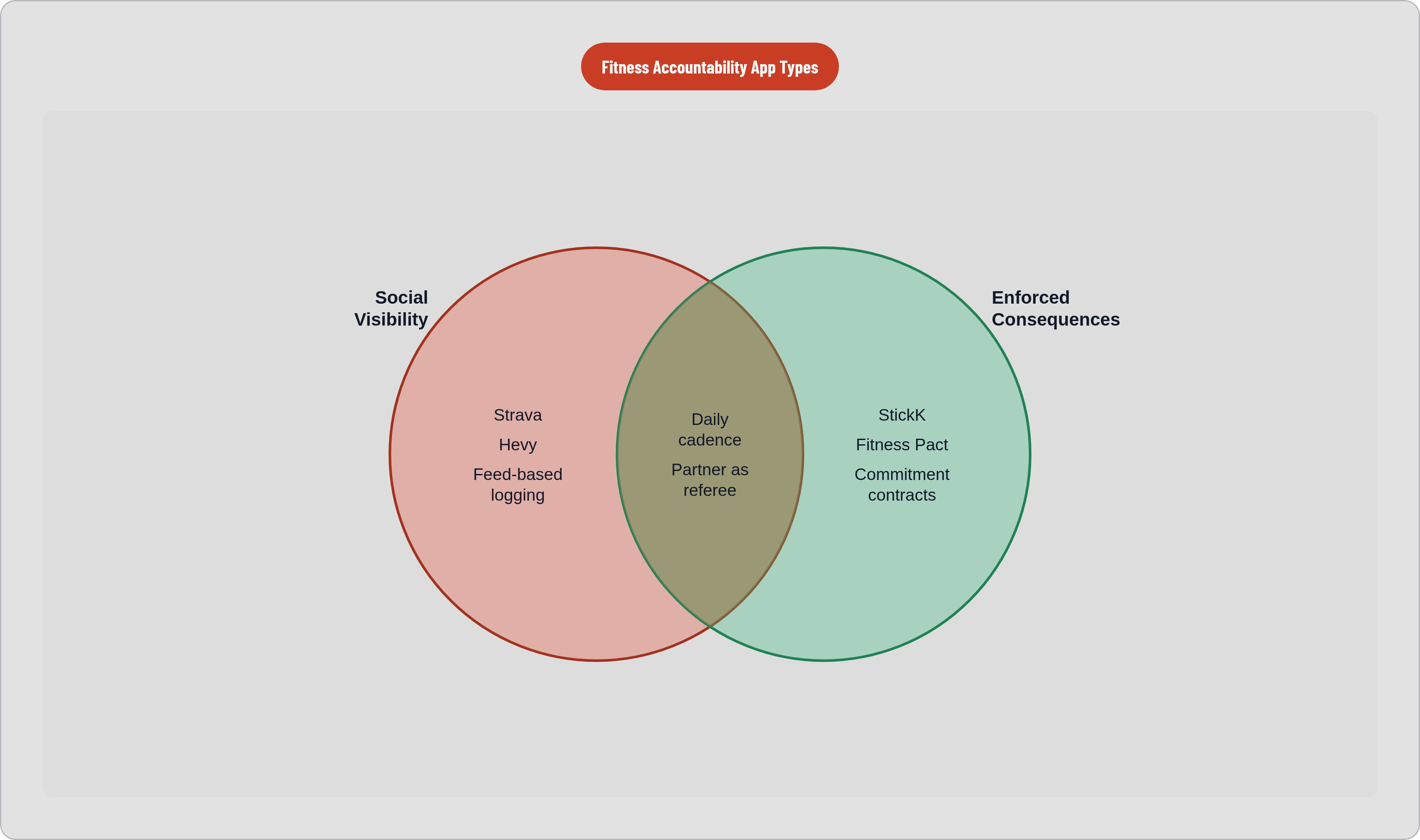
There are really three structural modes worth naming here, and most apps live in one lane:
- Self-tracking, where visibility and streaks do the work, which only holds up if both people are already fairly disciplined
- Social pressure, shared feeds and mutual following, which adds a gentle nudge of "someone's watching" without demanding anything
- Enforced discipline, commitment contracts and real consequences, which doesn't lean on motivation at all because it doesn't need to
Picking an app isn't about feature count. It's about matching the mode to how these two specific people actually behave under pressure.
What the evidence says about which accountability mechanisms move the needle
The STEP UP randomized clinical trial, 602 overweight and obese adults, published in JAMA Internal Medicine, gives us a clean signal. The competition arm added roughly 920 steps a day over the control group, and it was the only arm whose gains stuck around after the study ended. Light social nudges do something. Structures with real consequences do something that lasts.
A separate survey of 552 adults found that fitness app and tracker users had nearly double the odds (odds ratio of 1.91) of meeting aerobic activity guidelines compared to people who used neither. So the tools work, in general terms. Frequency matters too: daily check-ins consistently beat weekly ones, no matter which format you're using. A push notification you swipe away without reading isn't accountability. A short daily text is worth more than an hour-long weekly call, even though it takes a fraction of the time.
One honest caveat before we go further: a lot of the accountability statistics floating around fitness content, including that oft-repeated claim about being "dramatically more likely to succeed with an accountability partner," have no traceable source anywhere. Be skeptical when an app cites it. What the research actually shows is narrower and more useful: light social visibility helps some, real consequences help more and last longer, and daily cadence beats weekly cadence. None of it tells you which specific app fits which specific pair. That part's on you, and it's what the rest of this is for. Sweatmates, a shared fitness tracking app for partners, sits in that gap, letting couples set individual and team goals and check in through workout photos and weekly recaps.
Apps built around a social feed: Hevy and similar platforms
The shared idea behind feed-based apps is simple. They make your training visible to one specific person without requiring you to talk to them every day. Accountability through a visible record, not a check-in.
The first app in this category is one of the largest platforms in the world for runners, cyclists, and multisport athletes, with well over a hundred million users across more than a hundred countries. Two people can follow each other, leave encouragement on logged activities, and join a shared challenge for a little extra stakes. In a notable 2026 update, the platform overhauled its strength-training experience entirely: more than a dozen partner integrations, a dedicated workout log, muscle maps that populate automatically, and new ways to share a session. That update mattered because strength training had been a longtime blind spot for a platform built around distance and pace. The company reported hundreds of millions of strength-activity uploads in 2025 alone, which tells you gym-based users were showing up whether or not the tool was built for them yet. One thing worth flagging honestly: social comparison cuts both ways. It works through support and through comparison, and for people who don't love being ranked against a friend, the comparison side can flatten motivation instead of lifting it. Worth a conversation before two people commit to a public feed together.
The second app in this space, Hevy is a strength tracker with a social layer built in. Routines, supersets, rest timers, progression charts, the whole toolkit a serious lifter wants, with a feed alongside. The accountability feel here is closer to reading your partner's training diary than being in a group that clocks your absence. Lower pressure, higher specificity. Friends see your logged sessions and can react to them, partners can share routines and folders, and the app can auto-post to other platforms. It's a good fit for strength-focused pairs who want a real log with a bit of social visibility, but don't need a daily nudge to keep training.
What both apps have in common: they reward people who'd probably train anyway. The feed amplifies motivation that already exists more than it manufactures motivation that's missing.
Apps built around daily habit check-ins: HabitShare
HabitShare starts from a different premise entirely. Fitness isn't a workout log, it's a repeating commitment, and showing up counts more than any specific number on a chart.
The mechanics are deliberately plain: streaks, daily and weekly goals, flexible scheduling, reminders, and in-app messaging that includes GIFs for when words feel like too much effort. Each partner controls exactly which habits the other person can see, which matters more than it sounds. Two people at very different fitness levels, or one person tracking something sensitive, don't need an all-or-nothing sharing model. The app carries a 4.5 rating on iOS and 4.4 on Android, solid numbers for something that costs nothing. It's fully free, no paywall hiding the social features behind a subscription.
The catch: HabitShare has no discovery layer at all. It can't help two people find each other, and it can't manufacture structure out of nothing. Both people have to already exist as a pair and both have to agree to open the same app. If you're looking for a private, granular daily check-in rhythm, particularly good for couples or close friends tracking different kinds of activity side by side, this is built for exactly that. If you need the app to help you find a partner in the first place, look elsewhere.
Apps built around consequences: StickK and Fitness Pact
Some pairs don't need more motivation. They need a structure that holds up when motivation is nowhere to be found, which, let's be honest, is most Tuesdays in February.
StickK is built on commitment contract principles, a behavioral framework grounded in academic research rather than a wellness trend somebody dreamed up in a pitch deck. The setup: write a specific goal, pick a referee (someone who confirms whether you actually did the thing), and optionally put money on the line that goes to charity, or to an "anti-charity" you'd hate to fund, if you fail. In a two-person partnership, your partner becomes that referee. Not a casual check-in buddy, a defined structural role. Users have collectively staked over $75 million on the platform, and StickK's own data suggests people are up to three times more likely to hit their goals when real money is on the line. One honest note: the app itself has had support and billing hiccups over the years. The underlying behavioral science is sound; the execution has had rough patches. Sticking to the web interface and keeping stakes modest at first is the sensible move until you've seen how the tool behaves for you.
Fitness Pact runs the same consequence-based logic with a lighter touch, letting partners agree on stakes between themselves rather than a formal financial transfer. Accountability here is about outcomes, not shared presence. It's a wager between friends more than a legal-feeling contract, good for pairs who want stakes without the seriousness of actual money changing hands.
The real question separating these two: does the consequence need to be real and external, or playful and relational? Answer that honestly and the choice makes itself.
Apps built specifically for couples: FitWithLove
FitWithLove is designed around the pair as a single unit from the start, not two separate accounts that happen to follow each other around.
The app is built around shared workouts and milestone tracking, with features oriented toward marking progress as a pair rather than as two individuals. That orientation does something the lighter tools don't bother with: it reinforces a specific idea, that the fitness happening here belongs to the relationship, not to two people separately grinding away and comparing notes later.
Worth being upfront about scope. This app is built for couples who want to train in the same session, at the same time, side by side. It's less useful for two people who exercise on their own schedules and want connection stitched across the distance. And the guided-workout format loses some flexibility when fitness levels diverge sharply. A serious lifter paired with a total beginner may find the shared-exercise structure doesn't serve either of them particularly well. For couples who genuinely want to sweat together and celebrate hitting milestones as a pair, though, it's built exactly for that job.
How to match an app to what a specific pair actually needs
Skip the "which app has the best reviews" question. Ask instead: what does this specific pair need in order to stay connected once motivation predictably dips?
From there, it comes down to four rough paths. If the pair trains separately and just wants easy mutual visibility, a feed-based app covering cardio, multisport, or strength does the job. If the pair wants to treat fitness like a daily habit with a consistent check-in rhythm, HabitShare fits that shape well. If the pair has already tried the softer stuff and keeps falling off anyway, StickK or Fitness Pact bring real or playful stakes into the picture, depending on how much sting the consequence needs to have. And if the pair actually wants to train together in the same room and mark shared wins, FitWithLove is built for exactly that.
There's a second question that matters just as much: does both people actually want to use this particular tool? The best-designed app on the market fails instantly if one partner installs it enthusiastically and the other never opens it again. Simplicity wins more often than sophistication. A weekly shared photo and an honest one-line text can outperform a beautifully built tracker that neither person actually checks.
None of this is about finding the perfect system and locking it in forever. The goal isn't optimizing the partnership, it's keeping it alive, and the right tool at month one might not be the right tool at month six once schedules shift or fitness levels change. The app that earns its place is simply the one both people keep coming back to, together, long after the initial motivation from day one has worn off.