Using Friendly Fitness Wagers to Build Consistency
Money and accountability reshape how your brain weighs skipping a workout.
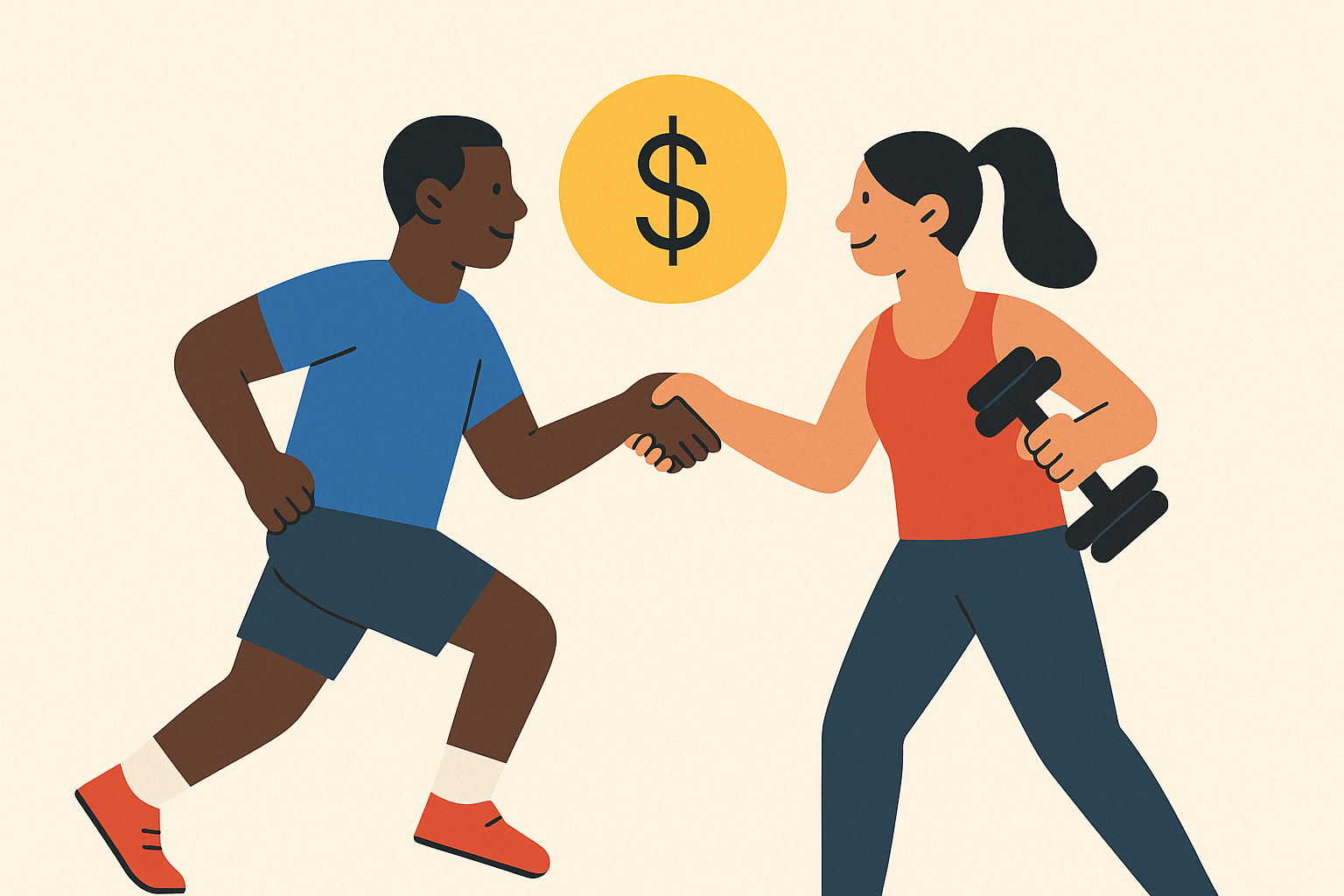
A large share of people who download a fitness app stop using it within the first month. That range is wide enough to drive a truck through, but the direction is unmistakable: the app gets deleted, the good intentions stay right where they were, and nothing structural ever shows up to stop it. This piece is about the thing that does show up: a friendly wager between two people who actually know each other, structured well enough to survive week three.
The gap between wanting to work out and actually doing it has a name in behavioral science: the intention-action gap. It's the space where New Year's resolutions go to die, and no push notification has ever closed it, because a notification carries no weight. Nobody's watching to see if you swipe it away.
The industry-level data backs this up in a different way. ABC Fitness's Mid-Year 2026 Wellness Watch Report found gym new joins down 9% year-over-year, cancellations up 8%, and check-ins up just 1%. Read plainly, that's fewer people walking in the door, and the ones who stay are the ones who've found something that actually pulls them back. The report calls this shift a move toward "reinforcement," meaning accountability, community, and progress you can actually see.
The pattern underneath all of it: consistency was never really a willpower problem. It's a structural one. A private goal, kept to yourself, has no scaffolding around it. Nobody notices if you skip. A wager builds that scaffolding, cheaply and fast, out of two ingredients: money and another person who's watching.
What a wager actually does to your brain, and why it works differently from a reminder or a streak
Two concepts explain most of what's going on here: loss aversion and commitment devices.
Loss aversion is the finding, central to prospect theory, that losing something hurts more than gaining the equivalent feels good. Losing a sum of money stings harder than finding the same amount feels nice, even though the math is identical. A commitment device is the tool built on top of that fact: you impose a cost on your future self today, in advance, specifically so future-you can't wriggle out of it later. Wharton professor Katy Milkman, who's studied commitment devices across savings, exercise, student achievement, vaccination, and discrimination, has described the research on them as consistently useful, across very different populations and very different goals.
One example she cites involves smoking cessation: people were substantially more likely to quit when they had money on the line that they'd lose if they failed. Smoking is about as stubborn a habit as behavioral science studies, so if stakes move the needle there, they'll move it for something as comparatively low-stakes as a Tuesday morning workout.
The framing matters as much as the stakes themselves. Research from Patel and colleagues found that loss-framed incentives beat gain-framed ones for physical activity specifically: points given upfront and then taken away for missed goals outperformed points earned by hitting them. "You could win a set amount" is a shrug. "You're about to lose the money you already put up" is a gut-punch, and gut-punches get you out of bed.
That's the actual mechanism. A wager isn't a reminder with a price tag stapled to it. It restructures the decision itself, so skipping the workout has a real, immediate cost, and because someone else knows about it, that cost is social as well as financial. A streak counter only judges you after the fact. A wager is judging you before you've even decided.
What the research actually shows about wagers and exercise, and where the evidence gets complicated
A systematic review on PubMed pooled 11 studies covering 1,453 participants and found financial incentives produced a significant, positive effect on exercise in 8 of the 11 (pooled result: z=3.81, p<0.0001). One study in that review found incentives sustained exercise for more than a year. Two found the new habit stuck around even after the money disappeared. That's about as clean a signal as behavioral research gets.
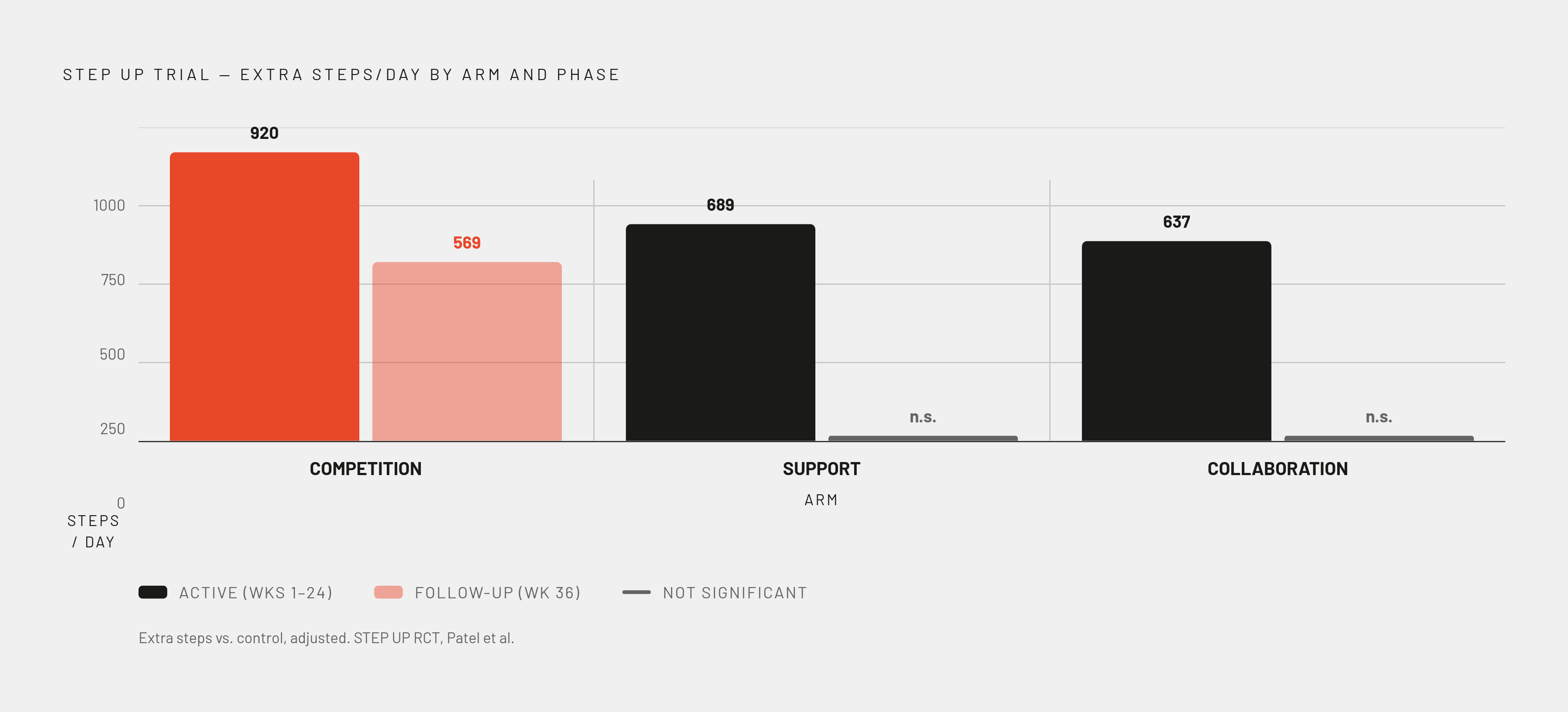
The most useful single study for anyone designing a wager between partners is the STEP UP randomized clinical trial from 2019: 602 overweight and obese adults across 40 states, run over 36 weeks (24 weeks of intervention, 12 weeks of follow-up). Three gamified arms went up against a control group: support, collaboration, and competition. All three beat control during the active phase. Competition produced 920 extra steps a day. Support produced 689. Collaboration produced 637.
The interesting part happens after the intervention ends. Only the competition arm held onto a statistically significant edge, 569 extra steps a day above control, three months after the formal program stopped. Support and collaboration faded. Competition stuck. For two partners deciding how to structure a bet, that's not a minor footnote, that's the whole design brief.
Now the complication, because the research doesn't let anyone off easy. A 2026 narrative review in the Annual Review of Public Health, synthesizing 39 systematic and meta-analytic reviews, found financial incentives generally produce modest, often short-lived gains. They work best when the payout is substantial, delivered promptly, tailored to the person, and tracked with something objective, not a self-reported checkbox. Most of the benefit shows up under six months, and mostly while the incentive is still active. Pull the incentive, and a lot of people drift back to where they started.
There's a sharper caveat buried in the broader research too: wagers don't produce meaningful results for everyone, and design as well as individual readiness shape whether they work at all. Wagers aren't some universal cheat code. They're a genuinely powerful lever for a lot of people, and a complete non-starter for some. Design matters. So does who's actually in the bet.
Why the social structure around a wager matters as much as the money
The data says incentives work. This is the part that explains why a wager between two people who actually know each other tends to beat an anonymous cash pool.
ABC Fitness's Mid-Year 2026 report found 67% of gym members now say community is the single biggest driver of their motivation and accountability, up 12 points year-over-year. 57% say a fitness community meaningfully affects whether they stick around long-term. In a market where new memberships are shrinking and cancellations are climbing, that's not a soft, feel-good stat. That's the retention engine, in plain sight.
Orangetheory's VP of Fitness, Scott Brown, drawing on data from Purpose Brands' 2026 Transformation Challenge (roughly 125,000 participants across Orangetheory and Anytime Fitness), put it about as directly as it can be put: the most powerful form of accountability is knowing someone expects you to show up. In that same challenge, accountability was the single biggest contributor to results for more than a quarter of Orangetheory participants, ahead of family and ahead of friends as a support category.
Here's the distinction that actually matters: external accountability, a real person who notices whether you showed up or didn't, is a different animal from a self-tracked streak on your phone. Clients with real external accountability were 65% more likely to hit their fitness goals than people relying on self-motivation alone. A wager between two people who already have a relationship stacks social stakes directly on top of financial ones, and that combination is why it outperforms a pot full of strangers' money.
Put a private goal inside a wager, and it stops being private. It becomes a mutual commitment where both people have skin in whether the other one shows up. Missing a workout doesn't just cost you cash, it lets somebody down, and that distinction changes the entire emotional weight of a Tuesday you'd otherwise skip.
There's a real risk hiding in here too, worth saying plainly: when your progress is visible to somebody else, comparison can curdle fast, especially if the wager is built around outcomes like weight or appearance instead of behaviors like workouts completed. Outcome-framed wagers tend to breed judgment. Behavior-framed ones tend to breed solidarity. That's not a small design choice, it's the difference between a bet that strengthens a relationship and one that quietly wrecks it.
The apps and platforms that turn a handshake bet into a trackable structure
Every wager app on the market runs on one of two basic engines.
The first is pot-splitting: everyone pays in, and whoever hits the goal splits the pool left behind by everyone who didn't. The second is betting the house: you're wagering against the platform itself, not other users, and an algorithm sets your potential payout based on your goal, your timeline, and how much you put up.
Step-based pot-splitting apps typically sync with a fitness tracker, study your recent activity, and set a daily step target calibrated to you specifically, not some generic step-count number pulled from nowhere. Game lengths tend to run several weeks, sometimes with a short warm-up period before the real wager kicks in, and winners split whatever the people who missed the mark left on the table, with the platform typically taking a cut. Two partners can join the same game together and hold each other accountable inside a structure that's already tracking the numbers for them.
Weight-loss-focused pot apps run on a similar mechanic but measure a different thing entirely: pounds lost against a deadline, rather than steps logged day to day. That distinction matters more than it sounds like it should. Weight is an outcome, shaped by water retention, sleep, stress, a dozen things neither partner controls, and outcome-based wagers carry a higher risk of turning into judgment rather than support.
On the "betting the house" side, some platforms let a user set their own goal, timeline, and monthly stake, then calculate a prize algorithmically, no other players involved, no social layer at all. Accountability there is entirely self-directed against the platform, which works for some people and creates real friction for others. Strict no-refund policies show up on this side of the market too, built on the logic that making it hard to quit is the point. That logic removes the supportive layer completely and replaces it with something closer to a penalty box, which some users find motivating and others find punishing.
Group-challenge apps built around behavior, not outcome, tend to fit the friendly-wager model best: create a challenge with a defined circle of people, submit proof of the workout (often through a photo or an in-app camera check), and let some form of automated verification handle the "did this actually happen" question so nobody's stuck playing referee. No anonymous pool, no stranger's money in the mix, just the people already in your corner.
For couples and partners specifically, the platforms built around inviting named people and tracking each other's progress line up far better with the social-accountability mechanism than an anonymous pool ever could. The tool itself matters less than one simple test: does it make progress visible to both people, and does it keep the whole thing feeling supportive rather than punitive?
How to design a friendly wager that builds consistency instead of resentment
Six choices separate a wager that builds a habit from one that just builds tension.
Make the stakes real, not ruinous. Total rewards exceeding roughly $100 tend to produce sizeable behavior change in the research. But the goal is motivation, not dread. Pick an amount that would genuinely sting to lose, without creating financial stress or a power imbalance between the two of you.
Track behavior, not outcomes. Workouts completed and steps logged are durable and low-drama. Body weight and appearance are neither, since both get pushed around by things totally outside anyone's control.
Use objective measurement. The 2026 Annual Review of Public Health synthesis found incentives work better when outcomes are tracked objectively, not self-reported. A wearable, a synced step count, or a camera-verified workout submission ends the argument before it starts.
Frame it as a loss already committed, not a prize still up for grabs. Loss-framed incentives beat gain-framed ones in the research. Put the stake up front, treat it as already spent, and make the only question whether you get it back.
Lean toward head-to-head competition, if your relationship can handle it. It was the only arm in the STEP UP trial to hold its gains three months after the program ended. "I'm going to out-step you this month" is a more durable frame than "let's both hit our number," though this only works if the competitive spirit stays actually friendly.
Set the terms before a single step is logged. What counts, what doesn't, what happens with an injury, how long the whole thing runs, what's actually at stake. Ambiguity is where these bets go to die, and buy-in has to be voluntary on both sides or the whole structure is hollow from day one.
Build in a reset, too. Missing a goal should trigger a shrug and a re-commitment, not a punishment. The entire point of the wager is making the workout feel important, not making a missed one feel like a disaster. Agree in advance what happens if life actually gets in the way, illness, travel, a brutal work week, and treat a miss as information instead of failure.
What happens after the wager ends, and how to keep the consistency going
The honest answer, per the research, is that a lot of people slide back toward baseline once the money and the finish line disappear. That's not a flaw specific to any one app or any one couple, it's the general pattern across incentive studies: gains cluster in the active window, and they thin out once the active window closes.
The STEP UP trial's follow-up data points to the fix, or at least a partial one: keep some version of the social structure running even after the formal bet ends. The arms that lost their edge faded once the active intervention period ended. The competition arm was the only one to hold a statistically significant edge through the follow-up period, suggesting something in that structure proved more durable than the others.
Practically, that means the wager shouldn't be treated as the finish line. It's the on-ramp. Once six weeks or three months are up, the smart move is rolling straight into a second, smaller wager, or downgrading the stakes while keeping the same partner and the same tracking. The money got you in the door. The person standing on the other side of the bet is what keeps you there after the money's gone.
Sources
- Consistency Is Becoming Fitness’ New Growth Engine, According to ABC Fitness Mid-Year Wellness Watch Report - Health & Fitness Association
- Accountability Beats Motivation in Delivering Fitness Results, Data Shows
- Client Accountability Systems for Personal Trainers 2025
- globalyouth.wharton.upenn.edu
- researchgate.net
- annualreviews.org
- chibe.upenn.edu
- pubsonline.informs.org