Fitness Motivation Slumps in Winter for Active Couples
Couples lose fitness motivation together in winter, but working out as a unit rebuilds it fast.
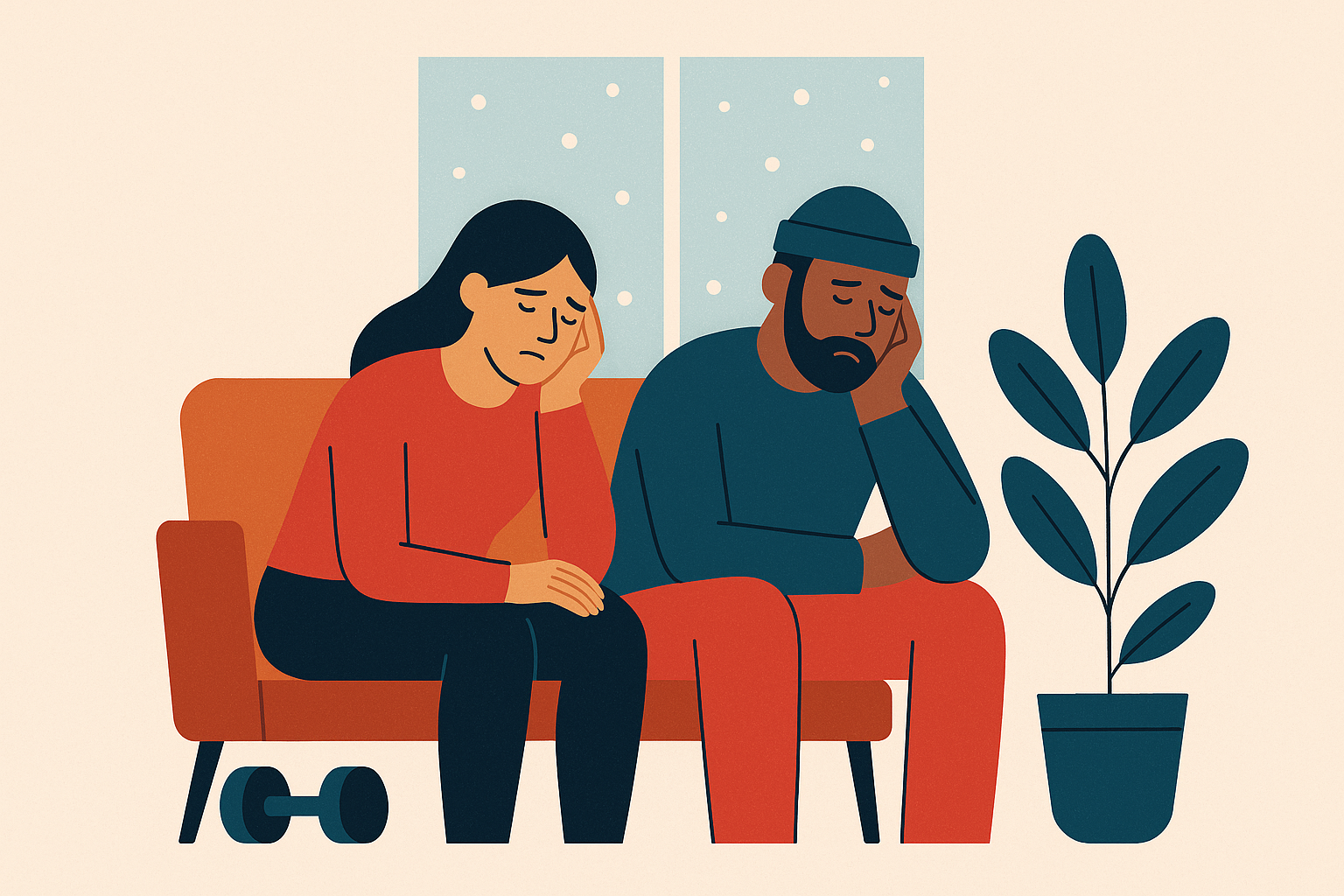
76% of people in the UK choose not to exercise during winter, according to repcave.com fitness data. It's not a personal failure. That's basically everyone. And if you're in a relationship, the odds get even weirder, because winter doesn't just tank your own motivation, it tanks it in sync with your partner's, which means the couch becomes a two-person event.
How the January gym spike and February collapse play out for couples
January is the fitness industry's busiest promotional season. Data puts 12% of all annual gym sign-ups in that single month, everyone buying a new membership like it's a fresh start sold in monthly installments. Roughly half of those new members are gone or inactive by March. It's a cliff, not a slow fade.
The numbers behind it are almost mechanical. Winter joiners average 2.9 visits a month, compared to 4.5 for people who sign up in spring or fall. That gap comes down to something other than willpower. It's structural: shorter days, worse weather, and a body of people who joined during the one month of the year least suited to building a habit.
There's even a name for the moment it all falls apart: the second Saturday in February gets called "Fall off the Wagon Day," which sounds like a joke until you realize it's basically a calendar entry for collective defeat. February and March are the highest-risk months for dropout, because motivation has already faded but the habit hasn't had time to set.
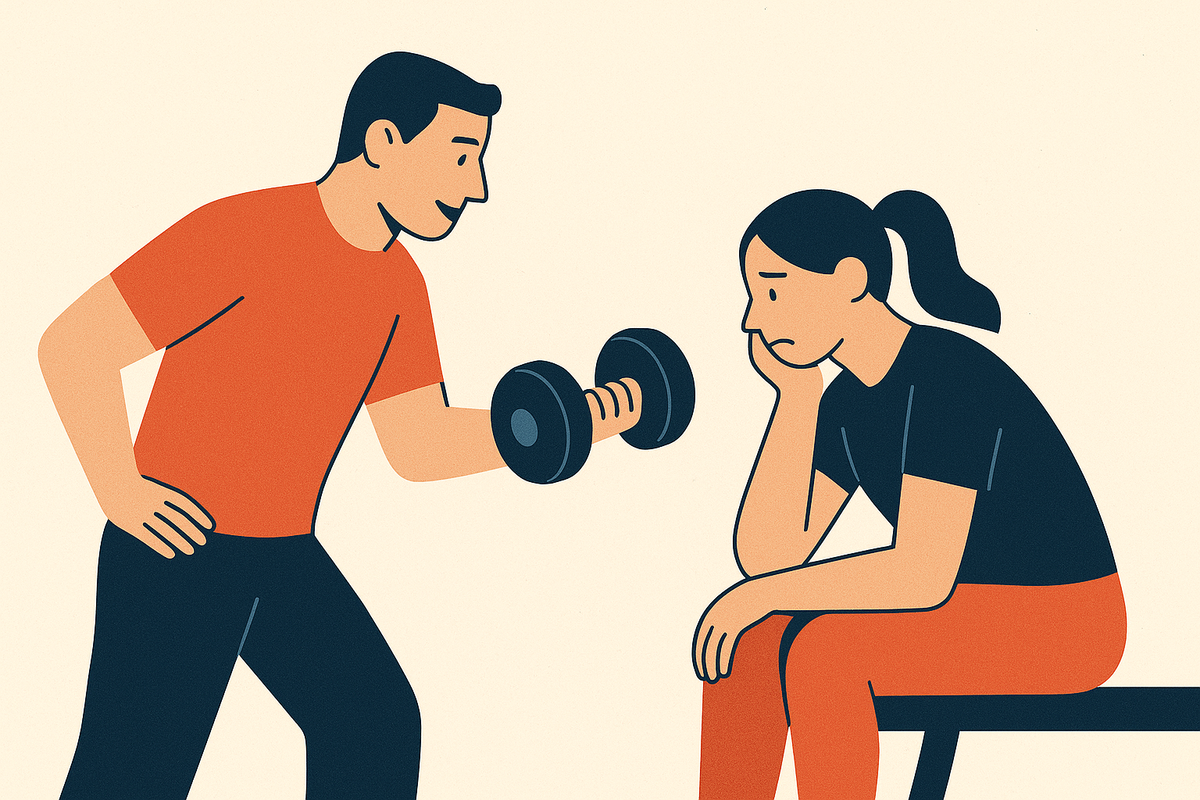
Couples feel this doubly. Matching New Year's resolutions are common, his-and-hers gym bags, a shared calendar invite for spin class. But when one partner skips a week, the other usually follows within days. It works in reverse too, which is the useful part: couples who know the February cliff is coming can plan around it instead of getting blindsided. And there's a structural fix hiding in plain sight. IHRSA found group fitness class attendees are 56% less likely to cancel their membership than people who go it alone. Built-in social accountability beats willpower every time, because willpower is a finite resource and a running buddy is not.
What the research actually shows about couples who exercise together
The completion-rate gap alone should end the debate. One study found 95% of couples finished a workout program, compared to 76% of people doing it solo. It's the difference between a habit and a New Year's card nobody sent, not a small edge.
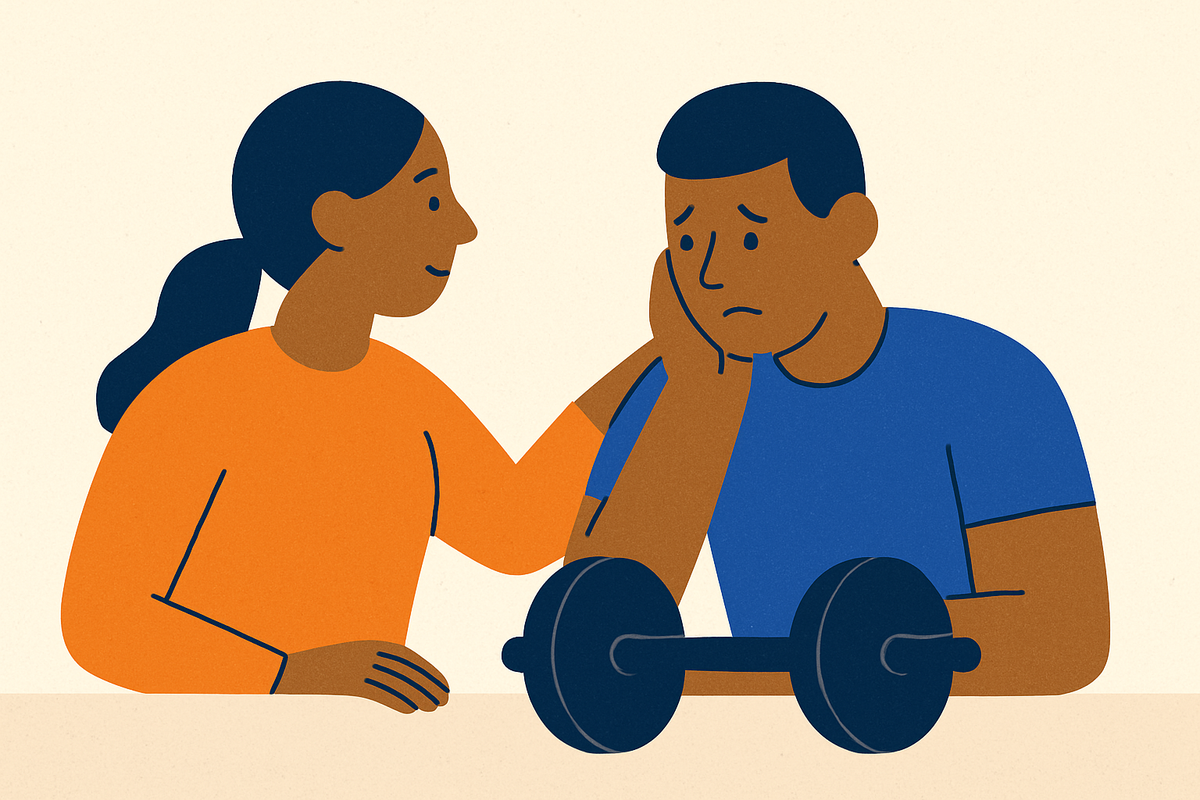
Part of this comes down to something psychologists call the Köhler effect: people who are less capable in a group tend to work harder than they would alone, almost like the group's presence resets their idea of what's possible. Research published in the Journal of Sport and Exercise Psychology found that working out with a more experienced gym partner boosted the less experienced partner's motivation by 24%. Translation: your slower-but-trying partner isn't dead weight, they're getting a boost from watching you not quit.
A study in the Journal of Social and Personal Relationships tracked how people felt on days they exercised with a romantic partner versus alone. Higher positive mood during the workout, higher mood for the rest of the day, and higher relationship satisfaction. No downside turned up in the data at all.
Research on couples who exercised together has found associations with better communication, better conflict resolution, and less marital conflict overall, more so than couples who exercised individually. And research has found people are more likely to stick with goals when their partner signs up for the same goal alongside them.
Arthur Aron's research out of Stony Brook adds a useful frame here: couples who take on novel, exciting physical challenges together tend to report stronger feelings of connection and relationship satisfaction afterward. Which means winter, instead of being the enemy, can be recast as exactly that kind of challenge. Same cold, same short days, different story.
Where partner dynamics go wrong in winter and how to read the signs early
Here's the twist nobody wants to hear: living with someone can make you less active, not more. Research has found that having a partner in the house can be negatively associated with exercise, with lower activity levels when a partner is present. Proximity breeds comfort, and comfort, in January, looks a lot like a blanket and a shared remote.
Mismatched habits cause a slower kind of damage. One partner chasing better habits bites their tongue instead of nagging, while the other feels like every trip to the gym bag is a silent judgment. Small comments about energy or exercise pile up over weeks and turn into defensiveness nobody signed up for.
Encouragement itself can backfire, oddly enough. A study of 115 people holding planks found that those exercising next to a silent, slightly stronger partner lasted longer than those getting verbal cheerleading the whole time. Constant "you've got this" starts to sound like a parent coaching a toddler through broccoli, according to the study's author, Brandon C. Irwin.
A 2024 population study in Frontiers in Psychology (Vuckovic & Duric, 830 participants) found that people in relationships showed more health-avoidance motivation when working with a personal trainer, compared to when they exercised alone, where intrinsic motives like enjoyment and stress relief took over. Different structures pull different strings, is the short version. Winter just makes all of this worse, because both partners are running on the same depleted battery, shorter fuses and all, and a small comment lands harder than it would in July. The line to watch for: accountability that feels like support keeps people showing up, accountability that feels like surveillance sends them running the other way.
Practical approaches that keep couples moving through winter without forcing it
Drop the scoreboard. In the February danger zone, showing up together beats any number on a treadmill display. Consistency now, intensity later, once the days get longer and the body's cooperating again.
Pick activities that actually survive winter. Walking, cycling, and swimming take the biggest seasonal hit, gym sessions and home workouts hold up much better. Plan that rotation ahead of time instead of scrambling the first morning it's sleeting sideways.
Exercise doubles as medicine here, not just metaphorically. Dr. James McDeavitt of Baylor College of Medicine recommends maintaining or even increasing exercise through winter-pattern seasonal affective symptoms, since aerobic movement lifts mood, and lower-intensity options like yoga, tai chi, or meditation help too on the days a full workout feels impossible. A well-balanced routine has been shown to cut poor mental health days by close to half, which reframes winter workouts for couples as something closer to mood maintenance for the whole relationship, not just a fitness checkbox.
Aron's "exciting challenge" framing is worth stealing directly: couples who treat a physical activity as a shared adventure, rather than a chore on the list, come out the other side more satisfied with the relationship itself. Language does real work here.
Workouts don't need to match to count. A study using dyadic data from 462 couples found that higher encouragement between partners tracked with higher relationship satisfaction, regardless of gender or orientation, whether or not the two people were doing the same routine. One partner can lift weights while the other runs, and the support still counts.
Skip the ambitious spreadsheet. A weekly check-in, a photo texted after a walk, a small friendly bet, these beat the elaborate January plan that's guaranteed to buckle by February. And agree ahead of time on what a bad week looks like, and what getting back on track actually involves. Missing a session should trigger a shrug and a plan, not a guilt trip.
How fitness tools and apps can support shared winter accountability without adding pressure
Wearables are officially the biggest fitness trend heading into 2026, according to ACSM, and somewhere between roughly 36 and 44% of adults already have one strapped to a wrist. The hardware problem has been solved. The question left standing is what couples actually do with all that data once it exists.
Most of these devices are built for an audience of one, offering a private dashboard, a private streak, and a private nudge to close your rings. That's fine for solo tracking, but it does nothing for the social accountability gap that makes winter hard for two people trying to move through it together. Individual tracking is a solved problem. Shared accountability, especially when partners are working out separately, at different times, in different rooms, is where most tools still fall short.
What actually fits how couples sustain habits looks less like a chart and more like a signal: did we both move today, yes or no. A workout photo. A short check-in. A playful, low-stakes wager that keeps the whole thing fun instead of turning into another spreadsheet to maintain.
Partner Fitness Review is designed for couples who want to feel connected across separate workouts. The best tool for a February slump is the one that fits how you actually work, not the one with the most features. It's the one both people are still opening in March.
What couples who get through winter together actually gain on the other side
Research on couples finds that exercising together tracks more strongly with better communication and less conflict than exercising solo does. The upside isn't limited to fitness, it spills into how two people actually talk to each other.
Research cited by ACE Fitness puts chronic relationship conflict in the same health-risk category as physical inactivity and smoking. So the stakes here aren't just about fitting into last year's jeans. They're relational.
Shared habits simply hold up better than solo resolutions. A couple that builds a low-pressure winter routine ends up with something to return to, not a plan that expired the second week of February. And the habit that barely gets off the ground in January is usually the one that solidifies in February and March, so the couples who don't quit during the worst stretch are the ones who walk into spring with something that actually sticks.
Winter's difficulty isn't the obstacle to work around, it's the whole test. Couples who lean into the shared grind, rather than waiting for the weather to cooperate, build a kind of consistency that doesn't care what the forecast says. Nobody needs a flawless winter of five-AM workouts and perfect meal prep. The actual goal is smaller and a lot more realistic: two people, still moving, still together, when the days finally get long again.