Motivating a Partner Who Has Lost Interest in Working Out
Your own consistency matters more than any pep talk you could give.
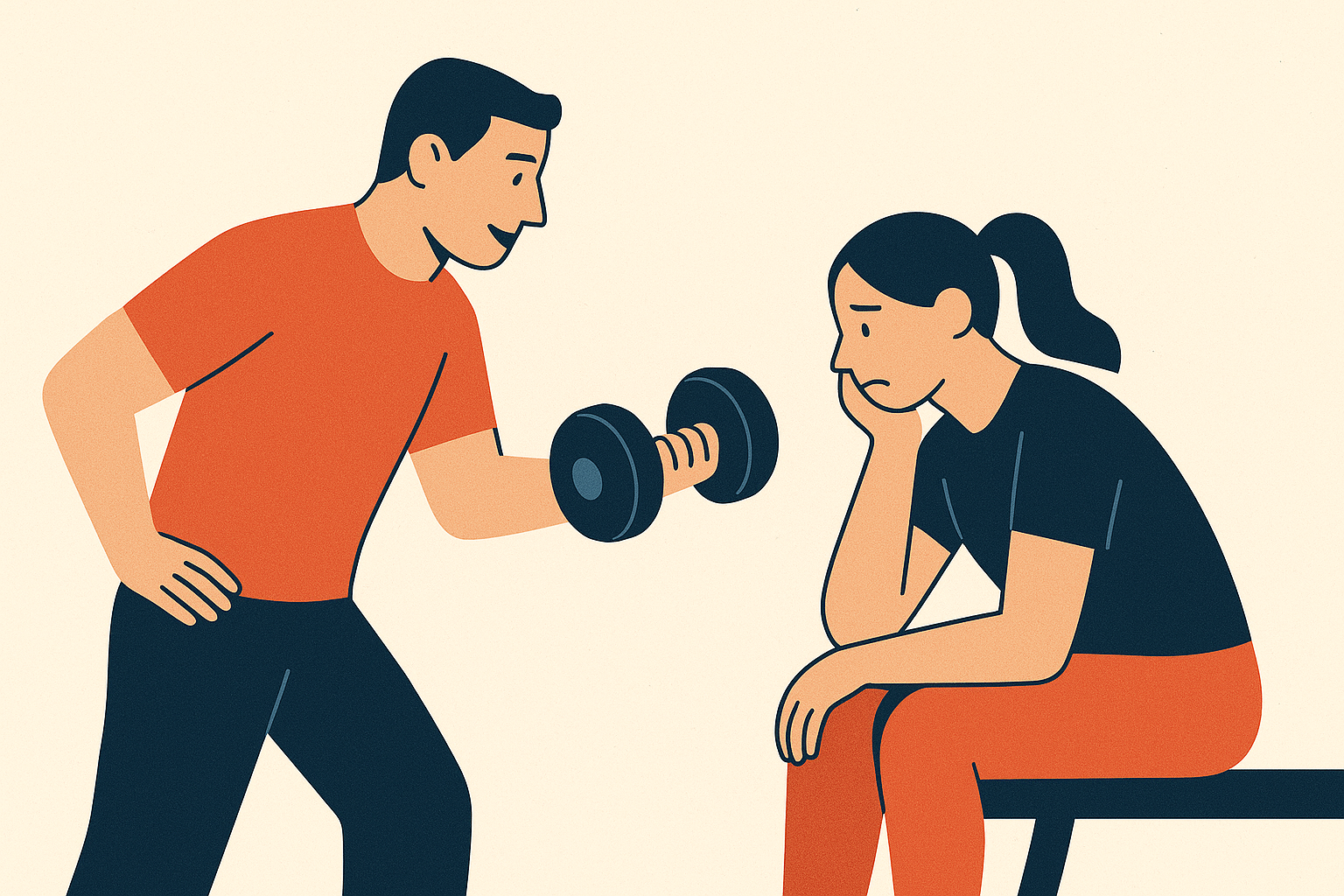
The first instinct is to push. A little encouragement. Then a little more. Then suddenly you're tracking their steps and forwarding articles about cardiovascular disease at 11pm. I know how that goes, because I've watched it play out. On clients, on friends, and honestly on myself a time or two.
Here's the thing: it doesn't work, and there's a pretty clean reason why.
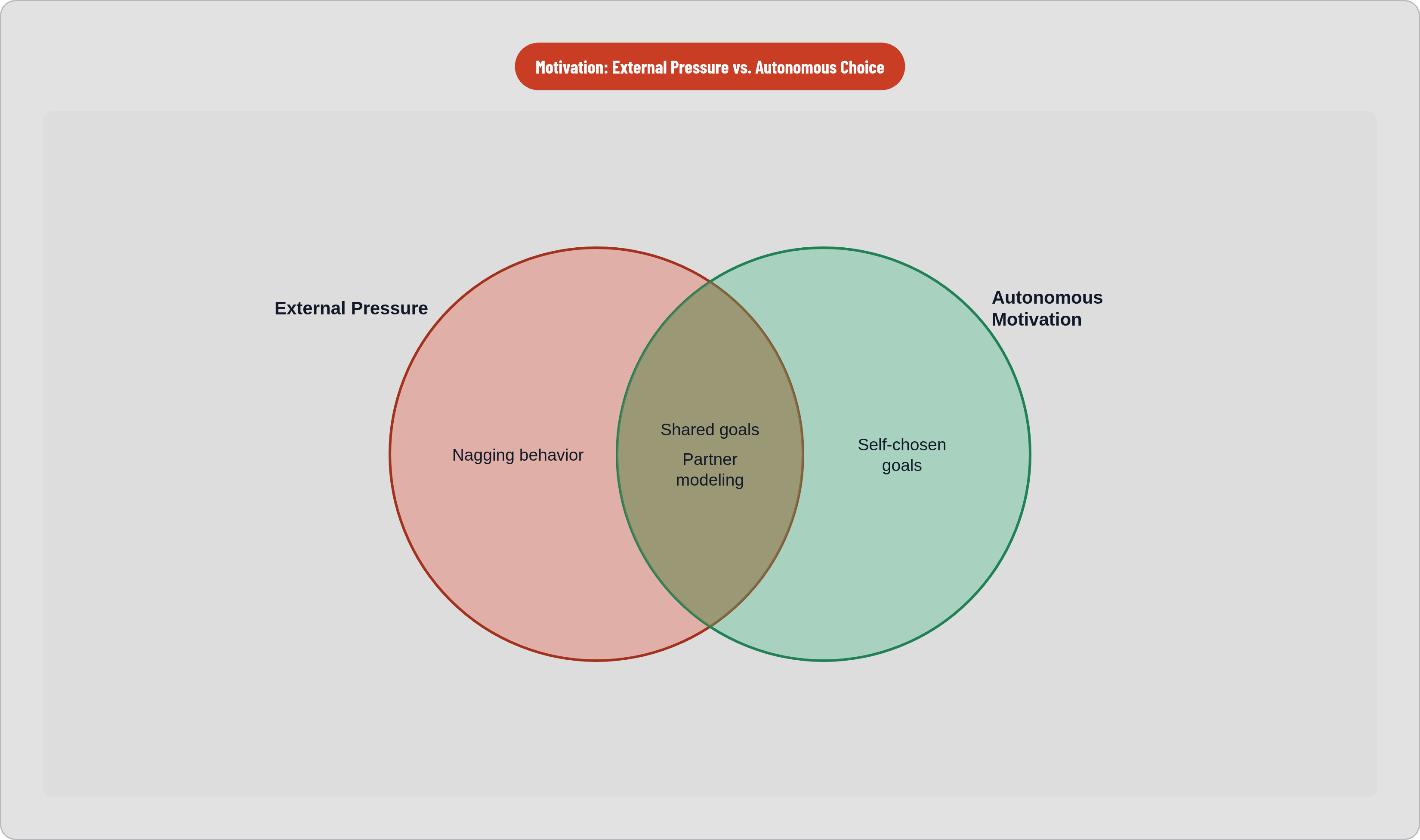
Self-determination theory draws a hard line between two kinds of motivation. Doing something because you chose it predicts consistency. Doing it because someone's watching you predicts burnout. When you push your partner toward exercise, you're not adding to their motivation. You're substituting yours for theirs. And yours doesn't live in their body.
It gets more specific; people who exercise mainly to earn someone else's approval report higher anxiety and more body dissatisfaction, even when they're actually working out consistently. That's not a small side effect. That's the opposite outcome.
The research community even has a clinical term for nagging: autonomy-thwarting behavior. It is, in technical terms, one of the fastest ways to hollow out someone's motivation entirely.
And before you think verbal encouragement is the safe middle ground, there's a study where 115 people held planks, some paired with a stronger, silent partner and others with someone cheering them on. The silent pairing won. The study's own author noted that constant praise starts to read as patronizing. Even your cheerleading has a ceiling.
So no, more pressure does not produce more movement. If anything, it produces less, and it costs you something in the relationship on the way out.
How connected exercise actually changes behavior
Nobody talks about this part enough, which is a shame, because it's the most useful thing in this whole conversation.
You don't need a strategy. You don't need a speech. You just need to stay active yourself.
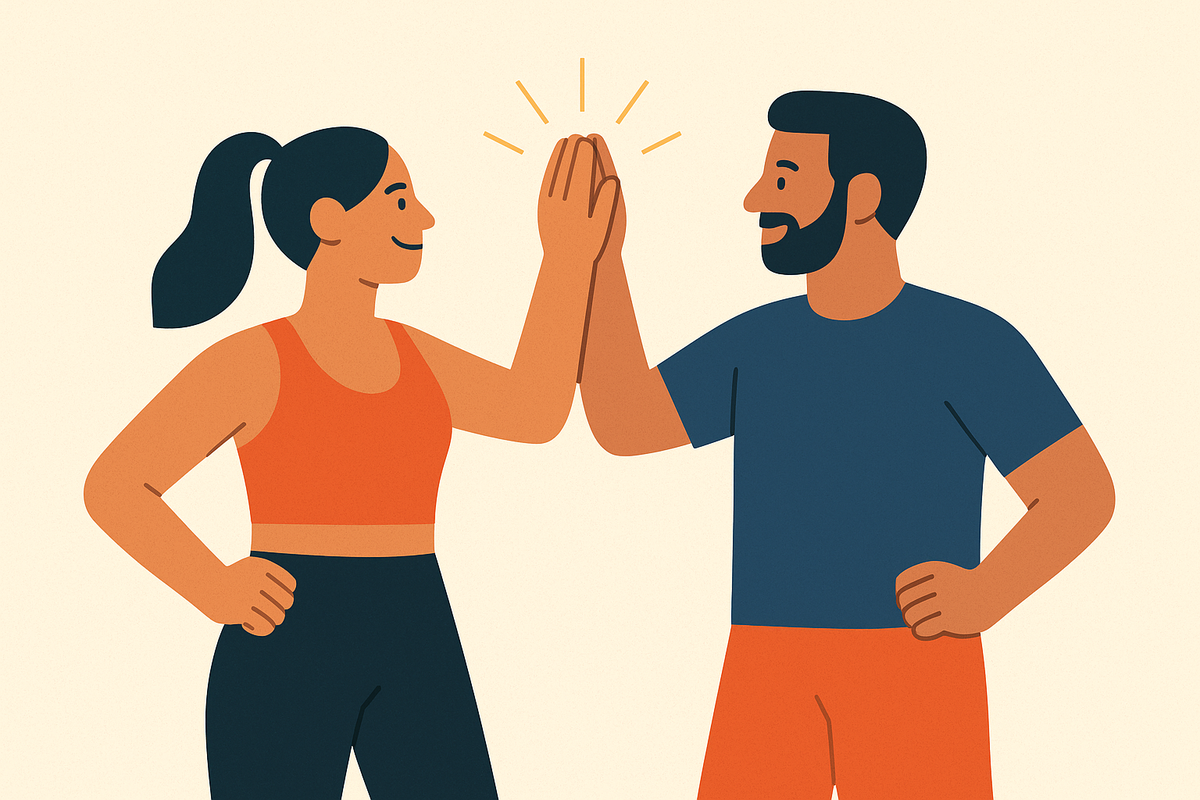
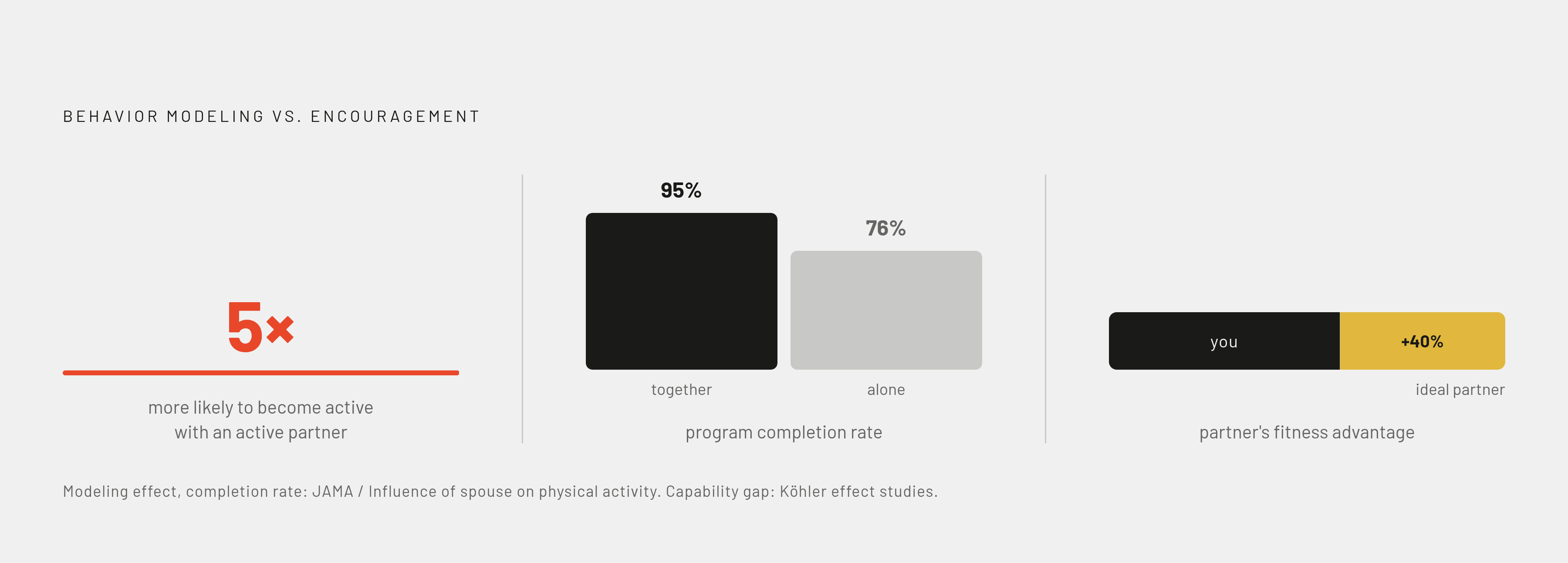
A study published in JAMA Internal Medicine found that having an active partner raises the odds of the other person becoming active by a factor of five. Not 5%. Five times. That's a structural change in someone's daily environment, and it happens without a single conversation about the gym.
Completion rates tell a similar story. Couples who started a workout program together finished at a 95% rate. Individuals going it alone came in at 76%. That gap has nothing to do with willpower or discipline. It's just context.
There's also something interesting in the timing research. Exercising on the same day as your partner, not even necessarily together, just the same day, is linked to higher positive feelings during the workout, higher mood overall, and greater relationship satisfaction. The movement starts strengthening the relationship instead of straining it.
And from Michigan State, there's the 40% finding: the ideal exercise partner is roughly 40% more capable than the other person. Enough of a gap to pull someone forward, not so much that it feels humiliating.
The point is that your own consistency is already an intervention. You don't need a plan for them. Just keep showing up.
Reading what your partner actually needs before trying anything
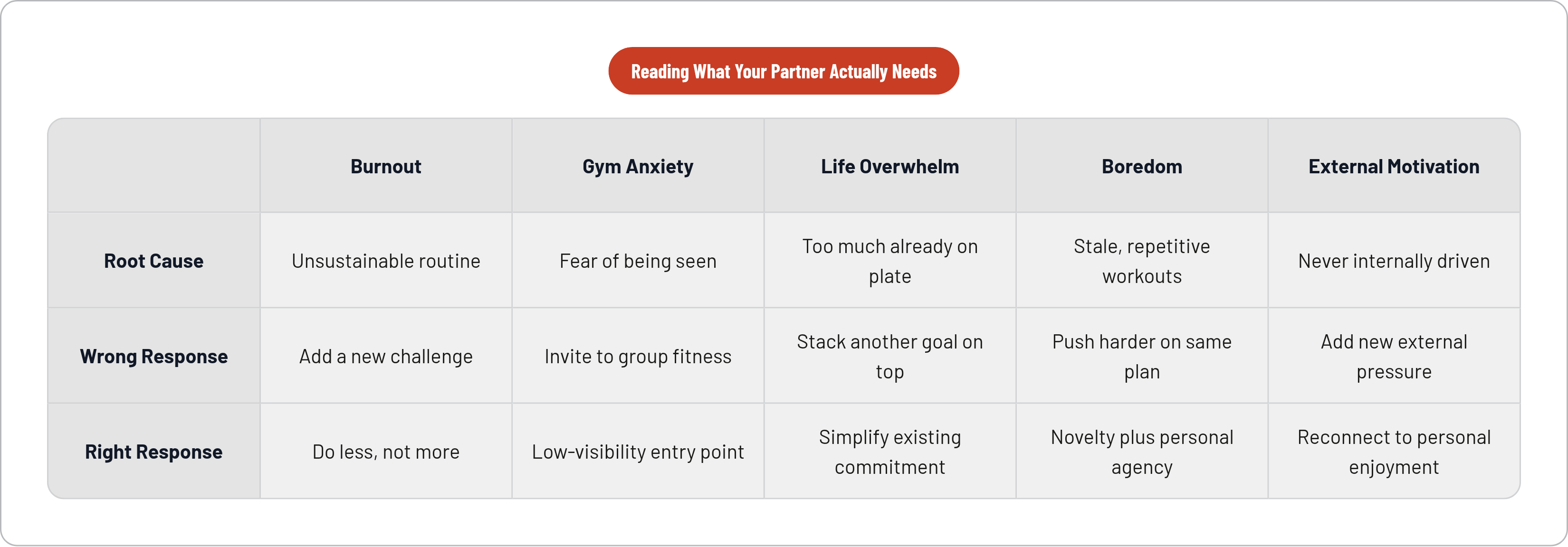
Lost motivation is not one thing. This is where most well-meaning partners quietly go wrong. They diagnose the problem as laziness and reach for the same tool every time: accountability, encouragement, a new workout plan. And they miss.
The cause shapes the right response completely.
- Burnout from an unsustainable routine doesn't need a new challenge. It needs less.
- Gym anxiety (and roughly half of people find exercising around strangers genuinely intimidating) doesn't need a group fitness invitation. It needs a low-visibility entry point.
- Life overwhelm from a new job, caregiving, or family pressure doesn't need another goal stacked on top. It needs the existing commitment simplified until it fits.
- Boredom with a stale routine needs novelty, and more importantly, some agency in choosing what comes next.
- Motivation that was always external needs reconnection to something they personally enjoy or care about, not a new external source of pressure.
Before you try anything, have a conversation. Use open questions. "What would feel manageable right now?" "How can I make this easier?" Frame it around something shared, like family health or just feeling better together, not around what they're failing to do.
Personality matters here too. Research in Frontiers in Psychology found that extroverts thrive in high-energy, social exercise settings. People with higher anxiety traits do better with shorter sessions in lower-visibility environments. If you're an extrovert enthusiastically recommending a Saturday morning bootcamp to someone who barely wants to be seen tying their shoes, you are solving the wrong problem with the wrong tool.
Just listen first. That's the whole ask at this stage.
Practical ways to lower the stakes and make showing up feel safe again
Right now the goal isn't performance. It's rebuilding a positive association with movement. Those are genuinely different projects, and confusing them is how you end up making things worse while trying to help.
Fitness coach Jonathan Roche frames it in a way I keep coming back to: let your partner decide on their own to follow your lead. Model it. Don't pitch it.
Some ways to make the bar actually low:
- Widen what counts as movement. Gardening, washing the car, a walk around the block after dinner. Activity that doesn't feel like "working out" removes the gym's psychological weight entirely. You're not lowering standards; you're rebuilding the emotional connection to movement that makes exercise self-reinforcing over time.
- Get specific on the when and where. "Want to walk at 7:30 Tuesday after coffee?" beats "want to work out this week?" by a mile. Specific planning dramatically outperforms vague intention. You're not pressuring them. You're just filling in the blanks.
- Focus on consistency, not performance. Three sessions beats a pace target. Early wins build the thing that makes later wins feel natural.
- Celebrate showing up, not output. A quick text, a shared photo from a walk, a real acknowledgment. Reinforce the behavior. Don't tie their worth to a number on a screen.
- Bring in other people gradually. A fitness-minded friend in the picture shifts some of the social pull off the relationship. It takes pressure off you both.
- Stay connected without doing the exact same thing. Parallel routines with shared check-ins, swapped progress photos, or loosely mirrored goals still build connection. They don't have to be in your gym at your time to feel like you're in it together.
Using friendly competition and shared goals without turning fitness into friction
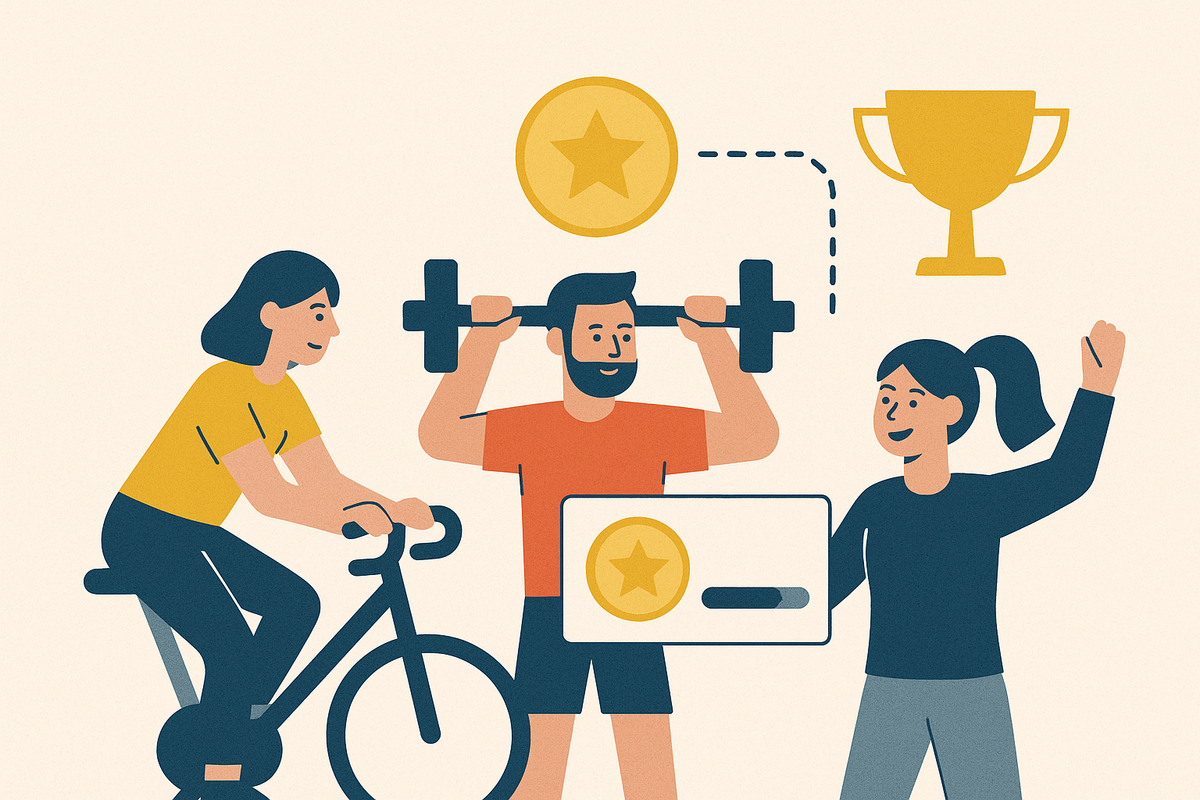
A little competition works; research shows a modest competitive element roughly doubles exercise time. The mechanism is engagement, not shame. That distinction is everything.
Whether it stays productive or turns corrosive comes down to one question: does this feel like a game, or does it feel like an evaluation?
Productive:
- Step count challenges
- Parallel goals where you're both aiming for something similar ("four sessions each this week")
- Small, low-stakes bets with genuinely silly rewards
Corrosive:
- Comparing performance levels
- Setting one partner's output as the standard the other should hit
- Letting affection or approval get tangled up in results
Fitness coach DeBlair Tate puts it plainly: games and bets work when the goal is enjoyment, not accountability pressure. Rewards you pick together feel like play. Rewards that feel transactional feel like a job. Nobody wants another job.
Keep the 40% gap finding in your back pocket here too. If one partner is significantly more advanced, identical workouts don't make sense. Parallel activities toward a shared goal (different programs, same week, same direction) often work better than forcing the same plan on two people at very different starting points.
Knowing when to step back and let consistency do its own work
A meta-analysis covering over 443,000 participants confirmed what self-determination theory has argued for years: support for autonomy, competence, and connection predicts long-term well-being and sustained behavior. Pressure does not. At some point, the most useful thing you can do is stop rearranging pieces and let the environment do its work.
A couple of things worth noticing in yourself as this plays out:
- Frustration turning into nagging. That's your signal to refocus on your own routine, not theirs. It sounds almost too simple, but it's genuinely the right move.
- Tying your workout satisfaction to whether they join. That dynamic breeds resentment fast, on both sides, and it puts weight on the relationship that it was never meant to carry.
How you respond when a goal gets missed matters more than most people expect. That moment shapes whether getting back on track feels safe or loaded. Shame closes the door. Curiosity keeps it open.
The timeline is longer than anyone wants it to be. Habit automaticity (the point where exercise stops requiring willpower and just happens) builds slowly. The workouts that stick are the ones tied to genuinely positive feelings during or after, and that process cannot be rushed. It can only be supported, and occasionally left alone to breathe.
The couple that keeps finding small ways to return to movement together will outlast the one chasing a perfect program every single time. That's not a motivational line. That's just what the data shows.