Fitness Goals After Having a Baby for New Parent Couples
Both parents' bodies and minds change after birth, so fitness works better as a shared practice.
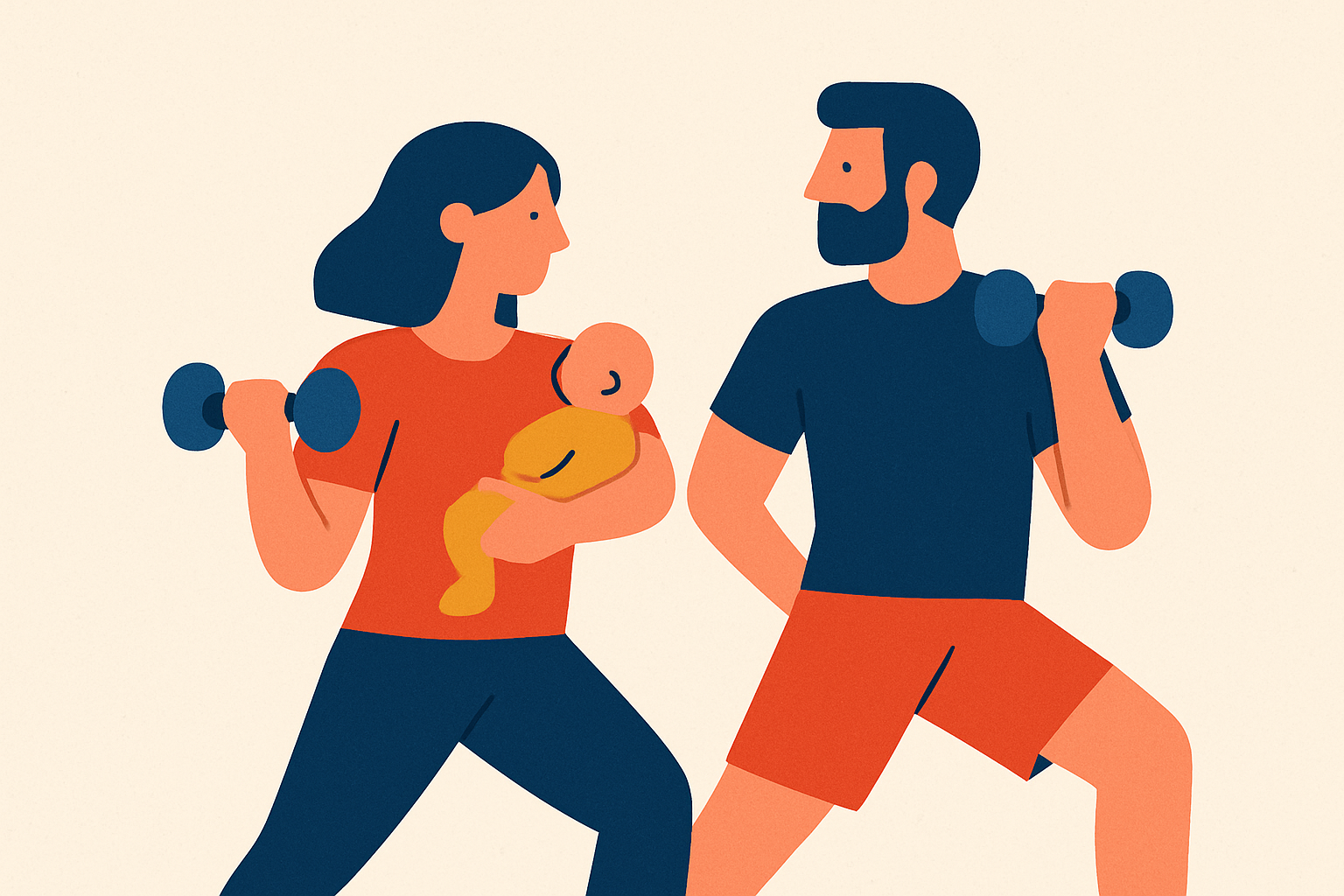
New parents get a lot of advice about sleep schedules, feeding routines, and diaper brands. Almost nobody tells them what to do about the fact that both of their bodies changed, both of their minds are stretched thin, and neither of them has a plan for getting back to any version of physical health. The most sustainable path forward isn't an optimized individual program for each person. It's a shared one. Simple, flexible, and built for the worst week, not the best one.
What's actually happening to both bodies in the months after birth
Let's start with the birthing parent, because the popular version of this story is wildly incomplete.
The six-week postpartum checkup gets treated like a clearance sale. You go in, the doctor says you're healing well, and the cultural implication is that you're basically back. You are not basically back. Many of the physiological changes of pregnancy persist well beyond that appointment, and the biggest one most new mothers don't know about is what's happening to their core.
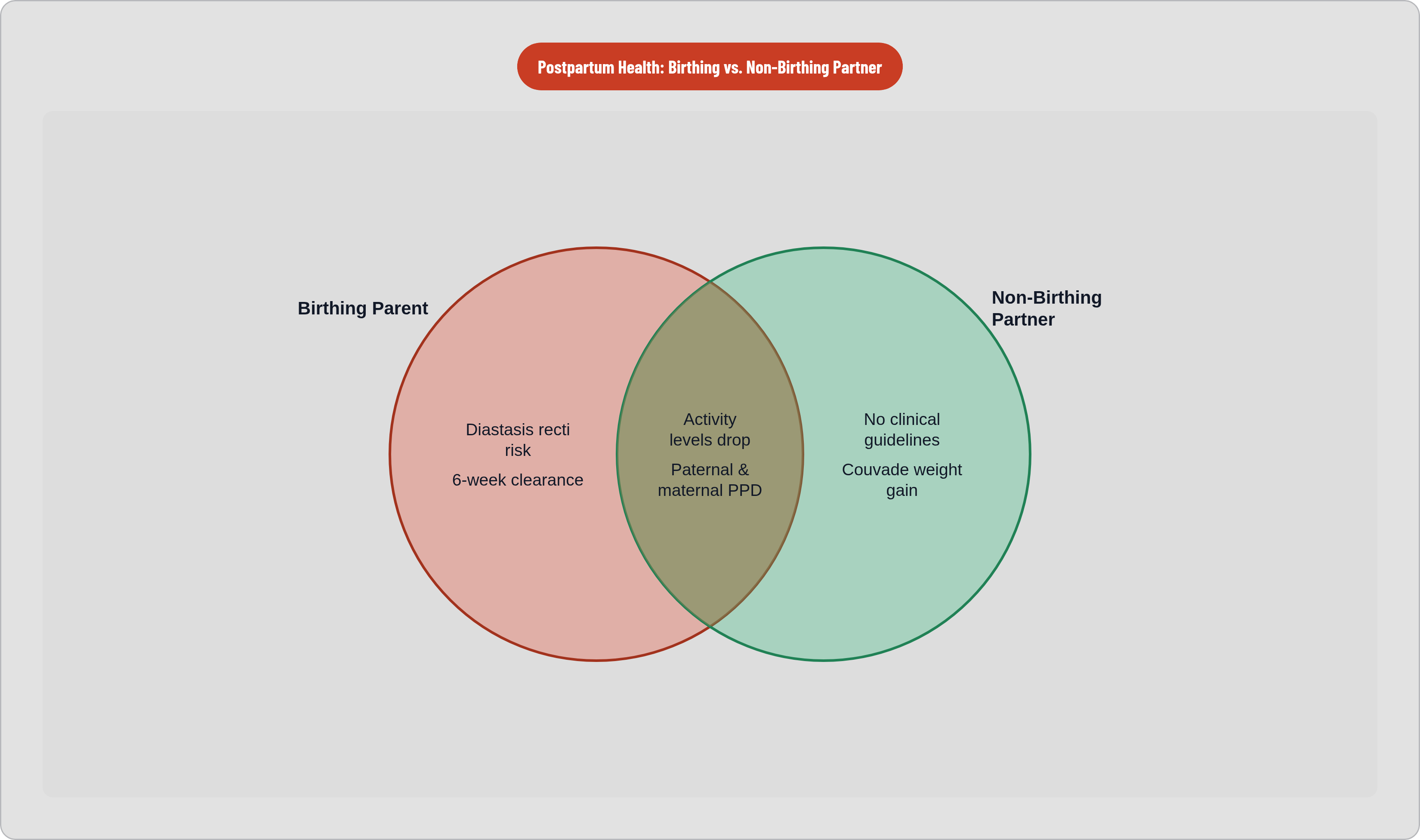
Diastasis recti, the separation of the abdominal muscles, affects roughly 60% of women at six weeks postpartum. And here's the part that matters practically: the exercises most people default to when they want to "work on their core." Crunches. Sit-ups. Planks. Those exercises can make the separation worse, not better. The moves that are actually safe in early recovery are things like diaphragmatic breathing, pelvic tilts, glute bridges, and heel slides. Not glamorous. Genuinely important.
For cesarean recoveries, the constraints are even more specific. At least six weeks before returning to activity, no lifting beyond the baby's weight, no abdominal work. The incision needs time. High-impact exercise, regardless of delivery type, generally shouldn't happen until three to six months postpartum.
Now for the part that almost never gets discussed: the non-birthing partner's body changes too.
A Northwestern University study of thousands of men found that fathers gained more than four pounds after a first child. Men without children, tracked over the same period, lost an average of 1.4 pounds. Research shows paternal BMI rises from pre-birth through the first year, and the changes persist. Weight gain can even begin during the pregnancy itself, a phenomenon researchers refer to clinically as couvade syndrome.
The University of Southern California has characterized new-father weight gain as a serious public health concern given its connections to cardiovascular risk in an already sedentary modern environment. That's not a minor footnote.
Both partners are in a different body than they had before. This is not a story of one person recovering while the other waits around. They're both in it.
The mental health dimension neither partner should navigate alone
Postpartum depression is the leading complication of childbirth in the United States. And the rate has roughly doubled over roughly the last decade, rising from about 9.4% in 2010 to 19.0% in 2021, according to a JAMA Network Open analysis of more than 440,000 births.
Separate from clinical PPD, up to 80% of new mothers experience what's called the "baby blues." Mood swings, weepiness, emotional volatility. These typically resolve within two weeks. They still affect motivation and energy in ways that make exercise feel genuinely impossible, not optional.
Paternal PPD is real and dramatically underreported. About 10% of new fathers experience depression in the postpartum period. If the birthing parent has PPD, roughly 50% of their partners develop depression too. Many new fathers don't have a primary care physician. Pediatricians are frequently the only clinicians in contact with fathers during this stretch. The infrastructure for identifying and treating paternal depression basically doesn't exist.
Regular exercise is associated with reduced PPD symptoms, better sleep quality, lower stress, and more energy. The relationship runs both ways, though. Fatigue from broken sleep makes exercise feel impossible. Inactivity worsens mood and sleep. That cycle is real, it compounds, and it is genuinely hard to break alone.
This is where the couple frame starts to matter in a concrete way. A partner who notices the other pulling inward and suggests a short walk together is doing something a fitness app cannot do. It's not therapy. It's not a replacement for professional care. Anyone experiencing clinical symptoms should seek it. But the social intervention of a person you love saying "let's just go outside for twenty minutes" is, according to the research on what actually moves people, more effective than most optimized programs.
Why both partners stop moving at the same time — and what that pattern means
Here's something the fitness industry mostly ignores: activity levels within couples are coupled. A Frontiers in Public Health longitudinal study found that when one partner's physical activity drops during the transition to parenthood, the other's drops too. The researchers concluded this is a strong argument for family-based initiatives that encourage couples to be active together.
The mirroring effect cuts both ways. Shared decline is common. Shared re-engagement is also possible and self-reinforcing.
This isn't a philosophical argument for togetherness. It's a structural one. If your activity levels are already linked, the smartest move is to use that link intentionally.
The barriers compound when both partners are exhausted. Research consistently identifies tiredness and broken sleep, unpredictable schedules, caregiving demands, and guilt around self-care as the top reported obstacles for new mothers. And here's the thing. Those aren't individual character flaws. They're structural conditions both parents share. A 2025 qualitative study found that sleep was the top self-care priority for new mothers, and that exercise, though recognized as beneficial, frequently got deprioritized because it felt effortful and came loaded with guilt.
Partners are positioned to reduce that guilt in a way that nothing else really is. When activity becomes a shared choice rather than something one person is sneaking off to do, it stops feeling selfish.
What official guidelines actually recommend — and how to interpret them realistically
ACOG recommends at least 150 minutes of moderate-intensity aerobic activity per week postpartum. Same target as the U.S. Physical Activity Guidelines for Americans. That's the number you'll see everywhere.
Here's the more useful part. That 150 minutes can be broken into ten-minute sessions spread across the day. That detail is in the official guidance and almost nobody leads with it. Ten-minute increments are explicitly validated. They also happen to map almost perfectly onto the fragmented, interrupted, unpredictable schedule of new parent life.
After an uncomplicated vaginal birth, gentle movement can begin when the person feels ready. Slow walks. Building gradually. Gentle pelvic floor and abdominal work can begin within a day or two of birth.
The framing that matters most here: 150 minutes is a destination, not a week-one requirement. Couples who treat it as an immediate expectation will fail. Couples who treat it as a direction will make progress.
For non-birthing partners, no clinical guidelines exist specifically for the postpartum period. Which explains a lot about why so many new fathers drift through this year without any structure at all. The absence of guidance is not the same as the absence of need.
The philosophy embraced by postpartum fitness professionals reframes the whole project. The goal is not to "bounce back." It's to reconnect and rebuild. That reframe applies to both partners.
How couples can build shared goals that survive the first year
The single most important design principle: goals should be small enough to keep on the worst week, not sized for the best one.
Three walks together per week counts. Hitting a step target together counts. A ten-minute bodyweight session during nap time counts. Frequency goals, meaning "we moved together four times this week," outlast intensity goals in conditions of unpredictable sleep. Every time.
Shared goals don't require moving simultaneously. One partner holds the baby while the other runs, then they switch. The goal is that both people moved this week. Coordinating each other's individual time is itself a form of accountability. It's still a partnership.
Oregon Health & Science University developed a structured partnered strength training model designed specifically so both partners work as a team. The research on dyadic exercise (that's just a formal way of saying exercising together) supports what most people intuitively sense: working out with someone you care about has social and motivational benefits that go beyond the physical ones.
Accountability framing matters enormously here. The goal is to be each other's support, not each other's performance monitor. Asking "did you hit your target?" after a sleepless night adds pressure. Offering to walk together removes a barrier. Those are very different moves.
Simple, visible progress beats detailed tracking. Marking four walks on a shared calendar feels different from opening an app that shows how far behind your weekly goal you are. One motivates. The other mostly just reminds you how tired you are.
Celebrating showing up, not just outcomes, reinforces habit. A completed week of any movement is worth acknowledging. The birthing parent and the non-birthing partner will have genuinely different physical starting points. Goals should be parallel, not identical. Both valid. Both visible.
Practical starting points by stage — what the first weeks and months can actually look like
Weeks one and two. For the birthing parent, rest is the primary goal. Gentle pelvic floor contractions and diaphragmatic breathing are appropriate. Short indoor walks if energy allows. That's it. That's enough.
Weeks two through six. Walking can build gradually. Pelvic tilts, glute bridges, and heel slides are appropriate for most. The rule of thumb: avoid anything that causes abdominal doming or pelvic pressure. If something doesn't feel right, it isn't.
Six weeks and beyond. Post-clearance, low-impact strength training and moderate cardio can begin. Clearance at the six-week appointment is a green light to start, not to resume pre-pregnancy intensity. That distinction matters more than most new parents are told.
Three to six months. Higher-impact exercise, running, jumping, heavier lifting, generally becomes appropriate. This is often the window when both partners can start a more structured shared routine.
For the non-birthing partner in parallel during those early weeks:
- Maintain or begin their own routine in ways that don't deprive the recovering partner of rest or support
- Stroller walks with the baby are a low-barrier shared option from the early weeks onward
- Bodyweight strength work at home requires no gym access and no childcare
One practical note about the core work timeline: before progressing to more demanding abdominal exercises, birthing parents should check for diastasis recti. Roughly 45% still have a measurable gap at six months postpartum. A pelvic floor physical therapist can assess this properly. That's not optional extra credit. It's genuinely useful information that changes what exercises are safe to do.
One longer-term data point worth holding onto: a five-year study found that women who retained a meaningful percentage of pre-pregnancy weight faced substantially greater odds of pre-diabetes or diabetes by year five. Not to create alarm. To reframe sustained movement as a long-term health investment rather than a short-term cosmetic one.
When fitness starts to feel like another source of pressure instead of a shared project
Here is the research paradox nobody talks about openly enough. Exercise relieves the exact symptoms that make exercise feel impossible. The fatigue. The low mood. The absence of energy. Acknowledging this openly with a partner reduces the shame of not starting, because you're naming the loop rather than pretending it doesn't exist.
Missing a week is not backsliding. In the postpartum period, missing a week is often the appropriate response to circumstances. A sick baby. A cluster-feeding night. A bad mental health day. The calendar doesn't care about any of that, but you and your partner do.
Couples who agree in advance that a missed goal triggers a conversation rather than guilt are dramatically better positioned to resume than couples who treat any lapse as failure. The conversation is "what got in the way and what can we adjust?" Not "you missed it again."
The "bounce back" narrative that saturates social media and parenting coverage is actively harmful here. It sets an aesthetic and timeline standard that the research does not support and that most new parents cannot meet. It is worth calling that out explicitly and loudly, especially between partners, before one of them starts measuring themselves against it.
Social support and partner engagement are identified in behavior change research as core enablers of postpartum exercise. The most effective intervention available is not a new app or a better program. It's a partner who says, "I've got the baby. Go outside for an hour."
Simple check-ins work better than elaborate tracking systems. Did we both move at least a few times this week? Did we help each other do that? Those two questions cover what actually matters.
Progress in this period is measured by consistency returning, not by performance metrics. A couple who moved together, imperfectly, most weeks of the first postpartum year has built something real. Something that will hold up. That's not a consolation prize. That's the goal.