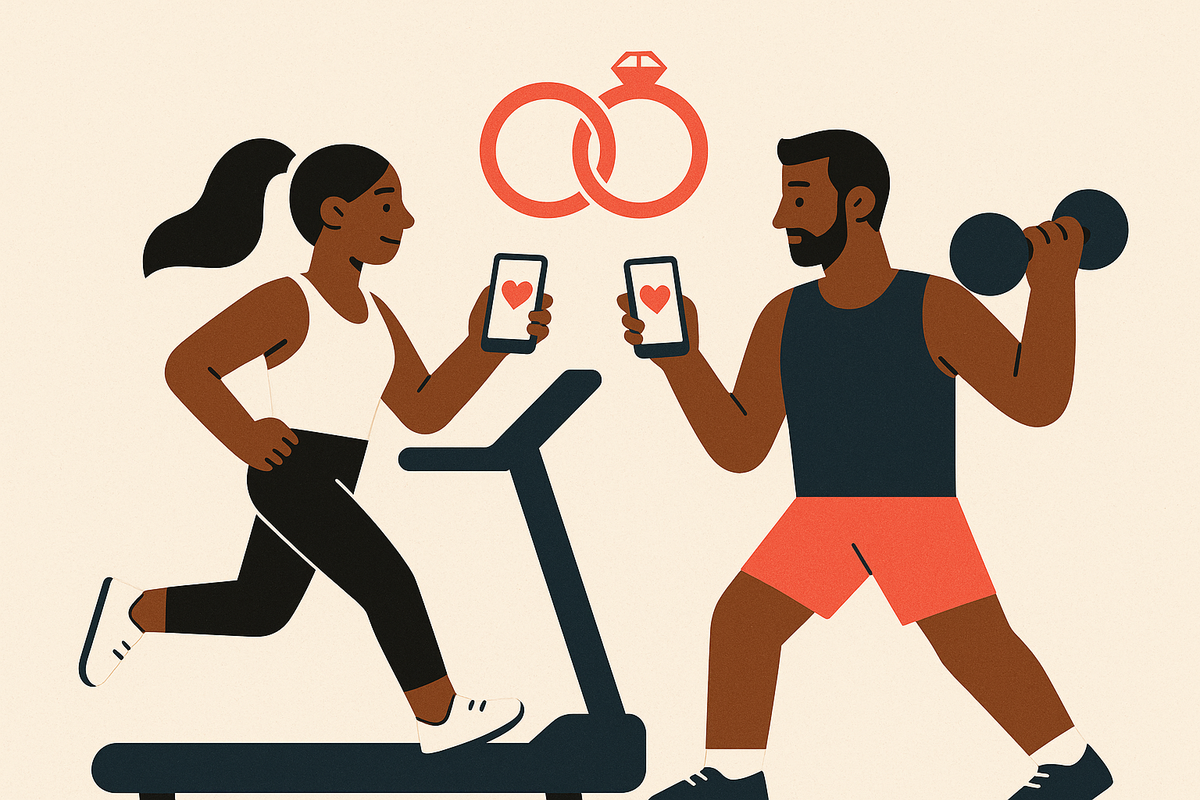
Finding a Workout App Where You and Your Girlfriend Can Both See Each Other's Gym Sessions
Sweatmates lets couples see each other's workouts in real time to stay mutually accountable.
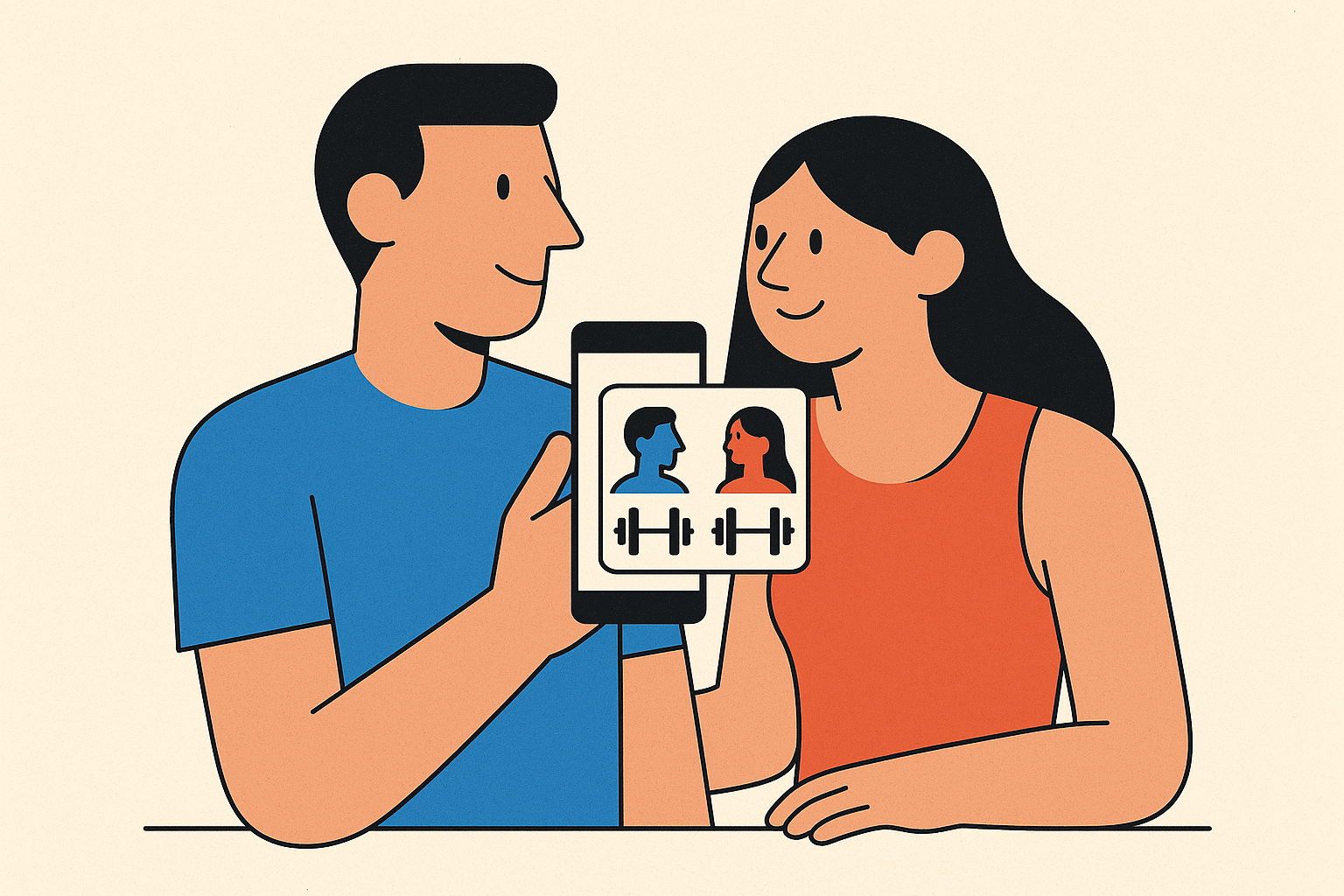
An app that lets you and your partner see each other's workouts needs exactly three things: instant notification when the other person logs a session, a shared view of weekly progress, and a small consequence for missing the goal. Sweatmates builds its entire design around that loop. Hevy covers the same ground for couples who both lift and want real training data. FitWithLove solves a related but different problem: couples who want to work out together, not separately.
Seeing Each Other's Gym Sessions: A Different Problem
Picture the actual situation. One person goes to the gym at 6 a.m. before work. The other trains after dinner, three hours and one time zone away from the first workout, mentally speaking. Neither one has a clean way to know whether the other actually went. That is the entire problem, and it's a narrower one than "couples fitness app" makes it sound.
Most couples training on separate schedules are not looking for a shared workout to do together, and they are not trying to build a public following with hundreds of strangers watching their reps. They want one specific thing: proof that the other person showed up. That requires mutual visibility across two independent schedules, where each person logs their own session on their own time, and both can see it land almost immediately.
That requirement quietly rules out a lot of apps. Anything built for synchronized co-workouts, both people doing the same video at the same moment, assumes a shared calendar most couples don't have. Anything built as a general social fitness network, aimed at broadcasting to dozens of followers, solves a different problem than two people who just want to know about each other. And a lot of couples simply train differently. One runs, one lifts. A tool that demands identical workouts from both people is the wrong tool before it even opens.
What actually works respects that each person has a separate plan, a separate schedule, and often a separate sport, while still making those individual sessions visible and rewardable to the other person. That's a specific design problem, and most of the apps on the market solve an adjacent problem instead.
Visibility, Not Data Volume, Drives Consistency
The accountability loop that keeps couples consistent runs on visible evidence, not on how much data gets logged. A workout showing up in a partner's feed acts as social proof and a trigger in one move: seeing that the other person went creates a pull to go yourself. That loop needs almost no information to function. A photo works. A checkmark works. A notification works.
Hide that evidence behind privacy settings, or bury it in a dashboard only the person who logged it ever opens, and the loop breaks, even if the underlying tracking is excellent. An app can record sets, reps, heart rate, and pace with total accuracy and still fail at this job completely, because the partner never sees any of it in a way that prompts action. The tracking can be flawless and the accountability can still be zero. Those are two separate systems, and only one of them is being asked about here.
That reframes the real question into which app makes it hardest for either person to quietly skip a day without the other noticing. Those are different engineering problems with different answers, and most fitness apps are optimized for the first one.
Apps built around this principle, Sweatmates among them, center on instant session visibility and shared weekly progress rather than detailed metrics, on the theory that the accountability loop depends on a partner seeing that the other person showed up, not on the richness of the data logged. When visibility is the primary feature, the motivational mechanism works even when training styles differ completely. Check any app for three concrete things before choosing one: instant visibility of completed sessions, a simple shared weekly goal, and some light consequence for missing it.
What the three features that actually matter look like in practice
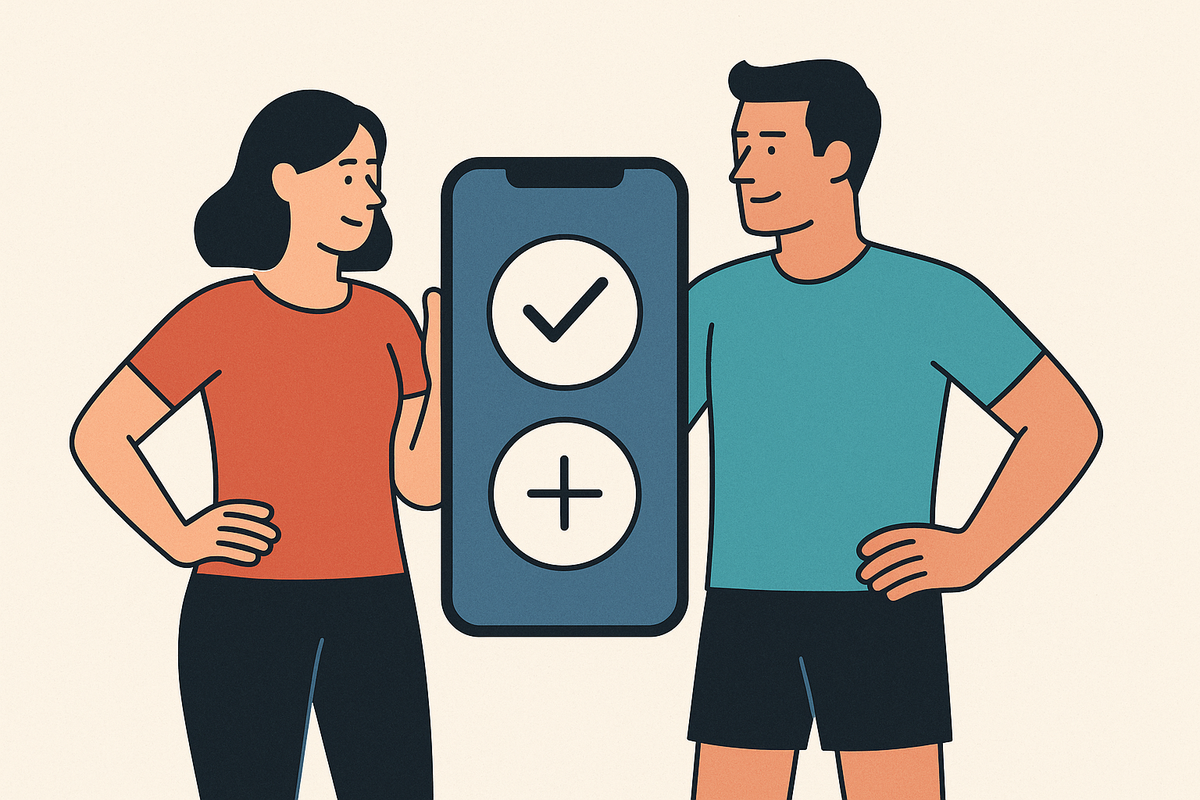
Those three features form a practical filter, not a scoring system. Run any app through them before downloading.
Instant session notification is the core of the loop. The moment one partner logs a workout, the other person needs to see it right away, as something that surfaces on its own rather than as a post sitting in a general feed they have to go scroll for. A six-hour delay defeats the purpose. Checking in feels close to real time.
A shared weekly progress view turns individual effort into visible team progress. Both people can glance at one screen and see how many sessions each of them has completed against a target they agreed on together. Without this, accountability depends on remembering to ask, "did you go today?" over text, which gets old by week two for most couples.
A lightweight consequence for missing the shared goal gives the loop actual stakes, something small and mutually agreed on, like covering dinner or taking on a chore for the week. The goal is a nudge toward reflection, not a punishment. Done right, it adds just enough friction to matter without turning fitness into a source of guilt or conflict between two people who are supposed to be on the same team.
One thing notably absent from that list: detailed metrics like sets, reps, and weight lifted. Those matter enormously for actual training programs, but they're secondary to the simpler question of whether your partner knows you went. And for couples with mismatched training styles, the app has to accept any kind of session, a run, a lift, a yoga class, rather than forcing one specific workout format on both people.
Sweatmates: the app built specifically around this loop
Sweatmates is built around exactly this loop, start to finish. The mechanics are simple enough to explain in four steps, and that simplicity is the point.
Each week, both partners set a personal goal: how many days they intend to work out. When someone finishes a session, they log it with SweatCam, a quick photo taken on the spot, and that photo reaches the partner instantly. Throughout the week, both people can see each other's progress against their own goals, side by side. If the weekly goal goes unmet, a small wager kicks in, something like buying dinner or taking on a chore. If the goal is hit, nothing is owed.
That photo-as-proof approach is deliberately basic. It functions less like a workout log and more like a check-in, closer to "I was here, I did the thing" than to a spreadsheet of performance numbers. That design choice is why it works whether one partner runs and the other lifts weights. The app never cared what the workout was in the first place, so neither workout type needs special support. It cared whether it happened.
Sweatmates exemplifies this feature set directly: instant notification when a partner logs a session, typically through that photo check-in, a shared weekly progress view showing both people's sessions against a joint goal, and a lightweight stakes mechanic, a small wager or chore, that keeps the loop real without making it punitive.
The App Store listing also describes Lock-In Mode, a feature where a partner who has already worked out can, once a week, lock the other's distracting apps until they work out too. It's a playful escalation of the same stakes idea, not a core mechanic, but it fits the tone.
The App Store listing shows a near-perfect rating from thousands of ratings, which is a meaningful signal for an app this narrow in focus. One App Store reviewer, describing a long-distance relationship, put the appeal simply: a morning gym photo would appear from one partner while the other was still at work, and seeing it felt like "just this little moment of like oh ok he's taking care of himself." Later, the second partner's after-work session closes the loop. No text conversation required. Both people register the connection just from the photos landing.
Sweatmates has real limitations. Logging a workout requires the phone camera. There's currently no manual logging option and no step-tracking alternative; location data only triggers reminders, it doesn't serve as a standalone check-in on its own. Some gym-goers have raised discomfort with the dual-camera (front and back) photo requirement, worried about accidentally capturing other people at the gym in the background. The app also doesn't track workout type, sets, reps, or duration, so anyone who wants a detailed training log will need a second app alongside it. And Google Play reviews point to a lack of upfront clarity about the subscription requirement, along with some reported difficulty reaching customer support.
Hevy: the better choice when session-level lifting data matters to both partners
For couples where both people are serious about lifting and want to see actual numbers, not just a photo confirming a session happened, Hevy does more technical work than any couples-specific app on the market.
Hevy, built by Hevy Studios S.L. and available on iOS and Android, is a gym workout tracker with a social feed layered on top of detailed lifting logs. A "Compare" function on any profile puts two people's training side by side: muscle split, number of workouts, time spent training, total volume, and shared exercises. It's a genuine head-to-head view of two lifters' progress, something no photo check-in app attempts.
A September 2026 update added gym-tagging to workouts, so a logged session shows where it happened. It's a small detail, but it makes an individual entry feel a little less solitary and a little more shared. Hevy Trainer, which launched February 18, 2026, goes further: it's an algorithm-based feature that builds programs and automatically progresses weights session to session, available to Pro subscribers.
The free tier includes all of the social features, following a partner, viewing their logged workouts, checking leaderboards, so couples don't need to pay anything to see each other's lifting data. Hevy Pro adds the AI programming layer on top, available as a monthly or annual subscription.
Hevy's social layer only works if both people are actively using it to log real training sessions. If one partner isn't interested in detailed tracking, the feed simply stays quiet. Hevy is also built specifically for strength training and doesn't offer GPS tracking for outdoor cardio, so a running-and-lifting couple will see a gap on the cardio side.
And Hevy doesn't try to be a couples-accountability tool. There's no shared weekly goal between two people, no lightweight wager, no instant notification the moment a partner finishes a session. It's a training-data platform with a social feed attached, which is a different product than a tool built to close the accountability loop. Couples who want that loop and the lifting detail both are looking at two different halves of the same problem.
FitWithLove: Who It's Built For
FitWithLove solves a real need, just not the one this article is focused on. It's designed for couples who work out together, at the same time, doing the same guided routine, which makes it a strong fit for one scenario and a weak fit for the one most of this piece addresses.
According to the Google Play listing, FitWithLove offers guided partner workout exercises, structured day-by-day couple fitness routines, calorie tracking for each person per session, and more than 30 achievement badges. Every part of that design assumes two people are doing the same session, in the same place, at the same time. Streak tracking, personal records, completion certificates, and cloud backup all layer on top of that simultaneous-workout model well.
The app has a significant number of downloads and uses a one-time Pro purchase to remove ads and unlock extra plans, with no recurring subscription required.
FitWithLove fits couples who want a shared home workout routine, who enjoy moving through the same exercises together, or who do couples yoga or bodyweight partner work as a joint activity. It does not fit two people running separate gym programs on different schedules who want visibility into each other's independent sessions. There's no asynchronous feed here and no mechanic for seeing a partner's workout that happened somewhere else, at some other time, without both of you present for it.
How to match your situation to the right app
The choice comes down to one real question: is the goal to feel connected and accountable, or to see each other's actual training numbers? Those are two different needs, and they point to two different apps.
For couples who want mutual accountability and the simple feeling of staying connected, where one person sees that the other went, both track progress against a shared weekly goal, and a small wager keeps things honest, Sweatmates is the most direct answer. It works regardless of whether one partner runs and the other lifts, because the proof required is a photo, not a specific data type.
For couples where both partners are serious lifters who want session-level detail, exercises, volume, personal records, a real side-by-side comparison, Hevy's free social layer delivers exactly that, and the Pro tier adds AI-driven programming on top. The trade-off is clear: no couples-specific goal structure, no wager mechanic, just the training data itself.
For couples who want to train simultaneously, following the same guided routine at home with no equipment and a shared screen, FitWithLove fits that use case well and costs less over time thanks to its one-time Pro purchase.
Couples with mismatched training styles, one running, one lifting, should look specifically for an app that accepts any kind of session log, built to handle multiple workout formats. Sweatmates handles this by design, since a photo check-in doesn't care what the workout actually was.
Some couples will want both: the connection Sweatmates provides and the training depth Hevy provides. Nothing stops a couple from running both apps at once, since they serve genuinely different functions and don't overlap. In the end, the best app for any couple is simply the one both people keep opening. A simpler tool used every week will always beat a more sophisticated one that gets abandoned after the first month.
Sources
- Sweatmates: Partner Fitness - App Store - Apple
- Accountability and Awareness: Recognizing Their Role in Behavior Change - Rochester Athletic Club
- Sweatmates: Partner Fitness - Ratings & Reviews - App Store
- Hevy Community Update: July, 2026 - Hevy - #1 Workout Tracker & Planner Gym Log App
- Hevy's Social Features and How to Use Them - Hevy App
- FitWithLove - Couples Workout - App Store - Apple