Setting Realistic Fitness Goals as a Couple
Research shows couples who exercise together stay committed far longer than solo exercisers.
Only 47.2% of U.S. adults hit the federal aerobic activity guideline, according to a CDC report using 2024 survey data. That is a coin flip's worth of Americans moving enough to matter, and the strength number is worse: 26.4% met both the aerobic and strength standard, missing the Healthy People 2030 target of 29.7% by a real margin. This piece is about what happens when two of those people share a bed, a fridge, and, in theory, a fitness goal.
What the research says actually happens when partners exercise together
Here's the part that should reframe how you think about a shared goal: intent isn't the problem. About 80% of adults set some kind of health or fitness goal for themselves. The problem shows up later, in the follow-through, and this is exactly where couples pull ahead of solo exercisers by a wide margin.
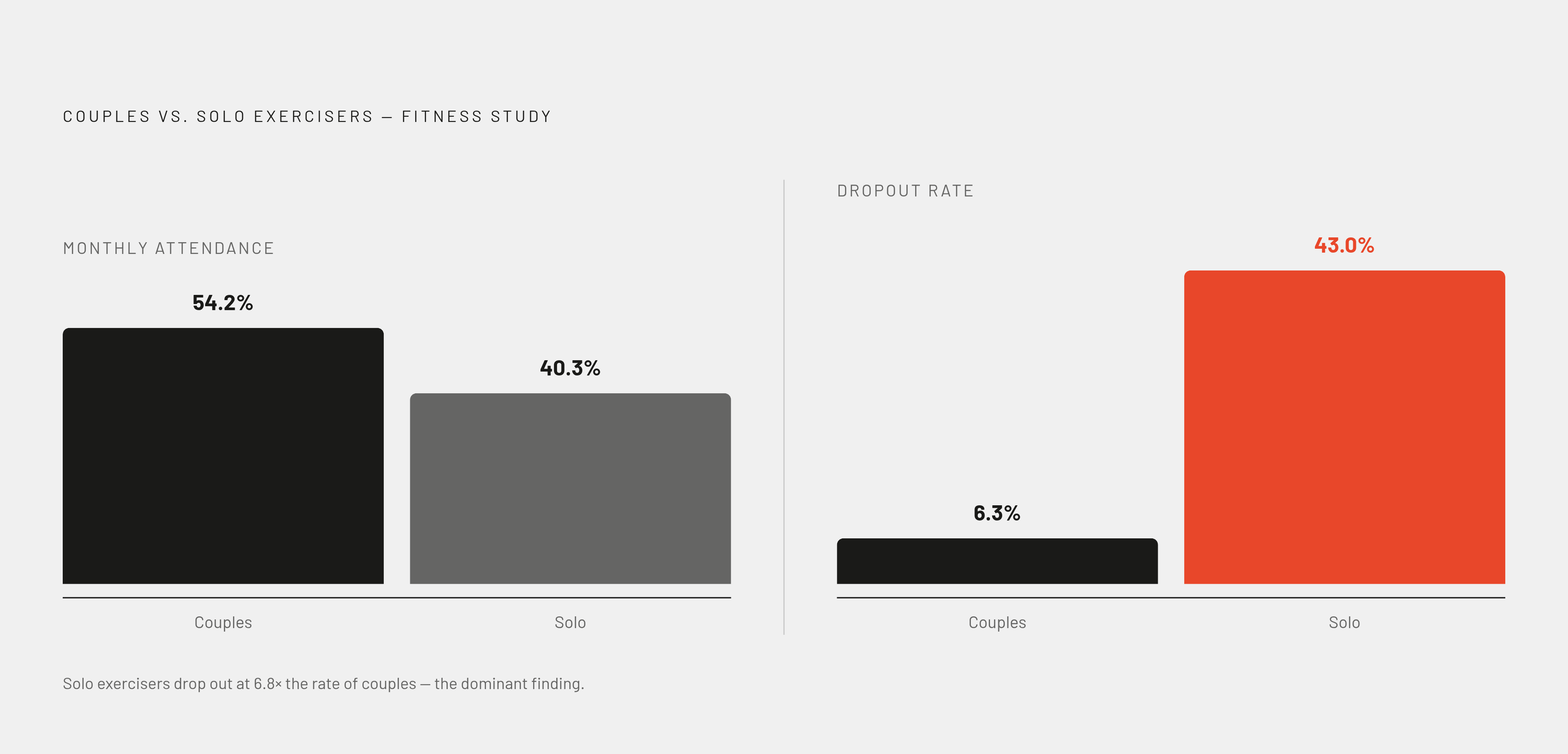
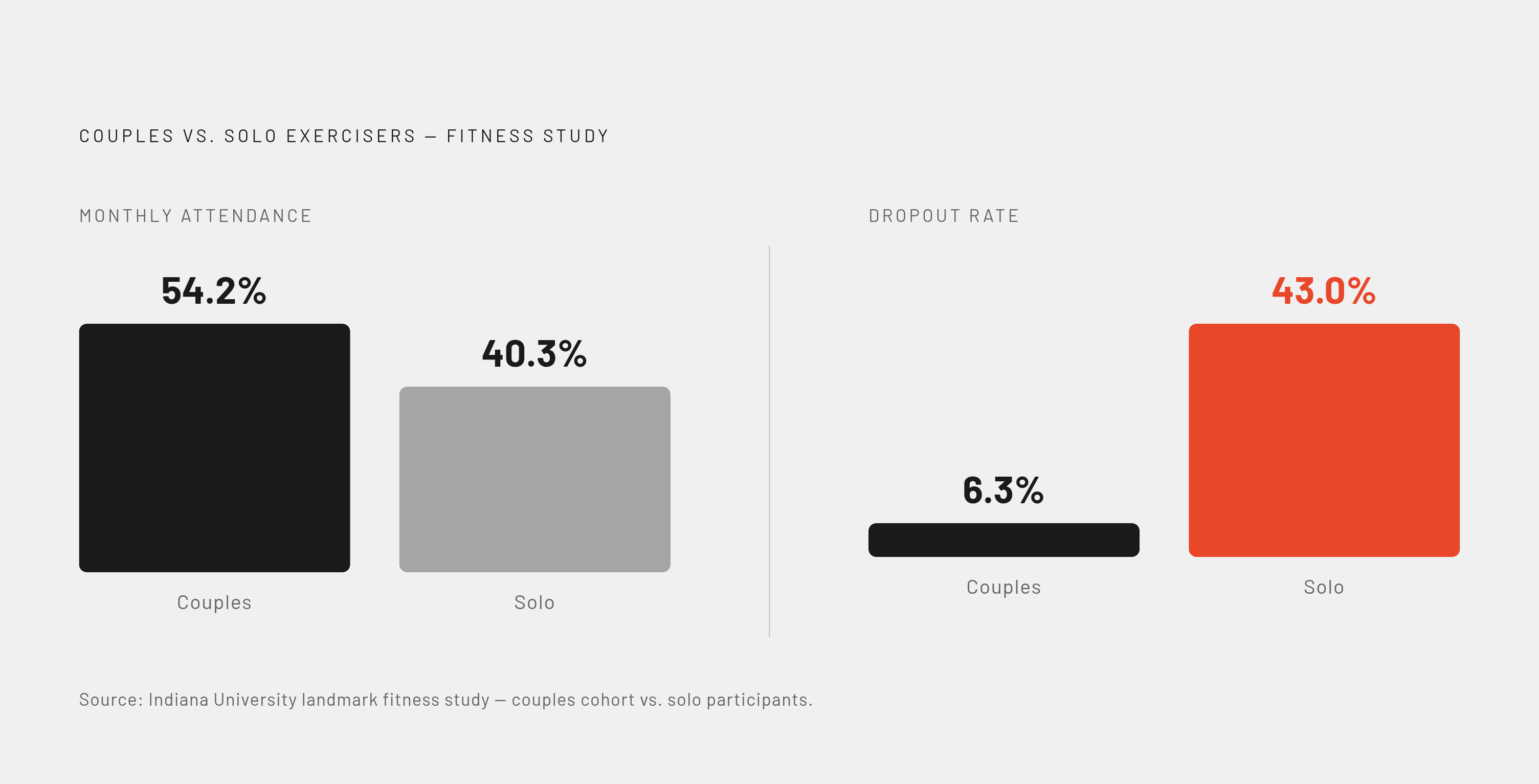
One landmark study tracked married couples who joined a fitness program together against married individuals who joined alone. Monthly attendance for the couples sat at 54.2%. For the solo group, it dropped to 40.3%. The dropout numbers tell the sharper story: 6.3% for couples, 43.0% for individuals going it alone. Of the people who did quit, half pointed to family responsibilities or a lack of support from their spouse, which is really just the same finding stated backwards. A partner's buy-in isn't a nice bonus. It's the single strongest lever in the whole system.
Other research backs this up. A study in the Journal of Sports Medicine and Physical Fitness found 94% retention for couples over twelve months, compared to 57% for people exercising solo. And Johns Hopkins researchers tracking 3,261 spouse pairs found something almost contagious about it: when a wife hit her recommended activity level, her husband became 70% more likely to hit his at the next visit. The effect runs both directions.
None of this is about workout plans. It's about whether both people are actually, genuinely in, and that's a much harder thing to fake than a shared gym membership.
Why a goal that works for one partner often doesn't fit the other
So if togetherness is the magic ingredient, why do so many couples' fitness plans die by February? Because "let's get fit together" is not a goal. It's a vibe, and vibes don't survive a Tuesday when one partner is exhausted and the other just PR'd their squat.
The most common failure looks like this: one partner is stronger or more experienced, so the workout is boring for one and brutal for the other. Within a few weeks, someone's frustrated and someone else feels like they're dragging dead weight through burpees. Layer mismatched schedules on top, and a plan built around simultaneous availability collapses the first time somebody works late or catches a flight.
There's also the quiet tension nobody wants to name out loud: unspoken comparison. When the goal gets framed as a shared outcome (both of you losing the same ten pounds, say) rather than a shared habit, one partner's faster progress starts to feel like a scoreboard instead of a team effort. And if one partner's fitness priorities run deeper than the other's, their commitment can start to feel isolating rather than motivating. Nobody signed up to feel lonely at the same gym.
The deeper issue: couples agree to "get fit" without ever deciding whose version of fit they mean, on whose timeline, at what pace. That's not a fitness gap. That's a planning gap.
Building goals around your actual life rather than an ideal version of it
Fix the planning gap before you fix anything else. Start with an honest inventory: which days can both of you actually train, what does each of you enjoy (not tolerate, enjoy), and what have you both already tried and quietly abandoned. That last one matters more than people admit; if you both hated spin class in 2022, don't rebuild your marriage's fitness plan around it in 2026.
The SMART framework, applied to a couple instead of an individual, still holds up: Specific, Measurable, Achievable, Relevant to both people, Time-bound. The Cleveland Clinic puts it plainly: without something concrete to move toward and a plan for getting there, motivation runs out of gas. Writing the goal down isn't optional flavor, either. People who write goals down are roughly 80% more likely to hit them than people who keep the goal in their head, and research on goal-setting found that 94% of athletes who actually practice it were still active nine months later. The structure protects you, regardless of what the specific goal happens to be.
For couples specifically, a few adjustments make the difference:
Set one shared behavioral goal, like two workouts together each week, rather than a shared outcome goal like matching weight loss. Behavior you control. Outcomes, you don't, at least not identically.
Give each partner a personal goal that doesn't depend on the other. This protects autonomy and quietly removes the pressure to progress at the same rate.
Aim for something that stretches without snapping. Research suggests moderately challenging goals outperform easy ones, but a goal one partner can't sustain inside their actual life is already broken on arrival, no matter how good it looks on paper.
Build in a weekly check-in to adjust intensity or timing before frustration has a chance to calcify into resentment.
Most couples land on two to three joint sessions a week, filling the rest with individual training. And the resolution graveyard backs up the whole argument: only 45% of people achieve their New Year's resolutions, and the usual culprit isn't weak willpower. It's a vague goal that never got specific in the first place.
How to train together when your fitness levels don't match
Match effort, not output. That's the whole principle, and it solves more couples' fitness fights than any app or program ever will. Nobody needs to lift the same weight or run the same pace to work equally hard in the same room.
Bodyweight exercises scale naturally here. A push-up on your knees and a push-up with a weighted vest are the same movement at different intensities, no separate equipment, no separate corner of the gym required. There's also a documented psychological boost to training with someone more capable than you: research has found that participants working alongside a stronger partner sustained effort longer than they did training solo. Handled well, a fitness gap motivates the less experienced partner instead of embarrassing them.
One wrinkle worth knowing: research on an older cohort, 240 participants between 54 and 72 in a Singapore-based study, found that couples in that age range actually logged lower step counts than individuals training alone. So the co-exercise advantage isn't automatic across every life stage; it seems strongest for younger and mid-life couples, or in situations where the shared activity demands real lifestyle change from both people. Translation: if there's a real fitness gap in your relationship, the way you structure the goal matters more than the workout itself. Shared presence with individual targets beats identical targets pursued at two different speeds, every time.
The communication habits that keep shared goals intact
Have the hard conversation about time and intensity before the resentment shows up, not after. That single sequencing choice, early versus late, decides whether a disagreement stays a conversation or turns into a pattern.
Relationship counselors generally recommend curiosity over judgment here: ask open questions, actually listen to the concern, and keep some space in your week that's just about connection, not reps. Then there's what researchers call the encouragement paradox. In one experiment tracking 115 exercisers holding planks, people paired with a slightly fitter, silent partner outperformed those getting verbal encouragement throughout. Constant coaching from your partner, however well-meant, can land as condescension rather than support.
A few habits fix this before it becomes a fight:
Agree in advance whether feedback happens mid-workout or gets saved for the check-in.
Separate "I noticed you skipped Tuesday" from "how are you feeling about the plan." One is surveillance. The other is support, and your partner can tell the difference instantly.
Treat a missed session as an opening for conversation, not a mark on a scorecard nobody asked to keep.
Research out of BYU, published in Family Relations and covering 1,693 couples, found that couples who exercise, together or separately, report better communication and fewer serious arguments. Couples training together showed a slightly stronger version of that effect, though the difference wasn't statistically significant. The through-line across all of this research is simple: fitness goals that actually strengthen a relationship treat the relationship as the point. The workout is just the excuse to show up for each other.
What realistic timelines actually look like for couples starting together
Most people feel a mood and energy lift within a few weeks of training consistently. Strength gains tend to show up somewhere between a month and six weeks in. Visible physique changes take longer, often two to three months or more, depending on where you started, how you're eating, how you're sleeping, and frankly, your genetics, which nobody gets to pick.
Set that timeline out loud, as a couple, before you start. It's the cheapest insurance against quitting early. When one partner expects a visible six-pack by week two and doesn't get one, that's usually where the whole plan dies; when both people know what the first three months actually feel like, they can read a slow week correctly instead of panicking. Name the small wins as they happen: showing up on the day neither of you wanted to, finishing a session you almost skipped, adjusting the plan instead of scrapping it entirely.
There's supporting evidence for the joint-commitment framing too. One frequently cited finding shows 95% of people who joined a weight-loss program with friends completed it, against 76% who joined solo. Framing shared fitness as an actual joint commitment, not just two people happening to sweat in the same room, changes how both of you experience the inevitable rough patch. And consistency beats perfection every time: a couple who shows up imperfectly for six months has built something sturdier than a couple who trained flawlessly for six weeks and then burned out.
Tools that help couples stay connected to their goals without overcomplicating them
Fitness apps by the mid-2020s have mostly figured out the social piece: shared progress views, gamified streaks, adaptive plans that flex for two different fitness levels under one roof. The good ones let you train separately and still feel like you're doing the same thing.
When you're picking a tool, look for a few specifics rather than a long feature list:
Individual plans inside a shared view, so each of you chases your own target while still seeing the big picture together.
Low-friction check-ins. A quick photo or a one-line note beats a dashboard neither of you ever opens.
A little gamification, friendly bets, small rewards, milestone badges, enough to add playfulness without turning your relationship into a performance review.
Flexibility for solo sessions. You shouldn't need to be in the same room to feel connected to the same goal.
Partner Fitness Review is built around exactly that model: shared goals, individual flexibility, and accountability that feels like support rather than a supervisor checking in. The best tool, honestly, is whichever one you both keep opening. Sweatmates, a fitness accountability app for couples that keeps both partners consistent through shared workout tracking, photo check-ins, and weekly recaps, is one option built around exactly that idea. Complexity kills consistency, especially in the first few months, while the habit is still wet cement. And if apps aren't your thing, a shared notebook works on the same principle: progress that belongs to both of you, written down where you can both see it, not locked inside one person's head.