How to Stay Motivated When Your Partner Progresses Faster
Performance gaps reflect starting points, not discipline—rewrite the story you tell about them.

One partner shows up to the gym and posts a personal record. The other shows up to the same gym and quietly wonders if they're the reason this relationship has a ceiling. That gap in progress feels like a verdict on who's disciplined and who isn't, but research on exercise and comparison suggests the gap is mostly just math, and the story you're telling about it is the part you can actually rewrite.
What the gap usually actually measures
Start with the scale, because that's where most of the panic comes from. One partner drops fat faster, or adds ten pounds to a lift while the other adds two, and it looks like proof of a talent gap. It's usually a measurement artifact.
A 2025 meta-analysis by Refalo and colleagues, reviewed by The Whole Health Practice in December of that year, pooled 29 studies and more than 2,800 participants and found men's relative muscle gains were just 0.69% higher than women's. That's noise, not a trend. A 10-week resistance training study cited in a medical research database found strength gains of 11.61% for men versus 11.76% for women, statistically identical. So the two sexes are gaining muscle and strength at close to the same relative rate.
Absolute numbers (bigger lifts, more pounds lost) mostly reflect where someone started, not how hard they're working now. Someone with a smaller starting frame or a lower training age often responds fast to early stimulus, meaning the partner who "started later" might be improving at the exact same biological rate as the one who looks ahead. Track your percentage change against your own baseline instead of stacking your numbers next to your partner's, and the scoreboard starts to look less dramatic. Neither of you is more special than the other. It's that you're standing at different starting lines and reading the same finish line as unfair.
How comparison turns from threat into fuel, and what determines which way it goes
Comparing yourself to a partner is a common, understandable response. It's wired in, and it happens constantly, more than once a day by some accounts, because your brain uses your partner as the closest available yardstick for how your own life is going.
Psychologists split the reaction into two lanes. Benign envy points your attention at the method: your partner got stronger, so maybe the plan works, and you copy it. Malicious envy points your attention at the person: you'd rather see them slip than see yourself improve. One builds. The other corrodes, and it corrodes the relationship right along with the motivation.
What decides which lane you land in comes down to whether the comparison feels fair. If the playing field seems level, the same painful gap that stings in the moment tends to convert into effort. Research on athletes and comparison suggests upward comparison (watching someone better than you) tends to track with higher performance, while downward comparison tends to track with lower performance. The discomfort isn't the villain here. Sitting with it productively is the skill.
Self-Determination Theory, from Deci and Ryan back in 1985, explains why external comparison eventually backfires anyway: motivation runs on three needs, competence, autonomy, and relatedness. A 2024 meta-analysis covering more than 443,000 participants confirmed all three predict well-being and performance. Comparing yourself to a partner's pace quietly attacks two of the three at once. It tells you you're less capable (there goes competence), and it hands your goalpost to someone else's calendar (there goes autonomy).
A 2024 Frontiers in Psychology study of 830 gym members found that intrinsic motivation, the enjoyment and stress relief kind, mostly showed up when people trained alone. Extrinsic motivation runs the show early on, but intrinsic motives are what keep people showing up years later. So a faster partner can supply a jolt at the start. They can't be the whole engine.
As researcher Reese put it in PsyPost in August 2026, comparison "can sting in a moment, but in the long run it helps us make decisions and build social worlds that I suspect are much happier." Comparison isn't the enemy. Ignoring what it's telling you is.
The 40% gap: why your partner pulling ahead may be the ideal structure
Here's the part that flips the whole conversation on its head: a gap isn't a bug in the system. Done right, it's the system.
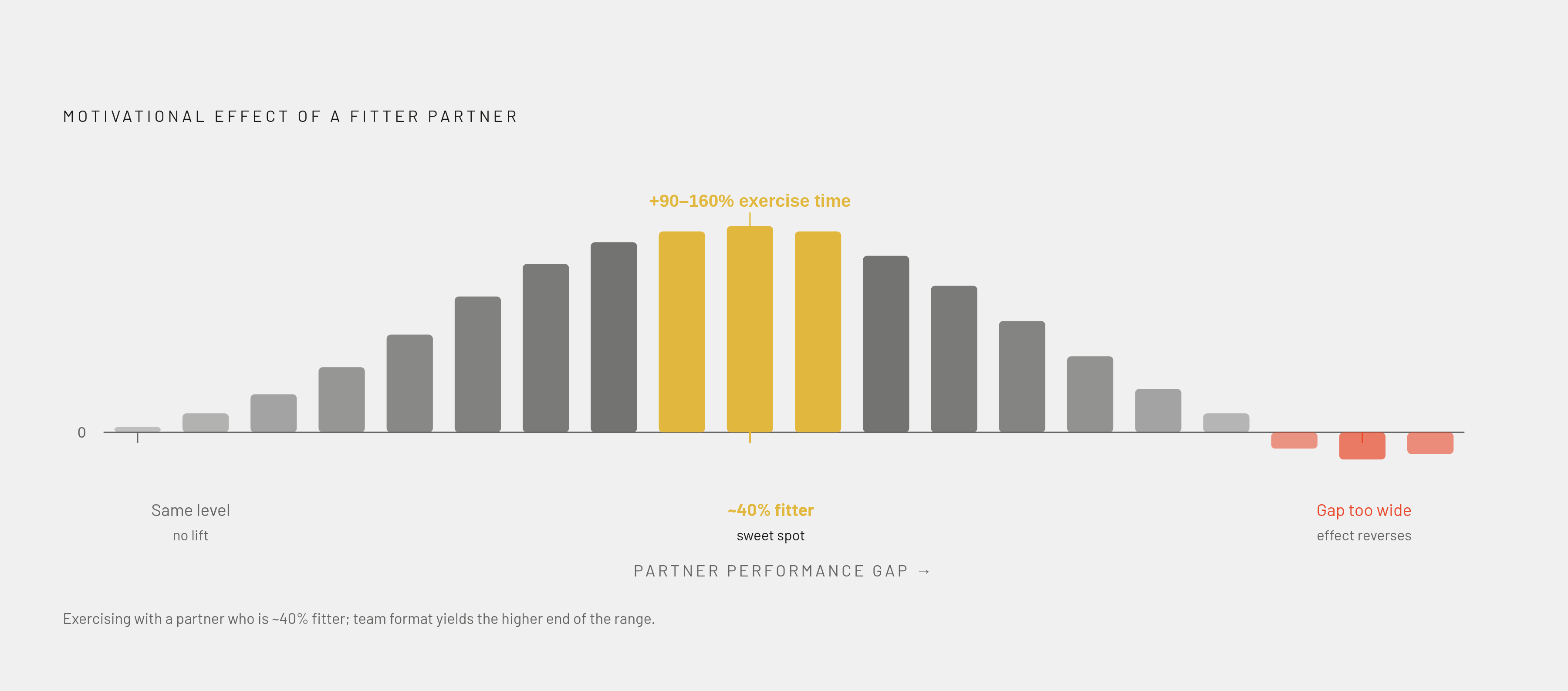
NCSF research led by Brandon Irwin at Kansas State University had people train with a virtual partner of varying fitness levels. Riders paired with a partner perceived as roughly 40% fitter pedaled about nine minutes longer than they did solo, a jump of roughly 90%. Pair the same person into a team setup, where collective performance is on the line, and total exercise time climbed to around 160% longer than solo, with the effect persisting across repeated sessions.
Match someone with a partner who's the same level, or so far ahead the comparison stops making sense, and the motivational lift disappears. Forty percent better sat in the sweet spot: close enough to feel reachable, far enough to demand something extra. And the mechanism wasn't shame. It was rapport, not wanting to let someone down.
So if your partner's a full class or two ahead of you at the gym, you might actually be sitting inside the most motivating gap that exists. Assuming, and this matters, they're not narrating it the entire time. Research on exercise partnerships points to something almost old-fashioned: exercisers respond better to a fitter partner who understands the power of silence. Once the gap gets pointed out constantly, or gets so wide it feels unreachable, the whole effect flips into the opposite direction.
Separating your goals from your partner's pace
If your unspoken goal has become "keep up with my partner," you've handed the keys to someone else's body. That's not a goal, that's a hostage situation, and their metabolism didn't sign up to be your finish line.
Fix it by defining progress in terms only you control. Set your own targets, your own deadlines, your own checkpoints, reviewed against your own baseline and nobody else's spreadsheet. Track percentage change instead of raw numbers, because raw numbers punish you for starting somewhere different than your partner did. Break the big goal into smaller ones and actually celebrate the small ones. The specific milestone matters less than whether the pattern of showing up survives contact with a bad week.
Name why you actually want this, not just what "this" is. A goal built around feeling stronger, sleeping better, or being more present in the relationship is a lot harder for a partner to accidentally take from you than a goal built around a number on a bar or a scale. A study by Cappuzzello and colleagues, following 59 newly dating couples, found that a partner's usefulness toward your goals (what researchers call partner instrumentality) predicted real gains over time, but only among couples who were already satisfied in the relationship. The shared gym membership only helps your personal goals when the relationship underneath it is solid to begin with.
Using the relationship as an anchor, not a scoreboard
A scoreboard tracks who's winning. An anchor just keeps you from drifting. Aim for the second one.
Committing to show up for another person changes the math of skipping a workout. It's no longer just you letting yourself down, it's a small broken promise to someone else, and that added layer tends to outlast whatever motivation was fueling you on day one. Research has found couples who joined a gym together logged more workouts and fewer dropouts over a year than married individuals who joined solo.
A 2021 study in the Journal of Social and Personal Relationships, led by Sackett-Fox, Gere, and Updegraff, found that on days couples trained together, both partners reported higher positive mood during the workout, higher mood for the rest of the day, and higher relationship satisfaction. Nobody had to win the workout for that benefit to land. Les Mills research adds a related wrinkle: when one partner is active, the other becomes about five times more likely to become active too. The influence runs both directions, which means the "slower" partner showing up consistently is quietly doing more work than they're getting credit for.
Celebrate the faster partner's wins as proof the goal is reachable, not as a scoreboard update against you. That reframe, treating their success as evidence rather than threat, is what benign envy looks like when you actually live it out. And watch the workout's share of the relationship. If exercise is the only thing you do together, the bond gets thin in a hurry. Let it be one thread in the rope, not the whole rope. Build in flexibility too. A missed week should read as a chance to reconnect, not a scoreboard reset.
What the faster partner can do, and why it matters more than the slower one realizes
The Irwin research made one thing clear: the motivational lift from a gap only works under the right conditions, and a lot of those conditions are the faster partner's job to maintain.
Silence tops the list. Not pretending the gap doesn't exist, just not narrating it out loud every session. The research on partners who "understand the power of silence" concerns something other than dishonesty. It's about not turning a workout into a running commentary on who's ahead.
Compliments carry more weight than most people assume. Dr. Deidre Douglas, quoted via Les Mills, put it plainly: "Compliments are incredibly motivating, so shower people with them… It's always a smart move to offer a compliment when your significant other exercises." Praise the effort, not the output, because effort is the thing that's actually in the slower partner's control.
Skip the unsolicited coaching, even the well-meaning kind. Telling someone to push harder mid-set feels helpful in the moment, but per Self-Determination Theory it threatens their autonomy, and can flip a healthy gap into a resentful one by making it feel imposed rather than earned. Ask instead what kind of encouragement they actually want. Psychotherapist Francesca Maxime, quoted in The Healthy, described the goal as detaching from the outcome of a partner's exercise, being present without judgment, calling it "unconditional love." That's not a low bar. It's just a specific one, worth actually discussing instead of guessing at.
ACE-certified coach Anna Szymanski, also via Les Mills, put the whole philosophy in one line: "there are two ways to present options, it can either be inviting or off-putting." Modeling your own workouts with visible enjoyment does more persuading than any pep talk ever will. The faster partner's progress works best as evidence that the goal is possible, not as a performance review nobody asked for.
Staying in the game when the gap refuses to close
Some gaps don't close. Ever. Pretending otherwise doesn't help anyone, and chasing full parity with someone whose body, schedule, and training history don't match yours is a losing game by design. The actual goal is narrowing the gap. It's refusing to let the gap set the terms of whether you keep going.
Lean into intrinsic motivation deliberately, because it won't show up on its own. The 2024 Frontiers in Psychology research found extrinsic motivators dominate the early months, but staying power comes from the stuff that has nothing to do with your partner's numbers: enjoyment and stress relief, the intrinsic rewards that have nothing to do with external results. Ask what you're actually getting out of the workout that survives even if the gap never budges.
Treat a missed goal as information, not a verdict. What changed that week? What needs adjusting? That question keeps a single missed session from snowballing into three, then none. Partners can train completely separately and still stay connected, a check-in text, a photo, a quick note about what felt good, none of that requires matching workouts or matching results.
For anyone who finds the gap harder to sit with, that's a real experience worth acknowledging. It just means the strategies above may take more deliberate effort, not less, and pretending otherwise does a disservice to the people who need them most.
The fitness system that wins in the long run was never the one producing the fastest gains. It's the one both people actually keep returning to. A slower partner who shows up every single week isn't behind. They're winning the only metric that predicts where either of you will be in five years. Simple tools carry a lot of that weight, such as a weekly check-in, a photo shared after a session, a low-stakes challenge, and one shared question each week, did we both show up? Shift the measurement from performance to consistency, and the scoreboard stops mattering because it was never the right way to keep score in the first place.