Fitness Rewards Systems for Couples and Friend Groups
Accountability shifts fitness from private failure to shared commitment.
Fitness rewards systems for couples and friend groups work for a boring, mechanical reason: they turn a private decision into a shared one. Skip a solo workout and nobody notices. Skip a shared one, and someone texts you. That single shift, from silent failure to visible failure, is the entire engine behind why these systems stick.
What a rewards system actually does (and what it does not do)
A rewards system doesn't manufacture motivation out of nothing. It's not a pep talk in app form. What it does is take something invisible, your intention to work out, and make it visible and specific enough that another person can react to it.
Three things a well-built system does. It makes progress legible, so neither partner has to dig through a dashboard to know where things stand. It creates stakes that are social but low-cost, meaning you show up because people you actually like are counting on you, not because a stranger on a leaderboard is watching. And it shrinks the gap between "I should work out" and "I did," by attaching a near-term payoff instead of some vague health outcome six months out.
Here's the part that gets skipped in most pitches for these apps: a rewards system can't fix a schedule mismatch, can't equalize two very different fitness levels, and can't invent motivation where there's none to begin with. Group settings do get a real boost from a well-documented dynamic where success depends on everyone participating, so each person feels more personally on the hook. Gamified apps reportedly see retention rates up to 50% higher than tracking-only apps (FitBudd, 2025). But retention isn't transformation. A system built on top of a habit someone already wants works. A system trying to force a habit that isn't wanted yet just adds friction with extra steps.
One more distinction worth sitting with, because it decides whether any of this helps or backfires: rewards that feel like surveillance corrode the relationship. Rewards that feel playful and mutual reinforce it. Same mechanic, opposite outcome, depending entirely on tone.
The four reward structures worth knowing, and which relationships they suit
There are basically four flavors here. Pick based on your group's temperament, not on which one sounds most fun on paper.
Friendly wagers and forfeit pacts. Everyone sets a goal. Whoever misses it owes something small: a chore, dinner, a coffee run. The stakes stay relational, not punitive, which is exactly why they work. This suits couples and small friend groups with similar competitive streaks. Watch out for the fairness trap, though: if one partner gets the flu or pulls a 60-hour work week, a rigid forfeit turns into resentment fuel. Build in a grace clause before you need one.
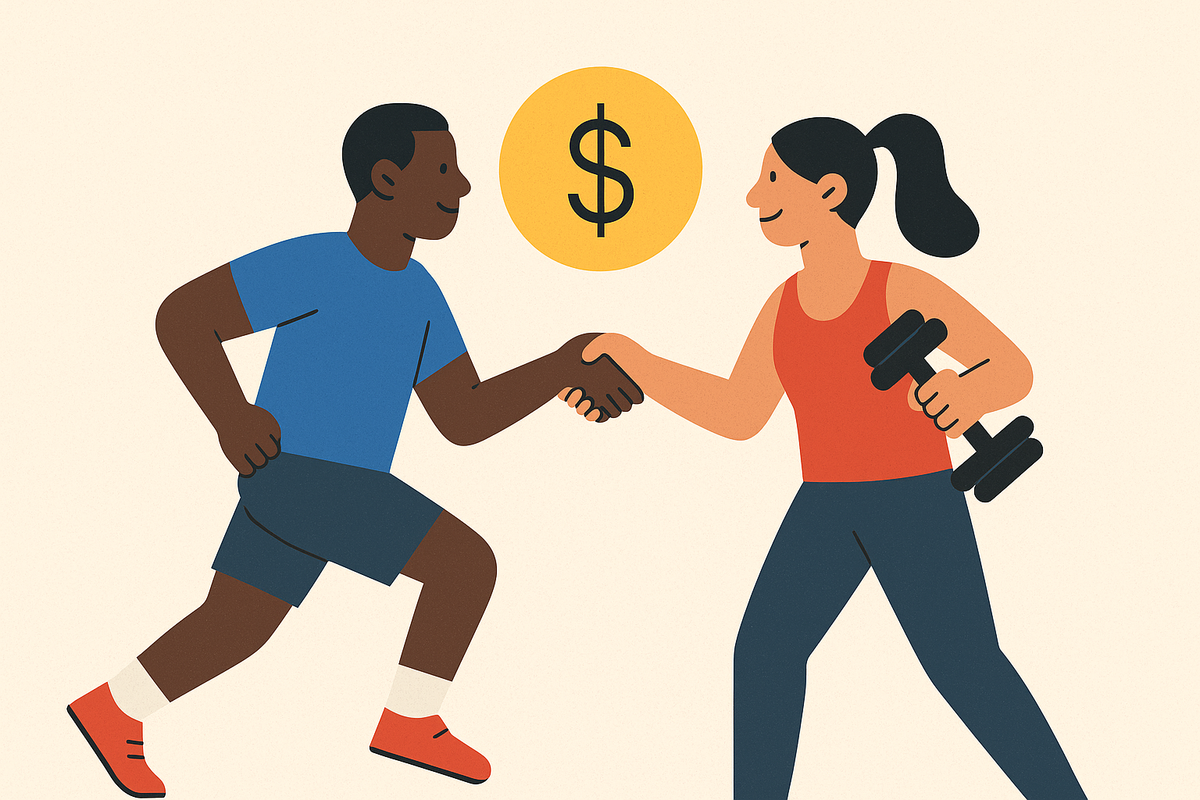
Pooled financial stakes. Everyone puts money in. Hit the goal, split the pool with the other winners. Miss it, lose the deposit. It's blunt, but it works precisely because it's blunt, no ambiguity about what happens if you skip week three. This fits groups who like a little financial skin in the game. It does not fit anyone who already carries guilt or shame around fitness, because losing money after a rough week reads less like "try again" and more like a fine for being human.
Collective goal with a shared reward. The whole group chases one number together. Hit it, and everyone gets the same reward: dinner out, a weekend trip, whatever you agreed on beforehand. No leaderboard, no ranking, no individual scoreboard shaming the slowest runner. This is the move for groups with mixed fitness levels, where competition would just create tension instead of fun. Comparison lights a fire under some people and snuffs it out in others. A collective goal sidesteps the whole problem by removing comparison from the equation entirely.
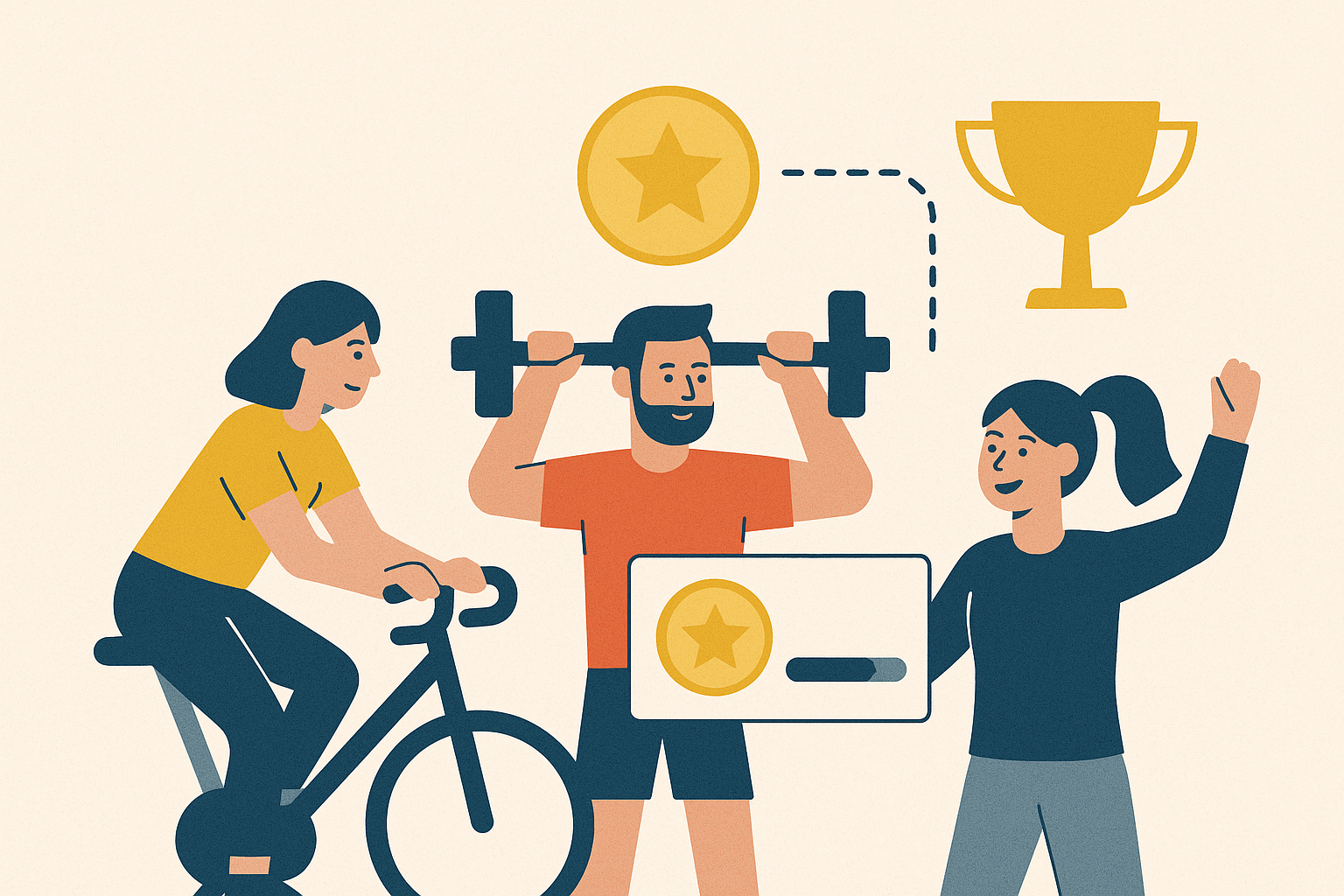
Recognition and celebration milestones. No money changes hands, nobody owes a forfeit. Just a shout-out, a photo in the group chat, a streak badge, something that says "we saw you show up." A 2025 study in Frontiers in Psychology (N = 425) found that fitness-related social media use significantly predicted both intrinsic motivation (β = 0.396, p < 0.001) and actual exercise behavior (β = 0.295, p < 0.001). Being seen, in other words, genuinely changes what you do next. This structure suits groups where the relationship itself is the motivator and any hint of competition would feel like the wrong tone entirely.
Competition versus cooperation: choosing the dynamic that fits your group
Competition works, full stop, when the playing field is level. The STEP UP randomized clinical trial, covering 602 adults and published in JAMA Internal Medicine, found the competition arm added roughly 920 extra steps per day compared to controls, the largest effect of any social design tested in that study. That's not a rounding error. That's a near-doubling in some cases of what cooperative or solo approaches managed.
But competition has a shadow side, and it shows up fast in mixed groups. Public leaderboards energize people who like being watched and quietly demoralize people who feel judged by every off day, same mechanism, opposite reaction depending on who's standing on it. Research on social competition suggests the competitive push is strongest when you're up against someone similar to you, or just slightly ahead. Stick a beginner up against a marathoner on the same leaderboard, and the effect doesn't motivate the beginner, it just embarrasses them.
There's also a fairness snag baked into mixed-activity groups that nobody talks about enough. A runner racks up steps automatically. Someone grinding through a hard strength session, sweating through sets of deadlifts, gets nothing to show for it on a step-based scoreboard, even if their effort was equal or greater. Two fixes solve this: count workouts completed instead of raw output, so any activity counts the same, or use effort-normalized scoring that adjusts for the type of exercise.
Cooperative framing, meanwhile, spreads accountability around without crowning winners and losers inside a relationship that's supposed to be a partnership, not a rivalry. Here's a quick gut check that settles most of these decisions in about five seconds: would the least fit person in your group feel motivated by seeing their name on this leaderboard, or embarrassed? If the honest answer is embarrassed, skip the leaderboard.
Apps and tools that implement these structures (what each one actually offers)
GymRats is built around one simple mechanic: a group challenge where everyone posts a photo of their workout with a title. Any activity counts, and the group picks its own scoring, whether that's total workouts, miles, minutes, calories, or a custom point system somebody dreamed up in the group chat. It pulls data from Apple Health, holds a 4.9 rating across 4.7K App Store reviews, and has 3.1 million downloads. Pro runs $3.99 a month or $32.99 a year, with a free tier available. Good fit for friend groups who want flexible scoring and a social feed without much financial commitment.
Stridekick solves a different, more mundane problem: device compatibility. One group can mix Fitbit, Garmin, Apple Watch, Samsung Health, and phone-only users without forcing everyone to buy the same hardware just to compete. Basic challenges are free to create. This is the pick for workplaces, families, or friend groups where everyone owns a different brand of wearable and just wants one shared target that actually works across all of them.
Financial-stakes platforms operate on a straightforward model: everyone deposits money into a pool, winners split it, and those who miss the goal forfeit their share. One well-known example runs a modal challenge with a $40 deposit over six weeks, refunding winners in full plus a cut of the losers' contributions, with subscription pricing around $69 every six months after an initial free week. These platforms report paying out over $200 million to winners combined, with one weight-loss-focused version citing figures of over a million participants and over $101 million paid out, numbers that come from the platforms themselves rather than independent peer review. This structure fits people who find money-on-the-line energizing. It's a poor match for anyone who already struggles with fitness-related shame, since losing a deposit after a hard week can read as punishment rather than a nudge.
Apple Fitness+ with SharePlay lets subscribers start a synchronized group workout with up to 32 friends and family over FaceTime, streaming in sync no matter where everyone's standing. You can see when a friend closes an Activity ring, and a real-time Burn Bar shows competitive standing during HIIT, Treadmill, Cycling, and Rowing sessions. The catch is the ecosystem lock-in: you need an Apple Watch and the full Apple hardware stack, which is a real financial barrier for any group that isn't already all-in on Apple. Best suited to couples or small groups already living inside that ecosystem who want to sweat together from different zip codes.
Fitcoin tackles the cross-activity fairness problem directly with something it calls a FitScore, designed so a runner doesn't automatically dominate a friend who just finished a brutal gym session, purely because running generates more raw steps. It converts compatible steps and workouts into one unified daily score, layers in streaks, achievements, and private Leagues, and lets friends compare scores across a day, a week, or a month. Worth noting that this framing comes from the app's own source material rather than an outside ranking, so take the pitch with the same grain of salt you'd give any product describing itself.
Fitness Pact leans hardest into the relationship-first end of the spectrum. Each person picks a workout frequency and sets their own payoff or penalty for missing it, and the app runs a group feed for encouragement (or the occasional ribbing). No need to share a gym, a city, or even a time zone. Current reviews flag real limitations, though, and the app has received mixed feedback on how fully its features match its ambitions. The developer, reportedly a two-person team as of early 2025, has acknowledged the gaps and says more features are coming. In its current form, it fits couples or small groups who want something lightweight and relationship-first, and who don't mind a bit of an honor-system approach to tracking.
Across all of these, the mechanism that shows up again and again is simple: consistency beats precision. A workout photo, a friendly bet, or a shared weekly target moves the needle on a relationship's fitness habit more reliably than any dashboard full of charts nobody opens after week two.
How to build a rewards system that fits your actual relationship
Start with the unit, not the reward. Before anyone picks a prize, agree on what actually counts as a workout for each person. A 20-minute walk might count for one partner and feel like a rest day for the other, so hash that out up front or someone's effort ends up invisible. Counting workouts completed, rather than performance hit, tends to hold up better over time, since it rewards showing up instead of punishing an off day.
Keep the goal boring. A realistic weekly target beats an ambitious 12-week transformation plan every time, mostly because the ambitious plan collapses the first week someone gets sick or travels for work. The best plan isn't the most impressive one on paper, it's the one both people can actually return to after a bad week without feeling like they've already failed.
Then, and only then, pick the reward, and pick it together. A reward one partner chose unilaterally for the other tends to miss the mark completely (surprise, a foot massage doesn't motivate everyone the same way spa day plans do). Ask what would genuinely feel like a treat to each person specifically, not what sounds good in theory. Asymmetrical rewards are perfectly fine here too. There's no rule that says both people have to want the same prize, so long as each one earns their own.