Celebrating Non-Scale Fitness Wins With a Partner
A partner notices the victories your scale will never count.
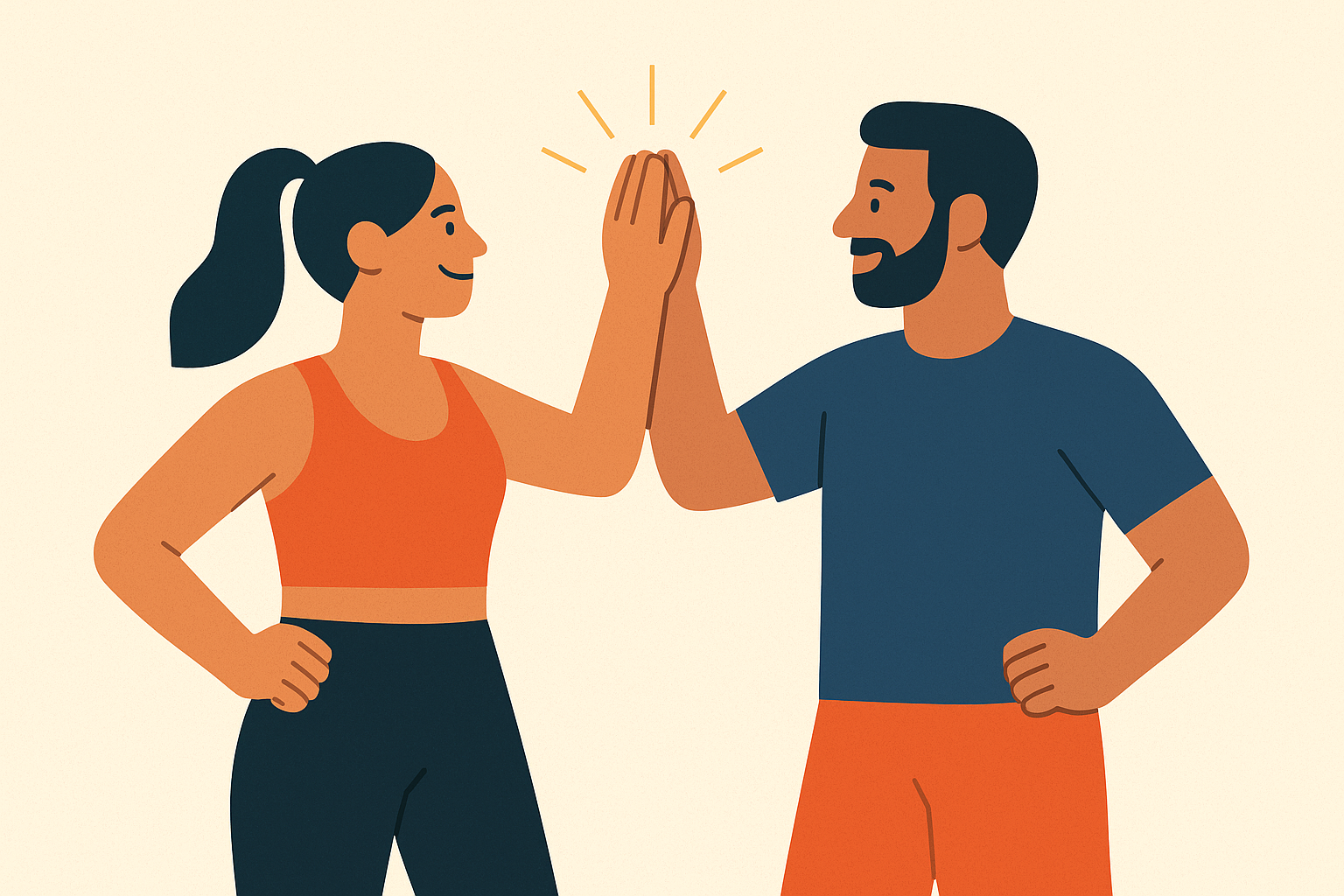
The scale can't tell you why your jeans fit better or why you didn't need a nap after climbing four flights of stairs. Non-scale victories, the wins that show up in how you move, sleep, and feel, are often the most reliable signs that fitness is working, and they get a lot easier to catch when someone else is watching for them too.
What non-scale victories actually are, and why they register as real progress
A non-scale victory is any improvement that has nothing to do with the number on your bathroom floor. Think more reps, better sleep, calmer nerves, or just not getting winded on the stairs anymore. These fall into five rough buckets worth naming on purpose, because vague progress is easy to dismiss and specific progress isn't.
There's physical performance: heavier lifts, longer runs, faster splits. There's functional life stuff: carrying groceries without setting them down halfway to the car, or moving through a workday without your back complaining. There are medical markers, the boring-sounding but genuinely important ones. A 2024 study on patients with metabolic syndrome (Borges et al., published in PubMed) found real improvements in blood glucose, blood pressure, and HDL cholesterol after exercise, even when weight loss was minimal and barely correlated with those changes at all. Then there's sleep and recovery, which forms its own feedback loop: better workouts lead to better sleep, and better sleep makes it easier to keep showing up. Last is the mental and emotional side, lower anxiety, steadier mood, and the kind of quiet confidence that doesn't show up on any chart. Add behavioral streaks to that list too, like getting back on the horse after skipping a week.
None of this is a participation trophy dressed up to make you feel better about a stalled number. A 2024 study on how people define success during weight loss found that for a lot of participants, the wins that felt most meaningful weren't quantifiable at all, they were things like freedom of movement and fuller participation in daily life. And research has consistently found that cardiorespiratory fitness, independent of BMI, is linked to lower rates of cardiovascular disease and all-cause mortality. Fit beat thin, every time.
Why NSVs are easy to miss when you're training alone
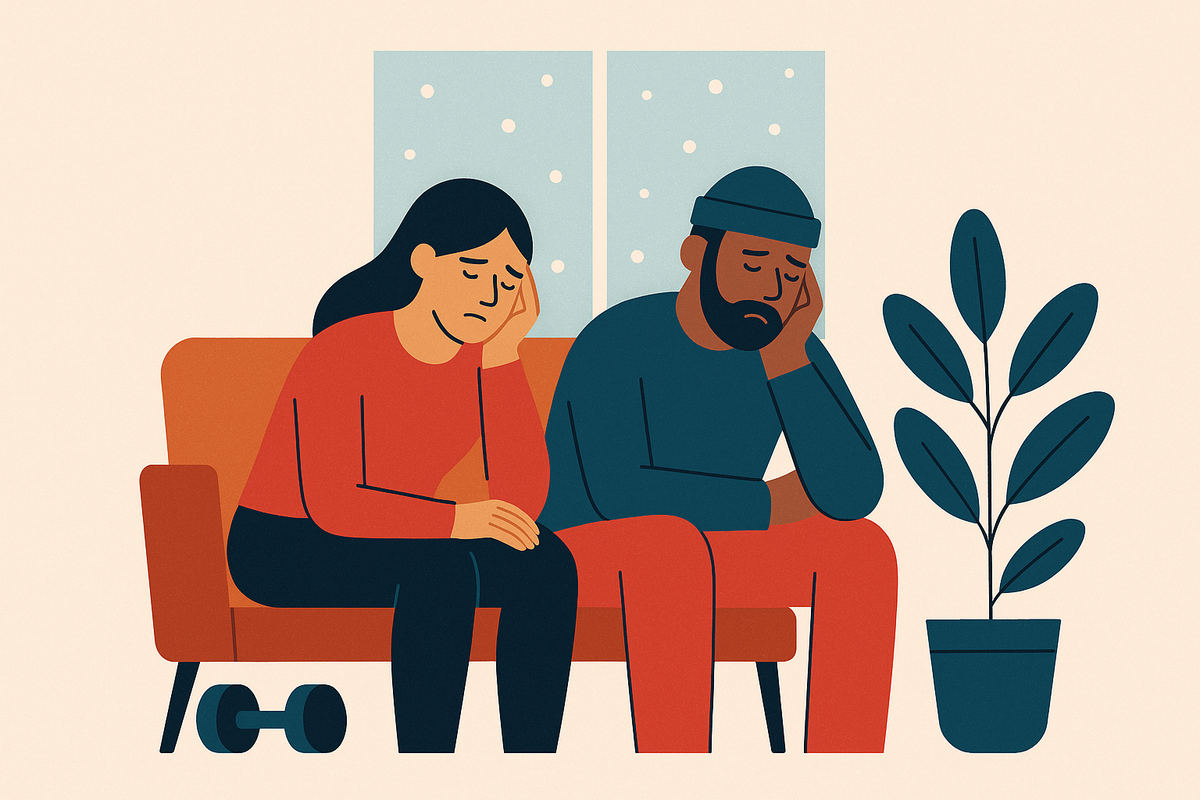
Here's the structural problem: the scale pings you with a number whether you ask for it or not, but nobody's phone buzzes to say "hey, you climbed those stairs without pausing to catch your breath." Non-scale victories require a witness. Without one, attention drifts right back to the most obvious, most familiar metric in the room, which is weight, because it's quantified and it's right there every morning.
Gradual wins are the worst offenders. Sleeping more soundly, feeling less winded, moving with more ease, these accumulate slowly enough that there's no clear before-and-after snapshot to compare against. Behavioral wins are even more invisible. Showing up again after missing three sessions is a genuine act of persistence, but there's no dashboard tracking your comeback attempts.
The motivation research on this is blunt: motivation erodes when progress feels invisible. Scale fixation manufactures that feeling constantly, flattening real physiological change into a number that refuses to move. So the real question worth sitting with is this: what does it cost someone, in consistency and motivation, to keep achieving things they never let themselves acknowledge?
How having a partner changes what gets noticed and celebrated
A partner remembers where you started. That's the whole trick, and it's more powerful than it sounds, because most people are terrible at remembering their own baseline.
Saying it out loud changes its weight, too. "You went back to the gym even after last week wrecked your schedule" lands differently than a private mental note that fades by lunchtime. Research on couples and health behavior suggests that shared accountability plays a meaningful role in sustaining healthy habits over time. Partners who treat fitness as a joint project consistently outperform people going it alone.
There's a documented mechanism behind this, called the Köhler motivation gain effect. A 2023 preregistered meta-analysis of 19 studies, covering 1,912 participants, found that performance and persistence in partnered exercise settings were significantly higher than solo conditions, with an overall effect size (g̅ppc) of 0.91. In practical terms, one piece of that research found participants exercising in a partnered, interdependent setup averaged nearly 22 minutes of aerobic effort, compared to just over 10 minutes solo. The difference wasn't equipment or programming. It was knowing someone else's effort was tied to yours.
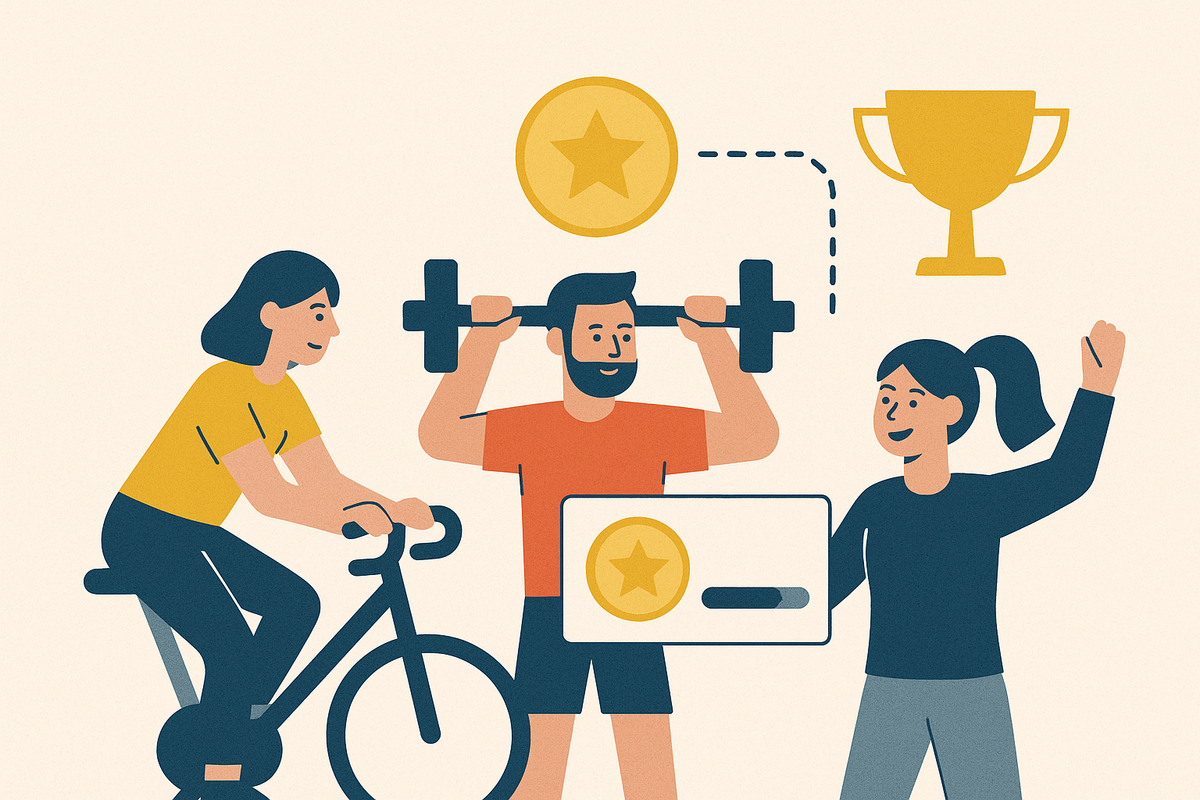
Celebration itself isn't just a nice feeling tacked onto the end of a workout. It encodes the behavior, making repetition more likely. A partner catching your win before you've noticed it yourself is doing something the scale is structurally incapable of: translating progress into human terms.
The specific wins that are richest for shared recognition
Some victories are basically built for an audience. A first 5K, a strength PR, the finish line of a challenge you both trained for, these come with a clear before-and-after that a partner watched unfold in real time.
Functional gains are smaller but just as telling. Taking the stairs without thinking twice, carrying in the bags without asking for help, someone who shares your daily life is positioned to catch these shifts long before you'd log them anywhere.
Consistency deserves its own mention, because context matters here more than almost anywhere else. A partner knows it was a brutal week at work, knows the excuses were sitting right there, ready to use. That partner is uniquely equipped to call out the significance of showing up anyway.
Sleep and energy are trickier to self-report but easy for someone else to spot. "You've seemed less drained after work lately" is the kind of observation that often lands as a surprise to the person hearing it. Medical markers are the hardest to notice day-to-day, but sharing a blood pressure reading or a doctor's note with a partner turns an abstract improvement into something worth toasting. And the emotional wins, less anxiety, a steadier temper under stress, often get spotted by a partner in ordinary conversation well before the person living it connects the dots back to exercise.
Research published in the Journal of Sport and Exercise Psychology (Feltz, Kerr, and Irwin, 2011) found that exercising alongside a more capable partner boosted the less experienced partner's persistence, the Köhler effect at work again. Part of what makes that work is the stronger partner naming progress the other person would've brushed past.
What makes partner recognition feel supportive rather than performative
Specific beats generic, every time. "You came back after skipping two days" does more work than "great job," because it proves someone was actually paying attention rather than reciting a script.
Recognition should track effort, not outcome. Celebrating that someone showed up, regardless of what the workout produced, decouples motivation from results and takes the sting out of a plateau. Missing a goal should prompt a conversation, not a verdict. A partner who treats a stumble as information rather than failure keeps the whole thing psychologically safe enough to keep trying.
Research by Corinne Reczek found that partners sync habits, both the helpful ones and the harmful ones, which means the dynamic a partner brings to these conversations shapes behavior more than most people realize. A 2023 study covering 462 couples found that higher exercise encouragement tracked with higher relationship satisfaction, regardless of gender or sexual orientation. Encouragement wasn't just good for the workout. It was good for the relationship running underneath it.
The line worth drawing clearly: a partner who witnesses progress and names it is doing something fundamentally different from a partner who monitors effort and grades it. And none of this requires shared workouts. Two people can train completely separately and still build this habit, since it only requires shared attention, not a shared gym schedule.
Simple ways to build NSV recognition into a shared routine
A five-minute weekly check-in works better than it sounds. Not a performance review, just a quick exchange where each person names one non-scale win from the week.
Shared milestones help too, training for a 5K together or picking out a trail to hike creates a natural finish line that has nothing to do with weight. A workout photo sent mid-session does something a private log never will, it invites someone else to notice, and it becomes a small, concrete record that the work actually happened.
Friendly wagers tied to consistency, not results, keep things playful. A dinner out after a month of solid streaks, a weekend trip after six months, works precisely because the reward is tied to a pattern of behavior, not a number on anyone's chart.
Saying it out loud still matters most. Research out of BYU, published in Family Relations in August 2026 and drawing on 1,693 couples, found that shared physical activity, even something as low-key as a regular walk, was linked to stronger relationship quality. The shared attention that comes with that walk reinforces the habit in ways a solo routine rarely does. A shared log, even something as unglamorous as a notes app or a kitchen whiteboard, makes slow progress visible. Scroll back through months of entries and a pattern shows up that no single week could reveal on its own.
Why making recognition a habit matters as much as the workouts themselves
Acknowledgment reinforces the behavior that earned it, which makes that behavior more likely to show up again next week. That's the whole loop, and it's a durable one.
A 2025 study of 499 couples found that more shared activity was tied to higher relationship quality and fewer negative interactions between partners. The habit of showing up for each other's progress doesn't stay confined to the gym, it bleeds into everything else two people build together.
Long-term consistency rarely comes from a flawless plan or an optimized training split. It comes from small moments of recognition stacking up over months until they're impossible to ignore. The best fitness routine isn't the one backed by the most data, it's the one both people actually keep returning to. Making wins visible, and sharing the job of noticing them, is what keeps that return trip happening.
Witnessing each other, in the end, is its own kind of training. Looking for progress, naming it out loud, and celebrating it without irony is a habit that, once it takes hold, ends up carrying everything else.