What to Say to a Partner Who Missed a Workout
One missed workout triggers shame spirals that prevent return—here's how to interrupt them.
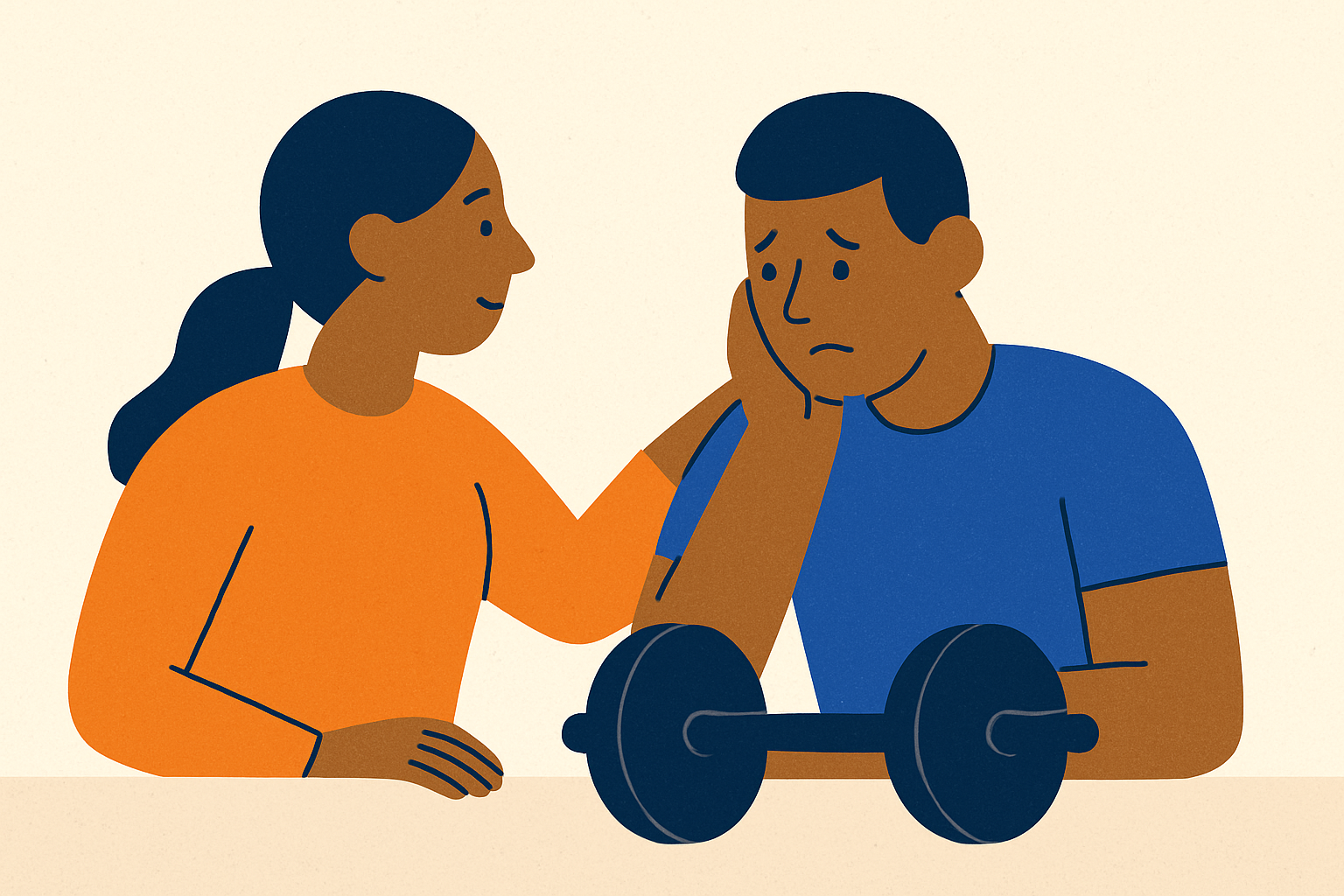
Your partner missed a workout. They know it. You know it. And the next sixty seconds of conversation will either keep that as a blip or turn it into a two-week absence. That is not an exaggeration. What you say in that moment functions less as encouragement and more as a circuit-breaker — like a fuse that either holds the current steady or lets the whole system trip. The right words stop one missed session from becoming a streak of avoidance. The wrong ones accelerate exactly that.
Here is the thing most fitness culture gets backwards: the danger of a missed workout is almost never physiological. The body is fine. The real risk is the story your partner starts telling themselves about it. There is a well-documented psychological pattern. One missed session gets interpreted as total failure. That "I've already blown it" feeling triggers avoidance of the next session. And the next. Researchers originally observed this in addiction behavior, but it maps cleanly onto exercise habits. One deviation becomes proof of who someone is, which makes returning feel pointless.
The near-universality of this response matters. Research found that roughly 78 percent of participants reported feeling less accomplished after a missed workout. This is not a personal weakness. It is a near-universal reaction. Fitness culture's emphasis on streaks and program adherence, as NASM trainer Rachel Trotta has noted, creates real anxiety in people who lean toward perfectionism. That anxiety does not push someone back to the gym. It makes them put it off.
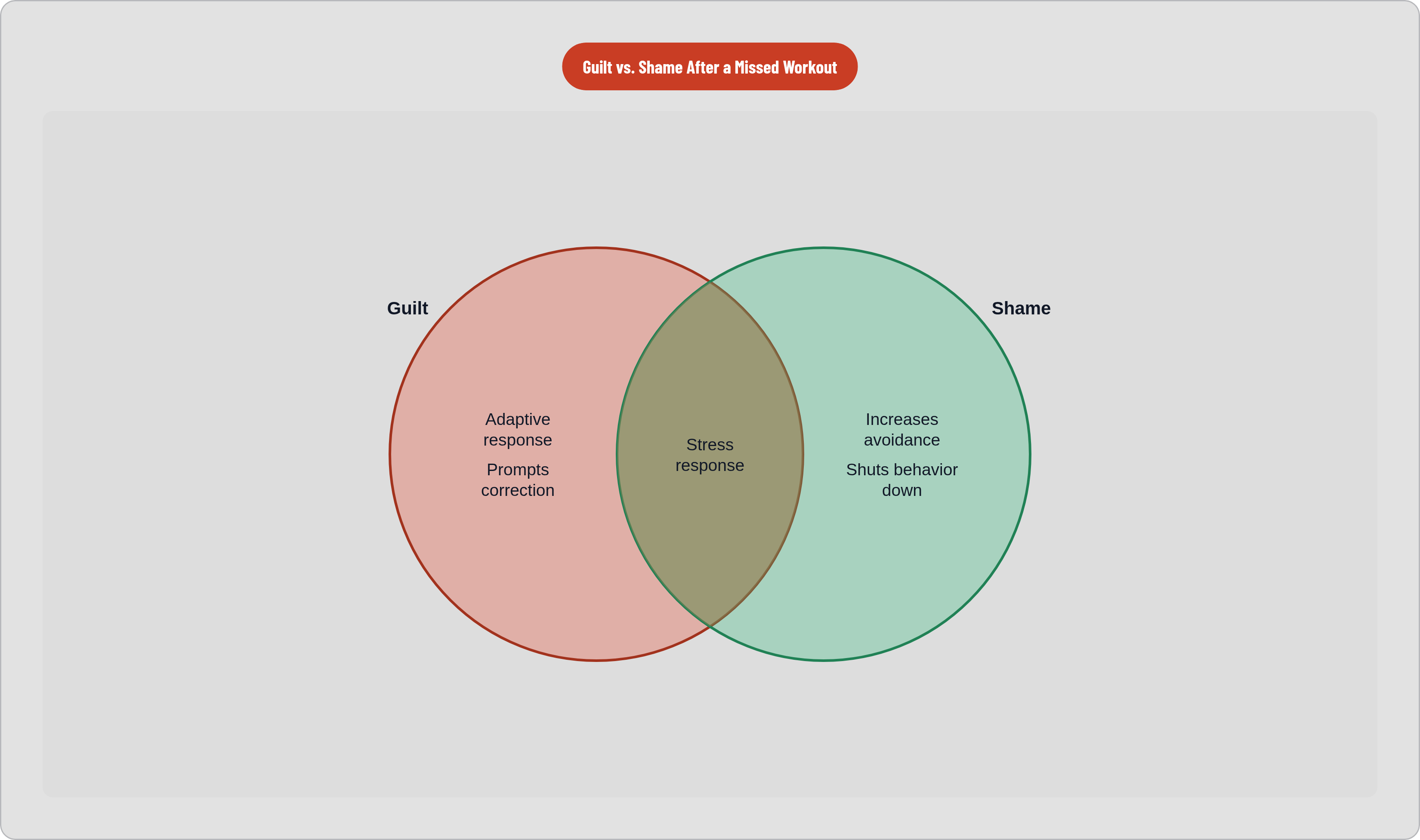
Guilt also has a physiological cost. It activates a stress response, elevating cortisol and increasing self-criticism, which over time erodes both motivation and recovery. The guilt that was supposed to be the engine for getting back on track is actively making returning harder. Your response either feeds that spiral or breaks it.
One Missed Session Does Almost Nothing to the Body (and You Can Say That with Confidence)
The first thing a partner can offer is genuine reassurance. Not hollow consolation. Actual, evidence-based confidence that the body is fine.
Fitness adaptations are more durable than guilt suggests. Muscle atrophy in trained individuals does not begin until roughly two to three weeks of complete inactivity, based on research published in the Journal of Strength and Conditioning Research in 2013. Cardiovascular fitness, measured by VO2 max, starts to decline only after around ten to fourteen days of inactivity. Even then, the drop is gradual. Around four to seven percent after two weeks of detraining, per Journal of Applied Physiology research.
For high-intensity training specifically, an unscheduled rest day often improves the next session. The nervous system gets to recover. Physiologically, missing one day can actually be a net positive.
This is not an argument for skipping workouts. It is an argument for being a credible, confident source of reassurance. When you say "your body is fine," you can mean it. That matters.
Guilt and Shame Are Not the Same Thing, and the Difference Changes Everything
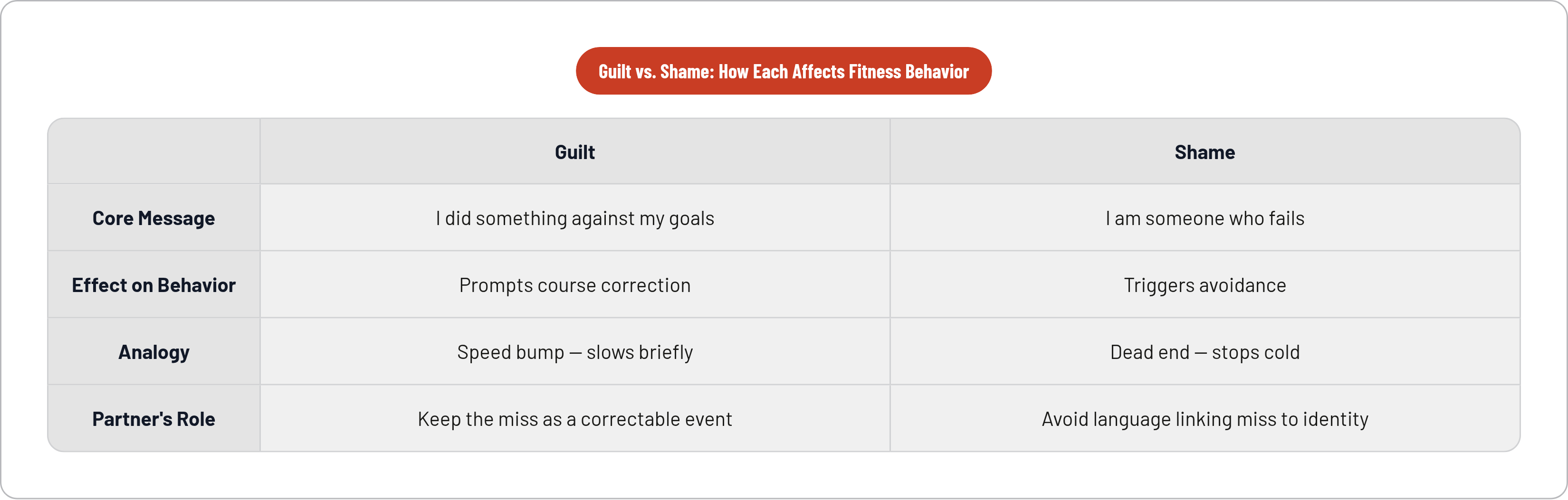
These two feelings appear similar. They are not.
- Guilt says: "I did something that conflicts with my goals." It is adaptive. It can prompt a course correction.
- Shame says: "I am someone who fails." It shuts behavior down and increases avoidance.
Think of guilt as a speed bump and shame as a dead end — one slows you down briefly, the other stops you cold.
Research shows guilt runs higher when someone perceives themselves as the direct cause of a missed session. Internal attribution, blaming yourself rather than circumstances, makes self-criticism more intense. Your partner is probably already doing this.
A partner's response can tip the balance between the two. Language that reinforces the person's identity as a failure pushes guilt into shame. Language that separates the missed session from who the person is keeps it as correctable guilt. A recoverable event, not evidence of character.
This is why the partner's words function as a circuit-breaker. The goal is not emotional support for its own sake. The goal is to keep the miss as an event, not as a verdict.
What Not to Say (A Lot of It Sounds Helpful at First)
Well-intentioned responses often land as control or criticism. They raise defensive walls. And when someone feels defensive, returning to the gym feels harder, not easier.
Outright shaming language is the obvious one. Comments about appearance or effort that link exercise to attractiveness or worth are direct threats to someone's sense of self. They do not create motivation. Relationship therapists are consistent on this.
"You always / you never" framing triggers defensiveness and argument. When someone hears a character attack, they spend their energy disproving it rather than reflecting on what they actually want. More flexible language, something like "in situations like this, I've noticed," lands as feedback rather than a verdict.
The "just make it up" suggestion backfires more than people expect. Trotta has pointed out that suggesting someone pile compensatory sessions onto their schedule can feel more demoralizing than the original miss. The mountain gets bigger, not smaller.
Pestering and nagging deserves its own mention. The line between a reminder and a nag is tone, frequency, and emotional intent. Nagging signals distrust. It does not create motivation. It creates resentment.
Lecturing about health consequences targets awareness. Awareness is almost never the actual barrier. The real barriers are emotional. Low confidence, fear of falling further behind, past bad experiences in fitness spaces. Talking about step counts or long-term health risks addresses the wrong problem entirely.
Two of the most commonly reported barriers to fitness are lack of accountability and feeling unsupported by family and friends. Unhelpful responses actively create the second barrier. You become part of the problem without meaning to.
What to Actually Say (Specific Language That Keeps the Door Open)
The goal of any response is not to motivate your partner in the moment. It is to prevent the missed session from becoming a reason not to return.
Trainer Candice Cunningham puts it plainly: encourage them that it's okay, it will happen, and they can start again tomorrow. Normalization, not minimization. There is a difference. Minimization says "it doesn't matter." Normalization says "this is a normal part of the process, and the process continues."
Some specific language that works:
- "I believe in you, you have this" is forward-facing and identity-affirming. It does not dwell on the miss.
- "I love that you're investing this time for yourself" reinforces the habit identity even when one session was skipped. You are treating them as someone who works out, not someone who failed to.
- "I" statements keep the conversation about the relationship without attacking character. The structure: "I feel because when . What I need is ." Simple. Clean. Harder to get defensive about.
Asking rather than telling is consistently more effective. Therapists suggest something like: "What are your favorite ways to get movement in? How can I support you in that?" It positions you as an ally rather than a supervisor. Big difference.
The "never miss twice" reframe is one of the most useful tools in this conversation. Offer it as a mental model, not a rule. It removes the vague guilt of "I need to get back on track" and replaces it with a specific, achievable threshold. Missing once is built into the system. Missing twice is where the pattern becomes a risk. This directly counters the abstinence violation effect by treating a single miss as expected and manageable rather than as a system failure. Think of it this way: one missed workout is a detour, two in a row is a wrong turn.
Sports psychologist research also supports offering a scaled-down alternative. A ten-minute walk, a mobility session, some breathwork. Something that means the day is not a total loss, without the pressure of a full session.
One final note: do not volunteer to be their accountability partner unless they ask. Autonomy over the response matters as much as the response itself. If they want a check-in, they will say so.
Self-Compassion Is Not Letting Someone Off the Hook. The Research Is Clear on This.
This is the part where people push back. "If I'm too understanding, they'll just keep skipping." Understandable instinct. Completely wrong.
Researcher Kristin Neff and colleagues have consistently found that people who score higher on self-compassion show more motivation to improve after failure. They are more likely to take personal responsibility for mistakes. They favor getting better over protecting their image. Self-compassion supports follow-through. It does not undermine it.
A 2018 study in the Journal of Sport and Exercise Psychology (105 adults who had experienced an exercise setback in the prior six months) found that self-compassion was associated with goal reengagement and self-determined motivation. It was negatively associated with rumination and negative affect. It predicted unique variance in reengagement beyond self-esteem alone. Helping your partner feel less shame is not soft. It is the evidence-based path back to the gym.
As one sports psychologist has noted: athletes often think guilt keeps them accountable, but self-compassion actually leads to better consistency. Speaking to someone the way you would speak to a teammate creates the emotional space to reset without mental baggage.
The theory behind this is fairly elegant. Self-compassion provides emotional safety in failure. When someone is not in threat mode, they can see what actually happened and act on it clearly. When they are in threat mode, they avoid the whole subject.
Your role is to be the external source of that emotional safety when your partner cannot generate it for themselves.
This Conversation Is Bigger Than One Missed Workout
A single response to a missed session matters most because of what it signals about the pattern around fitness in the relationship.
Self-Determination Theory tells us that people exercise more consistently when they perceive their environment as autonomy-supportive. The partner is a significant part of that environment. Autonomy-supportive responses preserve the person's sense of ownership over their own fitness. Controlling responses erode it. Over time, those controlling responses make the gym feel like an obligation being enforced rather than something they own.
There is a conversation worth having before any of this comes up. Relationship therapists suggest asking directly: "Are there things I should avoid saying that don't make you feel good in your body?" Have that conversation before friction arises. It makes the supportive response easier when it is actually needed.
The shared goal is consistency, not perfection. A partner who feels safe missing a session occasionally is more likely to maintain the habit long-term than one who feels every session is a test they will fail.
The right response to a missed workout is a small act in a larger practice. Making fitness feel like a shared space both partners want to return to, rather than an obligation either one enforces on the other. That is the actual goal. And it starts with what you say in the next sixty seconds.