Which App Wins When Couples Want One Place for Calories and Fitness Goals
Two people sharing a kitchen need separate logs from one meal, and most apps don't offer that.
Most calorie and fitness apps are built around one body, one goal, one plate. That design falls apart the moment two people share a kitchen, a grocery budget, and a set of fitness goals that don't match. This piece breaks down what a couple actually needs from a tracking setup, which named apps come closest, and how to combine tools so both partners stay consistent.
Calorie and fitness apps built for solo users and couples
Picture a fairly ordinary household. She's targeting around 1,600 calories a day in a deficit. He needs roughly half again that much just to hold steady at maintenance. They cook the same chicken and rice dinner most nights, but they eat different portions, hit different macro splits, and are working toward completely different numbers. Almost no app on the market was built to start from that shared moment, the one dinner, and split it into two accurate individual logs. Instead, most apps assume a single eater, a single plate, a single set of goals, full stop on the design brief.
The workaround couples land on is predictable. One partner logs the meal in detail. The other either copies the entry, eyeballs a rough estimate, or skips logging that meal. That shortcut introduces real inaccuracy, and it usually means one partner's data stays reliable while the other's quietly falls apart within a few weeks. Fitness tracking has the same blind spot. Step counts, workout logs, and calorie burns are tracked per person by design, with no shared layer showing a couple whether they're actually both showing up during the same week.
Streaming services figured out shared households years ago: one subscription, multiple profiles, one bill. Calorie and fitness apps haven't caught up. No major app currently offers a true one-subscription, two-profile model built for couples. Most couples pay twice for tools that only partially fit how they actually eat and train together. The result is a patchwork of workarounds, copied entries, skipped logs, and separate apps that don't talk to each other, and that patchwork is the actual starting point for most couples trying to get healthy together.
What genuine shared tracking requires from one app
Six specific capabilities fall out of the actual workflow of a couple sharing a kitchen and a gym schedule. None of these are exotic asks. They're the basic functions a single-user app was never built to handle for two people at once.
The first, and hardest, is shared-meal logging with individual portions. Two people cook one dish and need two separate, accurate logs from that same food source, not a copied entry and not a guess. This is the capability that separates apps that are merely usable by couples from apps actually designed for them, and it gets its own section below because it's a harder technical problem than it looks.
The second is recipe sharing across accounts. One partner builds or imports a recipe once; the other partner should be able to pull it up without re-entering every ingredient from scratch. Rebuilding the same lasagna recipe twice because the app doesn't talk between accounts is the kind of friction that kills a habit in its second week.
Third, goal profiles need to be fully independent. Calorie targets, macro splits, and fitness objectives on one account shouldn't bleed into or override the other's. A couple sharing a grocery list is not the same as a couple sharing a calorie target.
Fourth, speed matters more than most apps treat it. If logging a meal takes the less-enthusiastic partner more than a few seconds, that partner stops logging, and the whole shared system collapses to one person's data. Speed isn't just a design nicety here, it's the actual difference between a couple that tracks together for a month and a couple that tracks together for a day.
Fifth, cross-platform support. Mixed iPhone and Android households are common, and an app locked to one operating system simply cuts one partner out of the picture before the first meal is even logged.
Sixth, optional progress visibility. Couples need the ability to see each other's consistency, whether both people showed up this week, without necessarily seeing every calorie number the other logged. Sweatmates, a shared fitness accountability app for partners, shows what this looks like in practice: photo check-ins and weekly recaps let both people see whether the other showed up, without requiring either partner to hand over granular calorie data, giving couples visibility without surveillance that makes accountability sustainable.
The difficulty of solving shared-meal logging
Letting both partners log the same food entry sounds like a solution, but it isn't one. The real problem is splitting one shared dish into two accurate, person-specific portions without doubling the work for either partner.
Most database-driven apps solve this the hard way. Each diner searches the food database and selects individual items separately, "roast chicken thigh, 4 oz," "mashed potatoes, 1 cup," building their own log line by line. In practice, one partner does this patiently every night and the other either copies the numbers or stops bothering within a couple weeks.
The database itself makes this worse. Thirty-day dual-account testing of couples using the same crowdsourced database found that when both partners independently searched for the same food, they often landed on different entries with different calorie counts. A search for something as basic as chicken breast can return a wide range of values depending on which crowdsourced entry gets selected: two people logging the exact same meal, cooked from the exact same pan, end up with two different numbers on their plates. That's two people eating dinner together and walking away with two different versions of what they ate.
Photo AI tools improve this without fully fixing it. Both partners photographing their own plate gets each person a workable individual log, cutting down on manual search time. But each partner still has to pull out a phone, snap a photo, and submit it separately. The friction drops. The double-entry problem doesn't disappear, it just gets faster for both people to repeat.
The one approach tested that solves this at the source is a family-meal photo workflow, where one partner photographs the shared dish a single time and tags who ate which portion, with the math splitting into accurate per-person macros without a second logging step from the other partner. One photo produces two accurate logs, and that capability is rare enough across the market that its presence or absence becomes one of the clearest ways to separate apps built with couples in mind from apps that simply tolerate them.
How the leading apps perform on couples' criteria
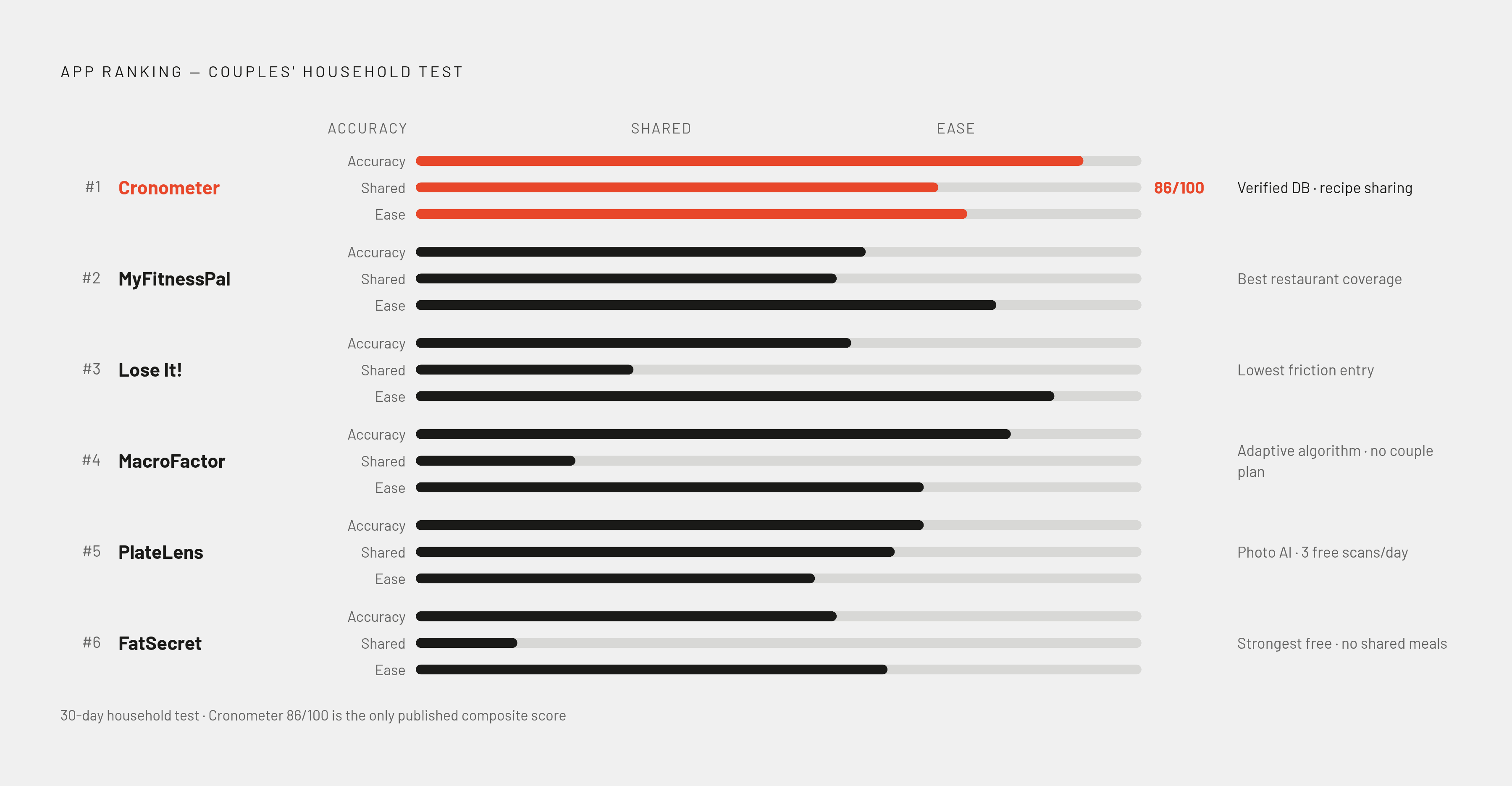
The strongest performers aren't the ones with the biggest food databases but the ones built around how couples actually share meals and workouts.
Sweatmates is built around a different premise than calorie-counting apps entirely: partners should be able to pursue fitness goals separately and still feel genuinely connected. Instead of tracking granular stats or forcing identical workout schedules, it treats showing up as the thing worth recognizing, even when you can't measure performance down to the rep, and that's a deliberate bet that simple weekly goals hold up better over time than complex tracking systems. Because partners can train at completely different times, in completely different ways (one lifts, one runs, one does yoga at 6 a.m.), and still hold a shared thread of accountability, it addresses something true about most couples: they rarely work out at the same moment, and an app that assumes otherwise is solving a problem real households don't have.
PlateLens runs on single-account AI photo logging: point the camera at a plate, get a calorie and macro estimate back in seconds. Its free tier allows 3 AI scans per day per profile, and that's enough to cover a couple's main shared meal each day without needing to upgrade. Its restaurant-chain database is smaller than MyFitnessPal's, and getting full feature parity between two partners requires both to be on Premium, which brings the two-account annual cost to double the single-account Premium price. It fits best for couples where one partner tends to be the one cooking and logging, since the photo-based workflow keeps the burden light for whoever's holding the camera.
Cronometer ranked second for couples in the same 30-day household test, scoring 86 out of 100, with accuracy considerably tighter than MyFitnessPal. That accuracy comes from its database, sourced from USDA SR Legacy, the NCCDB, and other lab-analyzed government sources, giving both partners searching the same food the same verified number. Recipe sharing across accounts is a real strength for households that batch-cook, letting one partner build a recipe once for both to use. Its free tier tracks over 92 nutrients and compounds, the deepest data of any app in this comparison. It has no photo AI and no native family-meal split feature, so both partners still log through search, and the shared-meal workflow still takes two separate steps. The learning curve is steeper than most alternatives, and the two-account annual cost runs double the single-account price. It fits data-oriented couples who both cook and both want to log carefully, prioritizing clinical-grade accuracy over convenience.
MyFitnessPal ranked third in the same test and remains a strong choice for households that eat out frequently at chain restaurants, thanks to its large restaurant database. Its core weakness for couples comes from its crowdsourced database: partners independently searching the same food often land on different entries with conflicting calorie counts, so a search for something as ordinary as a chicken breast can return a wide range of results. It fits couples who eat at chains often and want the broadest restaurant coverage, along with social diary-sharing features for added accountability.
Lose It! tested as the best entry point for couples where one or both partners are new to tracking, with a minimal learning curve that lets both people start logging the same day. Built-in partner challenges and social features lean toward motivation and streaks, not shared-meal logistics. It has no seamless shared recipe builder, so shared-meal logging still takes two separate manual steps, and database accuracy is inconsistent. The two-account annual cost runs double the single-account price. It fits couples new to tracking together who want the lowest-friction start and value social motivation over data precision.
MacroFactor stands out for its adaptive algorithm, which adjusts each person's calorie targets based on their individual metabolic response, so it directly addresses the common frustration of two partners following the same plan and getting different results. It's priced per person, with no couple or household pricing option. It fits couples where each partner is highly self-motivated and the priority is individualized, adaptive targets over a shared-tracking experience.
FatSecret is the strongest genuinely free option for couples who can't justify paying for two premium subscriptions. Its free tier includes unlimited food logging, barcode scanning, full macro breakdowns, a recipe builder, exercise logging, community features, and daily summaries, with a limited weekly review (the full version requires Premium). Both partners can run full free accounts indefinitely, removing the cost barrier that often pushes one partner off an app. It has no native shared-meal or cross-account recipe features, so both partners log independently. It fits couples where budget is the deciding factor and both people are willing to log separately.
The objection worth taking seriously: accuracy matters more than togetherness features
There's a serious, clinically grounded case for choosing the most accurate app available over the most couple-friendly one. Social features and shared logging don't matter much if the underlying numbers are wrong, and for anyone running a precise calorie deficit or tracking macros for athletic performance, a large database error rate can undercut results no matter how smoothly an app handles shared meals. The same dual-account testing that found partners landing on conflicting entries for identical foods confirms the gap between a verified database and a crowdsourced one is large enough to matter for anyone tracking seriously.
The counter runs just as strong, though. For most couples, the bigger threat to results isn't a modest error margin, it's one partner abandoning the habit entirely because the workflow takes too long or feels like a chore. Consistency compounds over weeks and months. A slightly less precise log that both partners actually keep up beats a perfectly accurate one that only survives in one partner's phone. The good news is the trade-off isn't as sharp as it first sounds: PlateLens and Cronometer, the two apps that scored highest on couples criteria in this comparison, also scored well on accuracy. MyFitnessPal is really the only app in this group that forces a genuine choice between strong social features and tighter data reliability.
Matching your household to the right combination of apps
No single app on the market currently covers calorie accuracy, fitness tracking, and relational accountability equally well. For most couples, the better move is pairing two apps deliberately rather than settling for one that compromises on everything.
The logic behind the pairing is straightforward. One app handles the calorie and nutrition side, where shared-meal logging and database accuracy do the heavy lifting. A second app handles the fitness consistency and accountability side, where showing up together, friendly wagers, and relational motivation drive results more than precise rep counts do. Sweatmates was built specifically for that second half of the equation.
For a household where one partner cooks and the other is the reluctant tracker, PlateLens's photo-based logging removes the burden from whoever isn't in the kitchen, paired with Sweatmates to keep both partners accountable for workouts even when their schedules don't overlap. For a household where both partners cook and both want precise data, Cronometer's verified database and shared recipe tools make sense on the nutrition side, again paired with Sweatmates to cover the fitness and motivation layer that a food-tracking app was never built to handle. If your household is budget-conscious, a free-tier nutrition app covers both partners without a second subscription, and Sweatmates's accountability layer adds the shared fitness thread without asking either partner to open their wallet twice.
The right combination depends on who cooks, who tracks, what the budget allows, and how much data precision actually matters to each partner's goals. What stays constant across every scenario is the same lesson the whole comparison keeps pointing back to: a tool that's slightly less perfect but genuinely used by both people will always outperform a flawless one that only one partner keeps up.