Wedding Fitness Apps That Keep Long-Distance Engaged Couples Training in Sync
Long-distance couples need accountability, not just a better workout plan.
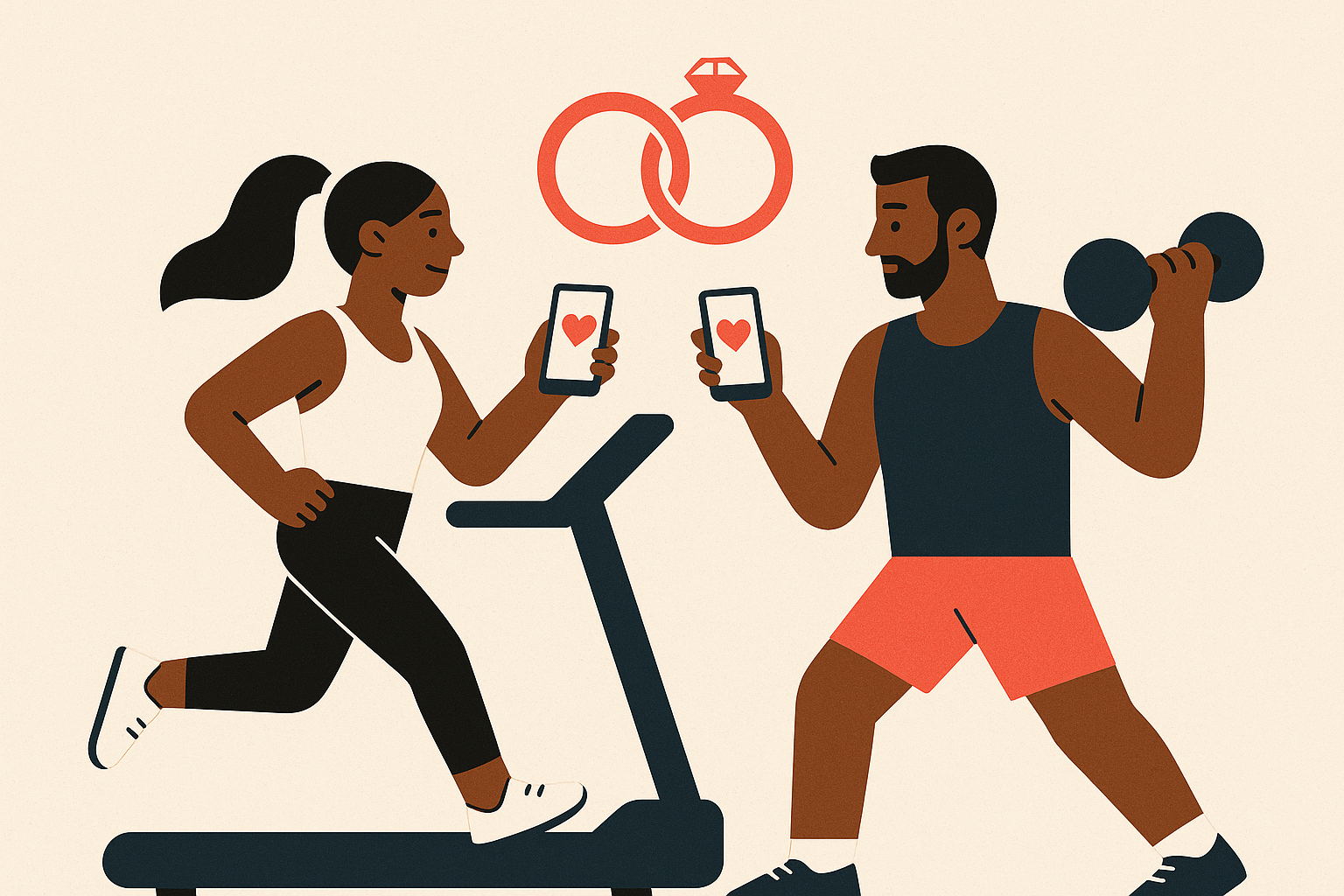
The best wedding fitness setup for a long-distance engaged couple is a stack that pairs wedding-specific programming (Bride Fit or Wedding Fit) with a couple-accountability layer built for distance (Fitness Pact: Better Together or FitWithLove's streak and badge system), plus a simple weekly habit of photo check-ins. Apps like Sweatmates, built around shared workout tracking and photo check-ins between partners, fit this model directly because mutual visibility, not matching workouts, is what keeps two people in different zip codes training toward the same date.
Long-distance engaged couples need more than a good workout plan
Picture two people, two cities, one wedding date circled on both calendars. One partner finishes a workout at 6 a.m. before work. The other won't train until 9 p.m. their time, alone, with nobody around to notice whether they showed up or skipped it. That gap, not a lack of discipline or a bad training plan, is the actual problem long-distance engaged couples run into.
When a partner isn't there in person, the small social cue that makes showing up feel worth it disappears. Nobody's lacing up shoes next to you. Nobody sees you skip leg day. The wedding countdown itself is one of the strongest behavior-change triggers available to any couple: a shared deadline loaded with emotion, tied to a date that means something. But distance cuts off the daily reinforcement that makes that trigger actually work day to day.
Accountability, not workout quality, drives fitness app adoption for this group. Couples planning a wedding from different cities don't need a better exercise library. They need a stand-in for presence, something that makes the other person's effort visible even when they can't see it with their own eyes. Wedding planning piles onto this problem rather than easing it: the stress, the schedule chaos, the travel for venue visits and dress fittings all make solo consistency harder right when motivation matters most.
The 2025-2026 wedding season has also shifted its whole framing. Couples are moving away from "shredding for the wedding" and toward what's better described as wellness over weight, managing "wedstress" and walking into married life with energy. That shift puts the emotional and relational side of training front and center, not as a nice bonus but as the main event.
What the research says about couples training together
Training with a partner does improve consistency, and the evidence backing that up is solid, though it comes with caveats that matter for any long-distance couple picking a tool. If pairs work out together, they show noticeably higher attendance and far lower dropout than people training solo. Research on married pairs in fitness programs points to spousal support, not individual willpower, as the main reason. The partner is the mechanism that keeps the habit alive, not the plan sitting behind it.
Whether couples need to be in the same room to get that adherence boost remains an open question. Most of the existing research looks at couples who train side by side in the same gym, same house, same city. There's no large-scale study yet that looks specifically at digitally connected, long-distance couples training in the months before a wedding.
A 2024 paper in Frontiers in Psychology adds a useful wrinkle. It found real differences in what motivates people depending on whether they exercise alone, in groups, or with a trainer, and those differences shift again for people in a relationship. Health-related motives appeared more strongly among people in relationships who trained with a personal trainer. Relationship status itself changes how motivation works. That's the exact reason a general-purpose fitness app built with a solo user in mind can fall short for an engaged couple: the psychology driving a single person to open an app isn't the same psychology driving two people trying to stay connected across a few hundred miles.
So an app's shared accountability features do genuine psychological work, not just decorate the programming with a social layer.
The design gap: why most wedding fitness apps serve one partner, not two
Most of the wedding fitness app market was built for one bride, or one groom, training alone. Long-distance couples get left to cobble together tools that were never built with two people, let alone two time zones, in mind.
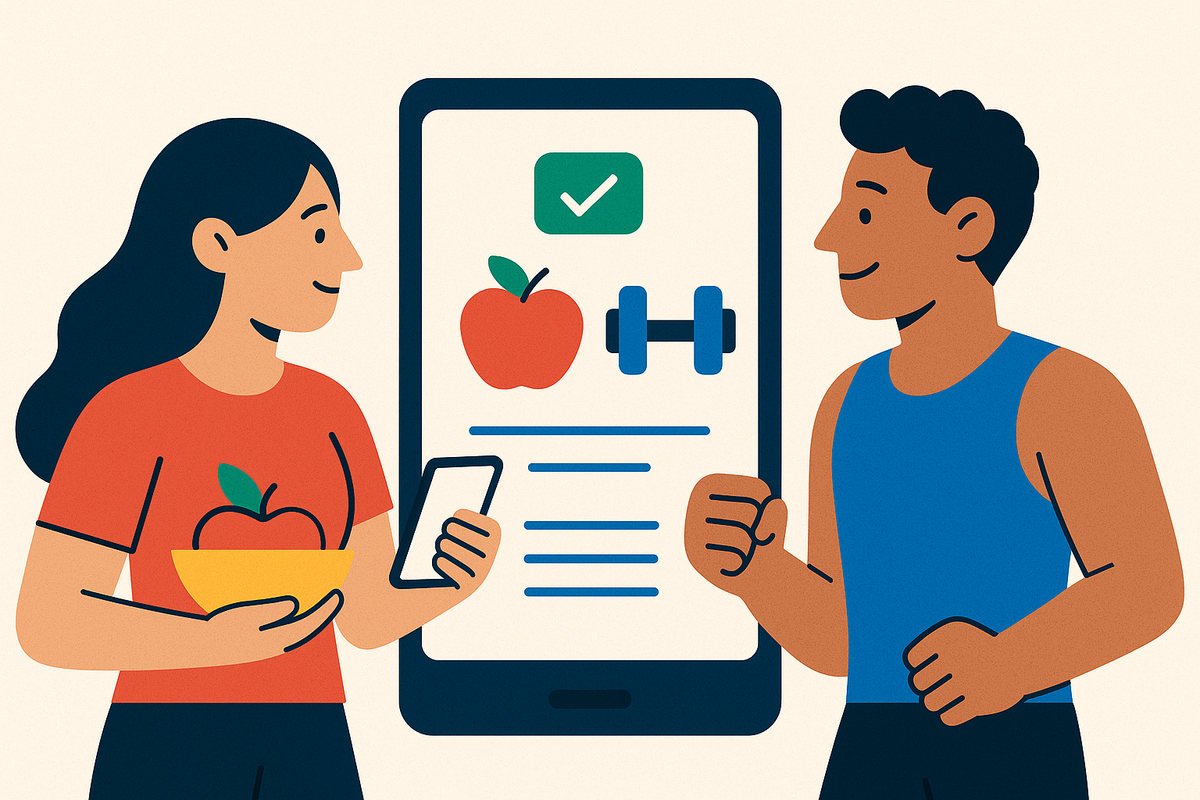
Bride-specific apps lead the category. Bride Fit gives users structured training plans, nutrition guidance, body measurement tracking, and progress photos, along with wearable sync through Apple Health, Garmin, Fitbit, MyFitnessPal, and Withings. Bridal Fitness by Anna D., led by certified trainer and former professional dancer Anna Dima, offers guided follow-along workouts in 30 minutes or less, built around strength training, Pilates, and yoga, with community challenges for extra accountability. Both are built well for what they do. Neither one has a feature that lets a partner see what the other is doing.
Groom-specific options follow a similar pattern. Wedding Fit builds a personalized training plan around the wedding date, the user's body, and their schedule, with a countdown dashboard showing weeks remaining, the current training phase, and each session loaded and ready to go. Setup takes about a minute after a short quiz, and it adapts for home or gym use depending on available equipment. According to the app, a partner can train alongside using the same plan if requested, but there's no documented feature for two-way sync, no shared dashboard, no way to see a partner's streak.
The pattern holds across every wedding app on the market: fitness is treated as an individual project that happens to share a date with someone else's individual project. The countdown is personal. The progress is personal. None of these apps were built for two partners syncing across distance, which leaves a couple-facing, wedding-countdown-aware accountability layer that treats two people's training as one shared project instead of two parallel ones.
What sync means: features that bridge distance vs. ones that just log data
For a couple planning a wedding from two different cities, "sync" doesn't mean doing the same workout at the same time. It means building mutual visibility, shared stakes, and easy ways to signal "I'm here, I showed up" across distance. Here's a breakdown of what to look for when evaluating any app for this purpose, wedding-specific or not.
Mutual visibility means each partner should be able to see what the other did, when, and how often, not to check up on them, but to feel them showing up even from far away. Shared activity feeds, workout notifications, and progress photo sharing work as digital stand-ins for presence, the equivalent of seeing a partner's gym bag by the front door even when they're not home yet. FitWithLove: Couple Workout, updated on Google Play in September 2026, builds this in directly: streak tracking, achievement badges across six categories, personal records dashboards, and cloud backup that syncs progress across devices. Both partners can see a shared history even when every workout happened separately, in different apartments, on different continents if it comes to that.
Good accountability tools give both partners a reason to show up for each other, not just for themselves. Friendly wagers, shareable completion certificates, and streak-based nudges work as lightweight commitment devices. Missing a workout starts to feel like letting someone else down, not just skipping your own goal. Fitness Pact: Better Together, rated 4.5 stars from 80 ratings on iOS, is built around exactly this idea. Partners don't need to do the same workouts, meet in person, or live in the same city. Pacts with built-in consequences or rewards carry the accountability instead. Partner Fitness Review has taken the position that friendly wagers and rewards rank among the most effective tools for turning good intentions into real action because a shared stake makes the goal feel like it belongs to both people equally.
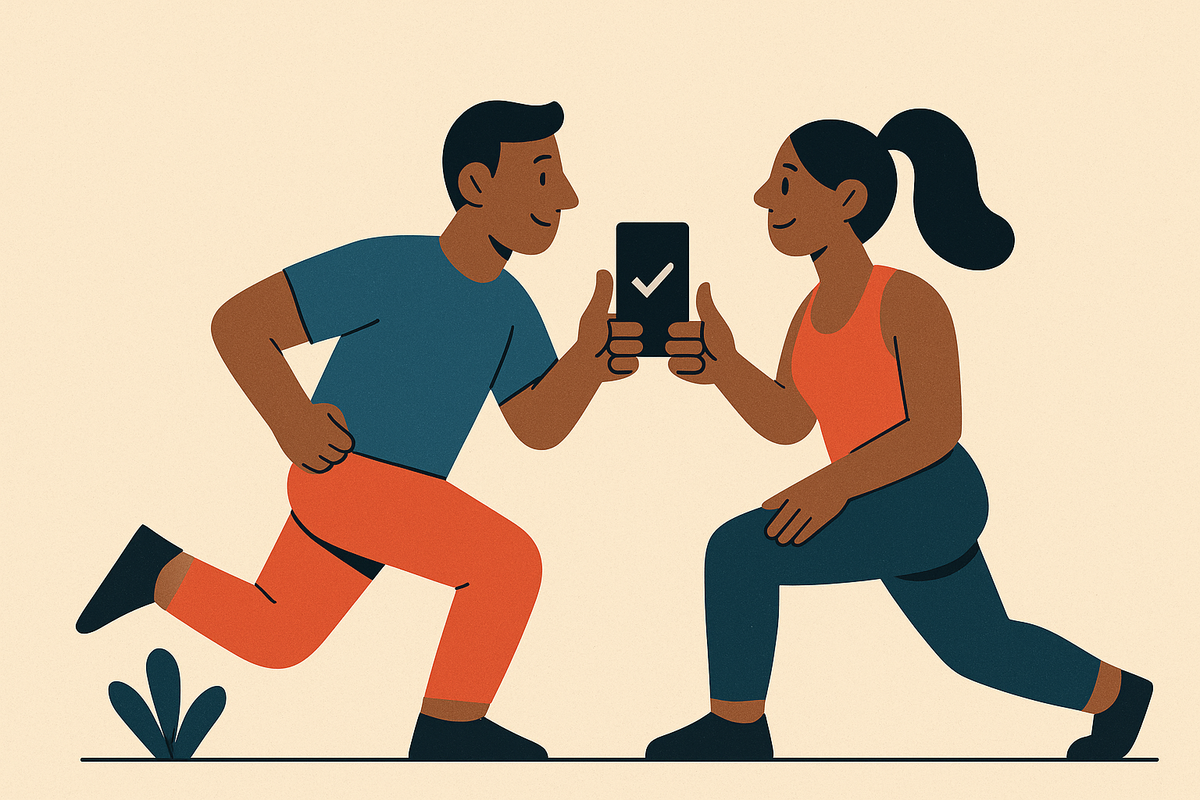
If a couple deals with time zone gaps and packed wedding-planning schedules, asynchronous signals tend to work better than live ones. A workout photo sent mid-afternoon does more emotional work than a shared chart ever could: it's proof of effort, an opening for a reply, and a small gesture of care sent across whatever distance sits between two people.
Identical programming forced onto both partners deserves real skepticism. Couples often have different fitness levels, different goals, and schedules complicated by time zones that don't line up. Locking both people into the same plan creates friction that works against consistency. The setups that hold up best give each partner a plan suited to their own level and goals, but still make shared sessions and mutual visibility possible. Accountability should sit above the programming, layered on top, not baked into a one-size-fits-all plan.
Shared accountability features carry real psychological weight in keeping couples motivated together. Apps built specifically for two-partner syncing, Sweatmates among them through its shared workout tracking and photo check-ins, become the actual test for whether a tool works, separate from how deep its workout library runs. Every feature in this list gets more valuable with a wedding date sitting on the calendar, turning a routine fitness habit into something tied to a day that matters to both people.
How the apps reviewed stack up against this framework
Measured against the three sync criteria, mutual visibility, shared stakes, and low-friction signals, these apps split into a few clear categories depending on what a long-distance couple actually needs.
Best for individual commitment with wearable integration: Bride Fit and Wedding Fit. Both offer strong solo programming tied to the wedding date, wearable sync, and progress tracking. Neither has a documented partner-facing feature. These work best as the backbone of each partner's own training, with something else layered on top to build the shared accountability piece.
Best for wedding-specific programming with community accountability: Hoola and Bridal Fitness by Anna D. Hoola's adaptive, day-by-day roadmap tied to the ceremony date, and Bridal Fitness's dress-fit milestone system, both give training a sense of purpose tied to a countdown. Both are built with women as the primary user, and neither has a partner-visibility feature. The bride-only community forums offer accountability of a kind, but seeing strangers check in isn't the same as seeing your own partner show up.
Best for couple-first accountability: FitWithLove and Fitness Pact: Better Together. FitWithLove's streak tracking, badge system, and cloud-synced progress history were built for two people from the start, so mutual visibility comes standard. Fitness Pact's explicit distance-compatibility and pact-based structure make it the clearest match for couples dealing with real geographic separation: no shared city, no shared workout required. Neither app ties itself to a wedding countdown specifically, so that framing has to come from the couple itself.
Partner Fitness Review fits this picture less as a single product and more as a philosophy, and that distinction matters. Its approach, simple weekly goals, photo check-ins, friendly wagers, and celebrating the act of showing up over any performance number, lines up closely with the low-friction signals and shared stakes that the research points to as the real engine behind partner-driven consistency.
That framing points toward a practical stack for long-distance couples: a wedding-specific solo app like Bride Fit or Wedding Fit for the actual programming, paired with a couple-accountability layer like Fitness Pact or FitWithLove's streak and badge system, topped off with a simple weekly ritual of photo check-ins. Combined, training starts to feel like one shared act instead of two separate solo projects that run on parallel tracks toward the same wedding date.
The trade-offs worth naming before choosing a setup
Every option here comes with a real trade-off, and naming them helps a couple land on a setup they'll actually stick with rather than one that just reads well on an app store listing.
Wedding-specific programming and general-purpose accountability rarely come in the same package. Dedicated bridal apps offer countdown structure and milestone tracking that general couple apps don't bother with, but none of the wedding-specific apps reviewed here build in real two-way accountability features. Couples who want both pieces, countdown structure and partner visibility, will likely end up running two apps.
Shared programming versus individual personalization is its own tension. Fitness levels and goals rarely match perfectly between two people, so forcing identical workouts onto both partners creates friction. The setups that work best give each partner their own plan but still keep a shared visibility and accountability layer running on top.
Synchronous connection (working out at the same time, on a call, matching reps) sounds appealing on paper but runs into the same wall that long-distance couples hit everywhere else: time zones, work schedules, and wedding-planning chaos make it hard to pull off reliably. Asynchronous tools, photo check-ins, streak notifications, badge unlocks, tend to hold up better over months of planning because they don't require both people to be free at the same moment.
The shift toward "wellness over weight" this wedding season is a good thing overall, but it doesn't erase the pressure some couples feel around appearance before the big day. A good app supports energy, strength, and showing up for each other. It shouldn't become one more source of "wedstress" layered onto a planning process that's already stressful enough. The right tool treats the wedding date as a reason to connect, not a deadline to dread.