Apps That Let Couples Log Calories and Workouts in One Shared Space
Shared tracking apps let couples log different goals from the same meal.
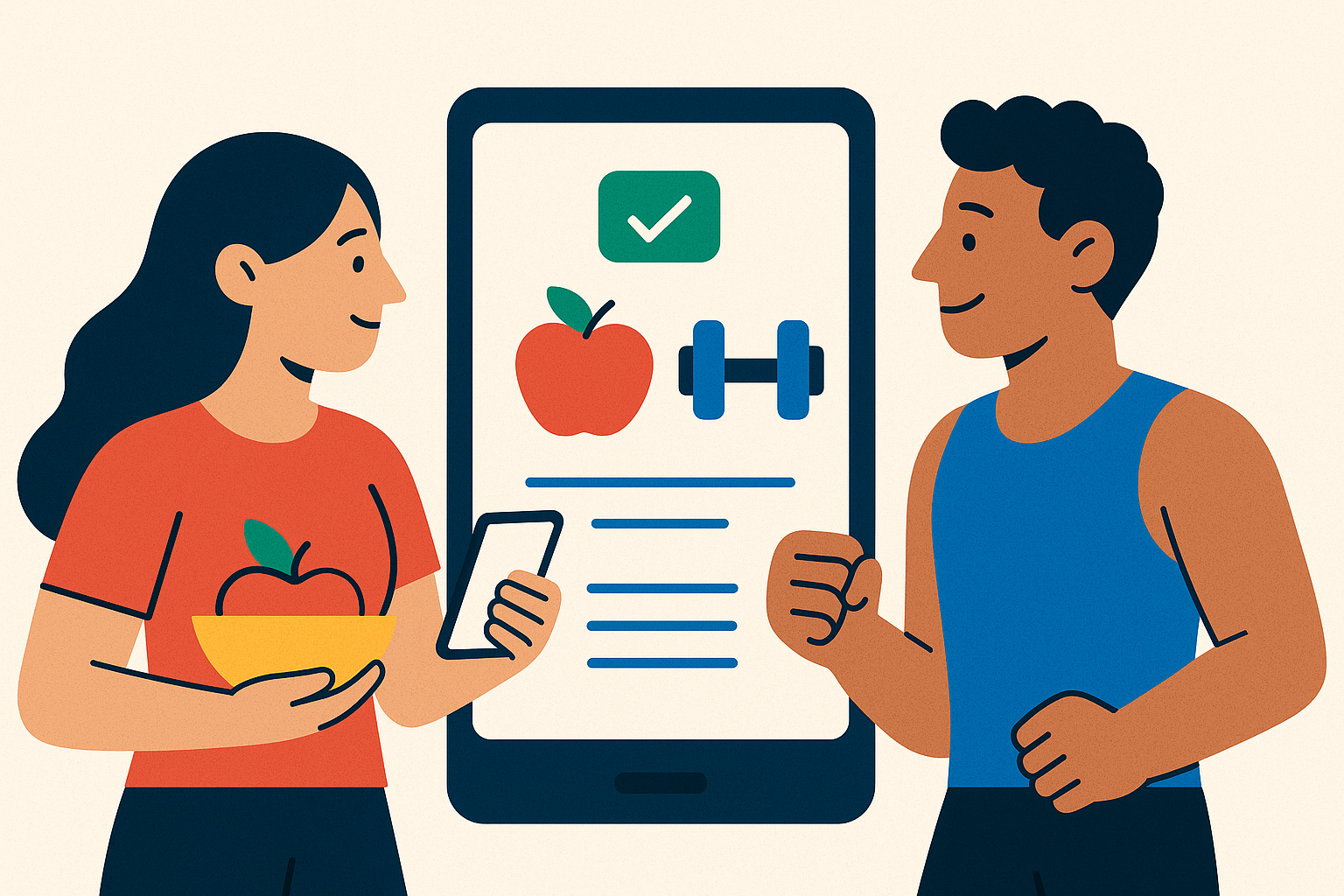
Two people eat the same lasagna, but one is counting toward a 1,600-calorie deficit while the other needs closer to 2,400 just to hold steady. Same pan, same night, two completely different numbers that need logging. Couples eating the same meals still need to track different calories: two bodies, two goals, one dinner to log.
The workout side has its own version of the same headache. One partner is easing back into training after months off, the other hasn't missed a session in weeks, and the app hands them the identical plan anyway. A program built for a consistent runner will wreck someone rebuilding a habit, and a rebuilding-friendly plan will bore the person who never stopped. Neither person wins.
So couples do what couples do when the tool doesn't fit: they improvise. Some settle for one app that quietly serves whoever set it up first. A lot fall back on texting each other "did you eat yet?" and calling that a system. None of those are actually a shared space. They're workarounds dressed up as solutions, and treating them as a real system costs couples the accountability they're trying to build.
A|The research case for shared tracking
The payoff for solving this isn't hypothetical. A 1995 study in the Journal of Sports Medicine and Physical Fitness found couples who exercised together stuck with it far longer than solo exercisers in the same program, and the gap wasn't a rounding error. A study in the Journal of Social and Personal Relationships found that on days couples worked out together, both partners reported better mood and higher relationship satisfaction. On the food side, research from the Journal of the Academy of Nutrition and Dietetics found couples tracking nutrition together reach their goals at meaningfully higher rates than people tracking solo.
Workout tracking has a parallel problem: one partner may be returning from a long break while the other runs three times a week, and identical programs fail both people. Shared commitment raises the social cost of skipping a workout without anyone saying a word about it. Working out with a stronger partner tends to pull more effort out of the weaker one, a pattern researchers call the Kohler effect. And once "we train together" becomes part of how a couple defines the relationship, skipping a session starts to feel like breaking a shared routine instead of just having an off day.
The real distinction between genuine shared tracking and bolted-on social features
A lot of "couples apps" quietly fall apart because letting your partner follow your stats is not the same thing as building an app around two people sharing one space. A shared space gives both people goals and progress inside one system, unlike bolted-on visibility where each person still logs separately.
Bolted-on social features leave the core app exactly as solo as it always was. Partners can peek at each other's numbers or fire off a thumbs-up, but each person still logs against their own separate target, in their own separate lane.
Genuine shared tracking is built differently from the ground up. Two profiles exist inside one shared account or linked space, each with its own goals. A single meal splits cleanly into per-person portions. Progress shows up side by side without forcing both people onto the same target. A feature comparison table from FitCraft (2026) names adaptive workouts for different fitness levels, shared progress tracking, and interactive guidance as the markers that separate genuinely couple-friendly apps from those with social features grafted on.
Apps that handle both calories and workouts in a shared space
No single app nails every part of this. Some handle workouts well and ignore food entirely, some handle food well and skip workouts, and pricing tells its own story about who each app was actually built for.
FitWithLove: Couple Workout, updated on Google Play as of June 1, 2026, comes closest to the unified space this whole argument is chasing. It runs structured workout plans built for two people, guided partner exercises, per-person calorie tracking after each session, streak tracking, and detailed workout history, all inside an interface designed around couples rather than individuals. It layers on more than 30 achievement badges across six categories, things like "Week Warrior" and a 60-day "Iron Will" streak badge, plus completion certificates, cloud backup, and support for eight languages. It's a free download with in-app purchases, and a one-time Pro purchase removes ads and unlocks extra workout plans. Its calorie tracking only covers calories burned during a session, not food intake, so it doesn't track what either partner eats at a shared dinner. Its Google Play listing does disclose data collection through AdMob, Google Analytics for Firebase, and Firebase Crashlytics, standard territory for a free app with ads.
PlateLens takes the opposite approach and splits a shared meal into per-person portions. A 2026 review from bestcalorieapps.com named it the top pick for couples and families after a month of testing dual accounts in real households. Its family-meal photo logging splits one shared dish into clean per-profile portions, the same dinner-table problem section one describes. Premium runs on an annual plan and was flagged in that review as the cheapest of the high-accuracy options tested. On privacy, PlateLens's own 2026 comparison against the Mozilla Privacy Not Included framework claims no third-party ad trackers, no sale of personal data, encrypted storage, and no AI training on user food photos. It doesn't offer structured workout plans built for two, so couples chasing joint fitness accountability will need to look elsewhere for that half.
MyFitnessPal, now paired with Cal AI as of March 2026, was described at the time of that acquisition as the leading global nutrition and food tracking app. The Cal AI deal followed an earlier acquisition of meal-planning app Intent in February 2025 and a ChatGPT Health integration added in January 2026, so the platform has been stacking features fast. Photo-based logging lowers the friction for couples who cook together: one partner snaps the plate, and each person logs their own portion against their own number. It still runs as separate individual accounts with friend connections layered on top. It also carries a 2018 breach that affected roughly 150 million accounts, a bigger risk when two people's data sits behind one login instead of one.
Nutrola doesn't have the feature detail the others do, but its pricing tells a story on its own. A couple pays 5 euros a month total, undercutting what most single-user premium subscriptions cost on competing apps. Charging for two people at a price below what one person usually pays elsewhere is a small but real signal that the app was built with couples in mind from the start, not retrofitted for them later.
For couples whose accountability runs through activity and friendly competition rather than food logging, social-fitness platforms built around following, kudos, and club challenges suit runners and cyclists who like a bit of rivalry. That style of app typically runs a free tier with a paid premium tier priced monthly or annually, but it skips food logging entirely and works better as an accountability layer sitting alongside a real calorie tracker than as the whole solution.
Where photo-AI logging is heading for shared meals
MyFitnessPal buying Cal AI signals that photo-based calorie estimation is becoming the baseline everyone's expected to offer, a shift that matters most for couples specifically.
Before photo-AI existed, splitting a shared meal meant manual guesswork. One person logs the dish, eyeballs their portion, the other eyeballs theirs, and the errors stack on top of each other by the time both plates are logged. Photo-AI cuts that step down to size: snap one photo of the meal, and each partner logs their own share against their own target, no guessing required.
Cal AI hit millions of downloads in under two years before MyFitnessPal bought it, so the demand for this kind of frictionless logging is already proven. Multi-modal input, meaning photo, voice, and text all feeding into the same log, is fast becoming a basic expectation across health apps generally, and couples stand to gain more from it than solo users do, since it lightens the logging load that usually falls on whoever cooked dinner. PlateLens's per-profile meal splitting already shows what this looks like in practice, applying the same idea directly to splitting portions of a shared dinner between partners.
Why shared visibility can backfire
Full visibility into a partner's numbers sounds like support. Sometimes it functions more like a scoreboard nobody asked to be measured against, especially when one partner is cruising and the other is starting over after a rough stretch.
That mismatch is the actual failure mode. One partner logs a clean streak day after day; the other is three weeks back into training after an injury or a long break, and now that gap sits right there on a shared dashboard for both of them to see. For the partner playing catch-up, that visible gap can stop feeling like encouragement and start feeling like proof they're falling short.
A 2025 systematic review of diet and fitness apps published in Body Image found real evidence that these tools can produce guilt and pressure to hit targets, effects that get sharper once one partner's numbers become the yardstick the other feels measured against. Defaulting to two solo apps plus a weekly verbal check-in scales better for couples in asymmetric periods, survives bad weeks, and does not turn a missed day into a relationship issue.
What matters is how much visibility this specific relationship can actually handle well. Some couples want the full shared dashboard and thrive on it. Others do better training apart and comparing notes over dinner. The tool should bend to fit that, not the other way around.
Privacy considerations when two people's health data is at stake
Sharing a fitness space means handing over two people's worth of sensitive information at once: weight, body measurements, eating patterns, sometimes menstrual cycle data, all sitting inside one app's data practices instead of one person's.
A lot of the most-downloaded calorie trackers pay their bills through advertising, and that business model means user behavior data flows out to marketing networks as a matter of course. A Washington Post investigation found several major health and fitness apps sharing dietary data with advertisers and data brokers, often without spelling that out clearly in their privacy policies. And history is part of the due-diligence checklist here too: MyFitnessPal's 2018 breach affected roughly 150 million accounts, a detail any couple weighing that app for shared use should factor in.
Checking an app's privacy before handing over two people's health data means looking for no third-party ad trackers, no sale of personal data to brokers, encrypted storage, and photos not used for AI training. PlateLens's own published Mozilla-style privacy review claims it leads on these criteria among mainstream calorie trackers in 2026, and FitWithLove's Google Play listing states no data is collected or shared with third parties. That's a meaningfully different starting point than an app funded primarily by ad networks, and it's the kind of detail that's easy to skip past when picking an app based on features alone.
Choosing based on what your relationship needs
None of this resolves into one clean winner, because the right app depends on which problem actually dominates for a given couple: shared meal logging, shared workout accountability, or genuinely both at once. No single app on the market currently handles all three well, so the honest move is picking based on which gap actually costs a couple the most right now.
If splitting shared meals and tracking nutrition accurately is the priority, PlateLens covers that ground with per-portion photo splitting and the strongest privacy claims among the options reviewed here.
If workout accountability matters more than food logging, FitWithLove offers guided partner workouts and per-person tracking, with its Couple Workout feature updated on Google Play. Couples whose bond runs on friendly competition around runs or rides might get more out of a social-accountability platform layered next to a separate calorie tracker than from any single all-in-one app.
And for couples going through an uneven stretch, where one partner is consistent and the other is rebuilding a habit from scratch, two separate apps and an honest weekly conversation can outperform any shared dashboard on the market. The dashboard was never the point. Getting both people to a goal they actually care about was, and sometimes the plainest tool does that better than the fanciest one.
Sources
- FitWithLove: Couple Workout - Apps on Google Play
- Best Fitness Apps for Couples in 2026 | FitCraft
- The Best Calorie Tracking Apps for Couples and Families in 2026 | BestCalorieApps
- 7 Best Calorie Trackers for Couples in 2026 (Shared Meals, Individual Goals)
- Cal AI Review 2026: Photo Food Logging Accuracy, Pricing & Best Alternatives | Vora Blog
- The Dark Side of Fitness Apps: Study Says They Can Do More Harm Than Good - Newsweek