How a Wedding Fitness App Keeps Both Partners Motivated Through the Engagement Period
Couples who work out together stick with fitness plans far longer than solo exercisers.
Getting engaged does something to people's workout habits that almost nothing else does. It hands them a real deadline, a public commitment, and a reason to move that feels personal instead of abstract, and engaged people set physical activity goals at a higher rate than the general population. That's a genuine opening. The problem is what happens next.
Sounds reasonable on paper. In practice, a date that far away doesn't feel like a deadline, it feels like breathing room, and breathing room is where good intentions go to nap. Then the calendar folds in on itself and the window that once felt generous is suddenly too short to do anything safely.
Something's shifted in how couples think about the goal itself, too. The old "shred for the wedding" mentality is losing ground to a wellness-first approach heading into 2026, one built around energy, confidence, and managing stress rather than chasing a number on a scale. That's a healthier frame, honestly, and it changes what a fitness plan for engaged couples should even be optimizing for. Wedding planning is stressful in ways that spill over into the relationship itself, and a fitness routine that holds up under that stress is doing more than shaping bodies for photos. It's managing what some people call "wedstress" before it manages them.
Why most fitness apps fail engaged couples before they begin
Almost every fitness app on the market is built for one person, and it shows the moment two people with different bodies, different fitness levels, and different goals try to share it.
Picture the usual setup. In practice, one partner is stronger or more experienced, so workouts feel too easy for one and too hard for the other, and within roughly two weeks, someone is frustrated, someone feels guilty, and the plan quietly dies. Someone feels guilty for holding the other back. Someone feels frustrated for having to slow down. The plan doesn't collapse in some dramatic blowout, it just quietly stops happening, the way a lot of good intentions do.
That's not a willpower problem. The couple wanted the tool to work, but it wasn't built to hold two people at once.
Goals diverge by gender in ways that make this worse. Male clients typically want to lose the spare tire, dial down stress, build upper-body muscle, and lean out, according to certified trainer Christian Pitkin, formerly of Diakadi Fitness Performance in San Francisco. Grooms tend to chase upper-body strength while brides lean toward core and lower-body stability, yet the fitness content aimed at weddings is still overwhelmingly marketed to brides, leaving grooms to fend for themselves and couples without any shared framework. An app built from day one for two primary users, not one user and a plus-one, closes that gap by design rather than by afterthought.
What the research shows about couples who exercise together
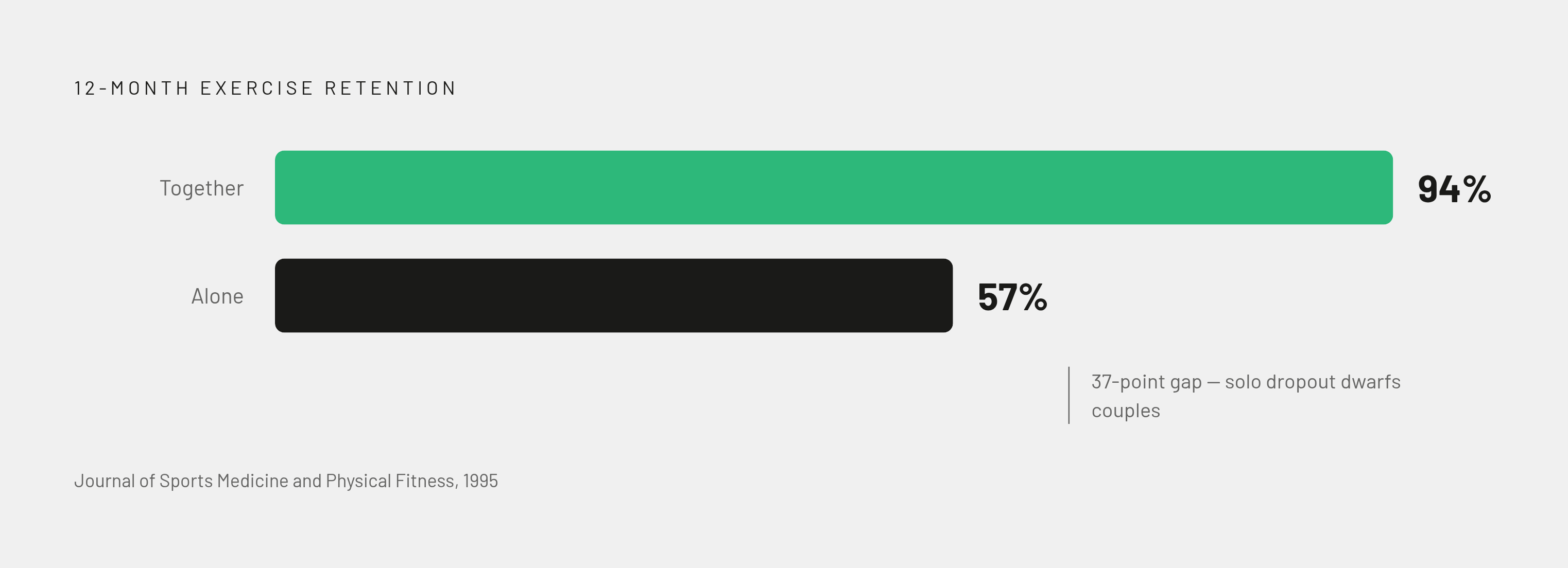
The data on this is not subtle. A 1995 study in the Journal of Sports Medicine and Physical Fitness tracked married adults enrolled in a fitness program and found couples who worked out together had a 94% retention rate over 12 months, compared with 57% for people who joined alone. That's not a small gap. Solo exercisers dropped out at a rate that dwarfs what couples experienced, and the reasons behind that gap map onto three separate mechanisms.
The first is accountability that doesn't feel like pressure. When a partner expects to show up at the same time, skipping the workout isn't a private failure, it's letting someone down, and that pull operates differently than guilt. The second is something researchers call the Köhler effect: people paired with a more capable partner ramp up their own effort without ever consciously deciding to, and the Journal of Sport and Exercise Psychology confirmed this holds specifically for gym partners. The third is identity. Once "we work out together" becomes part of how a couple sees themselves, skipping a session isn't just missing exercise, it's breaking something bigger, and that shift moves exercise from a chore into a default.
The mood data backs this up too. A 2021 study in the Journal of Social and Personal Relationships followed 95 adults in relationships over 14 days and found that on days couples exercised together, they reported better mood during the workout, better mood for the rest of the day, and higher relationship satisfaction. A separate 2020 study cited in the Journal of Behavioural Medicine found couples who train together release endorphins in sync, which strengthens both bonding and motivation at the same time. The engagement period is already a stretch of shared identity-building, and a fitness routine started inside that window has a real shot at outlasting the wedding itself.
How a wedding fitness app translates the science into a shared daily structure
Knowing the mechanisms is one thing. Building software that actually uses them is another, and this is where a handful of specific features do the heavy lifting.
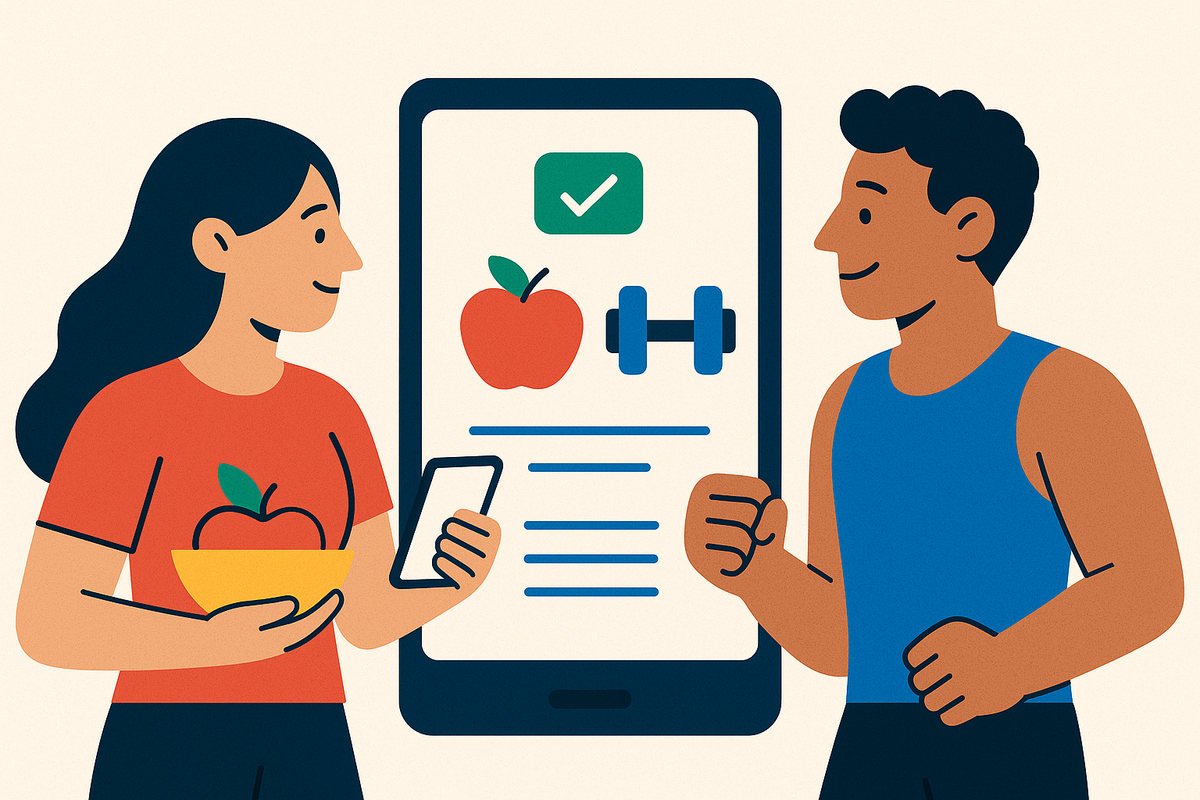
Start with the countdown itself. WeddingFit.app, built for grooms, puts a countdown front and center on the home screen: weeks remaining, current training phase, and that day's session ready to go with no setup required. That single design choice solves the "plenty of time" trap from earlier, because the date is never abstract, it's sitting on the screen every time the app opens.
Individualized programs inside a shared framework solve the mismatch between partners. Each partner gets sets, reps, and difficulty calibrated to where they actually are, so two people can train side by side, sometimes on the exact same movement, without one being bored stiff and the other gasping for air. Variety across yoga, strength, cardio, and mobility keeps both partners finding sessions they actually want to do, not just tolerate.
Mutual visibility matters more than it sounds like it should. Seeing a partner's workout logged creates a pull to log your own, even on days you trained in different rooms or different cities. Location flexibility keeps that visibility alive through the actual chaos of engagement life: sessions that need only a two-by-two-meter patch of floor and a phone, a feature Hoola highlights, survive hotel rooms, in-law visits, and the nonstop travel that wedding planning tends to generate.
Then there's the issue of intensity. Apps like Peloton IQ and Runna, both trending through 2025 and 2026, adjust workout intensity based on daily stress and sleep data, which fits an engagement almost perfectly, since a fixed plan will keep smashing into planning chaos no matter how well it's written. And in-app trainer access, a feature Hoola also offers, means a partner with shaky form gets a correction before it becomes an injury, instead of losing a week to something that could've been fixed with one message.
How the training structure itself should be built across the engagement timeline
A good pre-wedding fitness plan doesn't ask for hours in the gym every day, and it shouldn't. Pushing too hard too early leaves both partners sore, burned out, or hurt right when they need energy the most, which defeats the entire point.
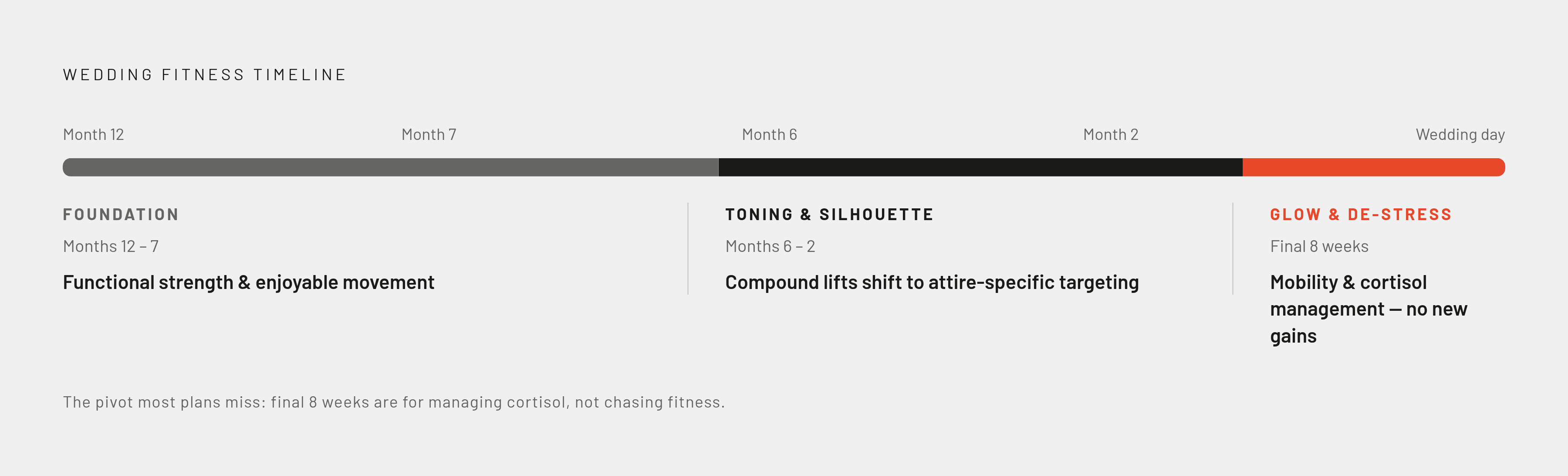
OurVows lays out a three-phase structure. Functional strength, activities both people genuinely enjoy, and if neither one is a gym person, something like dance lessons that double as cardio works just as well. Nobody's chasing a six-pack in month twelve.
The Strength Phase is where the most significant body composition changes happen, as compound movements build a metabolic engine, and experts recommend a minimum of six months to see sustainable changes in muscle tone. This phase asks more of both partners, physically and in terms of consistency, but it's also where the payoff starts becoming visible, which helps keep motivation from sagging in the middle stretch.
Months four through two shift into the Toning and Silhouette Phase. Once the dress or suit is chosen, workouts start targeting the specific garment, and maintaining results here matters for a reason beyond vanity: nobody wants to pay for alterations twice because they changed shape between fitting and wedding day. Attire drives some of the specifics: strapless and backless styles call for posterior chain work through the shoulders and upper back, mermaid silhouettes lean on core and lower-body definition, ballgowns need functional strength just to carry the fabric all day, and slim-fit suits come down to chest, shoulders, and posture.
The final eight weeks are the Glow and De-stress Phase, and the whole tone changes. Mobility, Pilates, and steady-state cardio take over, because at this point managing cortisol outweighs squeezing out new fitness gains. Training for a competition means building fitness; tapering before it means managing cortisol instead.
How gamification keeps both partners showing up across a year-long timeline
A 2022 study in the Journal of Medical Internet Research found gamified fitness programs produced a small-to-medium boost in physical activity compared with non-gamified versions, with an effect size of 0.42. The effect exists, but it's not a miracle switch. Gamification helps, it doesn't rescue a bad program.
What it actually does is make progress visible in the short term, when the real payoff (the wedding day, the body composition change, the shared habit) is still weeks or months out. Over a year-long engagement, that short-term feedback loop isn't a nice-to-have, it's structurally necessary, because nobody sustains motivation on a distant abstract goal alone.
Streaks and progression work early on, but the design has to be careful. A streak built on loss aversion, where missing one day feels like a small disaster, adds anxiety to a period that's already stressful enough. A missed workout during wedding planning should prompt a shrug and a reset. Co-op mechanics beat head-to-head competition for exactly the reason the earlier mismatch between partners exists: when one partner is meaningfully more experienced, a shared challenge that both people are rowing toward together works, while a leaderboard that ranks them against each other just reminds the less experienced partner how far behind they are. Light-stakes wagers, something as simple as "miss the weekly goal, you're buying dinner," turn consistency into a game instead of a report card. XP, collectibles, and milestone badges that both partners earn together push the same idea: progress as something shared, not something scored.
None of this is universally good design, though. Leaderboards motivate some people and demoralize anyone who feels permanently stuck at the bottom, which is a real risk for a couple with a strength gap. And systems built mainly on fear, of losing a streak, dropping a rank, losing a badge, tend to fall apart the moment that fear stops feeling like a game and starts feeling like a threat. Habitica offers a useful contrast here: its RPG structure lets parties raid bosses together with friends, building real accountability through a genuinely cooperative frame rather than a competitive one.
The apps available now for engaged couples
WeddingFit.app is groom-specific, and it's built entirely around the countdown. The home screen shows weeks remaining, current phase, and the day's session ready to start, no digging required. Onboarding is a 24-question consultation that takes about a minute, and the plan is ready the second it's done. Training runs four sessions a week, evolving as the user progresses, with home and gym versions of every workout plus swaps for travel days or limited equipment. The focus leans toward suit fit: shoulders, chest, posture. It's built for the groom, though the training itself works for anyone, and partner use is available on request.
Hoola takes the opposite angle, focused on brides, according to WeddingPlanner.co.uk. At first launch it asks for the ceremony date, current fitness level, and available equipment, then builds a day-by-day roadmap that adjusts as the user gets stronger. Workouts arrive as short, bite-size videos across four pillars: Strength, Cardio, Flexibility, and Mindfulness. In-app chat connects to a trainer within minutes if form starts slipping, and daily bride-only challenges add a layer of accountability. It needs only a two-by-two-meter space and a phone, so it travels well through hotel rooms and family visits. It's on iOS, offers a seven-day free trial before a monthly subscription kicks in (cancel anytime), and is 4.7 stars across 98 reviews, with users praising the variety and the clarity of the cueing.
Neither app solves every piece of the puzzle on its own, which is exactly the point this whole piece has been building toward. A groom-focused countdown app and a bride-focused video library both nail specific pieces, the date anchoring, the bite-size accessibility, but the couples who get the most out of the science described earlier are the ones using shared visibility, calibrated difficulty for both partners, and co-op accountability as the backbone of the plan, not an afterthought bolted onto an individual app. That's the gap a genuinely shared, two-primary-user approach is built to close, and it should be treated as the standard the rest of the field gets measured against.
Sources
- 7 Picks for the Best Workout App for Wedding Prep & Other Bridal Fitness Apps - WeddingPlanner.co.uk
- Best Fitness Apps for Couples in 2026 | FitCraft
- The Ultimate 2025-2026 Wedding Fitness Plan: A Holistic Approach to Your Big Day | OurVows Blog | OurVows
- Wedding Fit — The fitness & training programme for grooms
- Engaged couples more likely to commit to physical activity goals
- Better together: The impact of exercising with a romantic partner - Kyrsten Sackett-Fox, Judith Gere, John A. Updegraff, 2021
- Couple Goals: Pre-Wedding Fitness Plan for Brides and Grooms | FITPASS