The Best Fitness Accountability Apps for Couples Who Have Completely Different Workout Styles
These apps let couples stay accountable while pursuing completely different workouts.
The Best Fitness Accountability Apps for Couples Who Have Completely Different Workout Styles.
Why different workout styles sink shared fitness plans
The pattern repeats so often you could set a watch by it. One partner is stronger or more experienced, the workouts feel too easy for one and too hard for the other, and within two weeks somebody's annoyed and somebody else feels guilty about it. Then the whole plan dies quietly, without anyone officially calling it.
That's not a willpower problem. It's a design problem, and the app is usually the one holding the smoking gun.
Most fitness apps get built for one person using one device doing one kind of workout. The "add a partner" button gets bolted on afterward, like a cupholder welded onto a motorcycle. Technically there, functionally awkward. The social features exist (a leaderboard here, a nudge notification there), but the actual workout experience stays completely separate because the app was never built to be anything else.
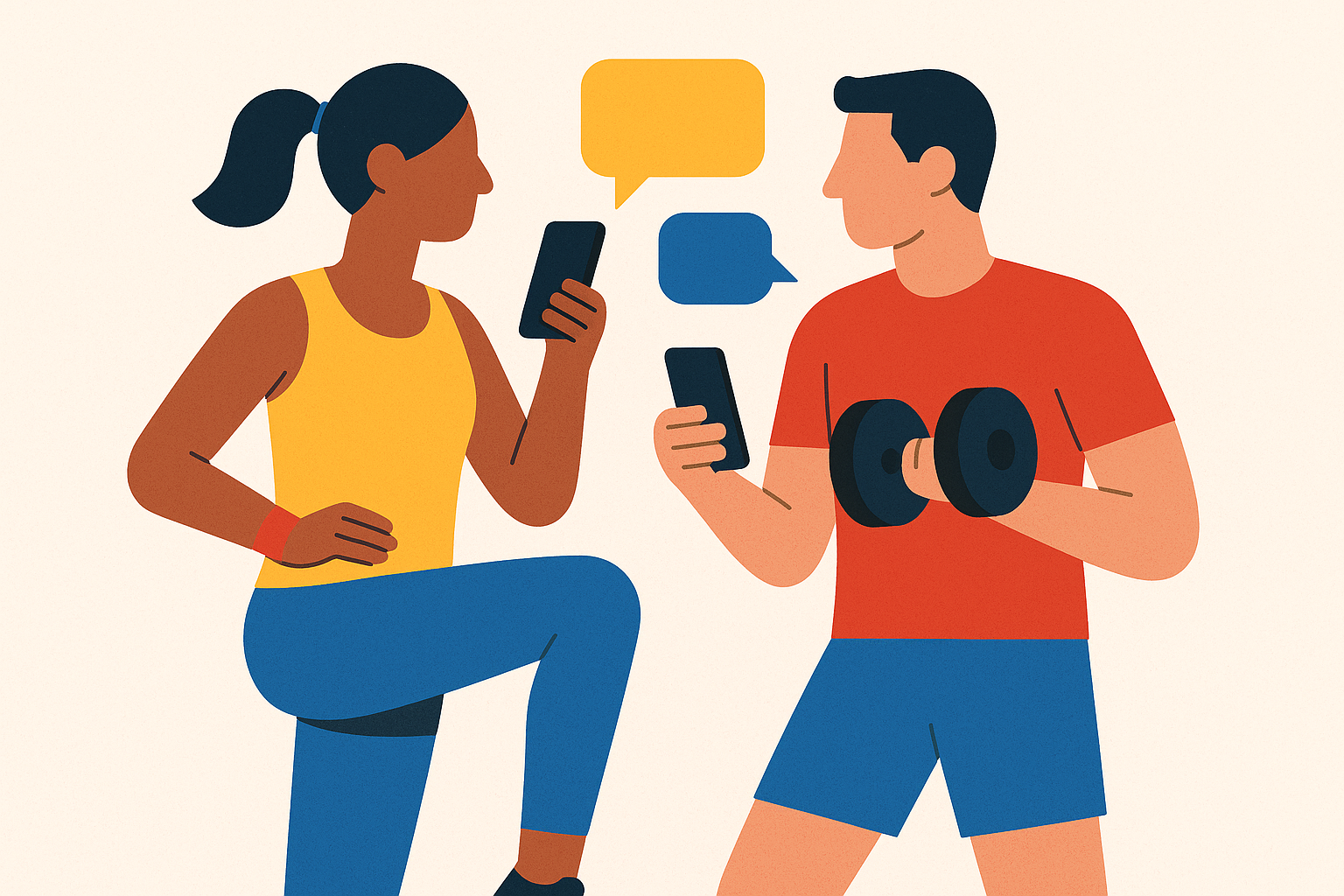
The misbelief driving most of this is the idea that shared fitness means doing the same exercises together. It doesn't, and clinging to that idea is the root cause of most couple-fitness burnout, not a lack of motivation. Real couples don't divide neatly into "lifts weights" and "also lifts weights." One partner might live for heavy squats and progressive overload. The other wants a long hike, a bike ride, a swim, a pickleball match, or just a walk where nobody's tracking heart rate zones. One person logs every rep in an app; the other just wants to move and feel human again.
So the real question isn't which app has the prettiest interface or the biggest workout library. It's whether an app can separate workout delivery (what each person actually does) from accountability (whether they both show up for it). That distinction is the entire spine of this article.
What the research shows about partners and workout consistency
The data on this is not subtle. A 1995 study in the Journal of Sports Medicine and Physical Fitness found that only 6.3% of couples who exercised together had dropped out after 12 months, compared to a 43% dropout rate among married individuals who exercised alone Trainwell. That's not a small edge; that's the difference between a habit that survives a year and one that statistically doesn't.
Separately, research published in the Journal of Consulting and Clinical Psychology found that having a social support partner meaningfully improves exercise adherence and helps people keep weight off after they lose it, compared to going solo. Dr. Gail Matthews at Dominican University ran a now-famous study on goal-sharing and found that people who wrote down their goals and told a friend were 33% more successful than people who kept their goals to themselves Trainwell. Telling another person turns an intention into a small, quiet contract.
Exercising with a partner also carries a mood and relationship benefit. A study in the Journal of Social and Personal Relationships found that exercising with a romantic partner improved mood during the workout, mood for the rest of the day, and relationship satisfaction overall. Couples who exercised together reported fewer conflicts, resolved disagreements more effectively, communicated better, and reported lower marital stress, and the link held up even after accounting for each partner's individual exercise habits, suggesting joint activity carries its own distinct relational benefit.
None of that requires identical workouts. Not one of these studies measured whether partners did the same exercises, same sets, same sport. What they measured was connection, whether one partner felt the other's effort and presence. That's the gap a good app needs to close, and it's a very different design problem than "build a shared workout plan." Mildenhall et al., 2026.
The accountability design problem: what "connected" requires when workouts don't match
Building for two different training styles under one accountability roof means building two experiences and one shared layer that sits on top, visible to both people. Get that architecture wrong, and you get either two separate apps pretending to be one, or one rigid plan that fits nobody.
The bystander effect is a leak in group fitness. In a big group, when someone goes quiet, everyone else assumes somebody else will notice. Nobody does, because everybody's waiting on everybody else. The bigger the group, the more accountability evaporates.
Two-person accountability structurally fixes that. There's no third party to absorb the silence, so when one partner goes quiet, the other one notices immediately, because there's nobody else it could be. That's the advantage. But it cuts both ways: with only two people in the system, one unreliable partner becomes a single point of failure, and there's no group cushion to catch the fall.
Trainwell's own framework for long-term consistency names four things that actually matter: catching silent drop-off before it becomes a pattern, flexibility in the plan itself, feedback on form or quality (not just whether a box got checked), and motivation systems that outlast the honeymoon period of week one. Couples frequently own different devices, and an app that only works within one ecosystem (Apple, Garmin, Fitbit) creates friction before the accountability part even gets a chance to start.
So the checklist for "does this app actually work for mismatched couples" comes down to a short, testable list: logging that doesn't care what style of workout you did, support across device brands, shared progress that's visible without requiring identical routines, and some layer (human or structural) that notices when somebody goes quiet.
Apps built around showing up together, not working out the same way
Partner Fitness Review, the company behind this site, builds on the idea that consistency beats a perfect workout every time, and that accountability works better when it feels supportive instead of like a compliance audit. The approach is style-agnostic on purpose. One partner lifts, the other does yoga, and both still feel plugged into what the other's doing. The emphasis sits on showing up rather than on performance metrics; a workout photo, a friendly wager, or a simple weekly goal often does more for consistency than another dashboard full of numbers nobody asked for. It fits couples who want fitness to strengthen the relationship, not become one more obligation competing for attention on a shared calendar.
Strava, with its Family Plan, made the single biggest move for mismatched couples in recent memory. In May 2026, Strava overhauled its strength training features, adding partner integrations, workout logging, and shareable muscle maps, so a runner and a lifter can now genuinely coexist on the same platform instead of one of them just tolerating it. Launch partners for that strength rollout include Amazfit, Caliber, COROS, Fitbod, Garmin, Hevy, iFIT Personal Trainer, Jefit, Liftoff, Motra, Remaker, Runna, and WHOOP, with 24 Hour Fitness set to join that summer. The Family Plan, launched back in 2024, includes unlimited Group Challenges for shared goals, and CBO Zipporah Allen's framing on it is simple: people keep people active. The company also acquired running app Runna in April 2025 and cycling app The Breakaway in May 2025, rounding out its reach across sports. It's best suited to couples where at least one partner is metrics-driven, and the May 2026 strength update is what makes it viable for a genuinely mixed-style pair rather than just endurance athletes.
Trainwell takes a completely different route: each partner gets matched with their own dedicated, certified personal trainer, so a devoted yogi and a devoted powerlifter both get served properly under the same app, with neither compromising. These aren't gig-app contractors either. Trainers are full-time W-2 employees with college degrees, NASM CPT certification or its equivalent, and at least three years of remote training experience, and fewer than 3% of applicants make the cut Trainwell. The accountability structure runs on daily check-ins, weekly form video reviews, and plan rebuilds when travel, injury, or plain old life gets in the way, so the trainer is the one who notices the silence, not the partner. The platform has over 52,000 members and a 4.9-star rating from more than 5,000 App Store reviews. Live motion tracking through Apple Watch or Wear OS sends real-time feedback straight back to the trainer, and Forbes named it Best Personal Trainer App of 2025, with the same engine now powering Peloton's Personal Trainer experience that launched in February 2026. Comparable human-coaching options include Future, Caliber, and Kickoff, and, with some caveats, Ladder, which leans more toward coach-designed team programs than dedicated one-on-one coaching. Trainwell suits couples who want the strongest possible individual accountability structure, human included, where each partner's plan is fully independent but the shared commitment to showing up for their coach is what actually binds the couple together. The tradeoff is cost. It's the highest-touch option on this list, and that touch isn't free.
Stridekick solves the wearable compatibility problem directly, syncing Fitbit, Apple Watch, Garmin, Withings, Misfit, iPhone 5S and up, Apple Health, Polar, and Xiaomi, so a mixed-device couple can compete in the same challenge without anyone switching ecosystems. It runs on five core challenge modes (Leaderboard, Target, Streak, Virtual Race, and Daily Habit), with up to 11 available on higher tiers, covering competition, consistency, and plain goal-hitting all in one place. It was last updated August 31, 2026. It's a strong fit for couples juggling different device ecosystems who want a shared challenge layer without the tech headache. The tradeoff: the interface feels a bit dated, and the social side is thin, basic messaging with no real activity feed, so accountability here runs on challenge mechanics rather than anything relational.
Edge, a UK-focused option, builds each partner a fully personalized plan across running, strength, HIIT, and mobility, generated in about 15 minutes, without forcing either person into a shared program they didn't ask for The Best Fitness App for Couples (2026, UK). Partners can share sessions and train side by side when schedules line up, and a real coach is available to message directly. It suits couples who want individualized coaching with the option to share sessions when schedules align, particularly for UK-based readers. Its footprint outside the UK isn't clearly established, so availability elsewhere is worth checking before assuming it travels.
Apple Fitness+ offers Custom Plans, letting each subscriber build a personalized schedule by workout type, trainer, and duration, so one partner does yoga while the other does HIIT, both under the same subscription. Apple's Activity Rings act as the shared accountability layer here, simple, visible, and refreshingly indifferent to what kind of workout produced them. The service expanded its dubbed content into Spanish and German in December 2025 and Japanese in early 2026, and added Strava integration for sharing workouts externally starting January 2025 and continuing into 2026. It's a clean fit for couples already living inside the Apple ecosystem who want low-setup individual plans and a passive shared layer they don't have to think about. This requires Apple hardware, including an Apple Watch, for the full experience, and a Garmin or Fitbit user can't meaningfully participate. Garmin data can route into Apple Health, but there's no direct account-to-account connection, so it works more like a patch than an actual solution.
FitWithLove: Couple Workout takes the opposite premise from everything above it. A Pro Plan is available as a one-time purchase that removes ads and unlocks extra plans, and the app was last updated June 1, 2026. Worth being clear-eyed about this one: it's not built for supporting two fully divergent solo routines. It's the "together" option on this list, not the "connected but separate" one, and that distinction matters depending on what a couple's actually after. More than 195 million users across more than 185 countries engage with the app more than 35 times per month, a strong signal for habit formation. Source: findyouredge.app. Best for couples already in the Apple ecosystem who want low-setup individual plans with a passive shared progress layer.
How to match an app to how your relationship works
The decision really comes down to two variables: how far apart the workouts are, and how much structure each partner personally needs to stay consistent. Get honest about both before picking an app, because the wrong match here just recreates the same two-week burnout cycle with a shinier interface.
Couples who genuinely want to move together, same room, same routine, will find FitWithLove the clearest fit. Couples with mismatched wearables who want a shared challenge without anyone switching devices should look at Stridekick first, since it removes the single biggest technical obstacle before accountability even becomes a conversation. If at least one partner is a committed numbers person and the workouts span running, cycling, strength, or some combination nobody's bothered to name yet, Strava's post-May 2026 strength update makes it the most credible cross-sport platform available, with the Family Plan adding a shared challenge layer on top.
For couples after individualized plans with shared session options and access to human coaching, Edge (UK-focused) or Trainwell for fully independent human accountability both deliver on that. Couples fully inside the Apple ecosystem who just want simple, passive shared visibility without a lot of setup should look at Apple Fitness+ and let the Activity Rings do the quiet work.
And for couples who want accountability that feels like support rather than surveillance, who'd rather have a simple weekly goal, a workout photo, or a friendly wager than another dashboard demanding attention, Partner Fitness Review's approach is built around exactly that kind of low-friction consistency.
Before committing to anything, run the wearable check first. Confirm both partners' devices are actually supported, because right now Stridekick and post-update Strava are the most device-agnostic choices on the table. A two-person accountability system is only as strong as both people's engagement, so pick something with real structure, a coach, a challenge mechanic, a check-in trigger, something that holds steady when one partner's motivation dips for a week or two.
The stronger long-term move isn't finding an app that makes two different workout styles look identical. It's building a shared physical life around two different routines that both get seen. The app is infrastructure for that habit. It was never meant to replace the relationship holding it up.