stat-free fitness accountability tools for people who hate tracking metrics
Social accountability and concrete planning beat metrics for keeping people consistent with fitness.
A meaningful chunk of people who buy fitness trackers or download tracking apps quit within months. UCL and Loughborough researchers combed through nearly 60,000 social media posts and found the same five complaints on repeat: calorie counts, rigid step goals, glitchy syncs, all sitting next to words like guilt, frustration, and burnout. I've watched clients cycle through this exact loop for years now, so this one's for anyone who tried the data-heavy route, watched it fall apart, and wants to know what accountability looks like with zero charts involved.
Why people stop using trackers — and the pattern behind it
One in three Americans who buy a wearable stops using it within six months. I've heard some version of the same line from a dozen different clients: "I just stopped opening the app." Same words almost every time. That's a pattern worth taking seriously.
A 2022 review in Behaviour & Information Technology names the boring, unglamorous culprit: the data is often just wrong. Step counts that don't match what your legs actually did. Sync bugs. Accuracy that drifts depending on which wrist you strap the thing to. Catch your tracker lying to you twice and you stop believing it the third time. Once trust goes, the whole system built on top of it goes with it.
Then you hit the novelty wall. Points, badges, leaderboards, all of it works great for about three weeks. Then the shine wears off and there's nothing underneath holding the habit up. The game was the motivation, and the game got boring, the way every game eventually does once you've memorized the rules. I had a client tell me she felt genuine grief when her step-streak badge disappeared after one missed day. Grief. Over a badge.
Nobody likes admitting the next part either: the notification loop turns into a compulsion instead of a choice. You move because the watch buzzed, not because you decided to. Somewhere in there the decision disappears, replaced by a Pavlovian flinch toward a screen.
None of this makes the quitter undisciplined. Usually it means the tool created friction it was supposed to remove. If you tried a tracker, hated it, and quietly filed yourself under "bad at fitness," toss that story out. The tool was the wrong fit for how you actually run.
What actually keeps people showing up when data isn't doing it
People rarely quit because their numbers ran thin. They quit because on a bad day, skipping costs nothing: no number moves, nobody notices, life keeps going. Change that one variable, just that one, and the whole equation shifts.
Someone noticing is the variable.
Social support has some of the strongest evidence in the whole field of behavior change, and it isn't close. A twelve-month study comparing adults who joined a fitness program with a spouse against people who went it alone found the paired group showed up more and dropped out less, by a wide margin. A recent meta-analysis backs it up at scale, showing social support meaningfully improves adherence, especially inside structured group settings. We're built to fear letting a person down more than we fear letting ourselves down. That pressure comes standard, no dashboard required.
Specificity works a similar angle. Gollwitzer's research on "if-then" planning, over 100 studies deep at this point, found a concrete plan ("Monday, 7 AM, gym") beats a vague intention ("I'll exercise more") by two to three times on follow-through. A 2024 follow-up from Sheeran, Listrom, and Gollwitzer pushed the sample size to 642 tests, and the effect held across formats and motivations. Vague goals evaporate by Wednesday. Specific plans survive even the days you don't feel like keeping them.
Self-Determination Theory adds a third piece. Motivation from genuine enjoyment outlasts motivation from external reward. A 2025 review found the strongest outcomes show up when people act from their own reasons and have real support around them, rather than chasing a badge that means nothing by Friday.
Perlus, a sports psychologist, said something that cuts against the entire wearable industry: "Subjective data can actually be just as beneficial as tracking more objective data from a smartwatch." Mood, energy, sleep, soreness: these predict whether you'll show up again better than most numbers do. A 2024 review of 122 mHealth studies linked self-monitoring to positive outcomes in 66% of interventions, and self-monitoring doesn't need a single digit to count. "Felt wrecked, showed up anyway," scribbled in a notes app, is data. It just doesn't guilt-trip you on the way in.
Three accountability models that work without a metric in sight
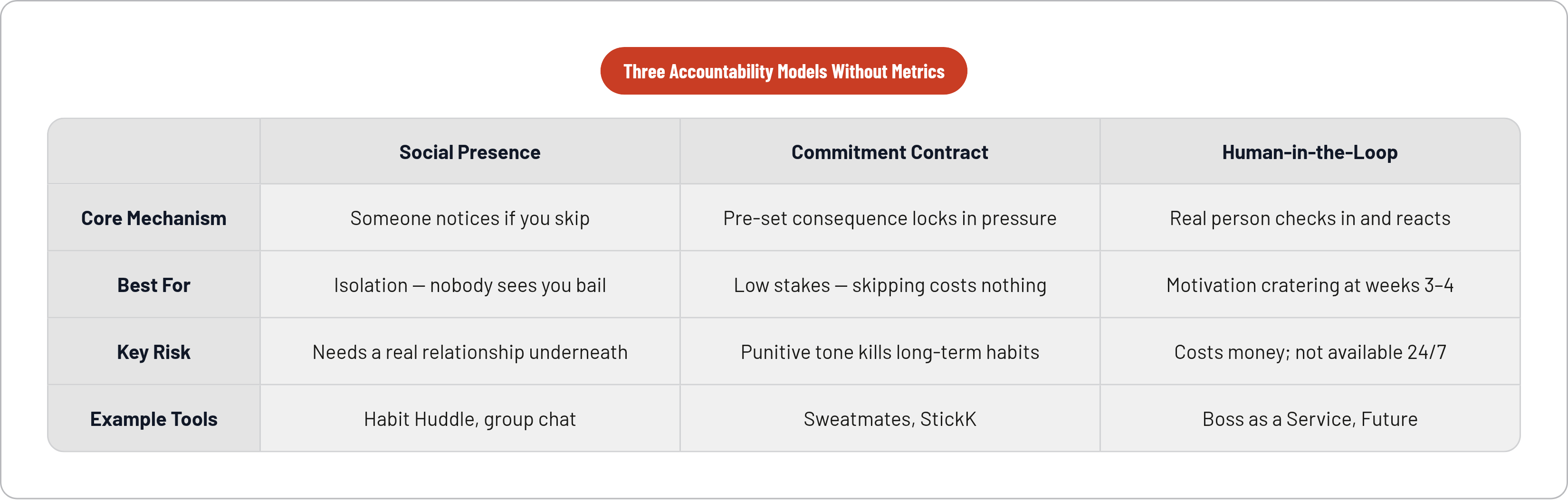
Lumping these three together does everyone a disservice, so let's take them one at a time.
Social presence is the simplest model going: someone else knows whether you showed up, and that's the entire mechanism. No contract, no wager, no onboarding flow. Just visibility. It runs on the same disappointment-aversion wiring from above, and the barrier to starting sits at basically zero. The catch is that it needs a real relationship underneath it. Tell a stranger you're skipping leg day and you'll get silence. Tell your training partner and you'll feel it in your chest.
Commitment contracts flip the order. You lock in a consequence, money, a chore, a bet, before the workout happens, so the pressure lands ahead of time instead of as regret afterward. This leans on a well-documented finding in behavioral economics: losses sting more than equivalent gains feel good. You don't even need a close friend for this one; the contract does the heavy lifting on its own. The risk is tone. Playful, it works. Punitive, it collapses fast, because nobody sustains a habit built on dread.
Human-in-the-loop oversight adds an actual person: a coach, a service, a partner who checks in and reacts to what actually happened that week. A 2025 randomized controlled trial in the Journal of Strength and Conditioning Research followed 79 trained participants over ten weeks and found supervised training beat both app-guided and self-guided training on strength, body composition, and well-being. The relationship does the work here, more than whatever data the coach happens to log along the way. The tradeoff is obvious enough: a real person's time costs money and isn't available at 6 AM on a whim.
All three share the same enemy: the all-or-nothing trap. Miss one session and it curdles into a story about total failure fast. A floor/ceiling structure, a bare-minimum version for your worst days sitting next to the full session for your good ones, defuses that without measuring a single thing. Leaderboard-style challenges tend to backfire here too. Strong starters pull away, everyone else quietly checks out. Formats that reward showing up beat formats that rank performance, at least for the person reading this.
Tools built around showing up rather than measuring output
Start with social presence tools. Habit Huddle keeps it to one-tap check-ins wherever your group already talks: iOS, Android, web, or a Discord bot bolted onto your existing server. The tone is warm rather than competitive, applause and replies instead of a leaderboard. It only tracks one behavior per huddle, no GPS, no set-by-set logging, and that's on purpose. It's for small groups who want to be seen, not ranked.
Partner Fitness Review points the same idea at couples or training partners who want to stay connected around shared goals. Simple weekly targets, visible progress through check-ins and photos, encouragement instead of competition. Partners can train on completely different schedules and still feel like they're doing it together, which kills the scheduling headache that usually sinks shared fitness plans by week two.
Don't sleep on the free option already sitting in your pocket, either. A WhatsApp group, a Close Friends list, a private group chat. No onboarding, no subscription. The tool is just a room, and the people in the room do the actual work.
On the commitment contract side, Sweatmates is a fitness accountability app for couples that keeps both partners honest through shared workout tracking, photo check-ins, and friendly wagers. Each person sets their own weekly goal, and the app lets couples layer in shared team goals and streaks so the pressure is mutual rather than one-sided. Good fit if you want a partner who actually notices whether you showed up, not just a consequence you arranged in advance.
StickK, built by behavioral economists at Yale, runs the same model at a bigger scale. Set a goal, stake money or another consequence, name a Referee to keep you honest. The Anti-Charity option, where your failed money goes to a cause you actually can't stand, might be the most psychologically loaded accountability mechanism on this whole list. StickK's own numbers show strong success-rate boosts among users who put money on the line, though that's their platform data and not an outside trial, so take it with a small grain of salt. The loss-aversion theory underneath it holds up regardless. It's free to join.
For human-in-the-loop, Boss as a Service puts a real person in your corner who checks in daily by text, email, or call: part cheerleader, part nag, in the useful sense of both words. No app. Runs around $25 a month, and it fits someone who needs a human asking "did you go?" instead of a push notification they've long since learned to swipe away without reading.
Future pairs you with an actual coach who builds your program, messages you, adjusts based on what really happened that week rather than what an algorithm guessed from your heart rate data. A person knowing you skipped Tuesday and asking why carries a different weight than a watch buzzing at 6 PM regardless of what your day looked like.
Ray brings accountability into the workout itself, in real time. Voice cues, a camera-based rep counter, no manual logging required. Built for people who need presence in the moment, not a contract they signed three days earlier and already forgot about.
How to choose based on why you actually skip workouts
The right tool depends on exactly where your accountability breaks: before the workout, during it, or in the guilt spiral after skipping it.
Isolation, nobody notices when you bail, gets solved directly by a social presence tool. Habit Huddle, a plain group chat, Partner Fitness Review: any of them puts a witness in the room.
Low stakes, where skipping costs you literally nothing, gets solved by a commitment contract. Sweatmates fits couples who want the accountability to come from both a watching partner and a shared goal structure, with wagers providing a little extra sting. StickK works when you want the consequence to do most of the heavy lifting on its own.
Motivation cratering around weeks three and four, that ugly stretch once the initial excitement wears off and doubt creeps in, calls for human-in-the-loop options like Boss as a Service or Future. An app can't fake a person responding to you, specifically, by name.
And if workouts feel like an all-or-nothing gauntlet every single week, the fix is the floor/ceiling structure, layered onto whatever check-in space you're already using.
None of these are locked doors, either. Social presence and commitment contracts stack easily, a two-person wager inside a shared group chat pulls both levers at once. Before picking anything, ask one question: does this reward showing up, or does it reward performance? For the person this piece is written for, only one of those answers actually holds up.
What presence-based accountability asks of you instead of your data
This swaps measuring output for making the act of showing up the whole point. Nothing fancier than that.
What gets tracked here is small, almost embarrassingly so. Did I come back? Did the other person know I showed up? Did we both return this week? That's the scoreboard, in full, no asterisks.
One habit worth building in: after a session, jot down how you felt, energy, mood, soreness, as reflection rather than data collection. Perlus's point holds up in practice more than most tracker marketing wants to admit. A few honest sentences often paint a fuller picture than a smartwatch graph ever will, and they cost you thirty seconds instead of a subscription fee.
Missing a goal in this model calls for curiosity instead of shame. What made this week hard? What would make next week easier? A decent tool supports that conversation. A bad one punishes you for answering it honestly, which is backwards, and you should probably delete that app anyway.
Consistency beats optimization. The evidence keeps landing in the same spot whether you're looking at implementation intentions, spousal support studies, or supervised training trials: specificity and relationship beat raw willpower, reliably, every time researchers bother to check. A workout shared with someone who'd notice your absence gets repeated more than a private number sitting untouched on a dashboard ever does. Nobody skips leg day on the person who's waiting for them at the squat rack.