How Couples Use Mutual Goal Tracking to Out-Motivate Solo Fitness Apps
Shared fitness goals between partners beat solo apps by replacing pushes with real social stakes.

Solo fitness apps are built for one person, and that's exactly the design choice that dooms them. Mutual goal tracking between two people fixes the problem by replacing a fading dopamine loop with a real social stake.
A new app gets downloaded, the first few weeks go great, life throws a curveball (a busy week at work, a sick kid, a bad cold), and the habit quietly dies because the design offers nothing in that moment, not because the user got lazy. The app has nothing to offer at the exact moment the user needs something more than a push notification. Streaks and reminders are stand-ins for accountability, dressed up to look like the real thing, but a phone buzzing at 7pm doesn't actually care if the workout happens. JMIR mHealth and uHealth published an analysis of training behavior among real fitness app users (not a lab study, actual app data) and found patterns consistent with exactly this kind of drop-off. The takeaway: no amount of clever UX fixes this, because the gap that needs filling is a person. Without a second human being whose expectations are tied to the user showing up, there's no cost to not showing up. That's the structural hole mutual goal tracking is built to fill.
The three psychological mechanisms that make a partner structurally different from an app
A workout partner changes the equation through three specific mechanisms, and none of them can be coded into an app that only talks to one user.
The first is accountability without pressure.
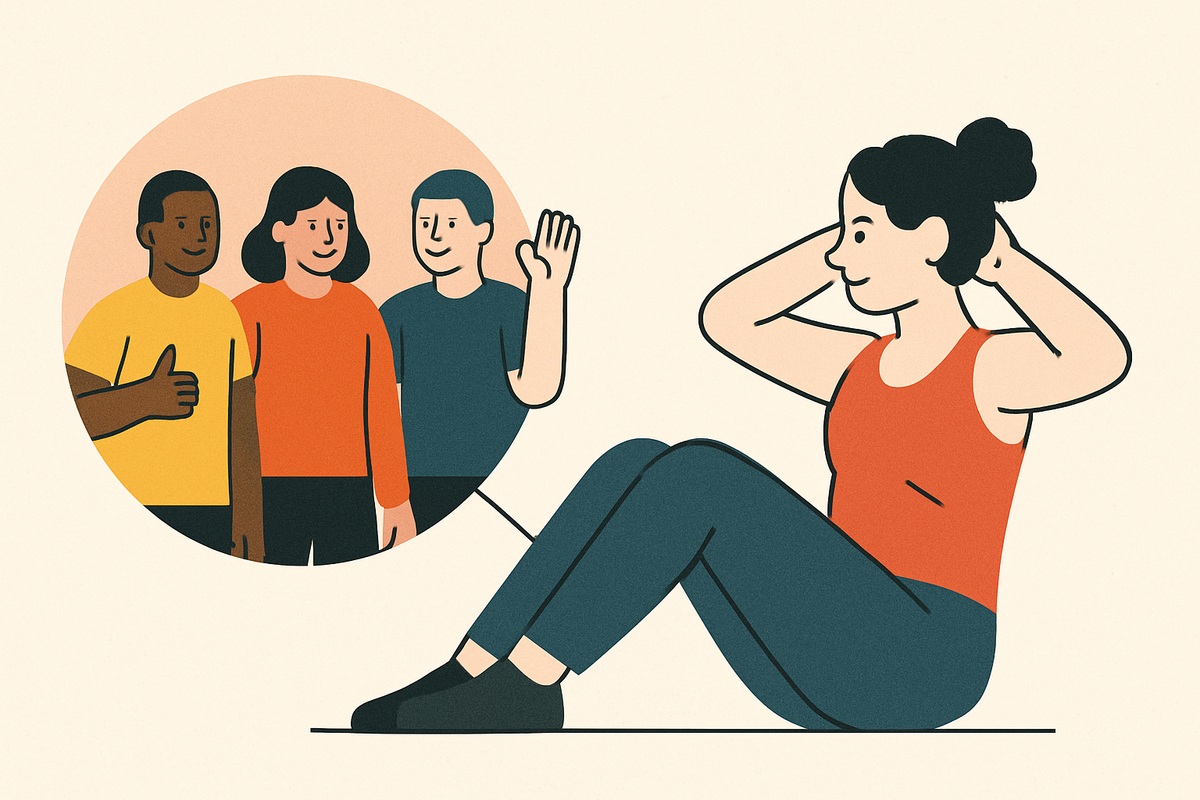
The second is emotional contagion. Effort is contagious when it's visible. Watching a partner grind through a hard set lowers how hard the workout feels to the person watching, and that's a live, in-the-room effect. A dashboard showing someone else's heart rate thirty minutes ago doesn't do that.
The third is shared identity formation. Once "we work out together" becomes part of how a couple describes themselves, exercise stops requiring motivation on any given day. It becomes the default, the same way brushing teeth doesn't need a pep talk. This identity-level attachment is the glue that makes the habit stick long after the initial excitement fades. When a partner's expectations are genuinely on the line, skipping a workout costs something real, in a way no streak counter ever will, and that's the structural gap solo apps can't close.
Social indispensability is a fourth mechanism alongside the first three. The less capable partner in a pairing often sees their own contribution as essential to the shared effort, and that perception raises their engagement instead of discouraging it. Pairing with a stronger partner can also raise effort in the weaker one, a pattern researchers call the Köhler effect, but it only kicks in when the performance gap between partners is moderate. Too wide a gap, and the effect can flip. That detail matters later, when the objections to this whole thesis get a fair hearing.
Exercise Adherence in Couples
The psychological mechanisms are one thing. The adherence numbers are another, and they're not subtle.
Wallace, Raglin, and Jastremski tracked married adults enrolling in a fitness program back in 1995, comparing those who joined with a spouse against those who joined alone. The dropout rate in the solo group ran more than six times higher than in the couples group. That figure is three decades old, but nobody has overturned it, and it still anchors how researchers think about adherence in this space.
More recent work backs up the pattern with a different kind of evidence: day-to-day mood. On days when couples exercised together, participants reported better mood during the workout itself, better mood for the rest of that day, and higher relationship satisfaction. The benefit isn't just that more workouts get logged. The people doing them report feeling better doing it, which is a different and arguably more durable kind of motivation than anything a solo app's badge system can produce.
None of this means the partner effect applies evenly to every couple in every circumstance. It doesn't, and the honest version of this argument has to deal with that directly.
Where the partner-tracking advantage breaks down
The partner-tracking advantage holds up well, but it isn't unconditional, and four real objections deserve a straight answer instead of a dodge.
The first objection: mismatched fitness levels. The Köhler effect needs a moderate gap in ability to work. Couples with a wide gap, one marathon runner and one person just starting out, may not get the motivating boost at all, and the less fit partner's effort can actually get suppressed rather than lifted. The fix here comes from the Mates in Motion trial design: give each partner an individualized goal instead of forcing identical targets. The accountability stays shared even when the actual workouts don't match.
The second objection: life stage matters. Research published in October 2023 found that older adults who exercise alongside a spouse can end up less active than those who exercise on their own. That finding doesn't break the underlying mechanism. It sharpens it. Younger couples, and anyone still in the early habit-formation phase, appear to get the most benefit, and how the shared-goal system is built matters as much as the fact that it exists.
The third objection: social support may work indirectly rather than directly. One interpretation in the research holds that partner support raises self-efficacy and intrinsic motivation, and those two things drive the behavior, rather than the social pressure doing it on its own. Accountability, in this reading, acts as a catalyst rather than a direct cause. That's not actually a problem for the argument here. If partner accountability raises self-efficacy and self-efficacy drives adherence, the end result is still a system that beats a solo app, which offers neither.
The fourth objection is the sharpest one: accountability that feels like policing instead of support can backfire, turning a partner into a source of shame rather than encouragement. That's a real risk, and it's a design and framing problem rather than evidence against the whole approach. Tools that treat a missed goal as a prompt for a quick, low-stakes check-in work differently than tools that treat it as a failure to flag. That distinction, more than anything else in this section, is what separates systems people stick with from the ones that quietly get deleted.
How mutual goal tracking works in practice
A lot of fitness apps let someone "add a friend" and glance at their stats. That's visibility. It is not accountability: visibility shows what someone else is doing, while accountability changes what the viewer is likely to do.
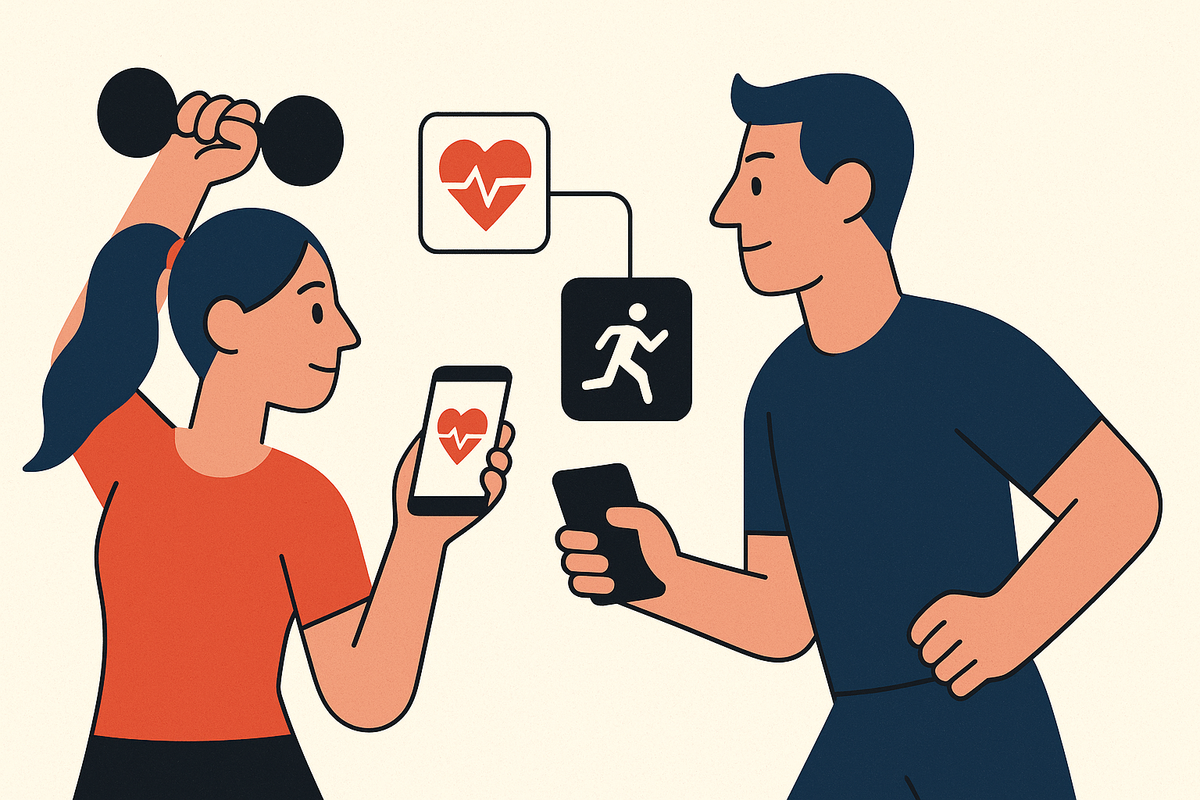
Genuine mutual tracking connects two people's goals rather than simply displaying them side by side. Three elements make that real: a shared or linked goal structure, progress visible to both people in something close to real time, and a feedback loop that actually involves the other person rather than just pinging the user who's falling behind.
The Mates in Motion trial offers a clean example of what "shared" should actually mean. Partners in that program got separate step goals, calibrated to their own ability, discussed together with a counselor. Shared doesn't mean identical. The accountability is relational. The target is personal.
Small design choices carry a lot of weight here. A workout photo sent to a partner creates something the other person can actually react to, a social artifact of effort, which functions completely differently than a private dashboard quietly logging a number nobody else sees. A friendly wager, five dollars on who hits their goal first, or a small shared reward for a milestone, raises the stakes just enough to matter without turning the whole thing into a performance review. And simplicity beats complexity: a single shared weekly target is something two people can actually hold in their heads, talk about over dinner, and pick back up after a rough week, in a way a twelve-variable dashboard never will be.
How Sweatmates and other couple-focused tools apply these principles
Among tools built specifically for couples, Sweatmates comes closest to putting the research into practice directly: shared but individualized goals, visible progress, playful rather than punishing accountability, and a relational frame instead of a performance-optimization one.
Sweatmates is built around a simple philosophy: consistency beats perfection, and accountability should feel supportive rather than like a compliance check. The app centers on shared weekly goals that both partners can see and respond to, which creates the relational stake that a solo app structurally cannot offer. Workout photos and honest encouragement sit at the core of the product, giving effort a visible, shareable form rather than reducing it to a number on a private chart. Friendly wagers and small shared rewards are built in too, turning the system into something closer to a game between two people who care about each other than an audit of who did or didn't show up. Partners don't need to be in the same gym, or even working out at the same time. The app is designed so two people can train separately and still feel connected to each other's progress, which removes the scheduling friction that kills a lot of couples' fitness plans before they start. And when a goal gets missed, the design is built to prompt a conversation rather than guilt, which lines up with the broader finding that motivation people choose for themselves holds up better over time than motivation driven by shame.
Sensai takes a different approach entirely, leaning on AI personalization that adapts to a user's schedule, recovery, and sleep. It's a useful option for a couple where one or both people want individualized coaching layered inside a shared routine, functioning fundamentally as an individual-first tool with adaptive intelligence built in rather than a relational accountability system. And on the clinical end, the Mates in Motion trial (NCT06073951) shows the partner model holding up even under medical supervision, with couples working through transplant recovery together. It's not a consumer app anyone can download, but it validates the mechanism at the hardest possible end of the adherence spectrum, which is exactly the kind of evidence that makes the mechanism worth trusting in an everyday app.
Setting up a mutual goal system that keeps both partners coming back
A mutual goal system only delivers its advantage if it's built to be simple, honest, and easy to restart. Complexity and perfectionism are the two things that turn a genuinely good idea into another deleted app three weeks later.
Start with one shared goal, not a full program. A single visible target, days active this week, a shared step count, workouts logged, is something two people can actually discuss, celebrate, and return to after a bad week. A twelve-week periodized plan is not.
Keep goals separate but linked. Each partner sets a target calibrated to their own fitness level, so the accountability stays relational while the standard stays personal. This is the Mates in Motion insight, applied to ordinary weekday life instead of a clinical trial.
Make effort visible to the other person. A photo, a quick check-in text, a logged workout the other partner can actually respond to, these create the social artifact that sustains the whole arrangement. Build in something playful: a small bet on who hits the week's goal, or a shared reward for a milestone, raises the stakes without turning the relationship into a performance review.
Plan the restart before it's needed. Agreeing in advance that a missed week means a short conversation, not a shame spiral or a restart from zero, is a design decision, not a test of willpower. Measure consistency before anything else. Counting how many weeks both partners actually showed up tracks the habit's survival better than pace, weight, or calories burned, because the relational habit is the real asset being built.
Couples don't need to share a gym or a schedule to make this work. Shared goals and visible progress hold up across different routines and different hours, as long as both people can see what the other is doing. The best fitness system, in the end, is simply the one both partners keep coming back to.
Sources
- JMIR mHealth and uHealth - Analysis of Training Behavior in Users of a Fitness App: Cross-Sectional Study
- Evaluation of a Couple-Based Physical Activity Intervention
- Method and system for providing fitness activity tracking and gaming
- The influence of social support and empowerment on physical exercise behavior in university students: A self-determination theory perspective - ScienceDirect
- Sweatmates: Partner Fitness App - App Store
- (PDF) Twelve month adherence of adults who joined a fitness program with a spouse vs without a spouse
- Better Together? A Pilot Study of Romantic Partner Influence on Exercise Adherence and Cardiometabolic Risk in African-American Couples - PMC
- Motivating Physical Activity with Fitness Tracking and the Interpersonal Context: International Journal of Human–Computer Interaction: Vol 40 , No 22 - Get Access