What Makes a Workout Tracking App Actually Work for Two People
Couples quit shared fitness apps when the design ignores their different fitness levels.
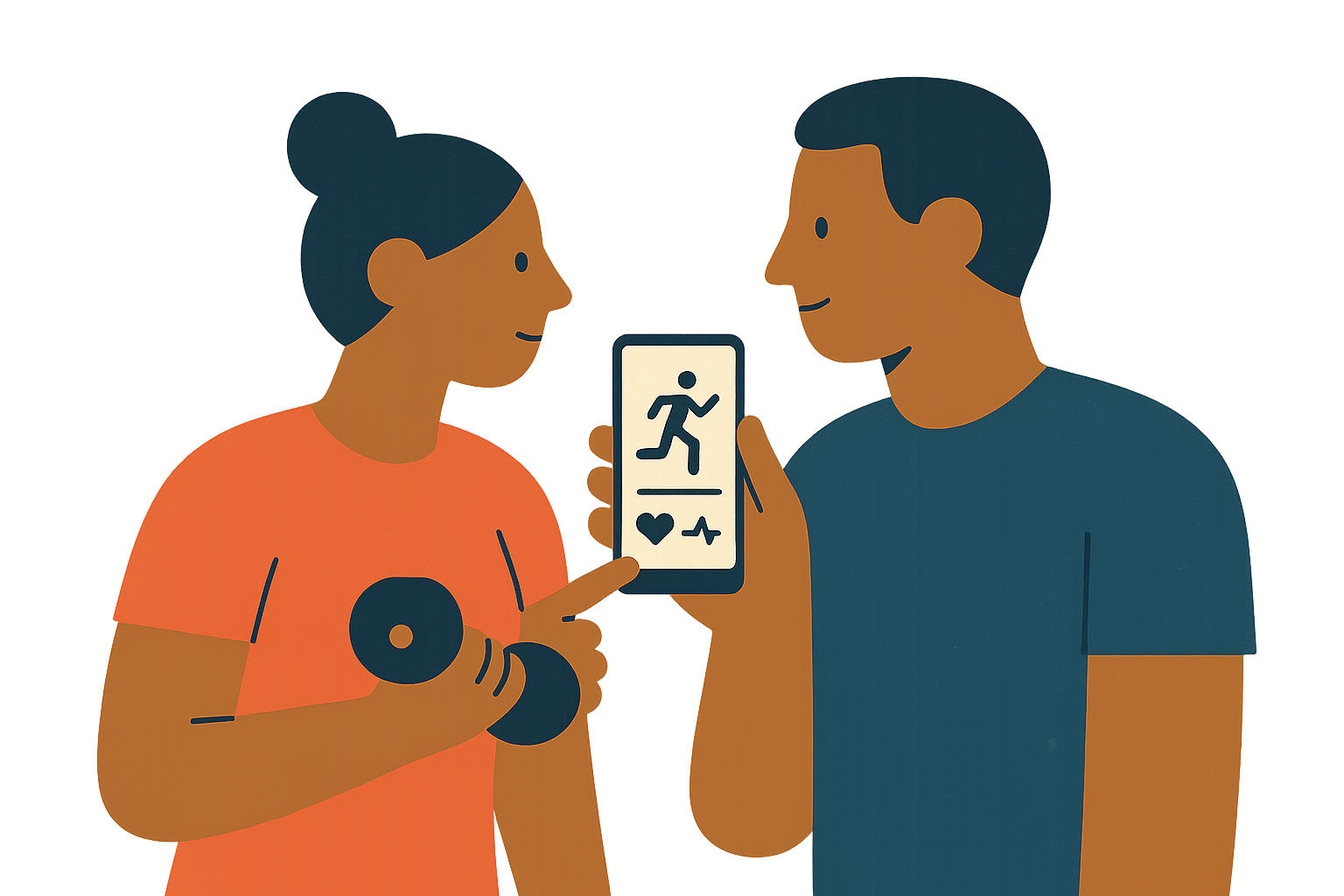
Couples don't quit shared fitness apps because they lack willpower. They quit because the app was built for one person and two people showed up to use it, and that mismatch appears quickly in daily use.
The frustrating part is that the motivation was never the problem. A 1995 study by Wallace, Raglin, and Jastremski in the Journal of Sports Medicine and Physical Fitness found partner exercise holds onto people at a far higher rate than solo exercise. Two people who start a routine together already have more staying power than one person going it alone. The app is what lets that go to waste.
The cost of losing that habit isn't just physical, either. A 2021 study by Sackett-Fox, Gere, and Updegraff in the Journal of Social and Personal Relationships found that working out with a romantic partner lifts both mood and relationship satisfaction. So when the shared workout habit falls apart, a piece of the relationship dies along with the fitness goal.
Three things explain why training with a partner works in the first place. Skipping a session feels different when someone else is counting on you to show up, so the shared commitment changes the math on quitting. Training next to someone more capable also tends to raise your own effort, a pattern researchers call the Kohler effect.
Most apps fail all three mechanisms at once. The standard move is "add a friend," show their stats, maybe let you send an emoji. None of that touches commitment, motivation-gain, or identity. The workout itself stays a solo experience with a social sticker slapped on top.
A simpler, more mechanical problem produces these failures: two people rarely have the same fitness level. Giving them identical workouts fails them both at once. The stronger partner is bored. The newer partner is gasping for air and dreading the next session. Neither one sticks around long enough for the habit to form.
Designing partner progress visibility without it backfiring
Being able to see your partner's progress is the feature couples want most, and it's also the one most likely to backfire if nobody thought carefully about how it's shown.
A broken streak sitting next to your name is basically a red mark on a report card, except this report card is graded by the person you live with. A quick "hey, you good?" text can start to feel less like concern and more like a performance review, simply because your partner can see the gap where your workout should have been.
Missing a day doesn't actually damage a habit, as Phillippa Lally's research on habit formation found. The problem is that most apps don't know it, so they present a missed day as a failure, broadcast directly to the one person whose opinion the user cares about most.
Real-world usage data backs up how messy this gets in practice. A 2026 cross-sectional study in JMIR mHealth and uHealth looked at how people actually use fitness apps day to day, and found a gap between what the app logs as progress and what users actually feel is meaningful progress. The number on the screen and the sense of accomplishment in someone's head don't always match up, and when they don't, the app's version of the truth usually wins the argument, even when it's wrong.
It gets worse under a microscope. A 2025 study by Sheen and colleagues in the British Journal of Health Psychology used machine-assisted analysis of real user posts and found that commercial fitness apps generate real psychological and behavioral damage, largely tied to algorithm-set goals that don't fit the person trying to hit them, and the fallout lands on emotion, motivation, and how long people stick around.
Self-Determination Theory explains why this cuts so deep. People need to feel in control of their own choices and competent at what they're doing. An app that turns every missed session into a scoreboard of deficits undermines autonomy and competence, eroding exactly the intrinsic motivation that makes partner exercise durable.
So visibility by itself isn't the fix. How a missed day gets framed to a partner matters just as much as whether it's shown. Skipping that part of the design turns the feature couples asked for into the feature that makes them quit.
What gamification between two people requires to work
Gamification does raise activity levels, that part isn't in question. Clinical trials confirm it consistently bumps up daily step counts. The real question is what happens when the two people playing the game don't start from the same fitness level, because that's where gamification either builds motivation or manufactures resentment.
Putting a beginner up against someone who's been training for years stops competition from motivating anyone. The less fit partner feels exposed. The more fit partner feels like they're not even trying. Everyone loses, just in different ways.
Field research on hybrid approaches points to a better answer: blend cooperation with competition instead of picking one. The cooperative layer protects the relationship from turning into a scoreboard, while a bit of competitive spark keeps things from going flat.
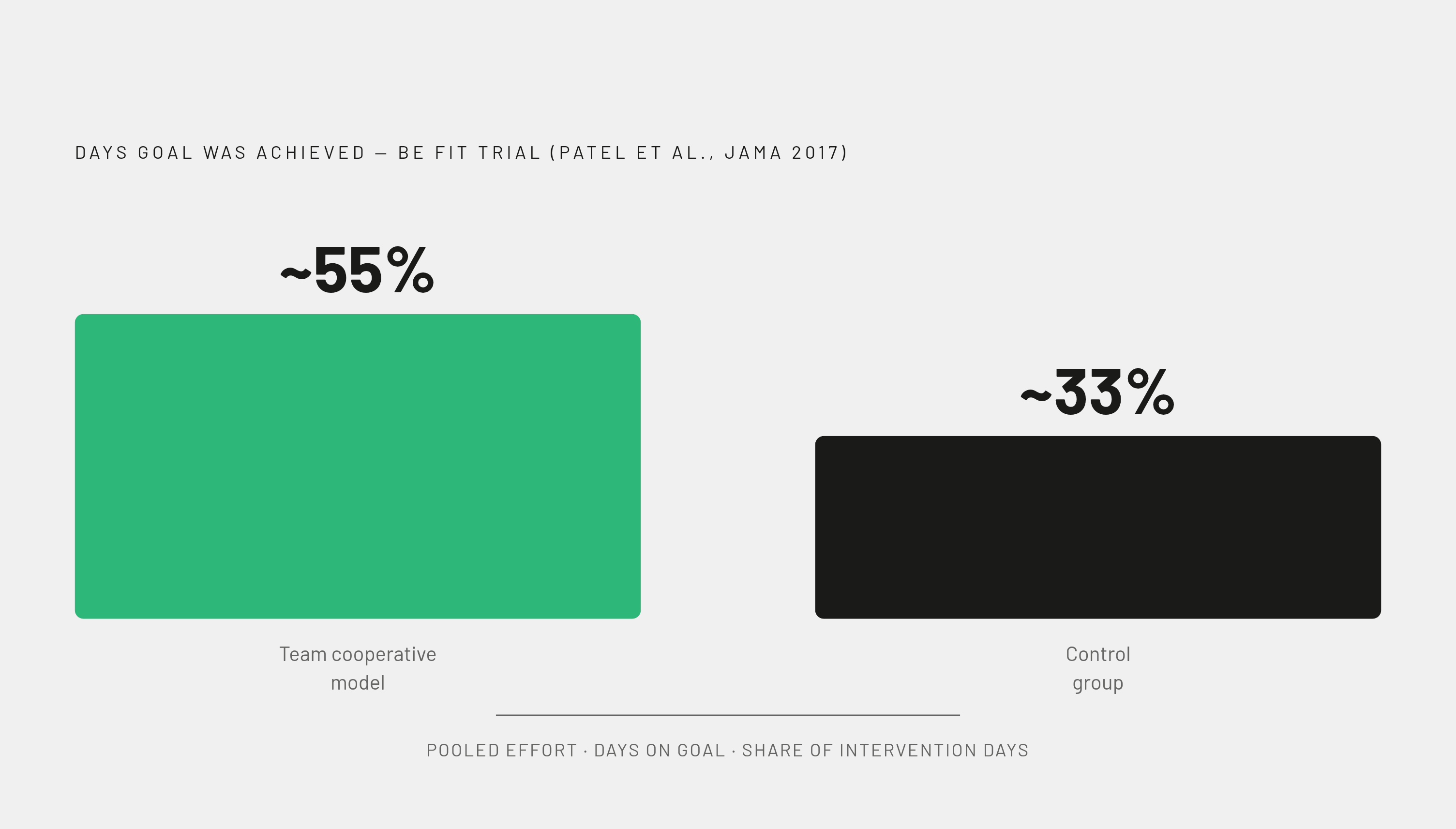
The clearest real-world proof of this comes from the BE FIT randomized clinical trial, run by Patel and colleagues and published in JAMA Internal Medicine in 2017. Families earned points together for hitting shared step goals as a team. The group using this gamified, team-based model hit their goals on a majority of days, compared to roughly a third of days for the control group. That's a household rewiring its daily default behavior, not a marginal bump.
One finding complicates the whole premise. At least one field experiment found gamification didn't build stronger intrinsic motivation than plain self-tracking without any game layer. The engagement boost from points and streaks may be running on borrowed time, propped up by external rewards rather than real desire, and a design that leans on points and badges alone could speed up quitting rather than slow it down.
So the principle that actually survives all this evidence is narrower than "add points and leaderboards." Gamification works for couples when effort gets pooled rather than compared head-to-head, when competition gets calibrated to each person's own level, and when showing up gets celebrated on its own.
The features that change the shared-tracking experience
In most app store listings, the features that actually move the needle for couples are few once the marketing copy is stripped away; they tend to cluster around three specific problems: mismatched fitness levels, mismatched training disciplines, and how a missed day gets framed.
Adaptive individual plans with shared visibility solve the most common failure point, and it's also the feature missing from most apps on the market. Both partners train at a level calibrated to them individually, while still sharing the same overall experience, so nobody is bored and nobody is overwhelmed. Edge, based in the UK, builds its plans this way: each partner gets a program scaled to their own level, and they can still share sessions together. The shared experience never required identical workouts. AI-driven adjustment is becoming the engine behind this kind of design, with apps analyzing behavior, fitness level, and even dietary patterns to adapt a plan in real time, which is exactly the tool a household with two different starting points actually needs.
Cross-discipline visibility solves a separate problem: couples where one person runs and the other lifts weights, with neither partner's effort visible to the other anywhere in the app. A major strength-training overhaul in the market added auto-populated muscle maps, a dedicated log for sets, reps, and weight, plus partner integrations with WHOOP, Garmin, Hevy, and Fitbod. That closes the gap for couples training in completely different disciplines, letting both show up in one shared feed instead of two separate silos. Hevy specifically lets partners compare performance, share routines, post gym selfies and training clips, and auto-share workouts, all for a low monthly cost, and it holds 4.9-star ratings on both the App Store and Google Play.
Stakes-based accountability solves a different problem entirely: making commitment real without requiring both people to be in the same room. Fitness Pact runs on stakes and forfeits within small groups, so missing a session has a financial or social cost attached, which outlasts motivation on its own. Partner Fitness Review takes the same view: a friendly wager turns a good intention into something that actually happens, and it lets partners train on totally separate schedules while still answering to each other.
Couples-specific workout design solves the problem for partners who actually want to train in the same room, doing the same movements. FitWithLove, on Google Play, builds structured day-by-day partner plans with guided pair exercises and step-by-step instructions, calorie tracking for each person separately, achievement badges across categories like "Week Warrior," "Century Club," and "Iron Will" for a 60-day streak, streak tracking, personal records, completion certificates, cloud backup, smart reminders, and support in eight languages, with a one-time purchase to remove ads. Demand for this kind of couples-specific programming isn't confined to Western markets, either: an India-based app in the same category has scaled to tens of thousands of users.
The most underrated feature in the entire category doesn't involve any data at all: a workout photo. A photo shared right after a session carries effort, mood, and presence in a way no chart can. Partner Fitness Review argues that a photo can motivate more than another graph, and showing up deserves recognition even on days when nothing was measured.
Matching app features to how a pair trains
No app wins for every couple, full stop, because the right pick comes down to two questions: do the partners train together or separately, and how far apart are their fitness levels?
Partners who train at the same time but at different levels get the most value from adaptive individual programming, the kind Edge builds its whole approach around.
Partners who train separately, in different disciplines entirely, need cross-platform visibility more than any shared workout plan. A strength-training platform paired with Hevy is the strongest option here, since it lets a runner and a lifter show up in the same feed without forcing either one into the other's training style.
Partners who want to train in the same room, doing the same movements together, need guided paired workout design built for exactly that. FitWithLove is a purpose-built option for this case.
Partners who already know what to do, but just need a reason not to skip it, get the most out of stakes-based tools like Fitness Pact, where a forfeit does the job motivation alone can't.
A shared calendar slot alone didn't move the number. That's the quality worth shopping for, not the app with the longest feature list, but the one that actually recreates that kind of support between two specific people.
And none of this pays off on day one. A Western University study, described as the largest and longest of its kind, found that digital health tools can support behavior change well past the usual three-to-six-month trial window most apps get judged on. The features worth paying for are the ones that hold up six months in rather than the ones that look impressive during a free trial.
Partner Fitness Review sums up the actual test well: the best fitness system isn't the one with the most data to show for itself, but the one both partners are still using together after three months. Start there, not with the app store ranking.
Sources
- JMIR mHealth and uHealth - Analysis of Training Behavior in Users of a Fitness App: Cross-Sectional Study
- Living well? The unintended consequences of highly popular commercial fitness apps through social listening using Machine‐Assisted Topic Analysis: Evidence from X - Sheen - 2025 - British Journal of Health Psychology - Wiley Online Library
- Fitness apps can help boost activity, Western study finds - Western News