accountability features that keep couples consistent with exercise
Couples who exercise together quit at 6% yearly, solo exercisers at 43%.

Couples who work out together quit at roughly 6% over a year, while couples who go it alone quit at rates seven times higher. That gap isn't a fluke of motivated people finding each other; it's a structural effect, and once you know which features cause it, you can actually design your routine around it instead of hoping willpower shows up on time.
What the data shows when couples exercise together instead of alone
Let's start with the baseline, because it's bleak. Average dropout from exercise programs sits around 20%, and half of that happens in the first six months. Real-world gym data is worse: a retrospective look at two facilities found 54% of members gone within three months, and at one location, 89% had quit within a year. Digital fitness apps don't save you either. A 2026 study in Frontiers in Sports and Active Living tracked 389,481 beginner users on a major platform and found only 10.1% still active at 12 months, with the typical user gone by week 19. Zoom out further and the picture doesn't improve: only 22.5% of U.S. adults 25 and older hit the recommended activity levels in 2022.
Forty percent of self-reported dropouts blame time. But the timing doesn't back that up. Dropout clusters hard in the first few weeks, before work trips, kid schedules, or holiday chaos have even had a chance to interfere. That's not a scheduling problem; that's a motivation and structure problem wearing a time-crunch costume.
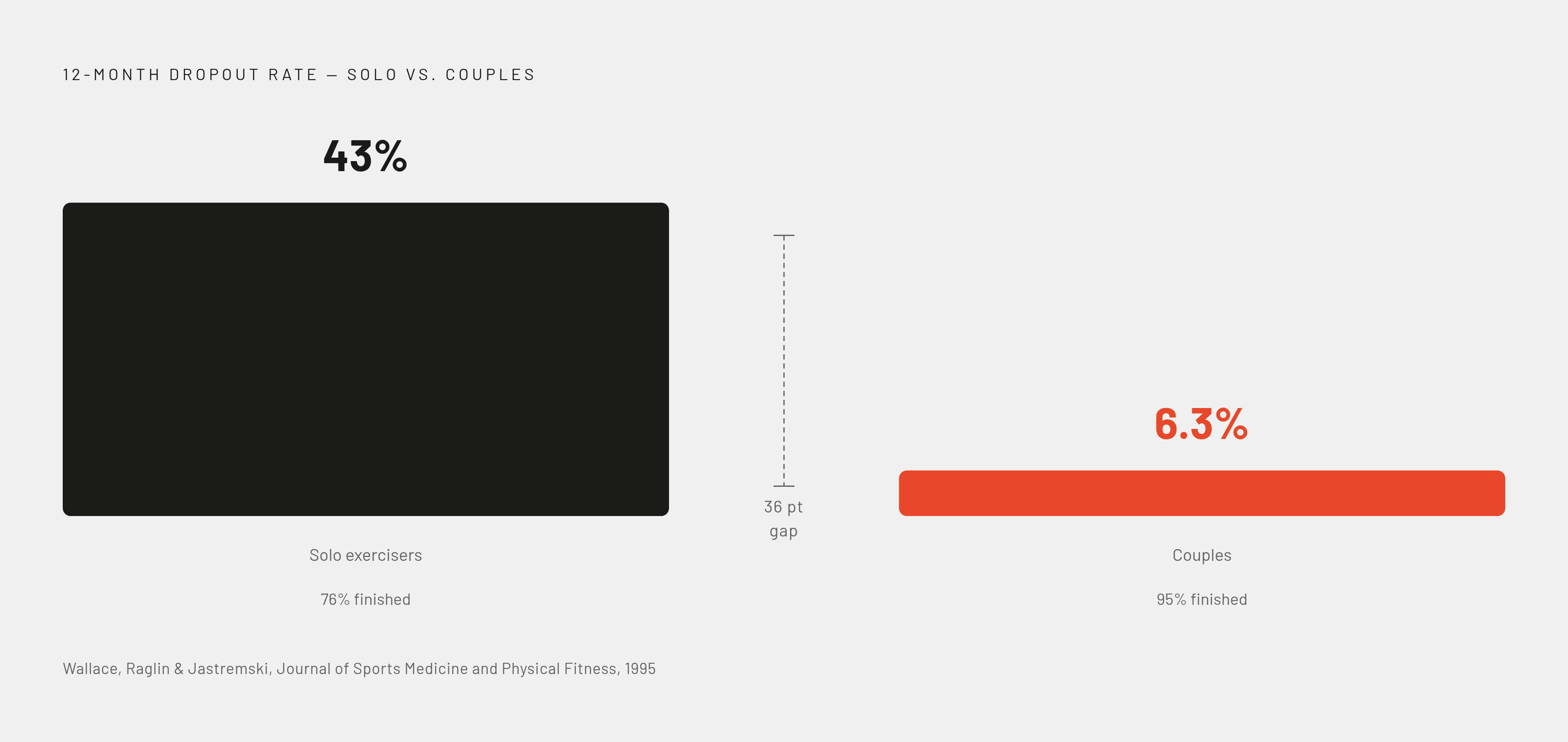
Here's where couples change the math. A 1995 study published in the Journal of Sports Medicine and Physical Fitness (Wallace, Raglin, and Jastremski) found that only 6.3% of couples who joined a fitness program together dropped out over 12 months, compared to 43% of people who joined solo. That's a 36-point gap, which is not a small effect in behavioral research; that's a cliff. A separate completion study found 95% of couples finished their program versus 76% of solo participants. An ASTD accountability study found the probability of hitting a goal climbs from 10% with just an idea, to 65% once you tell someone else, to 95% once you've got a specific appointment to be accountable to that person. Translation: your workout partner is doing more heavy lifting than your workout.
The psychological mechanisms behind partner-driven consistency
Three things are happening at once here, and they don't require you to understand any of them to benefit, but it helps to know which lever you're pulling.
First: the Köhler motivation gain effect. Pair up with a partner who's slightly more capable than you, someone whose effort actually depends on yours showing up too, and you push harder than you would solo. A 2023 meta-analysis in Kinesiology Review, pulling from 19 studies and just under 2,000 participants, found a large and statistically significant motivation gain effect. In individual studies, working with a stronger partner boosted plank hold time by 24%, and separate research has found team-format exercise can substantially extend workout duration compared to solo sessions. The catch: the ability gap has to be moderate. Pair a couch potato with an Olympic rower and the effect disappears, because the gap stops feeling motivating and starts feeling hopeless.
Second: shared identity. Once "we work out together" becomes part of how a couple describes themselves, skipping a session stops being a scheduling hiccup, and instead starts to feel like a tiny betrayal of who you both are. That's a much stronger deterrent than a missed calendar reminder.
Third: behavioral contagion. A 2015 study found people were far more likely to stick with a goal, exercise included, when their partner was chasing the same one. This cuts both ways: one partner's consistency drags the other along, but one partner's lapse hands the other a permission slip to skip too. Research has found this syncing effect applies just as easily to bad habits as good ones. Couples don't just share a gym membership; they share momentum, in either direction.
There's a quieter fourth mechanism worth naming: the oxytocin loop. Physical activity paired with social closeness raises oxytocin, and research suggests that higher early oxytocin levels are associated with greater relationship persistence and sustained closeness over time. Working out together doesn't just create accountability, it feeds the relationship, and a better relationship feeds the motivation to keep working out together. It's a loop, not a ladder.
Why the first three months are the make-or-break window — and what that means for features
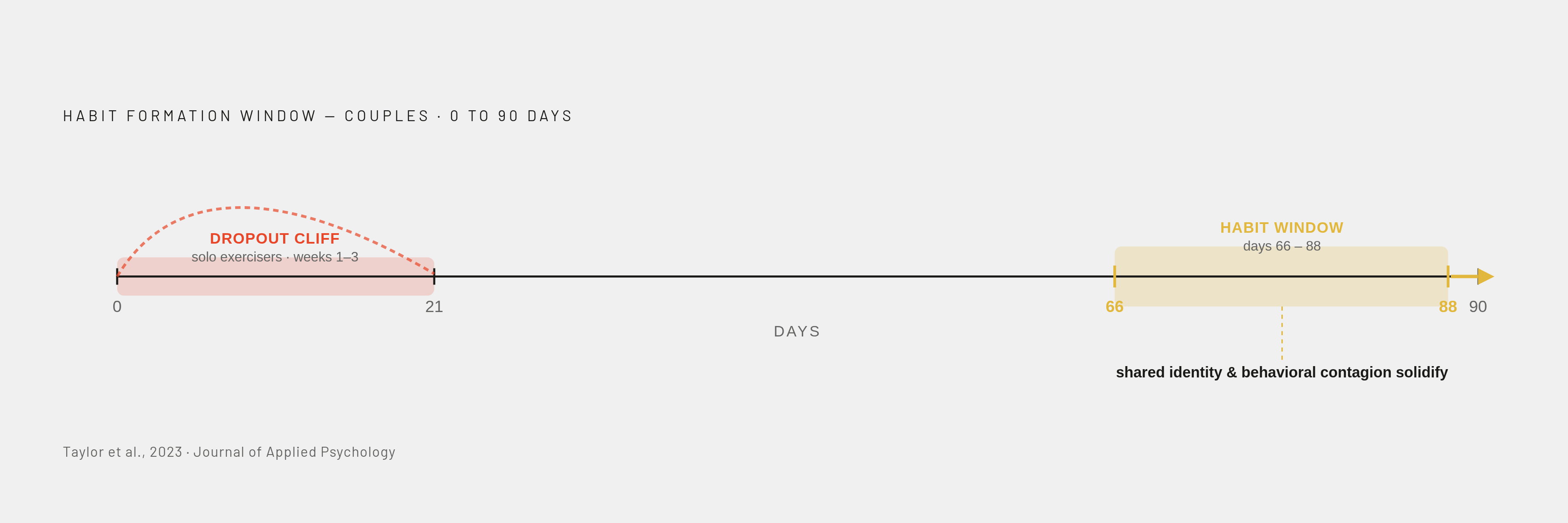
Habit research from Taylor et al. (2023, Journal of Applied Psychology) puts the window for a stable couple habit at 66 to 88 days. Line that up against the dropout data and the overlap is almost too clean: the solo-exerciser cliff happens inside that exact window. So the features that matter, matter most in weeks one through twelve, not month six, and not "someday."
Couples who make it through that window with consistent effort cross into different territory. Shared identity has had time to set, and behavioral contagion has had time to pull both people along instead of one dragging the other. At that point, the scaffolding, the apps, the check-ins, the friendly wagers, can loosen without the whole thing collapsing.
That reframes how you should judge any accountability tool. The right question isn't "will we use this forever?" It's "will this get us through the next ten weeks?" Forever is not the design target; the next ten weeks is.
Shared goals and how couples set them in a way that actually holds
The most common mistake: goals that sound shared but aren't. "We both want to lose weight" is two individual goals standing next to each other, not one shared commitment. If one partner drops weight faster, the slower one doesn't feel supported, they feel behind.
What holds up instead: a joint frequency goal. "We work out four times this week" is immediately checkable; either it happened or it didn't. "We lose ten pounds" is vague, slow to confirm, and breeds comparison the moment progress rates diverge. Mismatched fitness levels are one of the most common reasons couple workouts fall apart, and a shared frequency goal sidesteps that comparison problem completely, because showing up four times counts the same whether you ran five miles or walked two.
Simplicity isn't a compromise here, it's the whole design. A goal you can both repeat back in one sentence outlasts a spreadsheet with tiers and contingencies. Weekly resets matter more than people think: missing Wednesday doesn't wreck the week, it just leaves Thursday and Friday open.
Research on partner-assisted lifestyle programs has found that recruiting couples together and building shared goals into the intervention can improve retention for both partners, not just the one who was already motivated. Structure did what willpower alone couldn't.
Visible progress and what it does that a private log cannot
A private workout log is accountable to exactly nobody, while a shared one changes the social stakes without a single conversation happening. A shared calendar where both partners log workouts shows effort at a glance, no nagging text required, the pattern just speaks for itself. When both calendars fill in week after week, that visual becomes proof of the "couple that works out" identity, not just a record of it.
Photo-based check-ins do something numbers can't touch. A post-workout photo sent to your partner isn't a data point, it's a small proof of presence, a "I showed up" sent in real time. Because the partner sees it immediately, that instant visibility creates a light social loop, no dashboard required.
This is worth saying plainly: couples don't need more data. They need a signal that the other person is still in it. A photo or a filled-in calendar box carries that signal far more clearly than a chart of heart-rate zones ever will.
Weekly check-ins as a structural habit, not an optional add-on
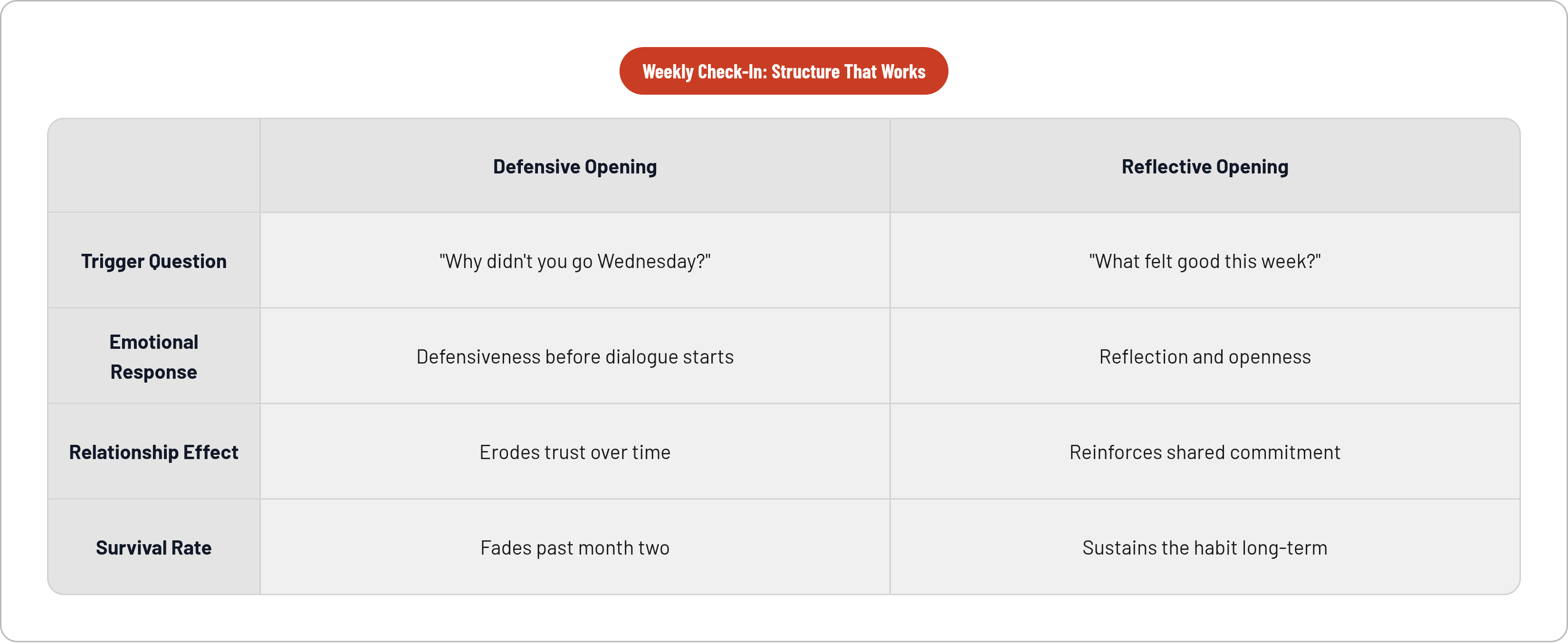
Here's the single strongest feature-level number in the research: Taylor et al. (2023) found couples who run weekly check-ins had a 67% higher success rate than those who didn't. That's not a small edge, that's the difference between a habit that survives and one that fades quietly by week six.
The prescription behind that number is simple: 15 to 20 minutes, covering three things, what went well, what got in the way, and what changes for next week. Short enough that it doesn't feel like a chore on the calendar, structured enough that it doesn't turn into a vague "how's it going" chat that goes nowhere.
Tone decides everything here. Open with "why didn't you go Wednesday?" and you've triggered defensiveness before the conversation even starts. Open with "what felt good this week?" and you've triggered reflection instead. Same 15 minutes, completely different effect on the relationship, and only one of those versions survives past month two.
For couples who know they'll skip an unscheduled check-in, anchor it to something that already exists, Sunday coffee, a Friday walk. Ritual beats reminder every time.
Gamification features — which ones are backed by evidence and which are mostly noise
The strongest clinical evidence here comes from the BE FIT Randomized Clinical Trial (Patel et al., JAMA Internal Medicine). Families in a gamification arm, earning points and leveling up tied to activity goals, hit their step goals 53% of the time versus 32% for controls, an increase equal to nearly a mile of extra walking a day. The effect was meaningful not just during the trial but in sustaining behavior change.
The follow-up STEP UP trial (Patel et al., JAMA Internal Medicine) tested several formats across 602 sedentary, overweight adults: support, collaboration, and competition. The most effective arm added 920 extra daily steps compared to controls. So if you've ever felt a little guilty about turning a workout into a contest with the person you love, don't. The data says a bit of competitive heat isn't a flaw in the system, it's a real driver.
What doesn't hold up: streaks and badges on their own. A broken streak tends to trigger a "well, what's the point now" spiral rather than a quick recovery, especially for whoever broke it. Gamification works when it's collaborative or competitive, and it tends to backfire when it's purely solo and punitive, because there's no one there to catch you when the streak snaps.
Variable rewards, surprise unlocks rather than predictable badges, tend to hold attention longer because the payoff is unknown. For couples, a shared surprise unlock creates a joint milestone. A predictable badge just decorates an individual's profile, and nobody's throwing a party over that.
Light wagers and friendly stakes — how low-friction consequences change follow-through
Gamification pulls the reward lever. Wagers pull a different one entirely, loss aversion, the well-documented human habit of working harder to avoid losing something than to gain something of equal size. Same goal, opposite psychology, and couples benefit from knowing which one they're actually leaning on.
The simplest version: each partner sets a weekly goal, and whoever misses owes the other something small, dinner, a chore swap, a coffee run. No metrics, no scoreboard, just "did you show up?" with a small stake attached if the answer's no. Other tools extend this into fuller commitment contracts, where the consequence is defined up front by the couple themselves.
The design rule that keeps this from going sideways: stakes stay playful, not punishing. A wager that creates real financial pressure or feels like punishment corrodes the relationship, and a corroded relationship is not a great foundation for a Tuesday-night jog. The target is just enough friction that skipping feels real, not so much that it feels shameful.
There's a hidden benefit too. A pre-agreed wager gives permission to miss occasionally, because the consequence is already decided. One missed workout doesn't collapse the whole system, it just triggers the agreed outcome (someone's buying coffee) and the week resets clean.
Exercising separately while staying accountable together
Mismatched schedules aren't a dealbreaker. They're a design constraint, and design constraints have solutions.
The mechanisms above don't actually require the same room, or even the same gym. Shared identity survives separate workouts fine, as long as both people are still checking in on the same goal. Behavioral contagion works over a text just as well as it works in person, maybe better, since a photo sent from a hotel gym at 6 a.m. carries its own kind of proof. What breaks accountability isn't distance, it's silence.
The fix isn't finding a way to force matching schedules, then. It's keeping the visible-progress and check-in features running regardless of where each person is sweating. A shared calendar doesn't care whether you're in the same building. A weekly check-in doesn't need you both on the same treadmill, it needs 15 honest minutes, whether that's over dinner or over a video call. The wager doesn't care either. Missed goals still trigger the coffee run whether you missed it in the same gym or three time zones apart.
Real accountability isn't about proximity, in the end. It's about visibility and a standing appointment to show up to each other, which, conveniently, works whether you're on the same yoga mat or on opposite sides of the country. Apps built around exactly that structure, such as Sweatmates, a shared fitness accountability app for couples that keeps both partners connected through workout check-ins, photo proof, and weekly goal tracking, are designed to hold that layer in place regardless of where each person is working out.