How to Structure a Partner HIIT Workout When You Have Different Fitness Levels
Mismatched fitness levels work in HIIT because intensity is relative to each person's effort.
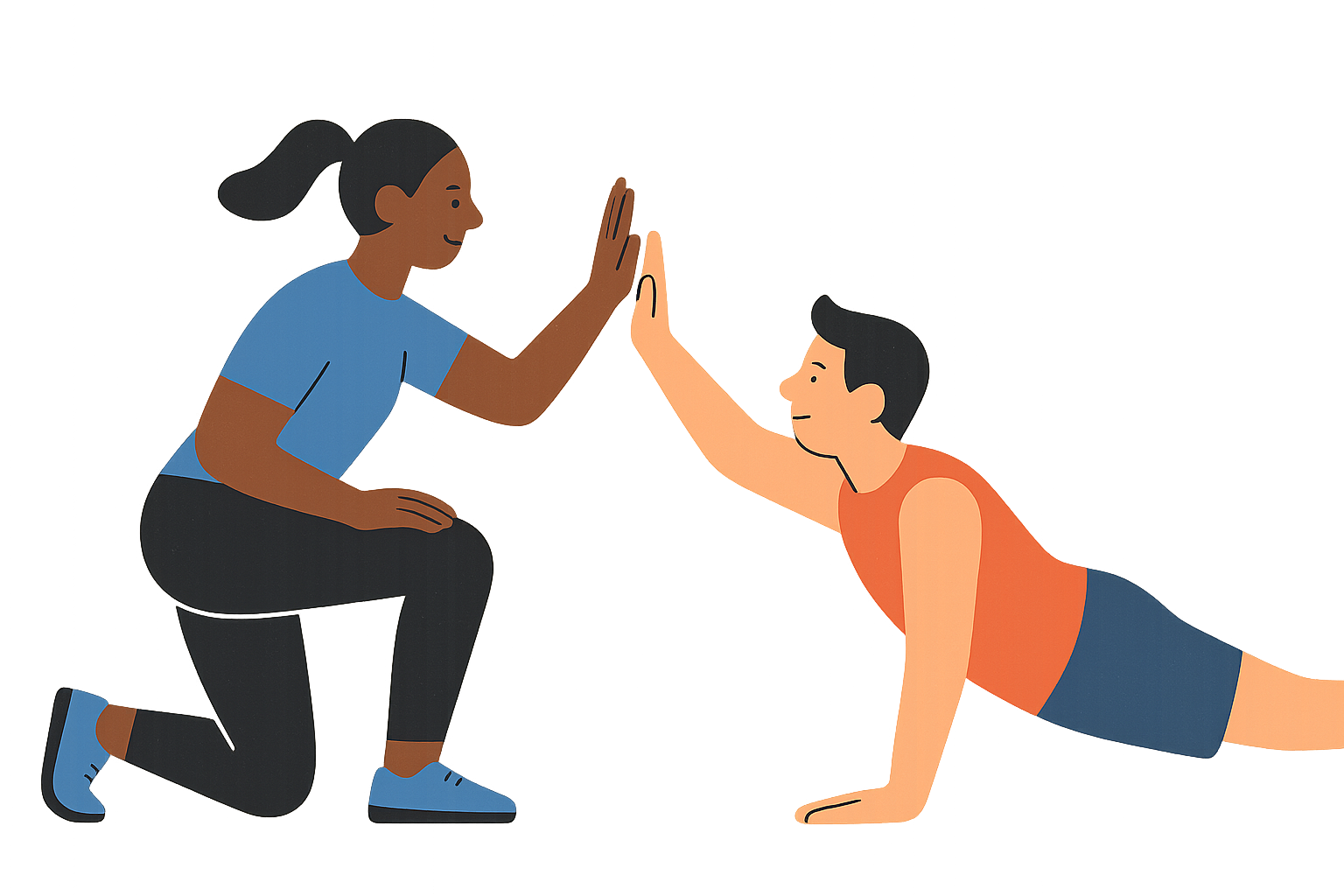
Two people with wildly different fitness levels can do the exact same HIIT workout, at the same time, in the same room, without one faking it and the other coasting. A well-built session lets each person hit their own ceiling while standing next to a partner doing what looks, from across the gym, like an identical exercise.
Most pairs get this backwards before they even start. One partner runs marathons, the other joined the gym three weeks ago, and the assumption is that these two people can't train together. That assumption has the mechanics exactly reversed. High intensity is relative by definition. A set of jump squats that pushes one person to 90-95% of max heart rate might barely nudge the other person's pulse. That gap is the reason mismatched partners can share a workout... It's the reason mismatched partners can share a workout.
What people actually want out of training together rarely has much to do with matching splits or reps. It's shared time, shared effort, somebody to bump fists with after a brutal round of mountain climbers. A University of Pennsylvania study found gym attendance climbs 35% when people show up with a friend, and a separate study clocked a 6.3% dropout rate after 12 months for couples who trained together, versus 43% for people training solo. Get the mixed-level structure wrong, though, and none of that survives. The habit doesn't fade slowly either. It usually dies by week six, right around when one partner starts quietly resenting the pace.
How HIIT is already built to accommodate different levels
HIIT runs on a mechanic that happens to favor mismatched partners, even though nobody designed it with that in mind. Those work intervals typically are 80-95% of max effort. Trainers don't program HIIT around a fixed pace or a fixed weight. They program it around time, heart-rate zone, or perceived exertion, so the same 30-second window can ask two completely different things of two different bodies.
Same workout, in this context, means same timer, same station, same cue to start and stop. What changes is the size of the ask inside that window. A beginner doing a burpee without the push-up and a seasoned athlete doing a full burpee with a push-up and a jump are both, technically, doing HIIT. The format hasn't moved an inch. The explosive demand is the only thing that shifts.
Compare that to running or cycling, where the mismatch appears immediately and painfully. Pairing a marathoner with someone who hasn't run since gym class means there's no built-in way for the slower partner to modify the workload without falling behind or standing around waiting. Barbell work has the same issue: load is load, and swapping plates mid-set kills momentum for everyone at the rack. HIIT's timed-interval structure sidesteps all of it. Every interval is a natural fork in the road where two people can diverge completely and still land on the same second.
Work-to-rest ratios: the first lever for calibrating intensity by level
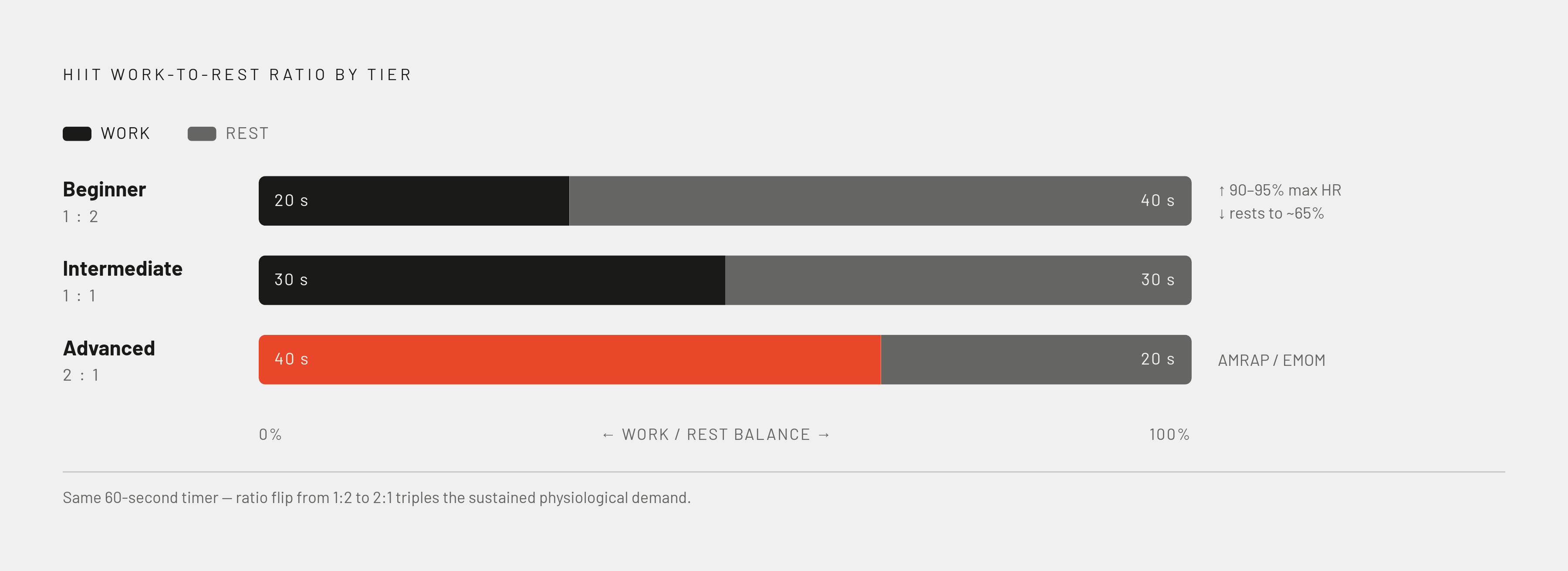
The work-to-rest ratio is the biggest dial for adjusting intensity, and most people barely touch it. Twenty seconds of work followed by 40 seconds of rest is a fundamentally different workout than 40 seconds of work followed by 20 seconds of rest, even when every other variable stays identical.
Trainers generally break this into three tiers. Beginners run a 1:2 ratio (20 seconds of work, 40 seconds of rest) paired with lower-impact movement variations. Intermediates run 1:1 (30 on, 30 off), with room for explosive moves like jump squats. Advanced athletes flip to a 2:1 ratio or move into formats like AMRAP and EMOM that keep intensity climbing without a real break.
What actually makes an interval count as HIIT, physiologically, is pushing heart rate to 90-95% of max during work and not letting it drop below roughly 65% during rest. That threshold is the target, not the specific numbers on the clock. Two partners running two completely different ratios can both be hitting it.
In practice, that means no separate stopwatches and no partner squinting at a different phone. Everyone runs off the same timer and the same rest cue. The partner who needs more recovery just gets a wider window built into the clock everyone else is already watching.
RPE as a shared language for effort when numbers don't match
Rate of perceived exertion, or RPE, measures intensity based on what a workout actually feels like: breathing rate, sweat, how much gas is left in the tank. Sports medicine uses it precisely because it doesn't depend on external numbers like pace or load. That's what makes it the one tool mismatched partners actually need, and numbers alone can't provide it.
Both people can hit an 8 out of 10 during the same 30-second interval, even if one is doing jump squats and the other is doing bodyweight squats at half speed. RPE lets each person set a personal ceiling instead of measuring against someone else's bar. The session-RPE method has been validated specifically for high-intensity functional training, which makes it a legitimate way to prescribe and track intensity, not just a soft feel-good substitute for real numbers.
Using it takes about five seconds. After a round, skip the vague "was that hard for you?" and ask for a number instead. If one partner keeps calling out a 5 or 6 while the other says 9 or 10 every single round, that's not a coincidence. That's a clear signal to adjust the movement variation or the work-to-rest ratio for whoever's underworked.
Five structural formats that keep mixed-level partners in the same session
No single format outranks the others here. Which one works depends on the pair, the space, and what the session is trying to accomplish that day.
You-Go-I-Go, or alternating sets, is the one most trainers reach for first, mostly because it needs zero extra equipment or coordination. One partner works, the other rests, and they swap every round or every timed interval. The less-fit partner automatically gets a longer break, since they're resting the whole time the fitter partner works. Workload can also be split on purpose: the stronger partner takes the longer or harder intervals, the other takes shorter or modified ones, each person using a different movement or load at the same station.
Same movement, different variation puts both partners at the same station, working at the same time, but on entirely different difficulty tiers. One documented version uses 30 seconds on, 30 off: beginners do a burpee without the push-up plus a kneeling push-up, intermediates add the push-up back, and advanced partners do the full burpee with push-up and jump. Fit Body Boot Camp runs something similar, tacking tuck jumps or lateral bounds onto the advanced side while beginners use step-outs, and uses working windows of 45 seconds with just 15 seconds of rest. Visually, both partners look like they're doing the same exercise. The output isn't close, and that gap is the entire point of the format.
Split-station circuit pairs a high-intensity move for one partner with something lower-key for the other, like squats or a wall hold, done at the same time, then swapped. This split-station approach pairs a high-intensity move with a recovery-focused one, keeping both partners moving the entire time with no one standing around. Nobody stands around.
Timed group circuits rotate stations on a shared clock instead of a shared rep count, so a slower station simply means fewer total reps for whoever's parked there that round.
Partner-assisted resistance has the fitter partner add manual resistance or count reps for the other, which turns "rest" into an active coaching role instead of dead air. Most of these formats share a simple pitch: HIIT is a lot more fun with somebody else in the room, even if that somebody is huffing through a different version of the move.
Movement modifications that make any exercise work at two levels simultaneously
The real gap between a beginner and an advanced exerciser in HIIT comes down to how hard each person has to work to hit their own ceiling inside the exact same movement pattern. Most modifications add explosiveness or load rather than swapping the exercise out for something unrecognizable, and that restraint is what makes them workable for two people training shoulder to shoulder.
A few documented pairings show how this plays out:
- Burpee: beginners drop the push-up and the jump, intermediates add the push-up back, advanced athletes run the full version with both push-up and jump.
- Push-up: beginners work from the knees to build strength safely, advanced exercisers move to standard or feet-elevated variations.
- Squat: beginners keep it bodyweight and slow, advanced exercisers add an explosive jump squat with a controlled landing.
- Jumping jacks: the modification steps one foot out at a time rather than jumping both feet simultaneously, the advanced version is the full jump, done smoothly.
- Mountain climbers: beginners slow it into a step-through, advanced exercisers maintain a faster, continuous pace.
Fit Body Boot Camp also documents tuck jumps and plyometric lateral bounds as advanced-only add-ons for partners who want more punishment at the same station.
The timing, the station, and the rest cue never move. Only the tier of the movement shifts, and that's the detail separating a real partner modification from a generic list of easy-and-hard exercise pairs. One person's version has to fit inside the exact same clock as the other's, or the whole system falls apart.
Structuring a full session from warm-up through cool-down
Every session opens with 5 to 10 minutes of dynamic movement covering the major muscle groups: thighs, hamstrings, glutes, back, chest. If the workout involves any jumping, the calves need their own attention too, given the demands of repeated jumping movements. This is where two mismatched partners can move through the same exercises together, before the workout splits off into tiers. Treat it as the connective tissue of the session.
Session length depends on where the pair sits on the fitness spectrum. A beginner-adapted session runs 15 to 20 minutes total: roughly a 5-minute warm-up, 10 minutes of intervals, a 5-minute cool-down. Intermediate to advanced sessions stretch to 20 to 35 minutes, with the high-intensity portion itself capped around 12 to 20 minutes, since fatigue past that point tends to wreck form faster than it builds fitness.
On frequency, most programs built for intermediate to advanced exercisers land on 2 to 4 HIIT sessions a week, with active recovery or lower-intensity work filling the gaps in between.
How to track progress without making it a comparison
The biggest risk in a mixed-level partner setup is the less-fit partner quietly measuring their own performance against the fitter one instead of against where they personally started. It's the less-fit partner quietly measuring their own performance against the fitter one instead of against where they personally started. That comparison is corrosive, and it's the kind of dynamic that erodes the very advantages that make partner training so much stickier than going it alone. Once one partner feels embarrassed standing next to the other, the entire relational benefit of training together evaporates.
The fix is picking progress markers that never need a scoreboard between two people.
Consistency comes first, full stop. Did both people show up this week? That matters more than any performance number early on, before either partner has enough data to compare anyway. RPE trend over time comes next: if the same movement feels easier at the same perceived effort than it did a month ago, that's measurable fitness improvement, regardless of what the other partner is doing three feet away. Ratio progression counts too. Moving from a 1:2 work-to-rest ratio to 1:1 is a genuine milestone, and it should get framed as a personal win. Movement tier upgrades round it out. Graduating from a half-burpee to a full burpee with the push-up and the jump is visible, concrete, and entirely the individual's own achievement.
None of these need a side-by-side comparison to mean something. They just need someone paying attention to where a person actually started.