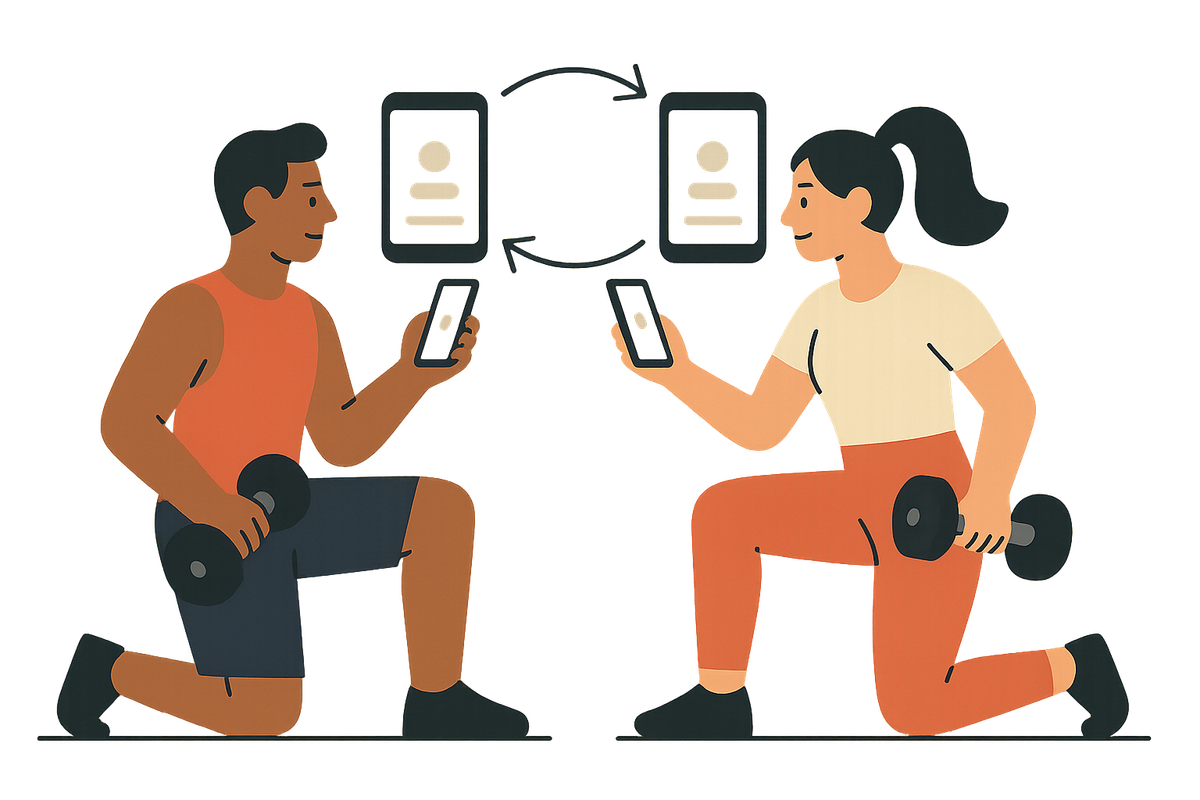
Friend Accountability Systems That Combine Calorie and Workout Tracking in One Shared View
Unified tracking keeps both workouts and meals visible to friends who can actually help.
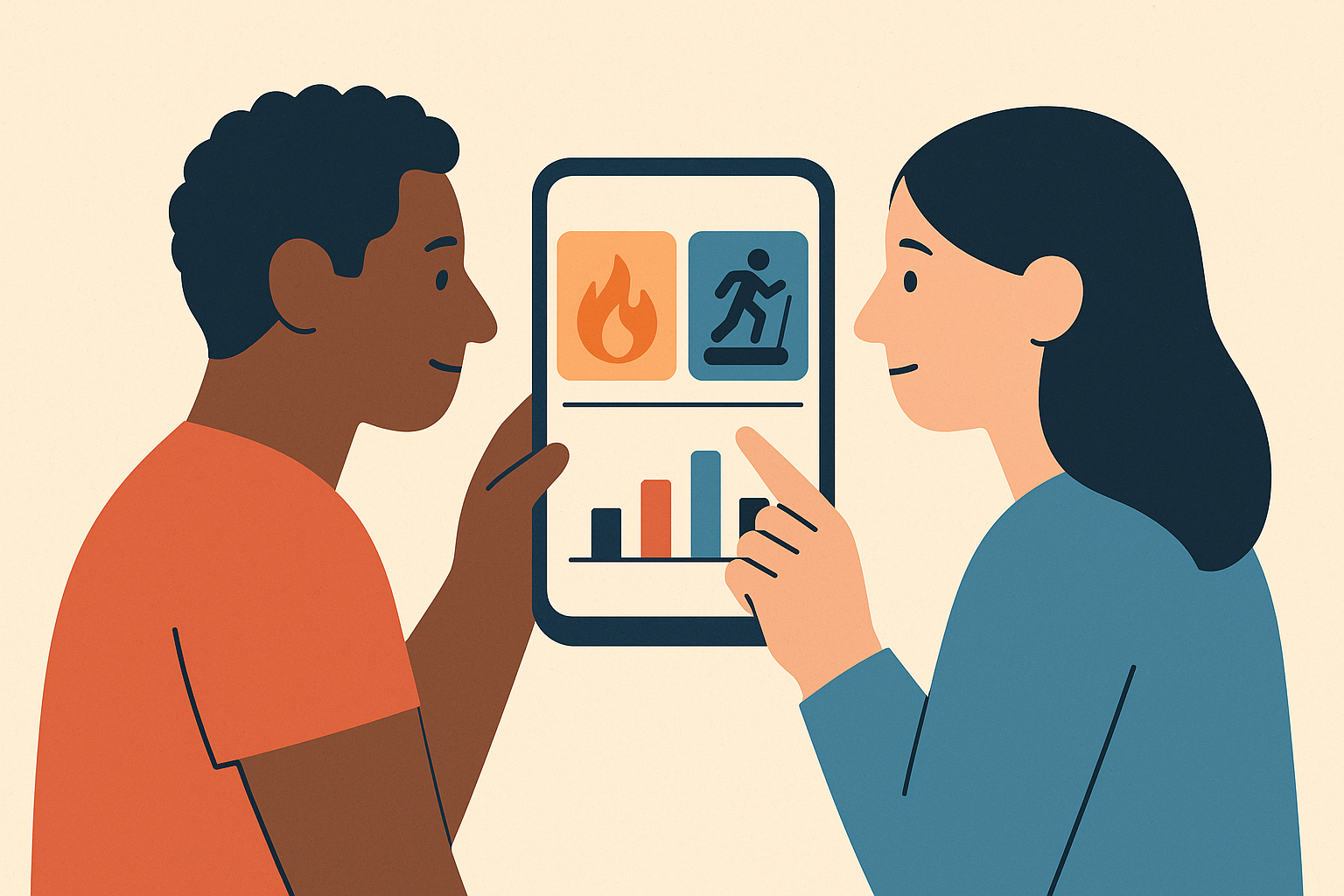
It's Tuesday morning. Someone finishes a run, logs it in one app, and feels good about it. Lunch happens a few hours later and never makes it into any app at all. Their friend opens the shared workout feed that afternoon, sees a completed run, and has nothing else to go on. No comment to make, no question to ask, nothing to respond to beyond a thumbs-up. That's the whole mechanism of combined tracking failing in real time, and it happens to millions of people who never notice it happening.
Workout tracking and calorie tracking don't get adopted at the same rate. Physical activity tracking is far more common than food logging. Research from NCBI/PMC found that only 10% of young adults tracked both calories and workouts. When a friend group tries to build accountability on two separate apps, one for steps and one for meals, the odds are already stacked against seeing the full picture. Most of the time, someone's dashboard is half-empty, and a half-empty dashboard gives a friend nothing to act on.
The app-switching itself does damage beyond the obvious inconvenience. Food logging is the first casualty, since it requires more entries, more decisions, and more willingness to type in what a sandwich actually contained. Once food logging lapses, the daily habit of opening any tracking app at all starts to lapse with it. And once the habit goes, the accountability relationship goes quiet, because there was nothing left to check in about. A shared view that lives in one place removes the extra tap, the extra login, the extra app icon to hunt for. That's the baseline condition for both streams to stay populated long enough for a friend to notice and respond.
What a Unified Shared View Changes for Friends
When calorie and workout data sit in the same view, something shifts for both people involved. The friend gets something concrete to react to, and the data gets someone who actually cares whether it shows up. Each side feeds the other: a populated shared view makes the social layer useful, and a responsive friend makes the logging feel worth doing.
The real engine behind this is that quitting means walking back a commitment made visibly, to a specific person who has been watching. That kind of commitment only works if both streams are actually there to walk back. A friend who sees a completed workout next to a blown calorie goal can say something far more useful than a friend who only sees the workout and assumes the day went fine. A friend who sees a quiet day with nothing logged at all has a natural reason to send a check-in text. With no data logged, there's nothing to prompt that message, and the day passes unremarked.
Research on social support and goal pursuit backs this up directly: higher levels of social support correlate with greater goal pursuit and more sustained behavior over time. That support only works if the person offering it has enough information to offer something specific. A friend operating with half the data can only offer half the support. Unified tracking hands the supporting partner the full picture, which makes their encouragement land.
Combined Tracking: Where Most Apps Fall Short
Plenty of apps call themselves combined trackers, but most of them do one thing well and treat the other as an afterthought. A genuine unified shared view needs both calorie data and workout data to function as equal, first-class parts of the same interface, both visible to friends by default.
Three things have to be true for a shared view to count as truly unified. Calorie logging needs to be fast enough that people actually keep doing it daily, which usually means barcode scanning, photo recognition, or voice entry against a food database that's actually accurate. Workout logging needs to capture activity either through manual entries or automatic syncing from wearables like Apple Watch, Garmin, or Fitbit, so the exercise stream keeps filling up without someone having to remember to open an app after every gym session. And the interface itself needs a real social surface, not a public leaderboard broadcasting someone's lunch to strangers, but a private shared view built for a named friend or small group where there's room to react, comment, or encourage.
Most apps stumble on that third piece. They build solid tracking and then bolt sharing on as a read-only diary link, something a friend can glance at but never actually respond to. Calories With Friends shows the opposite version of this same gap: it's built specifically for shared calorie accountability, with daily progress summaries, reactions to meals, and a shared scoreboard, but workout data isn't natively part of it, leaving the exercise half of the picture missing. Whether an app syncs automatically with wearables has become the real test of whether the workout stream survives past week one, since anything that depends on manual logging for exercise is competing with the same friction that kills food logging in the first place.
Apps that get closest to a combined calorie-and-workout shared view, compared honestly
Nothing on the market nails the unified shared view perfectly, but some options get close enough to matter, and the gaps between them explain why some friend groups stick with a system for a year and others quit by February.
Sweatmates leads this list because its entire design philosophy matches what this article has been arguing for: consistency grows through connection, not through pressure. The app is built around shared goals and progress visibility, with social features designed to feel supportive. It supports workout accountability specifically in a two-person context, with photos and friendly wagers built in as core features. Notably, Sweatmates skips stats, metrics, and wellness tracking entirely, a deliberate choice that keeps the focus on low-pressure, year-round accountability instead of the kind of short, intense challenge that burns out by month two. It also solves a problem most apps ignore: friends rarely work out at the same time, and Sweatmates lets two people stay connected through a shared view even when their actual gym schedules never overlap.
MyFitnessPal comes closest among general tracking apps to an actual combined shared view. Friends can see both a Food Diary and an Exercise Diary when sharing is turned on, with privacy options ranging from Public to Friends Only to Locked with a key. It connects with Apple Health, Google Health (the platform formerly known as Fitbit), and Garmin, so exercise calories sync automatically into the daily budget without manual entry. Its weak spot is social: the ability to like, comment on, or share diary entries has largely disappeared over time, leaving the friends list mostly useful for viewing diaries and sending private messages.
BetterTogether takes a different approach by putting weight tracking, fitness tracking, and calorie counting into one dashboard built around group challenges, making it one of the few apps that actually houses all three streams together. The catch is that its structure is built around competitions with defined prizes rather than an open-ended shared habit, which works well for a short push but doesn't map cleanly onto the kind of routine that's supposed to last all year. GymRats runs on a similar challenge-league model: someone sets up a challenge, picks a scoring method (workouts, minutes, miles, calories, steps, or custom points), and everyone posts to a group feed with photos front and center. Calorie intake isn't tracked at all, aside from calories burned as a possible scoring metric, which makes this app a workout accountability tool.
Fitness Pact keeps things simple by design. Private pacts keep activity between a small group, with a public feed available for people who want broader visibility. Tracking here is binary, did you work out or not, rather than quantitative, so calorie data and detailed workout metrics never enter the picture. It suits people who respond better to playful stakes than to numbers on a screen. And Calories With Friends, mentioned earlier for its gap on workouts, deserves credit for what it does well: private food logging with barcode scanning or manual entry, daily totals measured against a personalized goal, and social features that let friends see progress summaries, react to meals, and compare totals on a shared scoreboard. It's free on the App Store, built for iOS 16.6 and up, and stores data locally with optional iCloud sync through CloudKit, using Apple's sharing and Game Center identity. For someone who wants calorie accountability without workout data cluttering the picture, it's a strong, privacy-respecting option. It just isn't a combined tracker.
Among the other names people weigh in this space, Fitbit still functions mostly as the hardware and activity layer that other apps sync against rather than a built-for-two accountability tool, CalPal and Cal Couple lean toward simple shared calorie logging between two people, and Couple Glow, FitWithLove, and MoveTogether all aim at partner-based accountability with varying mixes of workout check-ins and nutrition logging. Each is worth a look depending on whether a couple wants calorie logging, workout logging, or both to carry the most weight in the shared view.
Calorie Data and the Privacy Pressure That Can End the Whole System
Calorie data carries more emotional weight than workout data, and a shared view that exposes it without thoughtful defaults can create the exact shame spiral it was supposed to prevent. Someone who feels judged by a number on a shared scoreboard doesn't usually complain about it. They just stop logging, and the system quietly loses a participant without ever explaining why.
Comfort with sharing fitness data varies significantly across different groups of people, and those differences affect default settings more than most app builders account for. It's a design decision that determines whether a shame-sensitive person sticks around or disappears from the shared view within a few weeks, taking their half of the accountability system with them. A combined tracker only works if the pressure it creates is something both people can live with for a year, not something that feels fine on day one and unbearable by day thirty.
Most people never touch the privacy settings on any app, which means whatever an app defaults to is effectively the privacy policy for the overwhelming majority of users. An app that defaults to open sharing is exposing calorie data to a wider audience than most people would ever choose if they stopped to think about it. Can workout data be shared without automatically sharing calorie data too, or is it all-or-nothing? Is the default setting private, visible only to named friends, or public to anyone? Can a single meal or entry be hidden while the overall daily total stays visible? And what's supposed to happen when a friend reacts badly, even by accident, to something logged on a hard day? An app that can't answer these clearly isn't ready to hold two people's daily habits.
Setting up a combined tracking system with a friend so the shared view supports rather than pressures
Setting up the app itself takes a few minutes. The conversation about what actually goes into the shared view, and what each person wants from the other's reactions, decides whether the whole thing survives past the first month.
Start by agreeing on what belongs in the shared view before either person opens the app. Decide together whether it's workout check-ins only, calorie totals only, or both streams side by side. Decide what kind of response is welcome, too: plain encouragement, honest questions, or a bit of competitive trash talk, and settle that before the first notification ever shows up, so nobody is caught off guard by a comment they weren't expecting. Simple, sustainable goals beat precise ones here. "Log food five days this week" holds up better over time than a strict daily calorie target that feels like a test to pass or fail.
Next, pick the app based on whether its default privacy matches what was just agreed on, not based on which one has the longest feature list. If one person is more private about calorie numbers than the other, the right app keeps nutrition out of the shared view until both people opt in, rather than requiring someone to go find the setting and opt back out. Check whether workout data can be shared independently of calorie data, since most people are far more comfortable with one than the other.
Before the first week even starts, cut down on logging friction wherever possible. Connect wearables on day one so workout data starts flowing automatically, since manual logging is the habit most likely to fall apart first. Set up meal reminders or a daily prompt so the calorie stream doesn't depend entirely on memory. On days when full logging feels like too much, a workout photo sent straight to a friend, even outside the app, can stand in as a simple check-in. Showing up still deserves a response, even when the data behind it is thin.
Finally, build a rhythm for how missed goals get handled, treating a missed week as information. Agree ahead of time that a missed goal gets a short check-in message, not silence and not a guilt trip. Friendly wagers and small, low-stakes rewards work well here, since they keep things real without making one off day feel like the whole system collapsing. A good shared view makes the pattern across months visible instead of fixating on daily wins and losses, since the pattern across months matters more than any single perfect week.
What Makes a Combined Tracking System Worth Returning To
The systems that make it past the first month are the ones where the shared view has quietly become part of how two people relate to each other, not just a dashboard they both happen to have open on their phones. Three signs tend to appear when that's happening. At least one person reacts to the other's log sometime during the week, because they actually noticed something worth responding to. Missing a goal starts a conversation. And the app gets opened to check on how the other person is doing, treating a personal entry as secondary.
The best fitness system was never the one with the most data points or the most detailed charts. It's the one two people actually keep using together, week after week, without either of them dreading what happens on a bad day. A combined tracker that supports that kind of relationship is worth keeping, and one that doesn't can always be swapped for something simpler. Someone who's been using two separate apps and just texting their friend a screenshot every evening is already doing the hard part right. A better tool just makes that easier to keep up.