Using a Shared Wall Calendar for Fitness Habit Tracking
Visible progress on a shared wall beats apps and guilt for keeping couples accountable.
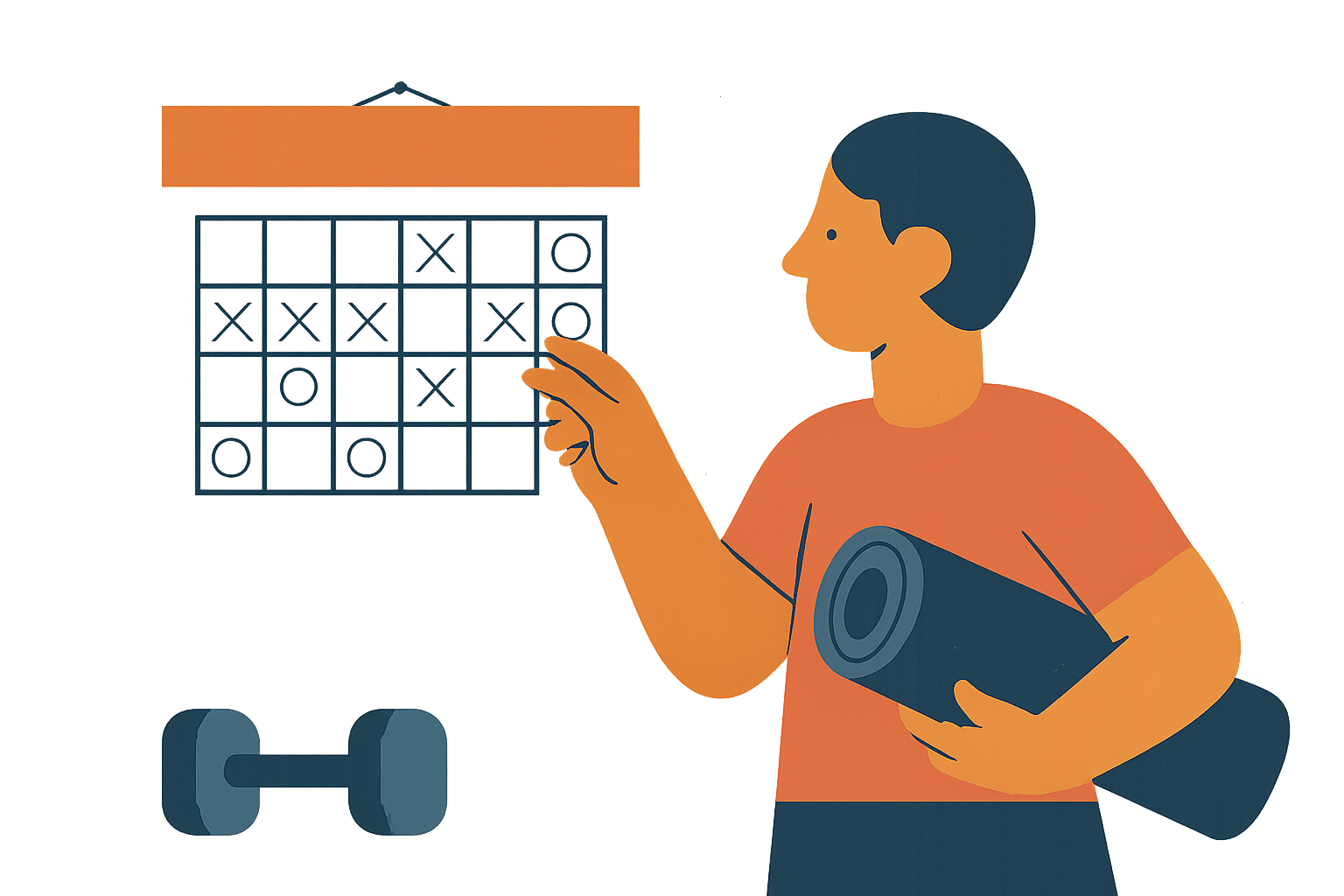
Most people think they exercise three or four times a week. The honest number, based on research, is closer to 1.5. That gap between what you think you're doing and what you're actually doing is exactly the problem a shared wall calendar solves, not through any clever technology, but through the dumbest, most effective trick available: putting the truth somewhere you can't avoid looking at it.
What makes a wall calendar different from an app or a private notebook
An app lives inside a phone that already has forty other apps screaming for attention. A wall calendar lives on your kitchen wall, where it screams at nobody and somehow still wins.
That's the environmental cue effect. Habit researchers have long known that behaviors attached to a visible, fixed location get performed more automatically than behaviors that depend on remembering to open something. A calendar taped next to the coffee maker doesn't send a push notification. It doesn't need to. You walk past it eleven times a day whether you like it or not.
There's also a physical difference in how the marking happens. Research has shown that handwriting activates more brain connectivity than typing does. The act of dragging a marker across paper does more for memory encoding than tapping a screen ever will. Digital check-ins get done on autopilot, half-asleep, thumb moving before the brain catches up. A pen in hand forces a beat of actual presence.
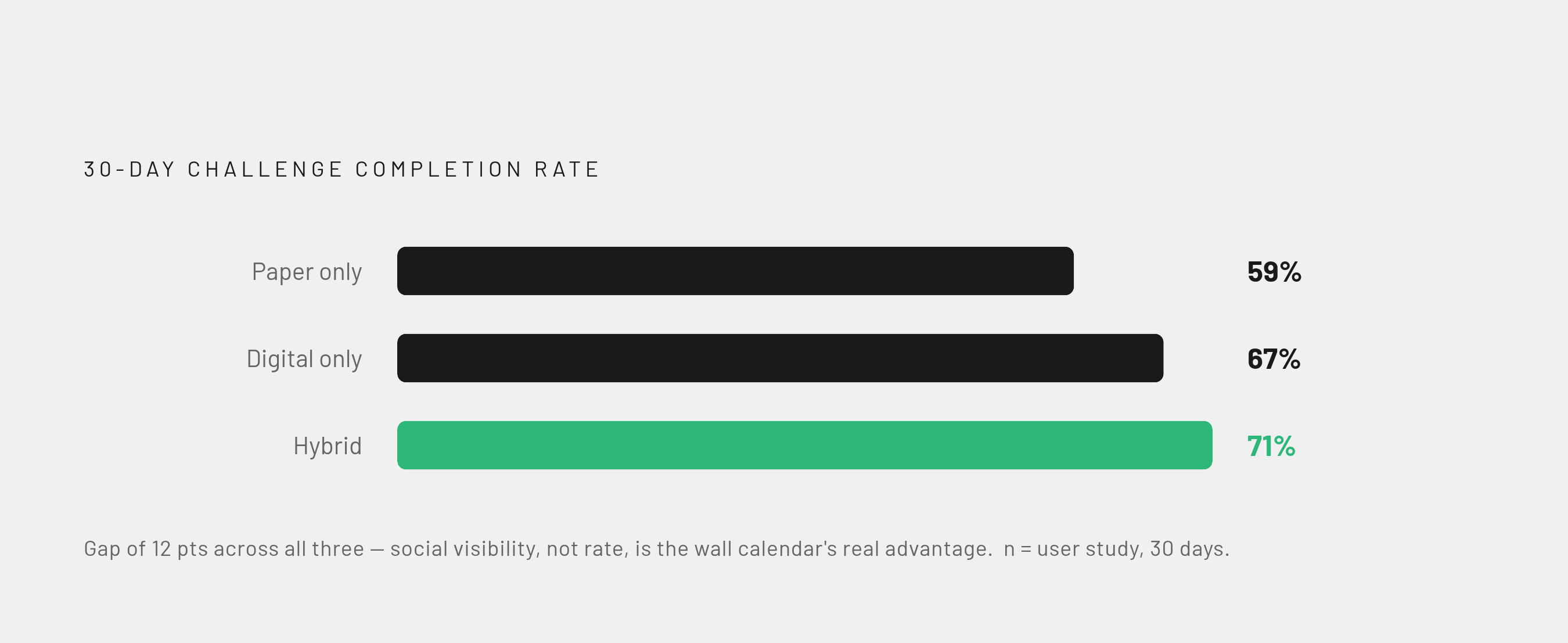
None of this makes paper superior on paper (so to speak). A user study of 30-day self-directed challenges found paper-only trackers finished at a 59% completion rate, digital-only at 67%, and hybrid setups, app plus paper, at 71%. The wall calendar is winning a different game entirely: the one where two people need to see the same thing without asking each other about it. It's winning a different game entirely: the one where two people need to see the same thing without asking each other about it. Let the app handle streak reminders and buzzy notifications. Let the wall handle the shared, unskippable truth.
How the "Don't Break the Chain" method translates to a shared calendar
The method has a origin story that's almost too tidy: The method is often tied to a story about a comedian and a wall calendar, though the origin has been disputed over the years. The name stuck regardless, which is its own small joke about how credit works in comedy.
The genius of the method is that it changes the question you're asking yourself. It's not "was that a good workout?" It's "did I show up?" That's a much lower, much more answerable bar, and lower bars get cleared more often.
Behavioral economics gives this some teeth. People tend to feel the sting of losing something more sharply than the pleasure of gaining something equivalent. Once there's a chain of ten red Xs on the wall, breaking it doesn't feel like skipping a workout. It feels like throwing something away.
For a shared calendar, the fix is almost embarrassingly simple: one calendar, two marker colors. Each partner builds their own visible chain on the same grid, and neither one has to ask "did you go today?" because the answer is right there in blue or green ink.
Build in a safety net too. Missing one day is a rest. Missing two days in a row is the start of a different, worse habit. That single rule, sometimes called "never miss twice," keeps a bad Tuesday from turning into a lost month.
For partners who hate the all-or-nothing pressure of an unbroken chain, there's a gentler version: the Additive Method, where every completed session adds to a running total instead of protecting a streak. It's more forgiving for a household where one person travels for work or has a schedule that changes weekly. Keep the bar low on what counts, too. Ten minutes of movement earns a mark. Hitting a protein target earns a mark. The goal is showing up, not showing off.
Why doing this together changes the accountability dynamic entirely
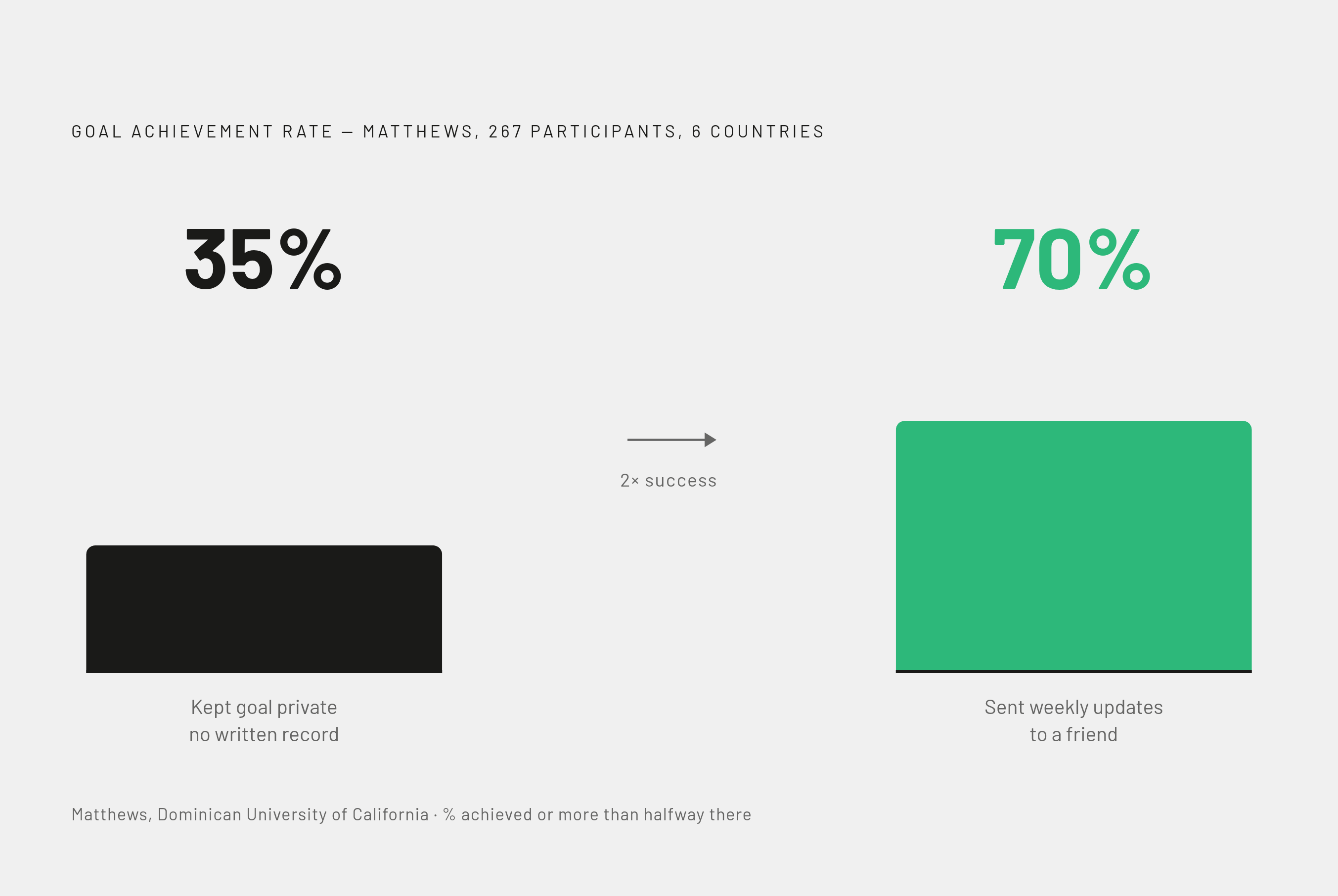
Dr. Gail Matthews at Dominican University of California ran a study of 267 people across six countries, ages 23 to 72, and found that more than 70% of participants who sent weekly progress updates to a friend reported successful goal achievement or being more than halfway there, compared to 35% of people who kept their goals to themselves without writing them down. A shared wall calendar is basically that same mechanism, minus the weekly email. It's a check-in that runs on autopilot because the evidence is just sitting there on the wall.
Research consistently finds that social support improves exercise adherence and reduces feelings of isolation, which tracks with something anyone who's tried to work out consistently already suspects: doing it alone is harder, and doing it alone while also feeling alone is harder still.
What makes the calendar version of accountability work is that it's ambient. Nobody has to text "did you go to the gym today?" The partner walking to the coffee maker just sees the square, filled or empty, and that's the whole conversation. Skipping a workout stops being invisible. It becomes a choice made in front of a witness, even if that witness says nothing about it.
And when one partner falls off for a few days, seeing the other partner's chain still intact on the same page makes coming back feel less like a confession and more like catching up to a friend already in motion. Research published in Frontiers in Public Health even found that kids logged about 15 extra minutes of moderate-to-vigorous activity a day, when a parent joined the same challenge. Visible effort spreads. It doesn't need a lecture to do it.
None of this works if it turns into surveillance. The calendar's job is to celebrate the X, not interrogate the blank square next to it.
How to set up the calendar so both partners will use it
Placement decides everything before a single mark gets made. A calendar in a home office gets ignored the same way a gym membership gets ignored: out of sight, out of routine. Put it in the kitchen, on a hallway wall, or on the back of a bedroom door, somewhere both people physically pass multiple times a day whether they want to or not.
Start small on what gets tracked. One or two habits, no more. Tracking four or five at once tends to collapse under its own weight within a couple weeks. Once a single habit feels automatic, usually somewhere between 60 and 90 days of consistency, adding a second one is fair game. Most people can juggle two or three ongoing habits at once before things get sloppy.
Define the rule before day one, not after the first missed workout turns into an argument. "Exercise" is too fuzzy a target. "Any intentional movement for 10 minutes or more" is a rule two people can actually agree on and stop negotiating over. Vague standards are how blank squares multiply.
Use two marker colors, one per person, on a single shared calendar. And log the mark within 24 hours of doing the thing. Wait two days and you're not tracking anymore, you're guessing, and guessing defeats the entire point of a record. Some couples even schedule the workout on the calendar in advance, blocking the time like a meeting, then marking the X once it's done. The calendar works as planner and proof, both at once.
For the physical calendar itself, there's a range of ready-made options. Workman Publishing's Habit Tracker 2026 Wall Calendar, sold through Calendars.com, runs 12 inches by 12 inches with a stapled binding, combines regular scheduling with habit-tracking grids, covers January through December 2026, and lists at $16.99. Etsy carries thousands of listings under exercise and gym wall calendars, including customizable and dry-erase versions for couples who want something more personal. Amazon's workout wall calendar category includes dry-erase whiteboards and undated formats meant to be reused past a single calendar year. And for a free option, the 2026 Habit Building Calendar from Fit with Food, Not Without offers downloadable monthly pages built around exercise progressions and nutrition prompts, printable at no cost.
Small rituals that turn the marking moment into relationship glue
Because marking the square takes only thirty seconds, it lowers the barrier enough that both people actually do it every day. Two people, one marker each, standing in front of the same grid at the end of the day: that's a tiny ritual of mutual acknowledgment, and it costs nothing.
Mark based on effort, not performance. A ten-minute walk gets the same X as an hour at the gym. Once the calendar starts grading workout quality, two different schedules and two different fitness levels stop showing up on the same page, because grading effort keeps them visible while grading performance doesn't.
Small rewards help too. Agree ahead of time that hitting two weeks solid, or a full month, earns something, choosing Friday's movie, picking Saturday's breakfast spot, some non-food treat that belongs to the chain and not to the fitness result itself. Pinning a photo next to the calendar, a hike, a gym selfie, a neighborhood run, turns the wall into something closer to a scrapbook than a spreadsheet.
End of the month, look at the grid together. Not to point at blanks and demand explanations, but to notice patterns: what week got hard, what got in the way, what a smaller goal might look like next month. Reflection instead of shame. And even partners with wildly different workout times or styles are still connected by the same sheet of paper on the same wall. That's the shared part. It doesn't require doing the workout side by side, just marking it side by side.
What to do when the chain breaks and motivation fades
A blank square means someone took a rest day, not that the system failed. It means someone took a rest day. The "never miss twice" rule exists exactly for this moment: one miss is human, two misses in a row starts a pattern that needs interrupting.
All-or-nothing thinking is the actual threat here, more than any single skipped workout. When one partner has a rough week, the other partner's chain, still unbroken on the same wall, works as an invitation back in. That framing needs to get said out loud when the calendar first goes up, so nobody's guessing at the tone later.
A broad meta-analysis covering 138 studies found that monitoring progress toward a goal meaningfully raises the odds of hitting it, and imperfect monitoring still beats no monitoring. A calendar with gaps in it is still doing its job.
When motivation dips, lower the bar instead of walking away from the whole thing. If three workouts a week suddenly feels impossible, agree that one counts for this month. The chain survives at a smaller size, and the standard can climb back up later once life calms down. Couples who've already broken a long streak can also switch temporarily to the Additive Method, counting up instead of protecting an unbroken run, which removes the sting of the break and gets momentum moving again without the guilt tax.
Treat the blank squares as information instead of an indictment. What actually got in the way that month? A scheduling conflict, an injury, plain boredom? The calendar can answer that question if it's read like data instead of a verdict.
A messy calendar that runs the whole year, full of gaps and restarts and second efforts, beats a spotless one that stopped cold in February. The habit that survives is the one both people keep coming back to. It's the one both people keep coming back to.