Apps That Help You Find a Workout Partner When You Don't Already Have One
Science shows workout partners boost commitment, and these apps help you find one.
Fitness is having a friendship moment, and it's not because a marketing team decided loneliness would sell gym memberships. The numbers back it up: recent data on exercise motivation found that social connection ranks as a leading reason people work out, with well over half of respondents saying they'd made new friends through fitness groups. Meanwhile, loneliness remains a widely documented concern across American life, and traditional dating apps are bleeding users (an SSRS survey put current dating app usage among American adults at just 6%, a steep drop from prior years). People are looking for connection somewhere else. Increasingly, that somewhere else is a gym floor, a running club, or an app that promises to introduce you to both.
This piece walks through that landscape: what the science says about why a workout partner actually works, why the search for one is harder than it should be, and which type of tool (dedicated app, big social network, or events-first platform) fits your specific situation. None of these apps are magic. But knowing which category to fish in beats scrolling the App Store at random.
What the science says about exercising with someone else
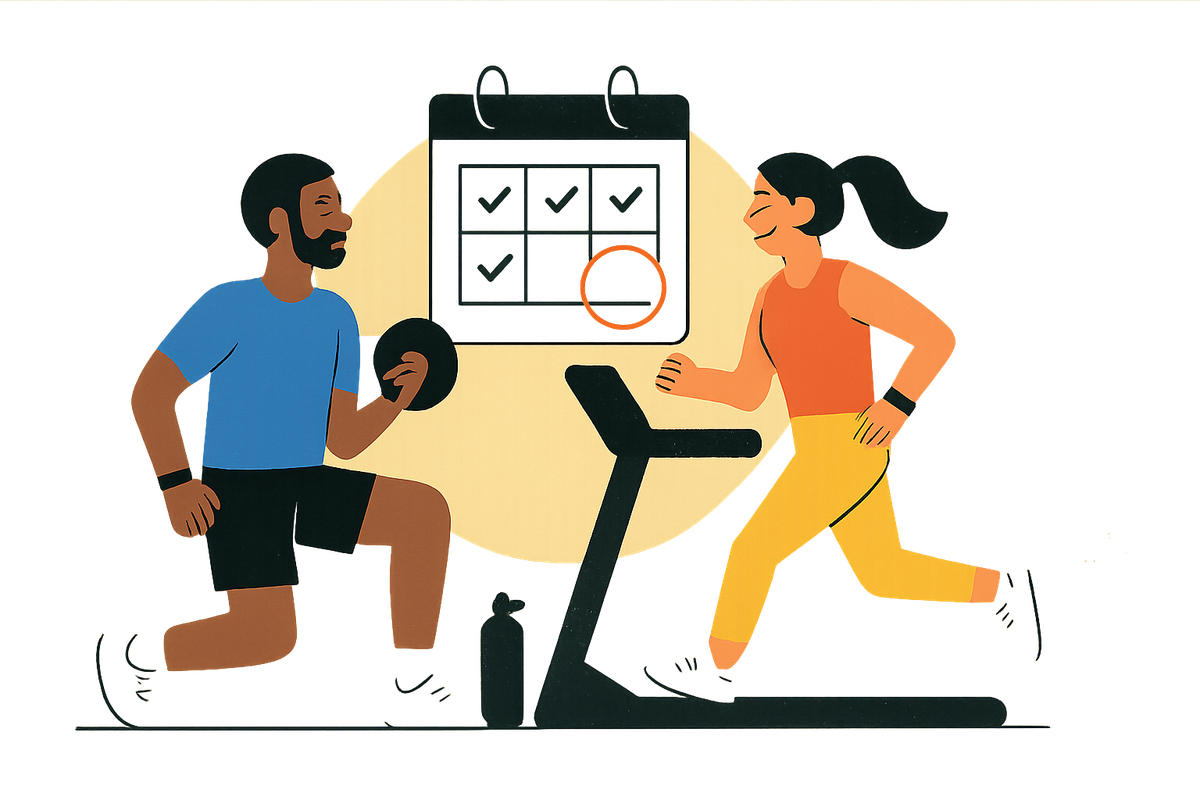
Accountability works, and it works by a wide margin. Research from an industry training organization found that people who set up regular accountability check-ins with another person had a 95% chance of completing a goal. Compare that to the baseline success rate of goals people set alone and keep to themselves, which hovers far lower. The 95% completion rate versus the far lower baseline for solo goals explains why "find a workout partner" keeps appearing as fitness advice that never goes stale.
There's also something called the Köhler effect, and it's one of the stranger findings in exercise psychology. Pair a weaker performer with a stronger one on a task where both people's effort matters, and the weaker partner works harder than they would solo, sometimes harder than the stronger partner. It's been documented in exercise settings specifically, not just inferred from office teamwork studies. Translation: a workout partner who's slightly better than you is motivating rather than intimidating. It's rocket fuel.
Even digital reinforcement moves the needle. On platforms that track group activity, sessions done in groups of ten or more have drawn up to 95% more kudos (likes, comments, digital high-fives) per session than solo workouts. Social reinforcement doesn't require a locker room. It works through a phone screen just fine.
None of this means any workout partner will do. A bad match, someone who cancels constantly, brings the wrong energy, or turns every session into a competition you didn't ask for, can tank motivation faster than training alone ever would. The science makes a strong case for finding the right partner. It says nothing about how to actually find one. That's where things get complicated.
The core obstacle these apps are trying to solve
Grant Hilton, founder of GymComrade, said: "People are reluctant to approach others in a gym environment: some are too afraid to ask for help and some just need a simple tool/app to make the initial introduction."
Think about it this way. Team sports hand you a social structure for free: you show up, you're on a roster, conversation happens because the game demands it. A gym floor gives you none of that scaffolding. Walking up to a stranger mid-set to ask if they want a training partner is the kind of move that requires either total confidence or total desperation, and most people have neither on tap. So people don't ask. They just put in their earbuds and train alone, week after week, wondering why the accountability studies don't seem to apply to them.
Apps exist to remove that awkward first move. Both people opt in before any face-to-face moment happens, so nobody's rejecting anybody in real time. That's the pitch, anyway.
Apps create the same emptiness problem in a different form: the empty room. Most dedicated fitness partner apps have fewer than a hundred active users in a given city, and a lot of the matches that do appear are hundreds of miles away, which is not useful when you're trying to find someone for Tuesday's leg day. GymBuddy, a UC Davis project from 2023 that matched over a thousand campus pairings using.edu email verification, is a good cautionary tale here. Solid concept, real early traction, and yet by mid-2026 it had vanished from the App Store with an essentially empty website and no announcement explaining why. No obituary, no goodbye post. It just stopped, vanishing from the App Store by mid-2026 with an essentially empty website and no announcement explaining why.
The practical lesson: download before you pay. Check whether anyone's actually active near you before handing over a subscription to an app that might be a ghost town, or might be gone entirely in a year.
Three broad categories of tools have grown up to deal with this problem, each attacking the empty-app issue differently. Dedicated matching apps go narrow and specific. Large social fitness networks go wide, betting that scale alone solves density. Events-first platforms sidestep matching almost entirely by giving people a reason to show up together before anyone has to decide if they like each other. The rest of this guide works through all three, in that order.
Dedicated apps built specifically to connect workout partners
These are the most targeted tools on the list, and also the ones most likely to leave you matched with someone three states away. Try it, but check local activity first, every single time.
Gym Buddy (Google Play, updated June 2025) uses location-based matching sorted by fitness goal and workout style, covering weightlifting, cardio, yoga, CrossFit, running, and general beginner fitness. It includes scheduling, shared progress tracking, and in-app chat. It's early-stage with a modest download count, so the honest move is checking local density before committing to anything paid.
FitFriends: Find Gym Partners (iOS) lets users browse people training at their specific gym, list workout interests, and message matches. It has a modest rating across a small pool of App Store reviews, and the recurring complaint is the one you'd expect: nobody else nearby has the app. Some users have noted friction in the profile setup process. The idea is sound. The population isn't there yet outside major cities.
Fitness Buddy (myfitnessbuddy.co) matches people looking for a running buddy, gym partner, or yoga companion, with matching built around motivation and shared goals. Public data on how many people actually use it is thin, so treat it as a wildcard.
Leg Day (iOS only, launched April 2026 in New York City) has the most literal concept in the category: it only works while you're physically inside your gym, showing you other members present at the same moment. There's no swiping, no bios, no messaging, just a discreet mutual-interest confirmation for members present at the same time. It reads as a deliberately low-friction concept. Too new to lean on heavily, but worth trying if training happens in New York City.
Jaha focuses on runners specifically. If running is the one thing you're trying to solve for, it's a tighter fit than a general fitness app trying to cover everyone.
RacketPal, rebranded "RacketPal by Sportega" in 2026, covers tennis, badminton, squash, table tennis, padel, pickleball, platform tennis, racquetball, beach tennis, and real tennis. The 2026 rebrand added doubles leagues and better wearable integration. It's most active across the UK and Europe, so its usefulness drops off sharply elsewhere.
Playo operates across India, the UAE, and Qatar, and bills itself as the largest sports community platform in the world, reporting over 5 million players across more than 50 sports including badminton, football, cricket, tennis, and pickleball. Users can find partners, join meetups, discover local clubs, and host games. Decathlon India struck a partnership with Playo in December 2025, which signals real staying power in that region. Outside those three countries, it's not much use.
The pattern across all seven: narrow focus (a specific sport, a specific gym, a specific city) is exactly what makes these apps useful, and exactly what makes them fragile. A hyper-specific app with nobody nearby is just a nicely designed empty room. Check before you pay.
Using large social fitness networks to find partners at scale
The logic here flips. Instead of a purpose-built app with a hundred users citywide, you're working with platforms that have tens of millions or more users globally, so even a mid-size city has a real population to draw from, even though partner-matching isn't the platform's main function.
Meetup isn't a fitness app at all, but it's one of the more reliable ways to find local fitness groups, ranging from casual walking clubs to CrossFit groups that train like it's a competitive sport. Its strength is structural: events happen whether or not you personally click with anyone, because the group-first format means the community exists independent of any one-on-one match. The tradeoff is patience. The tradeoff is that one-on-one friendships may take longer to crystallize inside a group setting than through direct matching. If structured, recurring, real-world events sound more appealing than swiping through profiles, Meetup earns its place here.
MyFitnessPal is known mainly as a calorie and nutrition tracker, not a partner-finding tool, but its community forums and challenges create incidental connection around shared health goals. Nobody's using MyFitnessPal specifically to find a squat rack buddy. Still, for people already logging meals there, the community layer adds a bonding opportunity that costs nothing extra to tap into.
The general rule for platforms in this bucket: they reward active participation. Joining a club, showing up to an event, commenting on someone else's activity, that's what turns a big anonymous network into an actual introduction. Passive waiting doesn't work any better on a large platform than it does on a small one. The scale just means there are more people to eventually notice you.
Events-first platforms and the pivot away from pure app matching
A pattern has emerged that's hard to ignore: apps built purely around swipe-to-match keep pivoting toward in-person events, because the events are what actually work. The founder behind the Lunge swiping app also launched an in-person singles run club, and the club is the part that took off, drawing significant membership and media coverage from outlets including NBC New York and Time Out. The swiping app didn't kill the run club's momentum. If anything, the run club outgrew the app that spawned it.
The mechanism isn't mysterious. Events give people something to actually do together before either person has to decide whether they like the other. That removes the exact pressure point that makes cold introductions so uncomfortable in the first place.
SweatPals (iOS & Android, US only) builds around exactly this idea, structuring itself as an events-first app for run clubs, yoga sessions, hiking groups, and pickleball communities, with partner-finding functioning as a feature embedded inside that structure rather than the whole product. It reports over 1 million users across 24 US markets and raised a $12 million seed round in October 2025, backed by Patron, a16z speedrun, and Kevin Hart's HartBeat Ventures. It's free to join, the events are the actual core product (not a matching algorithm dressed up with a calendar), and meeting people through a shared activity feels a lot less transactional than a profile swipe. It's limited to one country for now, and strongest in the cities where it launched first. Some events carry a fee. Of everything in this category, it's currently the strongest option if a covered US city is where you live.
ATEAM takes the opposite approach: exclusivity instead of scale. It's invite-only, founded by husband-and-wife team Dan Ilani and Megan Baldwin, originally launched in 2021 and relaunched as an in-person New York community in May 2026 with an 8,000-person waitlist, followed by a dedicated app later that year. Its rules are unusual on purpose: an 11-minute daily usage cap, no "Like" button, and a strict no-ghosting policy. Its Date Night Series partners with more than 15 studios, including Aarmy, Brooklyn Track Club, Fuze House, Gotham Boxing, SoulCycle, and The Yard. Right now it's New York only, though reported interest from Miami, Los Angeles, Austin, and London suggests wider ambitions. It reads less like a matching app and more like a members club that happens to use an app as the front door.
Fitafy (iOS & Android) started life as a fitness-focused dating app and has spent since late 2025 repositioning itself as a "fitness social club" with more weight on friend-finding than romance. It's had a rockier road: a small user base outside major metros, core messaging features locked behind a paywall, and reports of fake or scam profiles despite verification measures. The concept has promise. The execution isn't there yet outside a handful of big cities, which makes it a supplement at best rather than a primary tool.
The throughline across all three: when an app gives people a reason to physically show up before anyone's committed to a match, the community builds itself. That's the structural fix for the empty room, and it's why so many pure-matching apps keep morphing into event platforms whether that was the original plan or not.
How to choose the right type of tool for your situation
Three questions narrow this down fast: what's the activity, where do you live, and do you want a one-on-one match or a group to ease into first.
Runners and endurance athletes in most cities should lean on club features inside a large network first, since density beats precision when you're trying to find someone for a Saturday long run. Jaha is worth adding if pace-matched, one-on-one pairing matters more to you than a group vibe, and SweatPals is worth checking if a covered US market is home.
Racket sports players in the UK or Europe have a clear best fit in RacketPal by Sportega, given how tightly the app is built around that exact set of sports. Multi-sport players across India, the UAE, or Qatar are better served by Playo, both for its scale in that region and its sport variety.
Looking for a gym-floor partner in a major city comes down to geography and risk tolerance. Leg Day is the strongest fit specifically in New York. Gym Buddy or FitFriends are both viable elsewhere, with the same caveat repeated because it matters: check local density before paying for anything.
People who'd rather ease into a shared activity before committing to a one-on-one relationship should look at SweatPals, Meetup, or ATEAM if waitlist access opens up in New York. None of these ask you to commit to a stranger on day one. They ask you to show up to something, and let the relationship happen on its own schedule.
The single most useful piece of practical advice here: stack the tools. Most people get further pairing one large-network platform with one dedicated or events-first app than they do putting all their chips on either alone. A club membership on a big network gives you volume. A dedicated app or events platform gives you precision. Together, they cover each other's blind spots, which is really the whole game when you're trying to solve a problem that, until recently, most people just solved by getting lucky in a college dorm hallway.